Historians worthy of their craft must portray the past and present honestly, as accurately as possible, and ideally be unbiased. They should verify the truth of each subject to eliminate inaccuracies and establish the correct facts, or, at worst, as close to them as possible if no further research material is available. Unfortunately, this is not always the case, as there can be too many inconsistencies in the references they use.
Ken Wright explains.
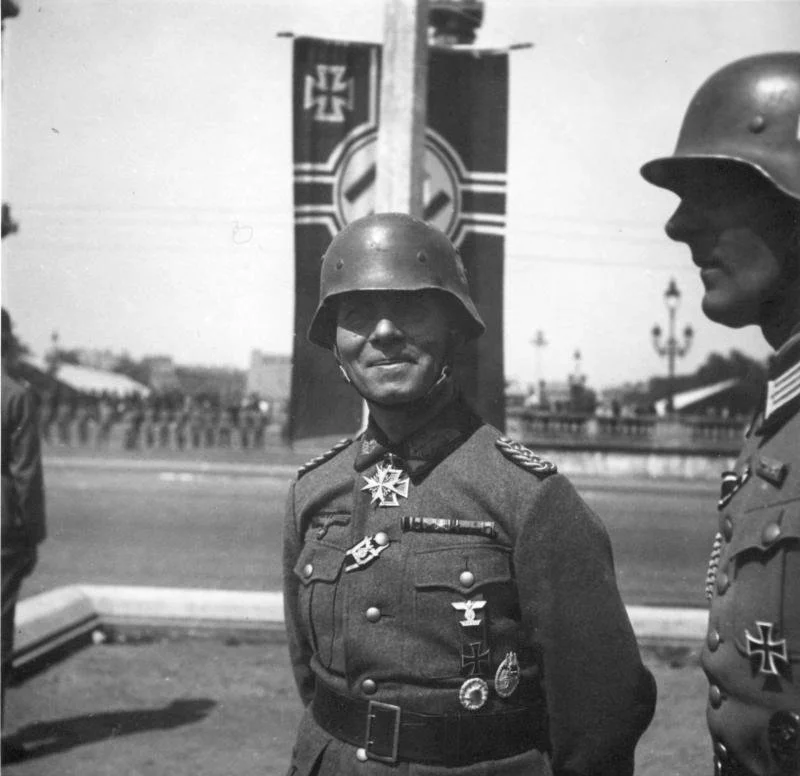
Field Marshall Rommel in Paris in 1940. Source: Bundesarchiv, Bild 146-1970-076-43 / CC-BY-SA 3.0, German Federal Archives, available here.
When attempting to write his history of the Roman people in the late first century BC, the Roman historian Livy [59bc-AD17] found it difficult to determine which (if any) accounts could be trusted. He concluded that none were reliable. In his research, he was troubled by how families had created traditions of heroic deeds and high office held by their ancestors—an early form of today's ‘fake news’.
Over the centuries, nothing has changed.
In the acknowledgment chapter of his excellent book ‘Last Battle’ Decapo Press, 2013, author and historian Stephen Harding wrote, ‘Writing history is always challenging and in that the passage of time often obscures certain events, versus revealing them. Eyewitnesses pass away, memories fade, and records, if they were kept at all, are destroyed as being no longer relevant or disappear into bureaucratic oblivion. That being said, the historian must diligently search out whatever documents remain. Like a detective evaluates evidence through knowledge of the subject and the application of both logic and common sense, the historian assesses the available information and then weaves all the various strands into an account that is accurate and as complete as possible.’
Readers interested in history should be aware that books, documentaries, magazines, and official records can, and quite often do, contain flaws. The who, what, when, and how are the main offenders, making it difficult for the reader to understand what the valid and proper account of an event or events is.
Using an extract from a distinguished American Research Professor at UCLA, Lynn Hunt's excellent book ‘History, Why it Matters’ discusses a universal problem facing historians. ‘Despite its occasional reliance on scientific techniques, history is not a science. It is a literary art that uses scientific techniques where relevant, but whose fundamental aim is to tell a true story. The truthful part rests on documentation, and in this regard, the historian is like a detective, lawyer, or investigative journalist sifting through information, analysing and comparing sources, written or not, using every possible forensic procedure to get at the truth, that is, the facts of the case. The story part requires something else: a literary reconstruction that relies on a series of interpretations. The interpretations make the facts relevant. The world is filled with mountains of historical facts, but we only care about a tiny number of them at any given moment. We care about those facts that enable us to tell the story we want to tell. Telling the story draws our attention to the facts but also frequently stirs up disputes. Historians can tell very different stories about the same event by emphasising different facts. This cacophony casts doubt on the truth of any one interpretation. If there is so much disagreement about interpretations, how can history make any claim on the truth about the past? Is it just your story vs. mine?’
EVENT ONE
Here, two military historical events are used as examples of the inconsistencies found in books, documentaries, magazines, and official records, which can often contain flaws. Errors in dates, locations, and who did what are the main issues, making it difficult for readers to determine the true and accurate account of events. These are just a few of the many historical incidents that show the challenges faced by historians and writers when working with material that might be incorrect but is still presented as fact.
Version One. July 17, 1944.
In this account, one author places Field Marshal Rommel in the area around Caen, France, visiting the 227th and 276th Infantry Divisions, the II SS Panzer Corps, and the I SS Panzer Corps headquarters to confer with various commanders, including SS-Oberst-Gruppenführer Sepp Dietrich and SS-Oberführer Kurt [Panzer] Meyer.
After the meeting, Rommel left Dietrich’s HQ in his staff car at 4:00 pm. Sergeant Daniel, the driver, took back roads until Livarot, about twenty-five miles from Caen. Rommel’s car then turned onto a paved road that joined the main highway a couple of miles outside Vimoutiers. At that point, Rommel and Daniel decided to attempt a quick dash on the highway.
Allied air supremacy had made any movement along the Falaise–Caen road extremely risky, if not impossible. When Rommel’s vehicle entered the main highway on routine patrol, a South African pilot with the Royal Air Force, Squadron Leader J.J. le Roux, and his wingman spotted an enemy vehicle and quickly attacked.
The official German report records what happened. ‘Suddenly, the air observer, Obergefreiter [Lance-Corporal] Holke, reported two aircraft closing in right above the road. Sgt Daniel drove at top speed, trying to reach a track and take cover there. Just as he reached it, the enemy aircraft, going flat out, opened fire. Field Marshal Rommel at that moment glanced backwards’ 2.
Hit in the left shoulder and arm, Daniel lost control of the vehicle, which ricocheted off a tree stump and ended up embedded against the embankment on the far side of the road. Shrapnel hit Rommel in the temple and cheekbone as he sat in the jump seat on the side away from the cannon fire and was thrown twenty yards from the car, suffering a triple fracture to the skull. 3. ‘A second aircraft flew back over the crash site, firing at the wounded where they lay.’ 4. Only two of the four men emerged unscathed. Field Marshal Rommel was taken to a Luftwaffe hospital near Paris and eventually returned home to recuperate.
Observations
The author only mentions Rommel and Daniel leaving Dietrich’s HQ. However, the official German account reports an air observer [Holke] observing two aircraft approaching. Only Rommel was taken to the hospital, so what happened to his driver? Who was the other person with the air observer, and where did both of them originate? The author and many other sources have credited Squadron Leader Johannes Jacobus le Roux, RAF 602 Squadron, with the attack on Rommel’s staff car. There are, however, other contenders for this event, as will be discussed further.
Version Two
Another author wrote that in a large open Horch, Rommel’s car, his party departed Dietrich’s HQ. Rommel sat in the front as was his habit. At the wheel was his regular driver, Daniel. In the back were staff members Captain Lang, Major Neuhaus, and Holke, who was there specifically as an aircraft lookout. On N179, just outside Livarot, the lookout shouted an alarm. Two Canadian Spitfires from 412 Squadron came diving down in a curving attack from behind and to the left. At about three hundred yards, Charlie Fox, in the lead aircraft, squeezed off a brief burst from his 20mm cannon.
Daniel was seriously wounded, losing control of the speeding car. It hurtled on for several hundred yards before crashing into the ditch. Captain Lang escaped unhurt, Major Neuhaus received minor injuries, and Daniel died of his injuries shortly afterwards—no mention of Holke. Field Marshal Rommel was thrown against the windshield post, sustaining serious head injuries. 5.
Observations
In this account, five people are in the staff car, and Charlie Fox, a Canadian pilot, was credited with the attack. A ditch suddenly appears, and Rommel is alleged to have sustained a serious head injury from contact with the windshield post [pillar], compared with the injuries described in version one. And what is, or where is, N179? One could assume it was the major road or highway that Rommel’s car had just entered.
Version Three
From the German perspective, Second Lieutenant Heins was in a Panzer Grenadier Unit of the 21st Panzer Division, travelling in a German Kubelwagon [German version of the Willys Jeep] from Livarot to St. Pierre-sur-Dille. Two Mercedes cars overtook him, and he noticed that a General was sitting in the first one. He followed at about 550 yards distance. Their average speed was about 80-100 kilometres per hour. The General, he found out later, was Field Marshal Rommel, and he was sitting to the right of the driver. Another two high-ranking officers were sitting in the back [of the first car] whilst Rommel’s adjutants were following in the second car.
About a mile outside Livarot, they came to a bend in the road, an open target for any prowling enemy aircraft. Heins, in the Kubelwagon, noticed six [Typhoons] were in the air. Heins saw one of the Typhoons diving onto the road from the right. He took evasive action and managed to get onto a sidetrack whilst the other two cars continued on their way. The first car was machine-gunned, but no rockets were fired. Rommel’s driver was hit and lost control of the car, which was swaying from one side of the road to the other. At this juncture, Rommel jumped out of the car, which was still travelling at high speed, fell on his face, and slid about ten yards along the road. His driver, who was severely wounded, managed to stop the car about 200 yards further on.
When Rommel’s Adjutants and Heins arrived on the scene, they found Rommel had bad injuries to the right side of his face and a possible skull fracture. Rommel was taken straight back to Livaro, staying one day, then was transferred to the Luftwaffe hospital at Bernay. Rommel was sent home after three weeks to recuperate. 6.
Observations
Heins noted Rommel’s two cars as Mercedes. The previous author stated they were Horch. Heins describes seeing six Typhoons, but both earlier authors suggest only two Spitfires were involved. Heins mentioned no rockets being fired. Since Typhoons carried rockets, this might mean the attacking aircraft had expended all their rockets, or perhaps they weren’t Typhoons at all. Another possibility is that he saw Typhoons earlier and assumed they were the same aircraft attacking later. Even Rommel eventually said they were Spitfires. All three accounts give very different versions of Sergeant Daniel’s fate and whether he lost control of his car. Did it crash, or didn’t it?
There is no consistency among these three versions regarding how Rommel sustained his injuries, and Heins noted that Rommel’s two cars were Mercedes. The previous author stated they were Horch. Heins describes seeing six Typhoons, but both earlier authors suggest only two Spitfires were involved. Heins mentioned no rockets being fired. Since Typhoons carried rockets, this might mean the attacking aircraft had used all their rockets, or perhaps they weren’t Typhoons at all. Another possibility is that he saw Typhoons earlier and assumed they were the same aircraft attacking later. Even Rommel eventually said they were Spitfires. All three accounts give very different versions of Sergeant Daniel’s fate and whether he lost control of his car. Did it crash, or didn’t it? What exactly they were. The first author wrote that Rommel was taken to the Luftwaffe hospital near Paris, but Heins placed the hospital at Bernay, which is nowhere near Paris. The shortest distance in modern times is eighty-one miles [130 km]. The air observer, Holke, is not mentioned. Was he killed, wounded, or having a quiet cigarette? If he was injured, did he go to the hospital with Rommel.?
The final question is who should get the credit for taking the famed Desert Fox out of action. The debate still rages today. Not to be left out, of course, the Americans claimed that it was one of their fighters, a P-47 Thunderbolt, that deserved the credit. Since both Le Roux and Fox were flying Spitfires, and as Rommel himself stated, it was a Spitfire, Typhoons and the American P-47 are dismissed.
17 July 1944. Field Marshal Erwin Rommel was always a risk-taker. His bold manoeuvres, ferocity in attack, and tenacity in pursuit were the qualities that earned him the nickname 'Desert Fox’ during his battles against the Allied forces in the Western Desert. He was both feared and respected as a highly professional soldier — polite, decent, and untainted by the crimes of the Nazi regime. Although he was not a member of the Nazi Party, he was nevertheless devoted to Hitler, who had shown him respect and affection. As the tide of war turned against Germany and its Axis allies, Rommel, by 1944 or even earlier, had realised — as many others in the German armed forces also did — that Germany’s only hope of survival lay in making peace or facing destruction. Rommel’s views on the future of the war damaged his once-excellent relationship with Hitler, and he was branded a defeatist and consequently ignored.
While Rommel was recovering from his wounds at the Luftwaffe hospital, ‘Operation Valkyrie’, an assassination attempt on Hitler, was carried out by Colonel Count Claus von Stauffenberg on 20 July 1944 at ‘Wolfsschanze’ [Wolf’s Lair] in East Prussia. A bomb was detonated inside the building where Hitler was holding a meeting. Hitler survived, and his vengeance was severe. Those who were implicated or even suspected of being involved were rounded up and executed. Rommel had become involved in the plot but had only taken a passive stance, prepared to assume whatever role the new government might ask of him rather than actively attempting to kill Hitler.
Rommel had been transferred to his home in Herrlingen, which is midway between Munich and Stuttgart, to convalesce when on 14 October around midday, Generals Burgdoff and Maisel arrived. Their driver remained outside in the car while the two visitors spent the next forty-five minutes in private conversation with Rommel.
Rommel was informed he faced two options due to his involvement in the plot to remove Hitler: a poison that acted in three seconds, a state funeral with no repercussions for his family, or going on trial for high treason. This would have been a sham trial, and the verdict a foregone conclusion.
For the sake of his family, Rommel chose the first option and, leaving his home and family for the last time, went with the two Generals some distance away from the house in their car. The news spread all over Germany. Rommel had died of a heart attack and was given a state funeral as befitting one of Germany’s most popular military leaders and folk heroes.
Of the two pilots believed to have attacked Rommel’s car on that significant day, 17 July 1944, Sqn Leader le Roux died in an aircraft crash on 19 September 1944, and Charlie Fox died in a car accident on 18 October 2008.
EVENT TWO
The second example of historical inconsistencies begins in early August 1944. Allied intelligence reported that the German army threatened to break through the Allied lines near the small French village of Mortain, using four or five Panzer units. The German code for this operation was Unternehmen [Operation] Lüttich. Opposing them were only two United States divisions. At a high-level Allied conference, it was decided that rocket-firing Typhoon squadrons would be deployed to help counter the German attack.
7 August
Around midday, once a heavy mist had lifted, the RAF Typhoons attacked and inflicted significant damage on the German forces. Three pilots were lost, all from the 245 Squadron. One aircraft crash-landed in what was then a ‘no man’s land’ between the opposing forces.
Lieutenant Belton Cooper served in the United States Army’s 3rd Armoured Division Maintenance Battalion, which played a role in the battle described in his excellent book ‘Death Traps’ about American Sherman tanks struggling against the superior firepower and heavy armour of German tanks. As tank casualties increased, an air strike was called for. The American Ninth Air Force was already stretched thin, so the Royal Air Force was brought in to help.
Lt Cooper describes a group of low-flying RAF Hawker Typhoons coming in at low altitude, firing rockets at German armour and infantry on the hilltop. This, combined with heavy artillery, infantry, and tank fire, eventually brought the German counterattack to a slow, grinding halt.
As soon as it was safe to do so, Lt Cooper’s Maintenance Battalion started moving their recovery vehicles into the area for the maintenance crews to salvage and repair whatever tanks they could. It was during this operation that a crashed wreck of a British Typhoon shot down by German ground fire was found upside down, with the tail section embedded in the ground.
Lt Cooper; ‘One of the maintenance mechanics notified a sergeant that there was a body inside the aircraft upside down and still secured by his seatbelt. There was a strong odour of gasoline leaking from the plane's fuel tanks as the graves registration people removed the young British Flight Lieutenant’s body and placed it on a stretcher. But suddenly, they realised that the Flight Lieutenant was still alive. He had been hanging upside down for several hours; it was a miracle that he had survived. A fuel line in the engine department had broken, and fuel was leaking inside the cockpit and running down his seat, down his back, into his hair and onto the ground. He was soaked from head to foot and was beginning to develop red burn marks on his neck and hands from the high-octane fuel. Medics brought blankets, rolled him on his stomach, and stripped off his gasoline-soaked clothing.’
‘His entire back, buttocks, and the back of his legs were burned red raw from the gasoline. As he slowly regained consciousness, he was obviously in severe pain. As soon as the medics had moved him a safe distance from the plane, he asked for a cigarette. 7.
Observations
Lt Cooper fails to mention the date when his recovery crew started their battlefield clearance, nor does he specify who the pilot was or what events led to the pilot's predicament. Usually, this is a simple account of a battlefield event. The more curious reader might want to know that the pilot was Flight Lieutenant Robert [Bob] Gordon Fallas Lee of the Royal Air Force Volunteer Reserve, from Selbourne, Orchard Road, Shalford, Surrey, England. His aircraft, MN459/M-R, belonged to 245 Squadron, part of the 2nd Tactical Air Force, and he had been flying in combat for two years.
It is here that six writers offer conflicting accounts that challenge Lt Cooper’s version. They are as follows:
Version One
Wounded by flak, Flight Lieutenant Lee lost consciousness and control of his Typhoon while attempting a forced landing. The aircraft crashed inverted into the ground, trapping him inside the cockpit. The wreck lay in ‘no man’s land', and as Lee drifted in and out of consciousness, the Germans used the aircraft for target practice. He was struck in the hand and leg by rifle bullets. At one stage, a fire broke out, but fortunately, it was quickly extinguished. After five days, a US Army battlefield clearance team discovered the wreck and rescued an emaciated Lee from the wreckage cockpit.
Version Two
Flight Lieutenant Bob Lee of 245 Sqn was hit by flak and lost consciousness. When he regained awareness, he found his Typhoon had crashed into the ground upside down in ‘no-man's land.' Lee managed to release his harness but was trapped inside his aircraft, where he would spend the next few days. During that time, the Germans used the wreck for target practice, hitting him in the hand and leg; on one occasion, they started a fire that fortunately went out. A US unit clearing the battlefield rescued him.
Version Three
Bob Lee was shot down and performed a wheels-up landing in enemy territory. The aircraft slid along the ground and rolled onto its back, trapping him inside as he hung from his straps. He managed to turn upright but couldn’t escape because the sides of the fuselage had dug into the earth. Besides a broken leg from the crash, he was wounded twice more when the Germans fired shots into the plane. He survived for six days on his emergency rations. When the Germans left, a salvage unit from the army's recovery section checked the aircraft and heard some sounds and knocks on the fuselage. They lifted him out and found him in a serious condition. He was hospitalised and awarded a Distinguished Flying Cross [DFC] 9.
Version Four
An extract from the fourth supplement to ‘The London Gazette’, dated 27 October 1944, lists the awards approved by the King. It states in part, ‘Flight Lieutenant Lee [124172] was, during a sortie near Falaise in August 1944, forced to attempt a landing on rough ground after being hit in the hand and having his aircraft disabled by anti-aircraft fire. As he touched down, the aircraft overturned close to the enemy lines. Flight Lieutenant Lee was trapped in the cockpit. As he tried to free himself, the enemy directed machine gun fire at him. From then on, he was repeatedly shot at, and on one occasion, he was hit in the leg, which was shattered. Flight Lieutenant Lee was found alive by our [British or US] advancing troops. For five days, he lay trapped, badly wounded, and harassed by enemy machine gun fire.
Version Five
An unknown reporter wrote that while lying in a hospital with a broken leg, a Typhoon pilot shared an amazing story.
‘I got my kite down on the ground all right, but it hit a bump and turned over, leaving me trapped in the cockpit. The petrol tanks were nearly full, and I expected to be roasted any minute as many bullets and shells flew around. There is not a lot of room in the cockpit of a Typhoon, and there I was upside down. I had to risk ripping my parachute off. It might have opened and filled the cockpit anyway. But I succeeded and was able to lever myself into a hunched-up position with my feet resting on the instrument panel.’
‘For four days, the battle raged around me, with the Germans periodically firing a few shells and bullets at my machine. But the armoured plating saved me. On the sixth day, I heard planes above me and switched on my wing lights, trying to attract their attention, but all I got were some bullets from the Germans. Finally, on the eighth day, some American ambulance men came along, and they got the surprise of their lives when they found me.
[The reporter wrote that Flt Lt Lee had lived on malted milk tablets] 10.
Observations
The only consistent facts so far that can be positively established from the previous five versions are that he was shot down, trapped in his aircraft cockpit with a damaged leg, and with an injured hand. He was rescued and later awarded the DFC.
The following has not been positively established.
How was his plane shot down? Was it caused by flak or ground fire? Was he trapped upside down, or did he manage to right himself? Did his hand get wounded in flight or on the ground? Was his leg broken during the crash landing or by German ground fire while he was already on the ground? Was it actually broken? How close was he to enemy lines, and were they firing machine guns or rifles at the wreck? Why would they use the wreck as target practice in the first place? If they did, how was he not killed? It would have been easy for the Germans to walk to the wreckage and check if the pilot was there. Was he covered in aviation fuel, as Lt Cooper wrote, and did any fires start and then stop? Did he land the plane, or, as one report suggests, did he pass out only to find the aircraft had seemingly landed itself and then turned upside down? Were the wheels up or down? How long had he been trapped—eight days, six days, five days, or just a few hours? Did he have emergency rations and eat them? Was the wreck near a knocked-out American tank? Why would he turn on his wing lights, assuming it was nighttime and they were working, when he knew the Germans were nearby? That would’ve been a completely irrational move. How did he handle the blood loss from his wounds, and how did he deal with the call of nature, especially if he was actually upside down? The latter, while not historically crucial, still raises an interesting question.
How does the historian sort out all these mixed and inconsistent reports to form a true picture? What is the reader to believe? In this particular case, America’s most popular Pulitzer-Prize-winning journalist of the time, Ernest Taylor ‘Ernie’ Pyle, might provide some of the answers. But even here, one has to be cautious of journalistic licence and, in modern terms, his use of ‘feel good’ reporting. Pyle was well known for his columns in the American Scripps-Howard newspapers while working as a roving war correspondent from 1935 to 1945.
Pyle was inspecting the battlefield after the Battle of Mortain when he and an unknown officer [not Lt Cooper] noticed a man trapped in an aircraft wreck. His account is entirely different from Lt Cooper’s, yet both were at the scene.
Version Six
Pyle later wrote, ‘We ran to a British plane lying upside down and got down on our hands and knees to peek through the tiny hole in the side. A man lay on his back in the small space of the cockpit. His feet disappeared somewhere in the jumble of dials and pedals above him. His shirt was open, and his chest was bare to the waist. The pilot turned his eyes towards me when I peered in and said, ‘Oh, hello’ in a typical British manner of off-handed friendliness. Stupidly, I asked, ‘Are you all right?’ He answered, ‘Yes, quite. Now that your chaps are here.’ I asked him how long he had been trapped in the wrecked plane. He said he didn’t know for sure, as he got mixed up about the passage of time, but he did know the date of the month he was shot down. When he told me I cried out loud; ‘Good God!’ He had been lying there trapped for eight days.’11.
‘His left leg was broken and punctured by an ack-ack burst. His back was burned by raw gasoline that had spilled. The foot of his injured leg was pinned rigidly under the rudder bar. The space was so small he couldn’t squirm around to relieve his weight from his painful back. He couldn’t straighten out his legs, which were bent above him. He had not a bite to eat or a drop of water for eight days, and yet when we found him, his physical condition was good, and his mind was calm and rational. He was in agony, yet in his Oxford accent, he even apologised for taking up our time to get him out. The American soldiers of our rescue party cussed as they worked, and cussed with open admiration for this British flier’s greatness of heart, which kept him alive and sane through his lonely and gradually hope-diminishing ordeal. One of them said, ‘God, but these Limeys have got guts!’
‘It took us almost an hour to get him out. While we worked, he talked to us. Under the circumstances, we didn’t push him on details, but in a nutshell, he established that he was an RAF Flight Lieutenant piloting a night fighter. Over a certain area, the Germans had let him have it from the ground with machine gun fire. The first hit knocked out his motor. He was too low to jump so foolishly, he said, he turned on his landing lights to try a crash landing. The second hit got him in the leg, and a third bullet cut across his right-hand fingers, clipping everyone to the bone. He left his wheels up, and the plane's belly hit the ground going uphill, leaving a groove it had dug for about fifty yards. Then the plane flopped, tail over the nose, onto its back. He said that was all he remembered for a while. When he came to, they were shelling all around him. For eight days, he was in no man’s land, which passed back and forth between American and German forces.’
‘Lee was taken to a clearing station of the American 30th Division. His back responded very well to treatment. The gangrene [caused by aviation fuel?] was cut away, and when it was seen he would pull through; he was transferred to another field hospital and then three days later was evacuated by air to England.’ 12.
In early October 1944, Ernie Pyle interrupted his trip back from America to visit the hospital where Flt Lt Lee was recovering. He then penned an article for the Mt. Adams Sun dated 13 October 1944, describing his visit. ‘During that time, I clarified some details I would like to have pursued during the time of Lee’s rescue but did not due to the situation and the pain he was obviously in.’
‘I thought and wrote he was wounded while he was still in the air. But he told me it didn’t happen until about three hours after the crash, when shelling and shooting surrounded him. He said that whatever kind of shell it was, it made a terrific racket when it came through the plane and struck him. The wound was caused by a 20-millimetre shell that had exploded in his leg. It had destroyed about an inch of both bones in the leg, and he has had to date three operations with more to come. It would be about a year before he would have recovered enough to go home.
He said the worst thing in those eight days was the thirst. For days, he visualised creeks full of water, and all the pubs where he had left a little beer in the bottom of the glasses.’ 13. Pyle’s account, whilst detailed, does provide some of the answers, but not all and writing that a 20-millimetre shell had exploded in Lee’s leg could be viewed as a piece of journalistic licence. If this did happen, there is every chance the pilot would have had his leg shattered and died from blood loss or trauma. Considering all his wounds, would it be logical to assume the pilot would have bled to death, especially given the supposed severity of the leg wound.
At this point, the reader has read enough and may wonder if it all matters now. Yes, it does! For the historian whose central ethical responsibility is to record for posterity the truth, the whole truth and nothing but the truth, and for the reader who relies on the historian to inform and shape his or her perception of history, past and present. Moreover, if incorrect facts are not corrected over time, they will only get worse. How can mankind move forward if all its past isn't accurate? Inconsistencies aren't confined to just one branch of history. They are evident throughout it. Perhaps it will always be this way.
It should be pointed out that there is no intention to deride or cast any dispersions on any of the authors of the quoted articles or their historical presentations. They can write about their research and present a valid account. Their accounts were simply used to make chosen comparisons to point out the problems that make writing history so damn frustrating for both the writer and the reader.
What do you think about history writing? Let us know below.
Did you enjoy the piece? Join us on X here to receive regular updates: @HistoryIsNowMag
Footnotes
1- Prados. John. Normandy Crucible. New American Library, 2012. Pages 104-105.
2- Pimlott. John. [Ed] Rommel In His Own Words. Greenhill Books, London. 1994 Page 183.
3- Prados. Pages 104-105.
4- Pimlott. Page 183.
5- Russworm. Lance. 2003. Spitfire Emporium. www.spitcrazy.com/charleys account.htm
6- Darling Tim. www.amnesta.net/other/rommel.html [with kind permission]
7-Pages 72-73 ‘Death Traps’ Belton. Y. Cooper. Ballantine Books-New York. 2003. Recommended reading.
8- Typhoon Wings of 2nd TAF, 1942-45. Chris Thomas, Osprey Combat Aircraft No 86. UK.
9- Typhoon Warfare. Tom Hall. Self-published book. Australia, 2000.
10- Launceston Examiner [Launceston, Tasmania] Tuesday 22 August 1944, Page 1.
11-. Source-Wikipedia.
12- Extract from Ernest Pyle’s book ‘Brave Men’, University of Nebraska Press. 2001. Pages 311-312.
13- Extract from Mt. Adams Sun. Bingen, Washington. 13 October 1944. Page 2.