
The Avignon Papacy (1309-1376) was the period during which seven successive popes resided at Avignon, in modern-day southern France, rather than at Rome. It followed a bitter conflict between the papacy and King Philip IV of France, and the death of Pope Boniface VIII in 1303 marked a decisive shift in the balance of power within the Church. Talia Bega explains — and looks at the start of a new era in France with the Avignon Papacy.
You can read part 1 on the Church in the 13th century here, and part 2 on the Rise of Philip IV and financial problems here.
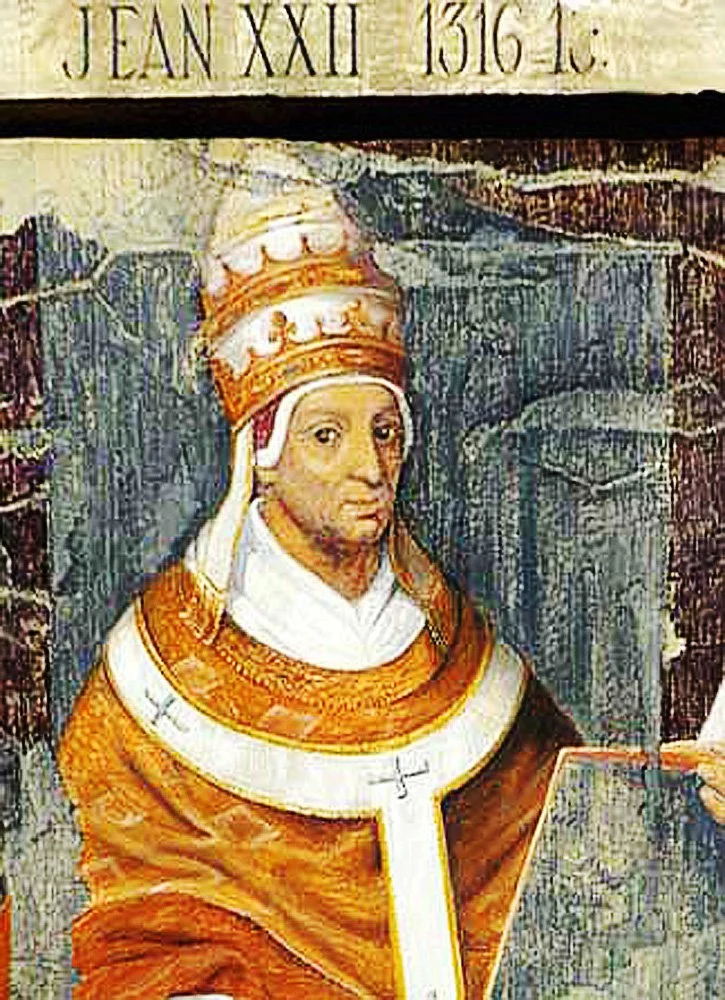
Pope John XXII, artist unknown. Source: c domain, Archives iconographiques du palais du Roure à Avignon, available here.
After Philip requested power
When Philip turned to the Church for money to cover his costly campaigns in the late thirteenth century, he set crown and Church on a collision course. Desperate for funds, he wanted the Church to help pay for his wars in Gascony and Flanders, and as France poured its resources into fighting rather than the welfare of its people, the kingdom slid into crisis. Philip treated these wars as a gamble worth taking, but drawing the Church into them brought him no relief. The confrontation culminated in the seizure of Boniface VIII at Anagni in 1303; released by the townspeople but broken by the ordeal, the pope died about a month later.
Rarely had a secular ruler laid hands on the pope, and never so nakedly over money; yet the seizure of Boniface set in motion what became the Avignon Papacy, during which seven French popes governed the Church from Avignon for some seventy years. The first of them, Bertrand de Got, was elected in 1305 and took the name Po. Clepe ment proved highly amenable to Philip - most visibly in his suppression of the Knights Templar, which he formally abolished at the king's urging (Théry-Astruc, 2016, 36). To many this looked like a capitulation that left the Church dangerously exposed. Clement spent most of his pontificate in France and never went to Rome, and it was under him that the popes came to reside in France rather than at the Holy See.
Clement also had to manage the posthumous proceedings that Philip's lawyers pressed against the memory of Boniface VIII, placating the king by revoking the bulls with which Boniface had asserted papal supremacy over France (Théry-Astruc, 2016, 39). The affair dragged on for roughly two years, the late pope's guilt or innocence argued on both sides, before Clement contrived to have it dropped. The deeper reason the papacy shifted from Rome to France was the turbulence of the Roman Curia itself: with powerful families feuding for control of the city, a more secure base seemed the safer choice, and it suited a papacy bent on centralizing its authority. As the French crown grew stronger through its hold over a compliant pope, Clement sought stability above all and chose never to return to Rome, even when he might have done. Abroad he took up the cause of crusade, receiving overtures from the Mongol Ilkhanate - which proposed a Franco-Mongol alliance against the Mamluks of Egypt - and proclaiming a new crusade at the Council of Vienne in 1312 (Housley, 1980, 166).
The crusade was slow to take shape; after much preaching, and with the backing of several kings, it eventually got under way, one of the last such expeditions ever mounted. In Italy, meanwhile, Rome was convulsed by the feud between the Orsini and Colonna families, which proved impossible to settle. Clement governed the papal lands from afar, entrusting authority in the region to allies while he remained in France, but the situation deteriorated and the cardinals he left in charge were themselves split along factional lines. The vacuum allowed the Holy Roman Emperor, Henry VII, to press his own claims in and around Rome during his Italian expedition, and from a distance Clement watched the region torn by the older rivalry between France and Naples and by Henry's ambitions. He also moved against heresy, calling a crusade that crushed the Dulcinians, the followers of Fra Dolcino. The body of canon law he assembled, the Clementine Constitutions, was completed in his reign but promulgated only by his successor, John XXII, in 1317; it asserted a broad papal authority that later popes would dispute. Clement died in 1314, but his reign had set the papacy on a French course, drawing it away from Rome and toward the power of the West.
France after Philip IV
Philip IV died after a hunting accident in 1314, and the Church's power carried on much as Clement had shaped it. Clement's death brought to the throne John XXII - Jacques Duèze - who came not from Paris but from Cahors, in southern France. Trained above all as a jurist in canon and civil law, he had served for years as an adviser at courts across the region; as chancellor to Charles II of Naples, he is said to have used his influence to have the gladiatorial games at Naples suppressed. In 1310 he became bishop of Avignon and rose swiftly through the ranks of the Church. When Clement died in 1314 it took almost two years to settle on a successor, amid bitter divisions among the cardinals and the deepening quarrel with the Holy Roman Empire.
In 1316 Philip, Count of Poitiers - soon to be Philip V of France - forced the deadlocked cardinals into a conclave of twenty-three at Lyon and pressed them to elect a pope; their choice fell on Jacques Duèze. Like his predecessor, John remained in France and never returned to Rome. His was among the longest of the Avignon pontificates, running for eighteen years. He governed with a formidable will - quick-tempered, jealous of his authority, and ready to assert the Church's claims across the known world, even in letters to non-Christian rulers. He backed Edward II of England against the Scots, though this entangled him in the affairs of Ireland, whose princes petitioned the papacy - in the Remonstrance of 1317 - to be released from English overlordship in favor of a ruler more sympathetic to the Church (Richardson, 1941, 97).
John's greatest struggle was with the Holy Roman Empire. The disputed imperial election of 1314 had set Louis IV of Bavaria against Frederick the Fair of Austria, and John refused to recognize either as emperor, insisting that confirming an imperial election was the pope's prerogative. When Louis prevailed and ignored him, John excommunicated him in 1324; Louis retaliated by invading Italy and installing an antipope, and the feud outlasted John himself. The pattern echoed the old wars between empire and papacy - Frederick II a century earlier had likewise defied Rome and marched into Italy - and John pursued the emperor's Ghibelline allies with the same weapons, condemning the Visconti of Milan as heretics and proclaiming a crusade against them (Menache, 1986, 436). The rest of his reign was taken up with controversies over witchcraft, Franciscan poverty, and the beatific vision. A plan to move the papal seat to Bologna came to nothing when the city rebelled, and the papacy stayed in France. John died in 1334, keeping the Church at Avignon and clear of the warfare consuming Italy.
What then
A single act by the French king in 1303 changed the course of history: for the next seventy years the popes resided in France. Hungry for power, they reached for supreme control over Christendom. Under Clement V the papacy formally left Rome, in what the poet Petrarch would famously condemn as the start of the Church's 'Babylonian Captivity.' Clement remained in Philip's grip and followed his lead at every turn, and under John XXII the papacy again found itself entangled with both France and the Holy Roman Empire. These first two Avignon popes embodied the office at its most political - a mirror of where the papacy's power now lay. What had begun as an attempt to curb the corruption of the Church had transformed it entirely, and the popes who followed would confront the same question anew.
Now read part 4 about whether it is over for France here.
Bibliography
Housley, N. J. “The Franco-Papal Crusade Negotiations of 1322-3.” Papers of the British School at Rome, vol. 48, 1980, pp. 166–85. JSTOR, http://www.jstor.org/stable/40310773. Accessed 5 Aug. 2026.
Menache, Sophia. “The Failure of John XXII’s Policy toward France and England: Reasons and Outcomes, 1316-1334.” Church History, vol. 55, no. 4, 1986, pp. 423–37. JSTOR, https://doi.org/10.2307/3166366. Accessed 5 Aug. 2026.
Mommsen, Theodor E. “The Date of Petrarch’s Canzone Italia Mia.” Speculum, vol. 14, no. 1, 1939, pp. 28–37. JSTOR, https://doi.org/10.2307/2853837. Accessed 5 Aug. 2026.
Richardson, H. G. “Clement V and the See of Canterbury.” The English Historical Review, vol. 56, no. 221, 1941, pp. 97–103. JSTOR, http://www.jstor.org/stable/553609. Accessed 5 Aug. 2026.
Théry-Astruc, Julien. “THE FLIGHT OF THE MASTER OF LOMBARDY (13 FEBRUARY 1308) AND CLEMENT V’S STRATEGY IN THE TEMPLAR AFFAIR: A SLAP IN THE POPE’S FACE.” Rivista Di Storia Della Chiesa in Italia, vol. 70, no. 1, 2016, pp. 35–44. JSTOR, http://www.jstor.org/stable/44807473. Accessed 5 Aug. 2026.