Few English monarchs have earned a reputation as dark and enduring as King John (reign 1199-1216). More than eight centuries after his death, his name remains synonymous with tyranny, injustice and failure. Unlike many medieval kings whose reputations have softened with the passage of time, John continues to occupy a unique place in English history as the king who alienated almost everyone around him, his family, his nobles, the Church, and ultimately his own people. His reign would culminate in one of the most significant constitutional moments in history: the sealing of Magna Carta in 1215. Yet the famous charter was not born simply from political theory or a desire for liberty. It emerged because one man's methods of ruling pushed his kingdom to breaking point.
Terry Bailey explains.
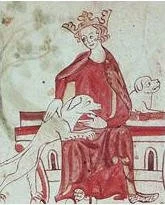
King John of England with dogs. Source: Public domain, painter unknown, available here.
John was born on the 24th of December 1166, the youngest surviving son of King Henry II of England and the formidable Eleanor of Aquitaine. He entered one of medieval Europe's most powerful dynasties, the Angevin Empire, which stretched from the Scottish borders to the Pyrenees and controlled vast territories in France. As the youngest son, however, John was never expected to inherit substantial lands. His elder brothers, Henry the Young King, Richard, Geoffrey and William, stood before him in the line of succession.
This uncertain position shaped much of John's early life. Henry II affectionately called him "Lackland" because he initially had no significant inheritance of his own. The nickname would remain with him throughout history, although later events would give it an ironic twist. While his brothers governed territories and led armies, John remained largely dependent upon his father, fostering a sense of insecurity that many historians believe influenced his later behavior. Growing up in a fiercely competitive royal household, where alliances shifted rapidly and family members frequently rebelled against one another, John learned that power depended as much upon suspicion and manipulation as it did upon loyalty.
Relations between John and his brothers were rarely harmonious. Richard, later immortalized as Richard the Lionheart, became one of the greatest military commanders of the medieval period and enjoyed enormous prestige across Europe. John lived perpetually in his brother's shadow. During Richard's reign, while the king fought during the Third Crusadeand later endured imprisonment in Germany, John attempted to increase his own influence and, at times, entered into political intrigues that appeared to undermine Richard's authority. Although popular legend often portrays John openly conspiring to seize the throne, the reality was more complex. Medieval politics encouraged opportunism, and John's actions reflected both ambition and the instability of the age. Nevertheless, these episodes damaged his reputation long before he became king.
When Richard I died in April 1199 from a wound sustained during a siege in France, John inherited the English crown. His succession, however, was far from universally accepted. Many believed that Arthur of Brittany, the teenage son of John's elder brother Geoffrey possessed a stronger hereditary claim. Although John secured the support of many English nobles and was crowned at Westminster, significant opposition remained across his French territories. From the beginning, his reign rested upon uncertain foundations.
John proved to be an intelligent and energetic administrator. Unlike Richard, who spent comparatively little time in England, John devoted considerable attention to government, finance and legal administration. He travelled extensively throughout his kingdom, supervised officials personally and kept detailed financial records. Modern historians generally agree that he possessed considerable administrative ability. Unfortunately, these talents were accompanied by serious flaws of temperament that ultimately overwhelmed his strengths.
Contemporary chroniclers consistently described John as suspicious, impulsive and deeply vindictive. He rarely forgave those who opposed him, often pursuing enemies with relentless determination long after they had ceased to pose any real threat. Whereas successful medieval kings relied heavily upon rewarding loyalty and maintaining personal relationships with powerful nobles, John frequently humiliated, intimidated or financially exploited those whose support he needed most. Trust became almost impossible within his court because few believed the king would honor promises once circumstances changed.
One event more than any other cemented John's reputation for cruelty. In 1202, during his conflict with the French king Philip II, Arthur of Brittany was captured by John's forces. The young prince disappeared while imprisoned in royal custody. Within months, rumors spread that John himself had murdered his seventeen-year-old nephew, possibly in a drunken rage before disposing of the body in the River Seine. No contemporary source provides definitive proof of exactly what happened. Some chroniclers claimed eyewitness knowledge, while others repeated stories circulating years later. Modern historians remain cautious because the evidence is inconclusive. Nevertheless, few doubt that John bore responsibility for Arthur's disappearance. Whether he personally committed the killing or merely ordered it, the political consequences were catastrophic. Across Europe, many nobles concluded that John had murdered a close relative to secure his throne, permanently staining his reputation.
Military failures compounded these personal controversies. In 1204, John lost Normandy, one of the crown's richest continental possessions to King Philip II of France. The loss represented a profound humiliation for the Angevin dynasty and forced many Anglo-Norman nobles to choose between lands held in England and those in France. John's determination to recover these territories became an obsession, and financing repeated military campaigns required enormous sums of money.
To raise the necessary funds, John pushed the medieval system of taxation to unprecedented levels. He imposed frequent scutage payments, allowing nobles to avoid military service by paying money instead, but demanded these payments far more often than previous kings. He exploited feudal customs to extract heavy inheritance fees, marriage payments and fines whenever opportunities arose. Justice itself increasingly appeared to be for sale. Wealthy individuals could purchase favorable legal outcomes or avoid punishment by paying substantial sums into the royal treasury. Although many of these practices had legal foundations within feudal law, John employed them with such relentless determination that even loyal supporters began to resent the financial burden.
His relationship with the English barons steadily deteriorated. Medieval kings depended upon cooperation with their leading nobles, who provided military service, governed local regions and advised the crown. John instead ruled through fear and financial pressure. Hostages were taken to guarantee obedience. Castles were confiscated. Lands were seized from those who fell from royal favor. Noble families found themselves subjected to crushing fines that could bankrupt entire estates. Rather than strengthening the monarchy, these measures encouraged increasingly organized resistance.
John's approach to justice also attracted widespread criticism. Royal courts expanded under his reign, but many believed legal decisions depended less upon fairness than upon the king's personal interests. Political opponents frequently found themselves prosecuted while allies escaped punishment. Property could be confiscated on questionable legal grounds, and imprisonment without meaningful recourse became an accepted instrument of royal power. Such practices undermined confidence in the very institutions that earlier Angevin kings had worked to develop.
Ordinary people fared little better. Although medieval peasants rarely played a direct role in national politics, they nevertheless experienced the consequences of John's government. Higher taxes filtered through society, while local officials often enforced royal demands with considerable severity. Forest laws, regulating access to woodland resources essential for many rural communities, were harshly applied. Merchants encountered tolls and financial demands, while villages bore the costs of supporting military campaigns. Life for the average English family was already uncertain through poor harvests, disease and local conflicts; John's relentless pursuit of revenue only deepened these hardships.
His troubles extended beyond secular politics. John's prolonged dispute with Pope Innocent III over the appointment of the Archbishop of Canterbury resulted in England being placed under an interdict in 1208, severely restricting religious services throughout the kingdom. When John refused to yield, he was excommunicated. Although he eventually submitted to papal authority and even accepted England as a papal fief, the conflict further damaged his prestige. To many contemporaries, a king condemned by the Church appeared to have lost not only political support but divine favor as well.
The overwhelmingly negative portrait of John owes much to medieval chroniclers, many of whom were monks writing within religious communities deeply affected by his policies. Writers such as Roger of Wendover and Matthew Paris described him as deceitful, greedy, immoral and cruel. Their accounts undoubtedly reflected genuine hostility, but they also carried institutional bias, particularly after John conflicted with the papacy. Modern historians therefore approach these sources carefully, recognizing both their immense value and their limitations. Even allowing for exaggeration, however, the remarkable consistency of criticism from numerous contemporary writers suggests that John's failures as a ruler were both real and widely recognized.
Yet history is rarely as simple as legend. John was not an incompetent fool. He was an able administrator, an intelligent strategist in some circumstances, and a hardworking king who understood the mechanics of government better than many of his predecessors. His tragedy lay in the fact that these strengths were undermined by profound defects of character. Suspicion replaced trust, vengeance displaced reconciliation, and financial exploitation substituted for genuine leadership. In attempting to tighten his grip upon power, he steadily weakened the foundations upon which royal authority depended.
By the second decade of the thirteenth century, England stood on the brink of open rebellion. Noble resentment had hardened into organized opposition. The monarchy's authority was increasingly questioned, while military failures and financial burdens intensified demands for reform. The stage was now set for a confrontation unlike any England had previously witnessed, a struggle that would force an unwilling king to acknowledge that even a monarch's power had limits. That confrontation would soon produce one of the most influential political documents in history: Magna Carta.
In conclusion, King John's reign serves as one of history's clearest reminders that the strength of a kingdom depends not merely upon the authority of its ruler, but upon the confidence and cooperation of those he governs. Although he inherited one of Europe's greatest realms and possessed undeniable administrative ability, his relentless pursuit of power, wealth and control steadily eroded the very foundations upon which that power rested. Through fear rather than trust, coercion rather than compromise, and punishment rather than reconciliation, John transformed political discontent into open hostility. By alienating his family, his barons, the Church and much of the wider population, he produced an alliance of opponents united by little more than a shared determination to curb the excesses of royal authority.
Yet history should resist the temptation to portray John as a one-dimensional villain. Many of the financial and legal mechanisms he employed had existed before his reign, and several would continue after his death. What distinguished John was not the invention of these methods, but the unprecedented scale, frequency and ruthlessness with which he employed them. His inability to inspire loyalty or command genuine respect meant that every military defeat, every financial demand and every perceived injustice compounded the growing belief that the king himself had become the greatest threat to the stability of his own kingdom.
The irony of John's reign is profound. In seeking to strengthen the English Crown, he instead exposed its vulnerabilities. In attempting to make royal authority absolute, he provoked demands that it be restrained by law. His failures would ultimately achieve what his successes never could: they compelled England's leading nobles to insist that even a king must govern within recognized limits. Although Magna Carta was initially conceived as a practical peace treaty between a desperate monarch and rebellious barons rather than a declaration of universal human rights, its enduring principles would echo through the centuries, influencing constitutional government far beyond medieval England.
John himself never accepted these limitations. Within weeks of sealing Magna Carta, he sought to overturn it, plunging the kingdom into civil war. The charter's immediate future appeared bleak, and few contemporaries could have imagined that this fragile agreement, born out of mistrust and conflict, would become one of the most celebrated constitutional documents in history.
The story therefore does not end with King John's failures; it begins with them. His reign illustrates how poor leadership, personal vindictiveness and unchecked authority can drive even the most powerful monarch towards political disaster. The rebellion he provoked would fundamentally alter the relationship between ruler and ruled, setting England upon a constitutional path whose consequences would eventually reach far beyond its shores.
As we continue to delve deeper into the kingdom, political opposition hardens into armed rebellion and the examination of years of mistrust erupted into the Barons' Revolt, the dramatic events leading to the meeting at Runnymede, and the extraordinary negotiations that produced Magna Carta, a document born not from idealism, but from crisis, necessity and the determination that no ruler, however powerful, should stand above the law.
Now, read part 2 on Losing an Empire - War, Defeat and a Growing Rebellion.