By the middle years of the English Civil War, the conflict had reached a decisive crossroads. What had begun in 1642 as a bitter constitutional dispute between King Charles I and Parliament were rapidly becoming something altogether different. The early campaigns had revealed the strengths and weaknesses of both sides, exposing flaws in military organization, political leadership, and strategic planning. Neither side had achieved the swift victory that many had confidently predicted, and England found itself trapped in an increasingly destructive struggle that divided families, towns, counties, and religious communities.
Terry Bailey explains.
You can read part 1 on the background to the war here, and part 2 on how the English Civil War began here.
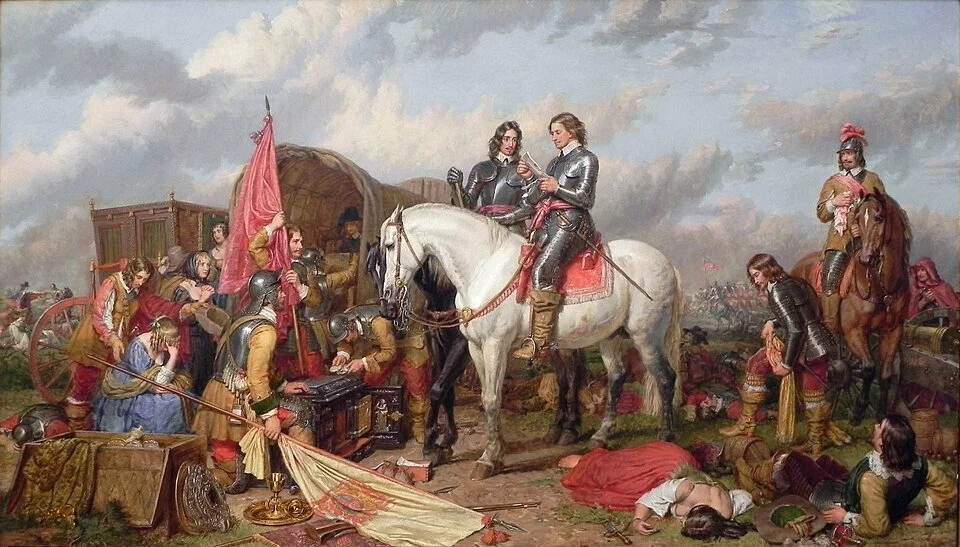
Cromwell in the Battle of Naseby in 1645 by Charles Landseer. Source: Public domain, Alte Nationalgalerie, available here.
Yet out of the uncertainty of these difficult years emerged one of the most remarkable military transformations in British history. Parliament abandoned the old methods of raising armies and instead developed a revolutionary fighting force whose professionalism, discipline, and ideological commitment would ultimately determine the outcome of the war. The rise of the New Model Army not only changed the balance of military power but also transformed English politics forever, helping to produce the conditions that would ultimately end the medieval concept of divine monarchy and lay the foundations of constitutional government.
When the war first erupted, Parliament possessed many significant advantages. It controlled London, the largest and wealthiest city in the kingdom, dominated England's principal commercial centers, and enjoyed access to most of the nation's navy. These advantages provided Parliament with considerable financial resources and enabled it to maintain communication with much of the country through secure sea routes. Nevertheless, these strengths did not immediately translate into success on the battlefield. Parliament's armies often struggled against Royalist forces that were smaller in number but better organized and more decisively led.
One of Parliament's greatest weaknesses lay in the way its armies had been assembled. Rather than developing a unified national force, Parliament initially relied upon county militias, local volunteers, and troops raised by influential noblemen. These regional armies frequently answered first to local political leaders before obeying central authority in Westminster. Many soldiers had enlisted primarily to defend their own counties and showed little enthusiasm for prolonged campaigns far from home. Supplies, weapons, uniforms, and training varied enormously between different armies, producing inconsistency that frequently proved costly during battle.
Leadership also presented serious difficulties. Parliament's senior commanders were often respected politicians or experienced landowners, but not necessarily gifted military leaders. Decisions were frequently delayed by committees, political disagreements, or disputes over seniority. Rival commanders occasionally refused to cooperate fully with one another, allowing Royalist armies to exploit divisions that existed within Parliament's military establishment. In contrast, King Charles I enjoyed the services of several talented commanders who were accustomed to exercising decisive authority in the field.
Foremost among these Royalist leaders was his charismatic nephew, Prince Rupert of the Rhine. Young, energetic, and possessing extensive experience gained during the Thirty Years' War in continental Europe, Rupert quickly became one of the most feared cavalry commanders in Britain. His mounted troops repeatedly demonstrated exceptional courage and aggression, charging Parliamentary formations with devastating effect. At battles such as Edgehill and numerous smaller engagements, Rupert's cavalry often swept opposing horsemen from the field and inflicted severe casualties upon inexperienced infantry.
Yet Rupert's brilliance also revealed an important weakness within Royalist tactics. His cavalry frequently pursued fleeing enemies over great distances after achieving an initial breakthrough, leaving the battlefield itself at precisely the moment their support was most needed. While this aggressive style sometimes produced spectacular victories, it also deprived the Royalist infantry of vital protection during the later stages of battle. Parliament's commanders carefully observed these recurring tactical patterns and gradually learned valuable lessons from their defeats.
Throughout 1643 and into 1644 the conflict settled into a prolonged and exhausting struggle. Neither side possessed sufficient strength to destroy the other completely. Castles and fortified towns changed hands repeatedly. Sieges became increasingly common, placing enormous burdens upon civilians who often suffered shortages of food, disease outbreaks, and destruction of property. Trade declined dramatically as roads became unsafe and agricultural production was disrupted across much of the country. The war was no longer simply fought between armies; it was becoming a national catastrophe affecting every level of English society.
These military frustrations forced Parliament to undertake a searching examination of its own shortcomings. Many members concluded that victory could never be achieved while military appointments remained heavily influenced by politics and social status. England required a professional national army rather than a loose collection of regional forces. Increasingly, reformers argued that the old military system reflected the same outdated aristocratic traditions that Parliament had originally sought to challenge. Military reform therefore became inseparable from constitutional reform.
Among the individuals who most clearly recognized this reality was Oliver Cromwell. Before the outbreak of war, Cromwell had attracted little national attention. A country gentleman from Huntingdonshire and a relatively obscure Member of Parliament, he possessed neither aristocratic title nor distinguished military background. Yet beneath his modest appearance lay remarkable organizational ability, unwavering determination, and profound religious conviction. The Civil War provided him with the opportunity to reveal talents that few had previously recognized.
Cromwell believed that successful soldiers required something deeper than military skill alone. They needed an unwavering conviction that their cause was righteous and that God Himself favored their struggle. He famously declared that he would rather command "a plain russet-coated captain that knows what he fights for" than a gentleman lacking conviction. For Cromwell, personal faith, discipline, and moral character mattered more than noble birth or social standing. This philosophy represented a revolutionary approach to military leadership in seventeenth-century England.
His first opportunity to put these ideas into practice came in eastern England, where he organized a cavalry regiment that quickly gained an enviable reputation for discipline and effectiveness. Unlike many cavalry formations of the period, Cromwell's horsemen were carefully trained to maintain formation after charging the enemy. Instead of scattering in pursuit of defeated opponents, they regrouped rapidly and returned to support their infantry. This seemingly simple tactical discipline proved enormously significant. Battles were increasingly decided not by isolated charges but through coordinated operations involving cavalry, infantry, and artillery working together.
The soldiers under Cromwell's command soon became known as the Ironsides. Their nickname reflected not only their battlefield determination but also their strict personal conduct. Drinking, gambling, looting, and disorder were actively discouraged. Officers expected soldiers to display honesty, restraint, and respect toward civilian populations. Such discipline distinguished Cromwell's regiments from many contemporary armies, whose undisciplined behavior frequently alienated the very communities they claimed to protect.
Religion lay at the heart of this discipline. The majority of Cromwell's officers and many ordinary soldiers were deeply influenced by Puritanism, a movement that sought to purify the Church of England of practices regarded as remnants of Roman Catholicism. Puritans emphasized personal Bible study, simplicity in worship, moral living, and direct accountability before God. They believed that every individual possessed a sacred responsibility to live according to Scripture and to oppose corruption wherever it appeared.
Within Cromwell's army, religious observance became woven into daily military life. Soldiers regularly attended sermons, prayed together before battle, sang psalms, and discussed Scripture around campfires. Chaplains accompanied regiments not merely to provide comfort but to reinforce the belief that the army served a divine purpose. Victory was interpreted as evidence of God's blessing, while defeat encouraged self-examination and repentance. This religious culture fostered extraordinary morale, encouraging soldiers to endure hardship with remarkable resilience.
For many Parliamentarian soldiers, the Civil War was far more than a political rebellion. They believed they were engaged in a holy struggle against tyranny, religious corruption, and ungodly governance. Charles I's support for Archbishop William Laud's religious reforms, together with his marriage to the Catholic French princess Henrietta Maria, convinced many Puritans that England faced a genuine spiritual crisis. Defending Parliament therefore became inseparable from defending Protestantism itself.
This powerful ideological commitment increasingly distinguished Parliament's forces from those of the King. While many Royalists fought out of personal loyalty to Charles or devotion to traditional monarchy, Parliament's soldiers frequently regarded themselves as participants in a providential mission ordained by God. Their military service acquired profound moral significance, giving them a sense of purpose that extended beyond ordinary political allegiance.
Recognizing the need for comprehensive military reform, Parliament introduced the Self-Denying Ordinance in 1645. This legislation required many Members of Parliament to surrender their military commands, reducing conflicts of interest and encouraging appointments based upon military competence rather than political influence. Although controversial, the measure reflected Parliament's growing willingness to place efficiency above personal ambition.
At the same time Parliament authorized the development of the New Model Army. This force represented one of the most ambitious military reforms ever attempted in seventeenth-century Europe. Instead of relying upon separate regional armies, Parliament organized a central national force of approximately 22,000 soldiers under the overall command of Sir Thomas Fairfax. The army received standardized weapons, uniforms, pay, training, and logistical support. Officers increasingly earned promotion through demonstrated ability, courage, and leadership rather than inherited social rank.
The New Model Army introduced levels of professionalism previously unknown in England. Soldiers underwent regular drill, strict discipline, and systematic instruction in battlefield maneuvers. Supply systems were carefully organized to ensure reliable provision of food, ammunition, and equipment. Uniform red coats promoted unity and fostered a common identity that transcended regional loyalties. The army became not merely an instrument of Parliament but an institution possessing its own culture, traditions, and professional standards.
Military historians often regard the New Model Army as one of the earliest examples of a truly modern standing army. Unlike temporary feudal levies or locally raised militias, it existed as a permanent national institution capable of sustained campaigning under central command. Its success demonstrated the growing importance of organization, logistics, training, and administration alongside battlefield courage. Warfare itself was becoming increasingly scientific, disciplined, and bureaucratic.
Even before the New Model Army officially entered service, Parliament achieved one of the most important victories of the war at the Battle of Marston Moor on the 2nd of July 1644. Fought near York, the battle involved approximately 45,000 soldiers, making it one of the largest engagements ever fought on English soil. Parliament's forces joined with their Scottish Covenanter allies to confront the combined Royalist armies commanded by Prince Rupert and the Marquis of Newcastle.
The battle proved decisive. Although the fighting was confused and often brutal, Cromwell's disciplined cavalry played a crucial role. After defeating the opposing Royalist horse, his regiments resisted the temptation to pursue scattered enemies. Instead, they regrouped and launched coordinated attacks against the exposed Royalist infantry. This disciplined maneuver transformed local success into complete victory. By nightfall, Royalist resistance had collapsed, leaving northern England largely under Parliamentary control.
Marston Moor carried immense strategic significance. It effectively ended Royalist hopes of dominating northern England and deprived Charles I of valuable manpower, resources, and recruitment opportunities. Equally important, it demonstrated beyond doubt that disciplined professionalism could defeat the traditional methods employed by aristocratic commanders. Cromwell emerged from the battle as one of Parliament's most respected military leaders, while support for comprehensive reform gathered unstoppable momentum.
The decisive test came the following year at the Battle of Naseby on the 14th of June 1645. Charles I recognized that the newly evolved New Model Army represented a grave threat to his cause and sought to destroy it before it could consolidate its strength. The opposing armies met near the village of Naseby in Northamptonshire under conditions that would determine the future of the kingdom.
The battle unfolded with extraordinary intensity. Prince Rupert once again launched powerful cavalry attacks that initially achieved success, but the disciplined formations of the New Model Army refused to collapse. Cromwell's cavalry maintained its cohesion, defeated the Royalist horse on the opposite flank, and then wheeled back across the battlefield to strike Charles's infantry from the rear. Parliament's infantry advanced steadily, maintaining formation despite fierce resistance. Superior discipline, effective command, and coordinated tactics gradually overwhelmed the Royalists.
By the end of the day, the King's principal field army had been virtually destroyed. Thousands of Royalist soldiers were killed, wounded, or captured, while Parliament seized artillery, ammunition, baggage trains, and vital military supplies. Even more damaging was the capture of Charles I's personal correspondence.
These private letters proved politically explosive. They revealed that Charles had secretly negotiated with Irish Confederates and sought military assistance from foreign Catholic powers while publicly presenting himself as the defender of Protestant England. Parliament quickly recognized the immense propaganda value of these documents. Published under the title The King's Cabinet Opened, the correspondence appeared to confirm long-standing accusations that Charles repeatedly negotiated in bad faith and placed his own authority above the welfare of his kingdom.
The publication of the King's letters profoundly influenced public opinion. For many English Protestants, the possibility that Charles would invite Catholic assistance against his own subjects appeared deeply shocking. Parliament skillfully presented the correspondence as undeniable evidence of royal dishonesty, arguing that constitutional compromise with such a monarch had become impossible. The battle for hearts and minds increasingly became as important as victories won upon the battlefield itself.
Following Naseby, the Royalist cause entered irreversible decline. Although isolated garrisons continued resisting and Charles attempted to raise new forces, he never again possessed an army capable of challenging Parliament in open battle. One fortress after another surrendered. Royalist recruitment declined sharply, financial resources became exhausted, and morale steadily deteriorated. By 1646 Charles surrendered himself to the Scottish army, effectively ending the English Civil War.
Military victory, however, produced an entirely new political challenge. The New Model Army had become far more than an obedient military force. Years of campaigning, religious discussion, and political debate had produced soldiers who increasingly believed they possessed a legitimate voice in shaping England's future. They had fought, suffered, and sacrificed in what they regarded as a righteous cause. Many refused to accept a simple return to the political arrangements that had existed before the war.
Within the ranks of the army, vigorous debates emerged concerning religious liberty, constitutional reform, justice, representation, and the proper limits of governmental authority. Radical religious groups flourished, encouraging unprecedented discussion about the rights of ordinary people. Although opinions varied widely, many soldiers questioned whether true liberty could ever exist while absolute monarchy remained intact.
These debates also exposed growing divisions within Parliament itself. Moderate members wished to negotiate with Charles I and restore a constitutional monarchy under carefully defined limitations. Others believed the King had repeatedly demonstrated that he could never be trusted to honor genuine constitutional agreements. The discovery of his secret correspondence reinforced these suspicions, convincing many that compromise merely postponed future conflict.
As political disagreements deepened, the relationship between Parliament and the New Model Army became increasingly complex. The army expected recognition for its sacrifices, payment of long-overdue wages, and assurance that the constitutional principles for which it had fought would not be abandoned through political compromise. Military victory had therefore produced a new and powerful political force whose influence extended far beyond the battlefield.
The transformation that occurred during these years reached far beyond military affairs. England witnessed the emergence of ideas that challenged centuries of political tradition. The doctrine of divine monarchy, which held that kings ruled directly by the will of God, increasingly collided with the principle that legitimate government required the consent of the governed through Parliament. Religion remained a powerful political force, shaping the convictions of soldiers, politicians, clergy, and ordinary citizens alike. Propaganda became an increasingly sophisticated weapon, influencing public opinion through printed pamphlets, newspapers, sermons, and political correspondence. Military innovation demonstrated the superiority of professionalism over inherited privilege, while revolutionary ideas concerning legitimacy, representation, and constitutional authority gained unprecedented influence.
The development of the New Model Army marked the moment when the English Civil War ceased to be simply a struggle between King and Parliament. It became a revolutionary movement that questioned the very foundations of political authority. The victories at Marston Moor and Naseby destroyed the military power of the Crown, while the publication of Charles I's private correspondence undermined his moral and political credibility. Yet the greatest consequence of these events was not merely the defeat of the Royalist armies. It was the emergence of a new political consciousness that would reshape England for generations to come. The nation was steadily moving away from medieval assumptions about divine kingship and inherited authority toward a future in which constitutional government, parliamentary sovereignty, and the rule of law would increasingly define the British state. The battles won by the New Model Army therefore altered far more than the outcome of a civil war, they transformed the course of English history itself.
Needless to say, the raising of the New Model Army proved that the outcome of the English Civil War would not be decided solely by numbers, wealth, or inherited privilege, but by organization, conviction, and adaptability. Parliament's willingness to reform its military institutions when faced with repeated setbacks demonstrated a capacity for innovation that the Royalists ultimately failed to match. Through disciplined training, unified command, logistical efficiency, and promotion based upon merit rather than birth, Parliament developed an army unlike any previously seen in England. The victories won at Marston Moor and Naseby were therefore not isolated battlefield successes but the visible results of a profound transformation in warfare itself. The conflict had entered a new era in which professionalism increasingly eclipsed feudal tradition, foreshadowing the development of the modern standing armies that would dominate European warfare for centuries to come.
Yet the military revolution was only one aspect of a far greater upheaval. As Parliament's soldiers marched from battlefield to battlefield, they carried with them not merely muskets and pikes but powerful ideas concerning justice, liberty, and political authority. The New Model Army became an institution in which ordinary men debated matters of government that had previously been regarded as the exclusive preserve of kings, bishops, and noblemen. For many of its soldiers, victory imposed a moral obligation to ensure that the sacrifices made during years of bitter conflict would produce lasting constitutional change rather than a simple restoration of the old order. In this sense, the army evolved into both a military and political force, capable of shaping the future of the nation long after the cannons had fallen silent.
Equally significant was the changing role of public opinion. The publication of The King's Cabinet Opened demonstrated that information could be as powerful as military force. Charles I's own correspondence undermined the trust upon which monarchy depended, revealing to many of his subjects that the King's public declarations did not always match his private diplomacy. Pamphlets, sermons, newspapers, and printed declarations increasingly became weapons of persuasion, helping to define legitimacy in the eyes of the people. The Civil War thus marked one of the earliest examples in British history of propaganda becoming an essential instrument of political conflict, a development that would shape future revolutions and constitutional struggles throughout the modern world.
Religion likewise remained inseparable from every stage of the conflict. Both Royalists and Parliamentarians believed that divine providence favored their cause, and both interpreted victory and defeat through the lens of faith. For the Puritans who filled the ranks of the New Model Army, military service became an expression of religious duty, while Charles I continued to regard his authority as sacred and ordained by God. The struggle was therefore never merely a contest over political institutions; it was also a battle over competing visions of England's spiritual identity. Questions of worship, conscience, church government, and divine authority became intertwined with debates over taxation, law, and sovereignty, ensuring that the Civil War reshaped both the political and religious landscape of the nation.
Most importantly, the years between 1644 and 1646 fundamentally altered the relationship between the Crown and Parliament. The doctrine of the Divine Right of Kings, which had dominated English political thought for generations, suffered irreversible damage as Parliament demonstrated that a monarch could be challenged, defeated, and held accountable by representatives claiming to act on behalf of the nation. Parliamentary sovereignty, though not yet fully realized, had emerged as a powerful constitutional principle that would continue to evolve long after the war itself had ended. The conflict had revealed that government derived not only from hereditary succession but also from legitimacy, trust, and the consent of those who were governed.
The victories of the New Model Army did not immediately bring peace to England. Instead, they opened an even more dramatic chapter in the nation's history. The defeat of the Royalist field armies removed the King's military power, but it did not resolve the profound constitutional, religious, and ideological divisions that had driven the kingdom into civil war. Questions concerning Charles I's future, the authority of Parliament, the influence of the army, and the very nature of English government remained fiercely contested. Rather than concluding the revolution, Parliament's triumph produced the conditions for an even greater confrontation—one that would culminate in the unprecedented trial and execution of an anointed king.
Thus, the turning of the tide was far more than a sequence of military victories; it was the moment at which England crossed a political and constitutional Rubicon from which there could be no easy return. The New Model Army transformed warfare through discipline and professionalism, revolutionized politics through its ideological convictions, and helped dismantle centuries-old assumptions about monarchy and authority. The England that emerged from these campaigns was no longer the kingdom that had marched to war in 1642. It was a nation entering a new and uncertain age, one in which the balance between Crown, Parliament, religion, and the people would be redefined forever. The next stage of the Civil War would determine whether that transformation could be reconciled with monarchy—or whether England would take the extraordinary step of bringing its own king before the judgement of the law.
Now read part 4 on the King’s defeat here.