What is it about the west? Why is country music listened to in every corner, region, city, small town, and house across the United States? Why does every child at one point dream of being a cowboy or a misunderstood outlaw? Why is it that at a turbulent point in life every man has stated at least once in his life “screw it, if it doesn’t work ill just move out to a ranch on my own and live off grid”? Why is it that still today that foreign countries still refer to an American at times as a cowboy? Wait, how did Americans even get the reputation of a bunch of cowboys and outlaws?
Jeffrey Horn explains.
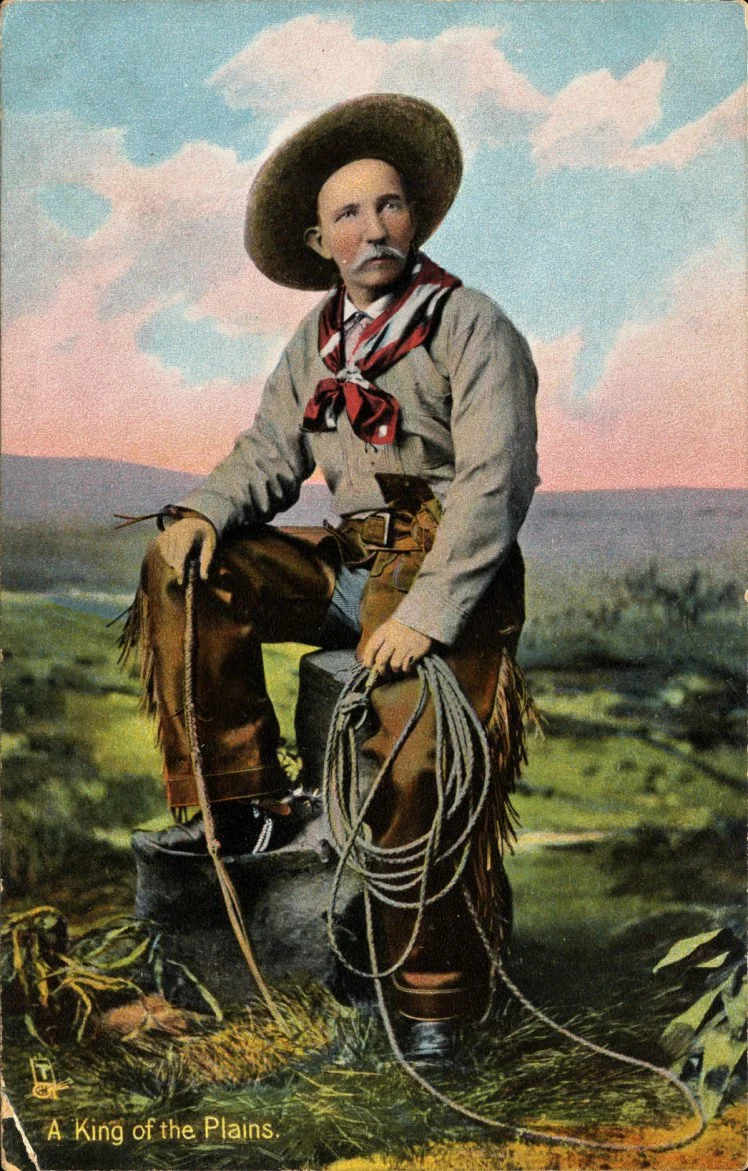
A Cowboy with the description ‘A King of The Plains’ . Source: Public domain, Postcard commercialized by Raphael Tuck & Sons, available here.
The matter of the West if curious. The reality of the history of the cowboy does not originate in the United States nor were they ever figures of glory and lifestyle. Cowboys were originally hired hands on ranches known as Vaqueros. The Vaqueros were known as experts of roping and herding, being trained from a young age to perfect the skills. By the 1700s the Vaqueros had expanded across Mexico, the American West, and into South America reaching as far as Argentina. As settlers expanded west into the new frontier, collaboration efforts with the Vaqueros became more and more common leading to adaptation into American ranch and farming life in the west. Which brings us back to the point of this - how did this collaboration and eventual takeover by the American way become our stereotype across the world and longed for identity at home? It makes no sense…
The original 13 Colonies had a 100-year (or more) head start on creating solidified personalities, stereotypes, and identities for colonists and eventual Americans that stemmed from the east coast. As we know these cities and historical towns do have their own strong personalities from the people of blue collar people of Boston who think the vowel O is pronounced like A and A is pronounced like H, to the hardnosed people of New York City, the loud and passionate people of Philadelphia, all the way down to the party and glamor people of Miami. But these personalities do a hard stop at the surrounding suburban neighborhoods outside the major cities. None of them extend past, no one from the middle of Oklahoma says “If all else fails I wanna be a New Yorker”. Although, if I lived in Oklahoma I would probably say that, but as a kid from Jersey I might be slightly biased. Regardless, the fascination of the wild west still sits in every American's mind, past and present.
Origins
Anyway, back to the Vaqueros, or well, the end of them. As the clash of cultures continued the idea of the cowboy began to take its own independent form and solidify into American culture completely detaching from its original Mexican roots. The image of the American Cowboy kept the same big curved hat, bandana, boots with spurs, and leather coat. But what completely erased the Vaquero Mexican roots was the profession change of the American Cowboy, both in the fantasized and real West. Now that the Mexican influence was completely Americanized and taken out, the American Cowboy needed a better profession then a ranch hand and it needed to have a cooler presence then just a guy who showed up to work.
But what? What could America give this physical, yet mostly mythical, icon to make it uniquely its own? Perhaps bear arms? The American Cowboy was depicted with and given guns to add to his image, much more than just some rope. The change to a more violent image came from the American idea that the settlers were in constant danger and needed to be ready to fight off any Native Americans or any other threat at a moment's notice. But who's surprised? We moved onto ancient native territories and took all their resources and just simply claimed it American? That does however bring up an interesting debate of was it a necessary evil to allow progress and societal evolution to occur or is it so completely wrong what the colonists and settlers did and we should feel bad and revert to how it was?
But again, not the point here. Another aspect that the new American Cowboy took away from the Vaquero origins was the idea of traveling together. The new image of the Cowboy was a lone ranger, a lone wolf, or a “one-man wolf pack” like Zach Galifianakis explained the roof of a casino in Las Vegas (part of the American west). This image of a lone cowboy triggered the fantasy or idea that he was running from a past that was haunting him from afar. Whether it was a girl he loved and lost, violent things he had done to get by that he no regretted, or simply not being able to find peace by staying put the American Cowboy never stayed in one spot for very long.
Appeal
Now that the origins of the American Cowboy are out of the way, how does this appeal to people? To be alone in the American West, which is essentially a desert, traveling on a horse with no name that you bought from an old guy in a trailer park for $20, if you wanted to stay true to the spirit of being a cowboy of course. To then be moving from place to place with no stability, doing some odd jobs to maintain at least a minimal cash flow, no contact with friends or family, and again traveling through desolate lands and potentially volatile weather. Especially if all you've known is the complete opposite, it can't be a solution to a life plan. Although, to escape the congestion of the northeast states or the skyrocketing prices and taxes of the west coast or even the extreme humidity and heat from the south and simply travel through near untouched lands and explore the national parks. Escape from the stresses of life, social media trends, buying the right clothing brands, keeping up with the latest technology, and running into every single person you know from high school at the bar wouldn’t be such a bad way to live, would never be able to keep up as much with my beloved New York sports teams or Florida Gators but they suck most of the time anyway so I wouldn’t miss much. Something to consider.
This draw to a simpler and/or easier way of life was originally a great selling point to the colonists that were tired of being confined to the original 13 colonies. So much so that at the conclusion of the Revolutionary War, the United States saw an increase of population by almost 2 million people. And by 1840, nearly 40% of the population of the infant United States of America lived west of the Appalachian Mountains, which once served as a hard stop and great divide from the rest of the unknown “New World lands”. What about in today’s America, you may ask? Well just like that “it was never a phase” emo lifestyle, Americans are still moving into the mid-west at growing rates. According to the U.S. News, of the top 25 fastest-growing places in the United States more than 50% of the places listed are located in western states such as Texas, Arizona, Utah, and Idaho (Cabral, 2025). But why? What is it about the west that makes it such an attractive place to live in? Your “next-door neighbor” is most likely over a mile away. However, you can buy that large property for less than you can buy a one bedroom shack on the Jersey Shore. Not to mention less or zero taxes on certain things whether it be property, food, or clothing. Although there are different levels of freedom living in the wild west today than at its initial discovery, the trends stay. Quiet, solitude if you choose, and seemingly more freedom to live as you like in, The Land of the Free.
Country music
However, the biggest influence and draw to life outside of the modern hustle and bustle is the grip that country music has on almost every American. Country music is found in every corner of the United States and has infiltrated almost every single person's music taste to some extent, and some of it is definitely intriguing. There will be at least one song that comes on and paints the picture of a green pasture, a cold beer, a sunset in the distance, and your wife and dog on either side of you that prompts a thought of “ah, that’s nice.” or at any BBQ in the summer you will find yourself singing and/or dancing to a song that is focused on the glory days of younger years or the old glory of the younger and simpler USA. Sometimes country music just hits the perfect musical vibe you're looking for, or triggers an emotion from a memory long gone. Perhaps it is not so absurd that everyone has at least one country music song on their playlist no matter if you live in the most suburban, urban, or rural place, and perhaps it’s a connector for us all that we do not see, or maybe it really is just a stereotype of America that we cannot outrun. Country music may also be the United States’ most prominent none-materialistic export (unofficially). Thinking about it, the biggest star in the world right now is Taylor Swift who was, or is depending on how you look at it, a country music super star. Before Taylor Swift though, global icons including Dolly Parton, Johnny Cash, and Willie Nelson dominated around the world and shared the American way of life and music sound outside the borders of the fifty states.
Western movies
Another massive American export that goes hand and hand with country music is Western movies. For nearly fifty years American western movies dominated the emerging cinema scene. Starting out with everyone's favorite pre-WWI entertainment source, silent movies, and to be specific the widely recognized first silent film to embody the “western narrative” was Edwin S. Porter’s eleven minute silent film called The Great Train Robbery was released in 1903. It was short but captivated audiences enough to make it an iconic part of cinematic history (Gioia, 2026, 1). Fast forward now to post-WWI with a longer addition of a silent western film that was released at the height of the Roaring Twenties, which of course was famously balanced out by Prohibition which also brought balance to the force, I mean decade, anyway. The movie was released in 1923 by James Cruz and depicted life traveling the west in a wagon, the hardships of traveling into the unknown, and living off the land. The film was called, The Covered Wagon and was a major step for cinema and westerns alike in the United States (Whiteman, 2019, 1).
For the next thirty years westerns were the top movie genre in the United States, and it was not long before European countries wanted in on the action. With Europe recovering financially and physically from the fallout of WWII, film makers realized that it would be cheaper to make the movies in their own countries rather than traveling to America and working through Hollywood. With this new idea all boots, steeds, and wagons started to point east beyond the Atlantic Ocean and find their new home on the boot-shaped peninsula of the Mediterranean, Italy. Spaghetti Westerns, as they were called affectionately, or derogatory sometimes, became immensely popular during the 1960s (Abreu, 2025, 1) and featured the greatest cowboy seen on screen, Clint Eastwood. The stand out strand of the large spaghetti pot was The Good, The Bad, and The Ugly and its iconic theme music. The integration of the Spaghetti Western movies into the world puts the final nail in the coffin in why the cowboy theme and stereotype surrounds the United States today.
It is possible America will never outgrow the stereotype of a bunch of cowboys and outlaws and it seems entirely possible that Americans will never stop fantasizing about the American West and continue to yearn for a quiet life living off the land. Somethings are so ingrained in the fabric of a being that it would be impossible to strip it out completely and we will wonder forever, what is it about the west?
What do you think of cowboys and the American West? Let us know below.
References
● Abreu, R. (2025, Feb 4). https://www.walkerart.org/reader/covered-wagon-photos-arapaho-wind-river-whiteman/.StudioBinder. https://www.studiobinder.com/blog/what-is-a-spaghetti-western-definition/
● Cabral, A. (2025). 25 fastest-growing places in the United States. U.S. News & World Report.https://www.usnews.com
● Davis, D. B. (1954). Ten-Gallon Hero. American Quarterly, 6(2), 111–125. https://doi.org/10.2307/3031207
● Gioia, T. (2026, June 6). The 50 Essential Western Films. The Honest Broker. https://www.honest-broker.com/p/the-50-essential-western-films
● Whiteman, M. (2019, Feb 14). The (Un)Covered Wagon: An Arapaho Filmmaker Unpacks the Complexities of an Early Western. Walker Reader. https://www.walkerart.org/reader/covered-wagon-photos-arapaho-wind-river-whiteman/