The largest slave rebellion in US history took place in Louisiana in 1811. Here, Husain H. Roussel looks at the background, including the slave rebellion in Haiti, and what happened in Louisiana – and its aftermath.
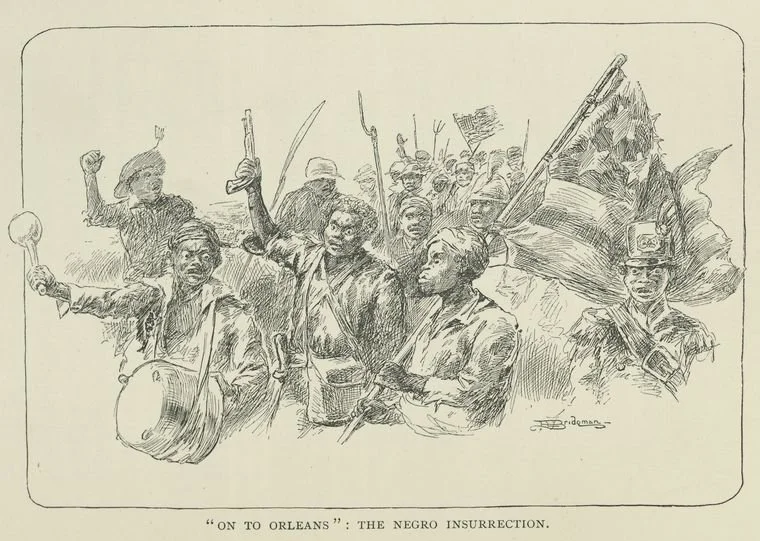
The slave rebellion, known as the 1811 German Coast Uprising. Source: Public domain, source here, image from here.
Introduction
The French planter population, what was left of them, had barely fled Haiti in 1804 during the Haitian Revolution. It left both French plantation owners and French civilians massacred with little mercy and no quarter given by former slaves during a widespread slave rebellion. The French Emperor Napoleon Bonaparte sent the best of his army along with Polish mercenaries to retake Haiti, but with little success and at great cost to the expedition forces, who suffered from disease and a relentless onslaught from the Haitian militia. A militia made up of men, women, the young and old, and free people of color unwilling to suffer the chains of slavery or the institution of slavery once again. The Polish mercenaries sent with the French Expeditionary force decided, after witnessing French cruelty during the conflict, to abandon their French allies and support the slaves in their fight against the French, making them some of the very few Europeans on the island to be both spared and given Haitian citizenship in the new republic.
The defeat of the French expeditionary force, the burning of most plantation homes, the extermination of whites in every town harboring the French citizens, and the religion of voodoo inspiring the slaves on every corner of Haiti with the beating of religious drums to take up arms against their oppressors, would witness the inevitable end for French control. The island of Santo Domingo would become the second republic in the western hemisphere, after the American Revolution, to obtain its independence from a European overlord. The difference was that this new republic would be solely controlled by former slaves and freemen of color who would now decide what course the future of Haiti would take.
News of a Slave Victory
The few French survivors who managed to escape took what they were able to carry or salvage, including Haitian slaves and newly enslaved Africans who were either loyal to their masters or forced to leave the island at gunpoint. French survivors fled to France, other French colonies in the Caribbean like Martinique and Guadeloupe, or Spanish-controlled Cuba. The French colony of Louisiana and the district of New Orleans would become another destination for many of the now recently created French refugees to settle in, and a few years later would become the next stage for the largest slave rebellion in the history of the United States of America. The news of the 1804 Haitian rebellion and their independence from France as a sovereign nation became a nightmare for all plantation owners in every country who held people of color in bondage, be they of African descent or native indigenous people.
Fear of the Southern Plantation Owners
The news of the Haitian victory over the French, not to mention a French professional army, was without a doubt the worst nightmare for every southern plantation owner in the slave-holding states of the newly established United States of America. The armed insurrection of slaves through none other than widespread rebellion was the fear they would awaken to each morning while looking out the window from the second floor of their lavish and genteel plantation homes. What if this happens here? A constant thought while watching their slaves working in brutal conditions on the plantation fields. This was also what every paid overseer who dared not be caught off guard worked hard to prevent by maintaining order as they ruthlessly whipped the slaves into obedience for any transgression, or used other brutal means to control the slaves in the unforgiving atmosphere of the southern plantation.
Slavery in French Controlled Louisiana
The French claimed the area known as Louisiana in 1682, and the territory claimed by the Kingdom of France was named in honor of the French King Louis XIV by the French explorer René-Robert Cavelier, Sieur de la Salle. The institution of slavery was initially introduced on the indigenous people of the colony around 1706. The harsh treatment of slavery, along with a lack of immunity to new diseases, led to the deaths of many indigenous people. The French would nevertheless continue to capture indigenous people for slavery throughout their control of Louisiana by military raids on native villages or enemy prisoners traded to the French who were obtained from various warring Native American tribes in the area. However, as far as the French were concerned, the use of indigenous people did not solve the problem for a wider need in slave labor, thereby witnessing the introduction of African slaves to Louisiana around 1719. While people of African descent were recorded in Louisiana census reports as living in the territory around 1712, the vast number of African slaves began to arrive in 1719.
African slaves in Louisiana
The first slave ships from Africa arrived in Louisiana in 1719, only a year after the founding of New Orleans. Around twenty-three ships or so brought slaves to Louisiana in the French period alone, almost all embarking prior to 1730. The need for labor on the large concessions proved so great that officials found themselves unable to satisfy the colonists’ demand for slaves. Thus, the large number of slaves brought over to supply colonists with free labor soon resulted in enslaved Africans outnumbering free whites. In 1741, four African slaves lived in the colony for every 1.2 free whites. The French period of control in Louisiana, due to commercial and agricultural needs for labor, continued to witness slaves becoming the majority of the population.
Spanish Controlled Louisiana
Spain obtained control of Louisiana and other French Territory as an ally of France in 1762, near the end of the Seven Years War in Europe, known as the French and Indian War in North America. The Kingdom of France agreed to the conditions of transfer under secret terms with Spain for the Louisiana territory in the Treaty of Fontainebleau. The Spanish Empire would control the territory by replacing most French authorities with some resistance by 1767, and establishing new laws and codes to govern the population of free citizens and slaves. For example, the laws on the enslavement of Native Americans had been banned by the Spanish government in Louisiana around 1769, but still allowed for the enslavement of African slaves. Spanish laws on the treatment of African slaves were less harsh than the French; however, there were still attempted slave rebellions by escaped slaves living in the swamps of New Orleans known as Maroons between the period 1780-1784. The years 1791 and 1792 witnessed two more slave uprisings, temporarily putting a halt to the slave trade in Louisiana and leading to questions about solutions for managing existing slaves in the area. The Spanish did allow enslaved people the opportunity under Spanish law to buy their freedom, regardless of whether their master was in disagreement on the purchase of their freedom. Slaves were given the opportunity to petition the court for better treatment if they were mistreated by very abusive masters. Spain would control the Louisiana territory and New Orleans until November 30, 1803, but the little fair treatment the slaves had under the Spanish administration would soon end.
Louisiana Purchase, 1803
Napoleon Bonaparte, witnessing the decisive defeat of his army by the Haitian General Jean-Jacque Dessalines in Santo Domingo at the Battle of Vertieres on November 18, 1803, and ongoing conflicts in Europe during the Napoleonic Wars, decided to disregard further attempts to establish a new French Empire in the western hemisphere. Napoleon had more pressing issues to deal with and made the decision to sell the Louisiana Territory to the United States to raise funds for his wars with Great Britain after Spain returned the territory to French jurisdiction. France formally turned over the colonial capital of New Orleans and the Louisiana Territory on December 20, 1803, at the Cabildo in the Plaza de Armas, currently named Jackson Square, to the United States Government. The United States immediately worked on a reverse of French and Spanish laws for slavery. Former laws allowing for slave self-purchase and rights for slaves to petition wrongs in court were replaced by 1806 with more brutal and harsh systems that identified more with the American plantation system of slavery already in practice in the southern states.
Liberty, Equality, and Fraternity
The spread of liberty, equality, and fraternity among the slaves on the plantations in Louisiana began with refugees, whether they were white, black, or free persons of color, who escaped Santo Domingo for New Orleans and Louisiana after the Haitian Revolution for a fresh start. The local authorities did their best to suppress the knowledge of the rebellion from reaching slaves; however, a fresh influx of slaves brought by the newly arrived French refugees began the spread of information in whispers on the successful rebellion in Haiti against brutal slave masters and the liberation of their island. The new laws against slavery formed by the United States after the Louisiana Purchase made the life of slaves more unbearable, in addition to new slave owners, especially from other southern states, who arrived in Louisiana with more strict views about punishment and justified control of slaves. This meant more radical and brutal treatment of slaves across several new plantations in Louisiana and New Orleans that finally sparked the flames for slaves to lead a rebellion, no matter the cost, in pursuit of their own liberty and equality.
The Slave Rebellion Begins
The leadership of the slave rebellion formulated their plans in secrecy on January 6, 1811. They decided to put their plan in action during the days when work was slow on the plantations and slaves were allowed some brief periods to relax. The primary leader for the rebellion was a mixed-race Creole who worked as a slave driver, a term used to describe a slave overseer of other slaves, named Charles Deslondes. Rasmussen, (2011), Charles and the other slaves on the German Coast were well armed with revolutionary ideology, and some with military training. They were conversant in the doctrines of the French Revolution, and aware of the powerful examples of the Haitian revolutionaries. He sent orders to spread the word up and down the area known as the German Coast to slaves on several plantations to get ready for the insurrection to begin. The slaves began the revolt at the Andry Plantation on January 08, 1811, with a group of 15 slaves attacking Colonel Manuel Andry, a militia leader and owner of Andry Plantation, and killing his son Gilbert Tomassin Andry. Charles Deslondes then gathered more slaves to join the rebellion from nearby plantations. The number of slaves from each plantation that joined numbered somewhere between 10 and 25 percent. The slaves gathered as many weapons as they could in the form of a few firearms, whips, sugarcane cutting knives, axes, hoes, pikes, and any other items that could be used as a weapon. The group also used flags and banners during their march to signify their organized revolt. They began to march upriver to New Orleans about 30 miles away to the sound of their own beating drums. The slaves continued a very organized march after they inflicted heavy damages on each plantation they passed and liberated more slaves during their march to New Orleans. The number of the slave rebellion reached between 200 and 500 slaves by the time the authorities were able to react and respond with a plan to end the rebellion.
Slave Owners and Officials Form a Militia
The slaves continued to search in homes for slave owners or other members of the planter class to kill during their march through the German Coast. A planter named François Trépagnier was killed with an axe by a slave named Kook as the rebellion grew in strength and more liberated slaves joined the insurrection. The rest of the white planter class in the area who were caught off guard quickly retreated across the Mississippi River as the slave army carried out more destruction on larger plantations and set others on fire. Among the planters retreating across the Mississippi River was Colonel Manuel Andry, who had survived his injuries and was heading efforts to mobilize a militia to stop the rebellion. Many of the planters were not in their plantations during the attacks due to having secondary town homes in New Orleans. A few other planters were warned by loyal slaves and managed to hide or find safety. The slaves managed to reach very close to the northwest of New Orleans after a few hours of marching. They were 15 miles away from the city before Colonel Andry had enough men in his quickly formed militia to oppose them.
The End of the Rebellion
On January 9, the Territorial Governor of Louisiana, William Charles Cole Claiborne, ordered a curfew as planters and their families began to panic while fleeing from the insurrection. Rasmussen, (2011), within hours, fleeing refugees in carts and carriages crowded the road into the city forming a traffic jam nine miles long. Governor Claiborne, along with Commodore John Shaw and General Wade Hampton, were able to assemble a small force of United States Army soldiers and United States Navy sailors to assist one part of the militia forces in suppressing the insurrection. The slaves managed on January 10th to avoid the regular military force who thought they were at the Jacque Fortier’s Plantation camping for the night. The slaves had instead already moved upriver about 15 miles close to the Bernard Bernoudy Plantation. The militia leaders, Manuel Andry, Charles Perret, and Judge St. Martin, quickly formed another militia force on the opposite side of the river to attack the slaves before they reached higher ground. The militia’s initial attack killed about 45 slaves, with the rest fleeing for safety in nearby swamps. The slaves fired their weapons, which were only accurate at short range. They fired until they were out of ammunition at the planter class militia. According to Rasmussen, (2011), angered white soldiers poured over the slave lines, shooting and bayoneting the slaves who put up resistance. The combined force of the militia and volunteer regular United States forces consisted of about 700 soldiers. On January 11th, the militia used Native American scouts to pursue the escaped slaves in the rough terrain of the nearby woods and swamps, along with hunting dogs. They captured the leader, Charles Deslondes, defeated more armed slave forces, and continued to suppress the remaining slaves in rebellion.
Trail of Decapitated Slave Heads Sends a Sadistic Message
The leaders of the militia forces identified Charles Deslondes as the ring leader of the slave rebellion. He received no trial and was immediately sentenced to death. He was tortured so other slaves hiding in the woods and swamps could hear his screams. He was shot in both legs, had his hands chopped off, shot with a nonlethal injury to his body so he could suffer more, and then set on fire before he died. The remaining leaders of the rebellion were captured and killed. Their heads were decapitated and given to Manuel Andry to put as warnings to slaves on his plantation. The rest of the slaves in the rebellion were hunted down, with 95 more slaves killed in combat or during capture. The trial consisted of more captured slaves watching their cohorts get 30 lashes from the whip, and then themselves being executed. The youngest rebel, a 13-year-old boy, received 30 lashes but was spared from execution. By the end of January, 100 decapitated heads of slaves executed from the rebel force were displayed on fence poles on the levee from the Place d'Armes in New Orleans, and throughout the River Road to the Plantation District and on the Andry's Plantation. The heads on high poles from the corpses of fallen slaves were a brutal and sadistic message to the consequences for future slaves thinking about rebellion. According to Rasmussen, (2011), in committing these atrocities the planters were using savagery to fight what they understood as savagery. They saw the imagery of heads on pikes as a language that their slaves can understand. Corpses represented a lingua franca in interactions between the colonists and the colonized, the masters and the slaves. The remaining slaves convicted of lesser crimes during the rebellion by the trial were forced back into harsh slave labor, due to the price each slave would cost in reimbursement for planters if they were executed.
Conclusion
How ironic that the Battle of New Orleans, only a few years later on January 18, 1815, witnessed the use of slaves, pirates, and freemen of color by General Andrew Jackson to protect the city from the British expeditionary force during the end of the War of 1812. In essence, this was to protect a nation that still saw them as little more than slaves and useful only in times of extreme desperation. Andrew Jackson made a promise of freedom for about 500 slaves enlisted under a conscription bond to fight the British in New Orleans, with the condition of obtaining their freedom after the war. This unfortunately did not occur when the white residents of New Orleans were alarmed at seeing slaves serving in military roles, armed with weapons and walking around freely in the city. The residents must have had the previous 1811 German Coast Uprising of 500 slaves still fresh on their minds. The fear of future uprisings with a combat-trained group of slaves was too much for the white residents to tolerate. The decision was made to disband them and return them back to their slave masters, thereby forfeiting the promise of freedom. The hope of freedom and rebellion from slavery would not die, and in 46 years, the American Civil War would finally end the brutal institution of slavery in the United States of America once and for all. The American Civil War would once again witness former slaves, freemen of color, and runaway slaves fighting as volunteer soldiers for the Union Army in this war, not only for themselves or loved ones, but for the freedom and equality of all enslaved people across the nation. The Emancipation Proclamation of 1863, issued by President Abraham Lincoln, was the defining moment enslaved people had prayed for that finally declared all enslaved people in the former Southern States of the Confederacy free from bondage.
Now read about the Louisiana Purchase here.
The author recommends this book: Rasmussen, Daniel, (2011). American uprising: The untold story of America's largest slave revolt. New York, NY: Harper.