
The Swedish colonial empire is not often discussed in the context of European colonialism; however, the powerful country of Sweden did hold territories across the Americas, Africa, and Asia.
Harrison West explains.
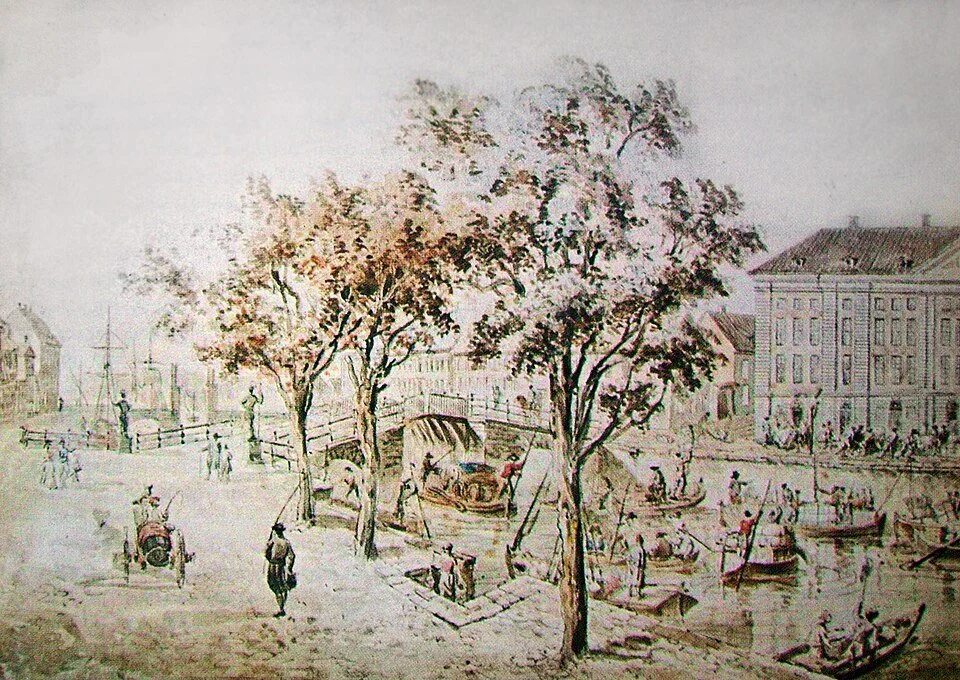
Gothenburg c. 1787, with the Swedish East India Company building to the right by Elias Martin. Source: Public domain, Svenska turistföreningens årsskrift 1978, available here.
The Swedish Kingdom
The Kingdom of Sweden was a major power and leader in Northern Europe, having a rich history and culture going back over five thousand years, from the first settlers in the region to the sailing adventures of the Vikings across the continent. Those Vikings sailed eastward, unlike the Danes and Norwegian Vikings, with Sweden establishing vast trading networks through Eastern Europe, the Baltic Sea and the Black Sea. Post 1100s, Sweden went from fractured Viking tribes into a unified kingdom, with Sweden being considered the last Scandinavian country to be Christianized. This period saw the century-long Kalmar Union until 1523, when Sweden was united with Denmark under Queen Margaret I to counter the influence of the Holy Roman Empire. This union lasted for just over a century before falling apart when Gustav Vasa became king of Sweden, re-establishing the independent kingdom and breaking away from the Catholic Church.
The fall of the Kalmar Union saw the rise of Sweden as a great power in Europe all the way to the 19th century, with it, at its peak, being the third largest nation on the continent behind Spain and Russia. The main reason that Sweden was considered a great power at the time was due to its successful military innovations, campaigns and political influence. The coming of the 15th century saw Europeans sailing to the New World to obtain trade, influence, territory and resources, with Spain and Portugal initiating this. This colonialism was swiftly followed by the British, Dutch and the French following in their steps and establishing colonies all over the world in Asia, Africa and the Americas. Sweden was one of the many lesser-known tales in European colonialism, as most of their colonies were either small or very short-lived, but nevertheless, a fascinating chapter in Sweden's overall history and other colonial histories as well. As for the question, why? Sweden sought to have a foothold in global trade to boost its economy and prestige, with interest in the fur, tobacco and sugar trades.
American Colonies
New Sweden
New Sweden was the only Swedish colony on the North American mainland, being situated on the Delaware River in what is now the States of Delaware, New Jersey and Pennsylvania. It was established in 1683 by the New Swedish Company and former and renegade Dutch governor Peter Minuit, who sent an expedition up the Delaware River and purchased land from the locals, constructing Fort Christina. The main goal of the colony was for Sweden's expansion in the tobacco and fur trade, as well as bypassing the French, English and Dutch. In the following years, the colony was built up and expanded, with the colony having a small population of less than a thousand comprising Estonians, Danes, Germans, Finns, Swedes, and a few Dutch. Along the river were various forts, established over the course of the colony’s short history, along with many settlements that still exist today, such as Christina (Modern-day Wilmington), Upland (Modern-day Chester) and Finlandia (Modern-day Marcus Hook).
I mentioned that this colony had a short history. Well, the colony’s expansion soon brought it into heated competition with the neighboring Dutch colony of New Netherlands. In 1651, the Dutch established Fort Casimir on the west side of the Delaware River, south of Fort Christina, but this was captured by Swedish forces in 1654, leading the Dutch West India Company to decide to drive the Swedes out of the river. A year later, a Dutch military force sailed to New Sweden from the island of New Amsterdam in the New Netherlands colony and swiftly conquered the colony. Under Dutch control, the settlers were largely allowed to retain their lands, local customs, religion, and court despite now being a part of the New Netherlands colony. This changed in 1664 with the Second Anglo-Dutch War, where the English seized the Dutch colony in North America and incorporated it into the Thirteen Colonies.
Antillean possessions
In the 1730s, Sweden attempted to establish a colony in the Caribbean with an attempt at settling in Tobago. Sweden wasn’t the first European power to attempt to colonize the island, with the Dutch, English, Polish, and more trying as well. Sweden's attempt failed as the native tribes, and Tobago was eventually claimed by the British.
In 1784, Sweden would try to rejuvenate its slave trade when King Gustav III negotiated with France in an attempt to create a new alliance between the two nations. Gustav offered the city of Gothenburg as a trading post for the French, and France, under Louis XVI, would give Sweden the island of Saint-Barthélemy in the Caribbean. This was agreed with the Swedish colony being established in 1784, with the capital being renamed from La Carénage to Gustavia, and with the island's agricultural potential and tax-free status, which drove immense economic prosperity through trading, contraband, and slavery. In fact, a third of the island's population of 6,000 were registered slaves by the year 1819.
During the French Revolutionary Wars, the island colony came under British occupation until 1802 and the end of the conflict in France, with trade continuing to flourish with the United States and Britain, especially during the War of 1812. That same year, the colony was transferred from the Riksdag (Parliament) to King Charles XIII as a private possession.
The nation was also temporarily given the larger island of Guadeloupe by the French during the Napoleonic Wars for a year. With this island also being a private possession, this time to King Charles XIV John, and after a year, Guadeloupe was given back to the French by the signing of the Treaty of Paris in 1814. Post-Napoleonic Wars, Saint-Barthélemy suffered an epidemic and drought, and by the mid-1840s, the Parliament ruled that the island be administered nationally once again. In 1847, as a result of growing international pressure and abolitionist movements, Sweden signed treaties to halt the slave trade, with the slave trade being legally abolished that October. As a result of the abolition of slavery, the island's economy collapsed, and its geographical limitations and lack of natural resources made it increasingly difficult to sustain. In the 1870s, Sweden looked at potential buyers, with the United States and Italy being interested, but in 1878, the island was sold back to the French.
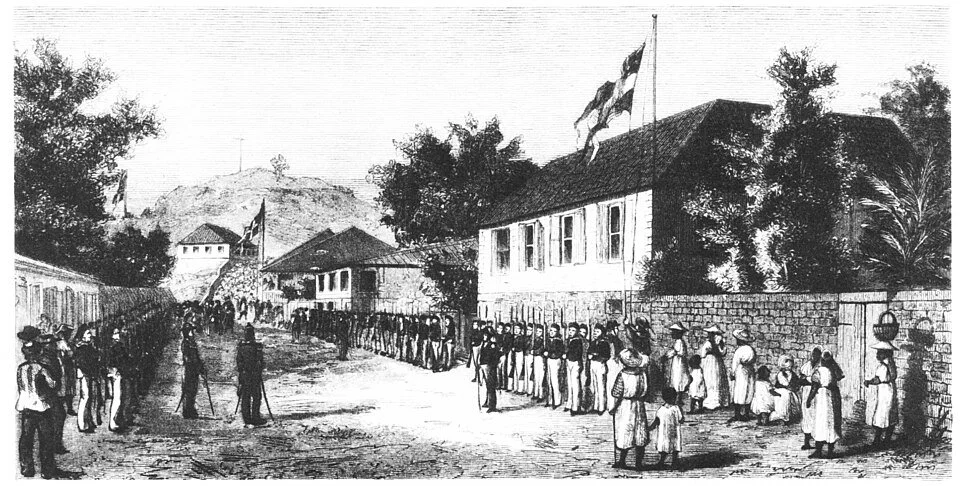
Saint Barthélemy - Ceremony when Sweden gave the island back to France in 1878. Source: Public domain, http://libris.kb.se/bib/13597237, available here.
African & Asian Colonies
Swedish Gold Coast
Moving on to Africa, we begin with the Swedish Gold Coast in what is now modern-day Ghana. The Swedish Gold Coast was established in 1650 by Hendrik Carloff, acting for the Swedish Africa Company, who purchased land in the region from the local Akan king, Futu. The colony itself was just a series of settlements and forts planted along the coast, with the main focus being on the slave trade, along with the trade of gold, ivory and timber. In 1656, to the annoyance of Carloff, a new governor was appointed, Johan Filip von Krusenstierna, causing Carloff to leave and then return in 1658 on a Danish vessel, which seized Fort Carlsborg and made it part of the Danish Gold Coast colony.
Back home, Swedish King Charles X Gustav used this event as one of his many reasons to go to war with Denmark-Norway in the Northern War of 1655–1660. During, unknown to the Swedes, Samuel Schmidt, an associate of Carloff, illegally sold the colony in April 1659 to the Dutch, then fled to Portuguese Angola, with the Swedes only discovering this after the war, when the land was meant to be given back to them from the Danes.
The Dutch withdrew and gave the lands back to the Swedish, who then had to deal with a local uprising, which was unsuccessful, but the colony came under the control of the Futu on behalf of the Swedish. The territories of the Swedish Gold Coast were then once again occupied by the Dutch in 1664, with Sweden officially relinquishing the colony in 1667 in the Treaty of Breda. The land was then divided and absorbed by the English, Dutch and Danish.
India & Madagascar
Next in Africa was a proposed colony in Madagascar. Between 1714 and 1728, Sweden tried to establish a colony on the island. This effort began when pirates on the island sought protection from Sweden, and in return, the kingdom would gain the island as a colony, and the pirates would provide them with a naval fleet to facilitate this arrangement. Initially, Sweden didn’t show any interest, so the pirates gave the same offer to Denmark, which also wasn’t interested, so they approached Sweden again, and this time the Swedes showed interest. Around New Year's Eve of 1717, negotiations began, which dragged all the way into the summer of 1718, ending with a signing that was never materialized, partly because of the death of King Charles XII. But Sweden wasn’t deterred from attempting to get the island, with one of the pirates being appointed governor during the early stages of King Fredrik I. In 1721, Sweden attempted to send an expedition to the island under the leadership of Carl Gustav Ulrich I, with the expedition making it to Spain when several problems (funding) caused the project to be cancelled. Thus, ending Sweden's attempt at occupying Madagascar.
Lastly was India. Inspired by the success of the Dutch and British East India Companies in Asia, the Swedish East India Company was founded in 1731 to conduct trade with the Far East. Two years after the company’s founding, a ship, “Ulrica Eleonora,” left Göteborg for India to seek business opportunities in the region. After negotiation with the locals, a factory was established at Porto Norvo (present-day Parangipettai). This threatened French and British interests in the area, and the two powers forged a rare alliance and successfully expelled the Swedes from India. The incident sparked a prolonged series of diplomatic disputes in Europe between the British, French, and Swedish crowns, which were ultimately settled around the 1740s. And the spat in India became known as the Affair of Porto Norvo.
Now, read Harrison’s article on the German colonial empire here.
Sources
- The Swedish Empire: A History from Beginning to End, Hourly History, 2021
- History of Saint Barthélemy, Georges Bourdin, 2012
- Swedes in America 1638-1938, Adolph B Benson, 1938
- The Baltic Story: A Thousand-Year History of Its Lands, Sea and Peoples, Caroline Boggis-Rolfe, 2020