The War of the Breton Succession, or Breton War of Succession (1341–1365), was a war over the succession to the dukes of Brittany, in north-western France, that lasted for over twenty years. The war was a major conflict in the long Hundred Years’ War, which drove both France and England into a fight for survival and a contest for supremacy in Western Europe. Talia Bega explains — and looks at what happened as the English kept winning – until they didn’t.

Part 1 on the origins of the war is here, and part 2 on the rise of the English is here, and part 3 on the rise of the English here, and part 4 on French Struggles Against the English at Crécy here.
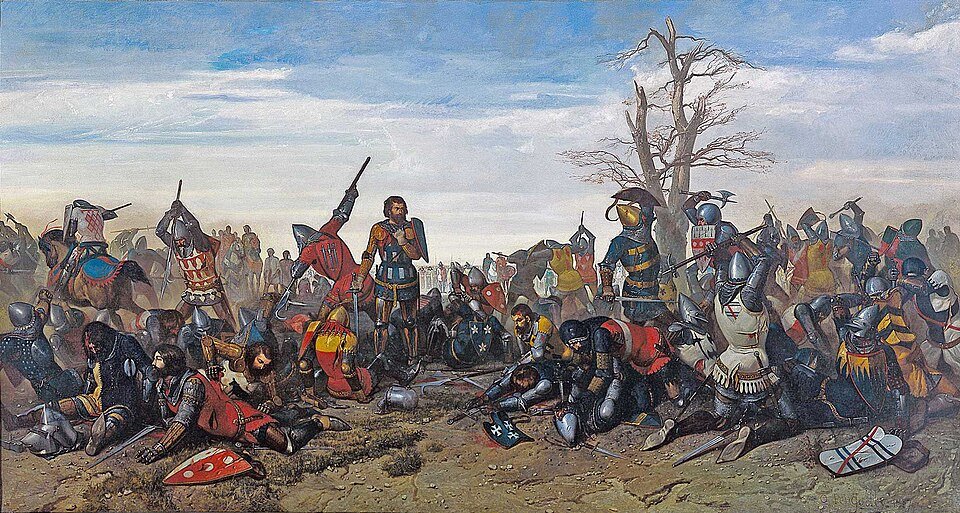
The Battle of the Thirty (1350). By Octave Penguilly L'Haridon. Source: Public domain, available here. 

The Failures at Crécy

In 1346, Edward successfully invaded France in a large-scale campaign known today as the Crécy Campaign. Edward saw it as a chance to press deeper into a France already reeling, striking further into its territories.  At first the campaign was risky for Edward: supplies ran short and morale was low. At the time, Charles of Blois was facing challenges as Edward was still sending in reinforcements to help strengthen the Montfort claim to the Duchy of Brittany.

Charles knew what Edward was about to do and had no choice but to face the fight.  Instead of a war for succession, it was now a fight for the survival of France. Philip VI, the first Valois king of France, saw much of the country fall apart. In 1337, he watched Edward lay claim to the French crown, and knew a reckoning between them was only a matter of time. A few years later, John III, Duke of Brittany, died, causing the War of the Breton Succession. Philip had a chance to win at first, but as the years dragged on, French morale collapsed.  He kept sending in as many men as he could, but the defeats kept coming.

Philip asked Charles for support to defeat Edward, but the risk was considerable. After the French defeat at Crécy, Charles lost hope, and a year later he was captured at La Roche-Derrien.


Charles vs the Hands of the English

In 1347, Charles had one more chance to lay siege to La Roche-Derrien and recapture it — but he was captured in the attempt. The battle showcased the power of the English longbowmen, whose arrows had an effective range of roughly 200m. Longbowmen would prove just as decisive nearly 70 years later at Agincourt. As at Crécy, the French besieging force heavily outnumbered the English relief force, yet still suffered the heavier losses.  The French were also backed by Genoese mercenaries, who remained a key part of their forces throughout the Hundred Years’ War. Despite their numbers, the French seemed unable to learn from their repeated defeats. The battle also saw surprise attacks on Charles’ forces by townsfolk armed with axes and swords, who harried his men and the longbowmen alike.

Charles thought he had won after his initial charge succeeded, but the English rallied and turned the battle against him. Charles was taken prisoner — another decisive victory for the English. With Charles gone, Philip’s support in Brittany had collapsed, and the English were closer than ever to securing their claim.

Charles was then held in the Tower of London for years, and little is known for certain about the conditions of his imprisonment. At the time, the Tower served as a central political prison, a royal residence, and a site for coronation ceremonies. The French pope, Innocent VI, was alarmed by the conflict and pressed for a peace treaty.  It allowed both factions to hold part of the territory and maintain an uneasy peace.


At Last Victory

At this time came one of the most famous episodes of medieval chivalry: in 1351, the Combat of the Thirty.  It came to represent the very peak of knighthood and honor. Both sides had thirty knights each, and the French were led by Marshal of Brittany, Jean de Beaumanoir, and for the English, Robert Bemborough. It was part duel, part military exercise — not simply a show for entertainment. The arrangements were straightforward: Jean challenged Robert to a fight, and both men accepted.

The fight itself lasted only a few hours, with four French knights and two English dead by the time of a short break. Bemborough was killed soon after, followed by several more of his knights. The English were surrounded and defeated, securing a French victory that underscored the era’s ideals of chivalry. The casualties were nine dead for the English vs six for the French. Unlike a typical battle of the period, it was remembered above all as a display of chivalric ideals. Chroniclers such as Jean Froissart cited the encounter as an example of chivalry itself.

Though the Combat of the Thirty had little effect on the war itself, Edward signed the Treaty of Westminster in 1353, formally recognizing Charles as the rightful Duke of Brittany — though this recognition proved short-lived. If Charles could pay a large ransom and forge an alliance with England, the arrangement would hold. Edward also wanted the young John of Montfort to marry his daughter Mary, though this required approval from both the Papacy and France. Amid the struggles, the treaty was never enacted, and Charles was freed and returned as the rightful duke.

This moment in history raises many questions, but it also offers lessons. Edward was now in his early forties and physically weakening, but his mind remained fixed on the prize. The English enjoyed strong support on both sides of the Channel, which helps explain Edward’s deep investment in the treaty. Charles became a political pawn after his capture — and so, in a sense, did France, which faced its own struggle for power.

How could France decide its own fate now? With Charles restored to his rightful duchy, peace settled over Brittany — but not for long. Ten years later, a new claim to the duchy would rise, asking the same question all over again.


A reminder that Part 1 on the origins of the war is here.


Bibliography

GRAHAM-GOERING, E. (2021). Princely power in late medieval France: Jeanne de Penthievre and the war for Brittany. CAMBRIDGE UNIV PRESS.

Sumption, J. (1991). The Hundred Years' War. University of Pennsylvania Press.
The War of the Breton Succession, or Breton War of Succession (1341–1365), was a war over the succession to the dukes of Brittany, in north-western France, that lasted for over twenty years. The war was a major conflict in the long Hundred Years’ War, which drove both France and England into a fight for survival and a contest for supremacy in Western Europe. Talia Bega explains — and look at French struggles in Crécy.

Part 1 on the origins of the war is here, and part 2 on the rise of the English is here, and part 3 on the rise of the English here.

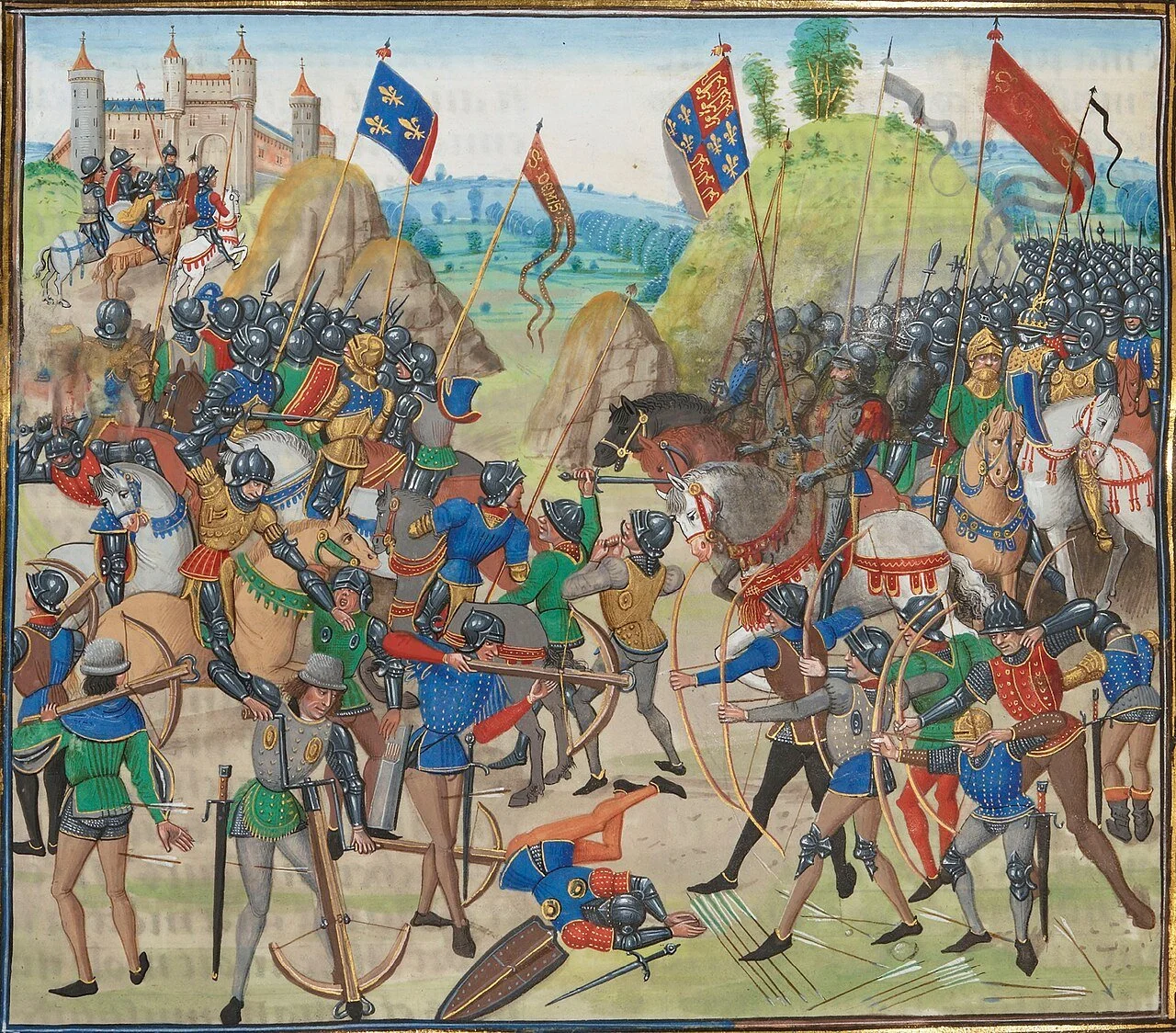
Battle of Crécy. From an illuminated manuscript of Jean Froissart's Chronicles. Source: Public domain, available here.

A Lost Tide

The effects of the Truce of Malestroit challenged the French about whether the world really supported the English cause in France. Signed on January 19, 1343, the truce paused the war until September 1346 and allowed the English to make gains in France, as the treaty was signed in favor of the English. The monarchs did not meet in person as the treaty itself was signed by the Papal legates who mediated between the two crowns. However, the truce did not last long as Edward III was planning something larger, what would become known as the Crécy campaign.  Edward also saw that after John, the Duke of Montfort, was released, Charles fought on, which angered Edward further.

In 1344, Charles led a siege in the town of Quimper, in south-western Brittany, which fell shortly after a one-month siege. An estimated 2,000 citizens were killed, and a few hundred English prisoners were captured. John, even though he was in his late 40s, had lost the drive he once had, and fled to England. Edward saw this as a chance to break the truce and sent a large force into Brittany with John to check Charles’ advance.  The forces were also led by the Earl of Northampton, who helped John get a victory in Central Brittany that defeated Charles of Blois at Cadoret.

Charles and John were locked in another back-and-forth, with John now looking as though he might be the rightful heir after all.  As king, Edward had to raise heavy taxes to fund these campaigns, but this tax raise was largely deferred, since he was already struggling with mounting debt.  John tried to recapture Quimper, but died shortly after in September, ending his long struggle for the duchy.

His death shocked many, since he had been the central figure in the dispute, and it plunged the conflict into fresh chaos. Charles now held the upper hand as duke, but the English were far from finished.  This also helps explain why Edward broke off the truce: he could see that John was already losing. Crucially, the war had now become a land campaign, with Edward using Breton territory as a springboard to invade France on a far larger scale. He understood the stakes: at heart this remained a succession crisis, not merely another campaign.

The new heir was the 6-year-old John, and his family could only wait for the right moment to intervene and weigh what best served them. Edward’s Gascon campaign would continue to ravage France and inflict humiliating losses on the French leadership. Brittany descended into chaos as English forces used the sea lanes to bring in supplies as fast as ever, sustaining their large-scale offensives in the Gascon region. 


The Crécy Campaign

After the fighting resumed in 1345, Edward wanted far more, sensing that a decisive victory was within reach. The truce was meant to last until 1346, but neither side honored it, least of all Edward. It would prove one of the most humiliating defeats the French suffered on their own soil. The brutal campaign saw Edward overrun much of northern France, bringing him a step closer to Paris.

The campaign began with an invasion of Normandy in the summer of 1346, designed to lay waste to the countryside. It came a year after Edward’s victorious Gascon campaign, which had inflicted a heavy defeat on the French in their own lands. For France, Philip VI had to borrow heavily from the papacy to keep France from falling to the English. Edward, by contrast, won strong backing from Parliament, which approved the invasion and the taxes needed to fund it.

The French again employed Italian mercenaries, especially Genoese crossbowmen, while the English drew support from the Flemish and the Holy Roman Empire.  The French suffered a humiliating defeat at Caen, but English casualties were also beginning to mount. One problem for Edward during this campaign was not only these losses but also supply, which grew into a serious difficulty for an army of such size. The French also shrewdly denied the English supplies, making it harder for them to advance. 

One of the most famous battles was at Crécy, which resulted in heavy French losses. It was also the battle in which the sixteen-year-old Edward, the Black Prince, won his first victory. The fighting was grueling, with both sides locked in a hard struggle until the French were broken. Casualties were heavy: the French lost many thousands, while the English lost only a few hundred. It was a humiliation: the French had the larger army yet were routed, raising hard questions about their leadership. In 1347, after a brutal siege, Calais fell to the English, who held it until 1558. With everything collapsing around them, the French even turned to Scotland, England’s old enemy, for support. That hope collapsed when the Scottish king was captured by the English at Neville’s Cross.

The campaign was a deep embarrassment for France — not only because so large an army had been defeated, but because of how that defeat came about, especially against an English force that seemed to have a clear plan. Edward was well prepared and widely supported; the French, by contrast, were in disarray, already stretched by the war in Brittany. How could France lose, even under Philip’s hands, having lost so much support, even from his own court? Despite these failures, the Truce of Calais was signed in 1347, halting the war for some time, helped in part by the Black Death that struck around 1348. The truce held for some time, surviving the death of Philip in 1350 and the accession of his son as John II.


What Now?

The Crécy campaign is closely bound up with the Breton War of Succession, since both formed part of the wider Hundred Years’ War. France’s defeats shaped much of Brittany’s future, especially now that Edward controlled so much of this territory. Many questions about the campaign remain, but much of the outcome can be put down to France’s financial crisis, poor morale, and weak planning. Charles faced a mounting problem, especially after Crécy: how could he hold on if England held all the cards?


Now read part 45on how the French started to turn the tide (somewhat) here.


Bibliography

GRAHAM-GOERING, E. (2021). Princely power in late medieval France: Jeanne de Penthievre and the war for Brittany. CAMBRIDGE UNIV PRESS.

Sumption, J. (1991). The Hundred Years' War. University of Pennsylvania Press.
The War of the Breton Succession or the Breton War of Succession (1341–1365) was a war over the succession of the Dukes of Brittany, north-western France, that lasted for over twenty years. The war was a major conflict in the long Hundred Years’ War, which drove both France and England into a fight for survival and a contest for supremacy in Western Europe. Talia Bega explains - and here looks at the rise of the English.

Part 1 on the origins of the war is here.

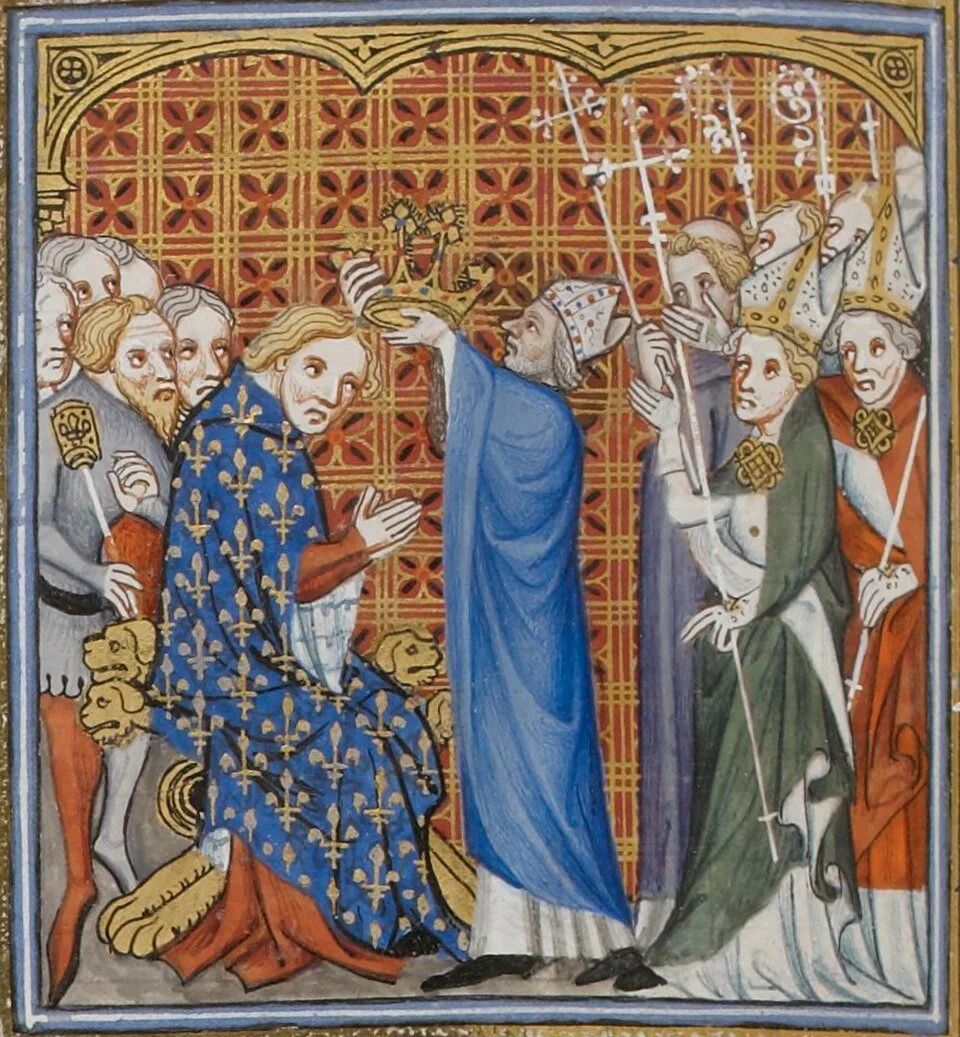
A depiction of the coronation of Philip VI of France.

1341, the Year that Changed Everything

The Hundred Years’ War (1337–1453) was waged by Edward III of England, who pressed his claim to the throne of France after the death of his uncle Charles IV in 1328, the last direct Capetian. The English fought to recover and expand the territories their Angevin predecessors had held in France in the twelfth century. The war brought bloody campaigns on multiple fronts and devastated large parts of the French countryside. However, it was not just about the French throne; it also intersected with internal conflicts in France. In 1341, John III, Duke of Brittany (1286–1341), died, leaving a crisis over who would succeed him. This was not just a problem of succession but a source of wider chaos, especially for France and England during the Hundred Years’ War.

The dukes of Brittany were important in French politics, serving as a basis for stability in the French realm. After John's death, there was widespread anxiety over who should become the next duke. Two candidates emerged, each backed by one of the rival kingdoms. On the French side stood Charles of Blois, who had married the late duke’s niece, Joan of Penthièvre. Joan was the daughter of the late duke’s younger full brother, Guy, Count of Penthièvre, making him one of the most plausible heirs. But this was not the only option. Whenever a dispute opened up in France, the English were rarely far away. The English backed John of Montfort, the late duke’s younger half-brother, born of their father Arthur II’s second marriage to Yolande de Dreux. Both sides knew where their candidate stood; what remained was to see whose claim could prevail.


A Truce that Turns the Tide

France and England were at peace with the Truce of Espléchin, which had been signed in 1340 and ran until the summer of 1341. The truce followed the failed English siege of Tournai, after which Pope Benedict XII asked Edward’s mother-in-law, Jeanne of Valois (who was also Philip VI’s sister), to mediate. The English would not attack France for nine months over the period. It was soon overtaken by events in the Breton War of Succession.  

The treaty allowed both sides to gather numerous troops and to rethink a new plan, especially as France faced a challenge from its own people to an increase in debt after constant battles with the English.  After the death of the Duke of Brittany, the violation of the treaty occurred as the English came to support John of Montfort. However, at the time, many of the nobility supported Charles, causing a wide division. Even though John had arguably the stronger legal claim, the French king, Philip VI, preferred Charles, who was well known and well-connected among the French aristocracy. John saw that the matter would not resolve itself in his favor, and he made other plans. Encouraged by his wife, he moved on the capital of the duchy, Nantes, after the funeral of the late duke, and took control of the treasury.

John’s aim was to seize as much of the duchy as possible and force the king of France to confirm him as duke. He pressed on to Rennes and took it without serious opposition. Still, his position had weaknesses: much of his support came from the lower classes and the towns, while most of the nobility continued to favor Charles. By the end of 1341, much of eastern Brittany was in John’s hands, bringing him closer to the ducal title. He also had the backing of Edward III, who pursued his own claim to the French throne. With Edward behind John and Philip behind Charles, any prospect of a negotiated settlement was vanishingly small.


A Spark of a New War

In September 1341, the French Court of Peers at Conflans, summoned by Philip VI, ruled in favor of Charles, with John of Montfort called as a witness. On September 7, Charles was formally recognized as the new duke. As Charles took up his duchy, he faced military pressure from several directions, and the situation in Brittany remained volatile. Philip also wanted to absorb the duchy into the French royal domain as a province, although the terms of the recent truce restricted what he could do openly. Edward, for his part, was furious that events were running against him and decided to resume the war. He saw Brittany as a useful foothold for English forces, and a Montfort duke would strengthen the English position in France.

Aware of the growing English threat, Charles secured the king’s help and a force of more than 7,000 troops was dispatched to defend the duchy against any invasion or siege. It was led by the future king of France, John, Duke of Normandy. Montfort saw the large army approach and rallied whatever fighters he could muster. Heavily outnumbered, his forces were defeated, and the French took Champtoceaux. John had no choice but to retreat to Nantes, where he soon surrendered to the duke of Normandy after a long blockade during which the French broke into the town. Philip had John escorted back to Paris and once again pressed him to drop his claim. What Philip did not know was that John’s wife was already working to bring English forces across the Channel and widen the war.

The west of Brittany still held out for the Montfort cause, but with John captive, time was running short. This was not only a struggle for power, but also a contest of wills between two powerful realms. John’s wife, Joanna of Flanders, fought hard to keep her husband’s claim alive. So too did Charles’ wife, Joan of Penthièvre — a rivalry that gave the conflict its other name, the War of the Two Joans. These events have rarely received the attention they deserve, yet they reveal how local successions could feed into the larger Anglo-French struggle, with the outcome only settled more than twenty years later.


A reminder that Part 1 on the origins of the war is here.


References

GRAHAM-GOERING, E. (2021). Princely power in late medieval France: Jeanne de Penthievre and the war for Brittany. CAMBRIDGE UNIV PRESS.

Sumption, J. (1991). The Hundred Years War. University of Pennsylvania Press.
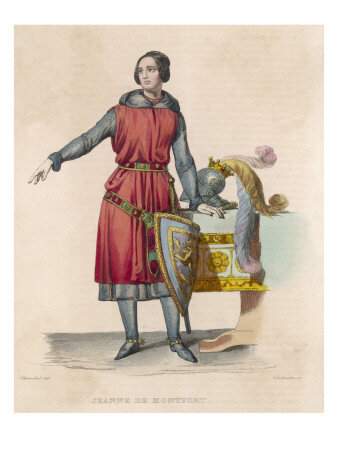
Jeanne de Clisson’s husband was killed following a sham trial in 1343; however, this betrayal by the French nobility led Jeanne to take extraordinary action. Here, Tom Daly explains how her lust for revenge led her to become one of history’s most famous female pirates.

You can also read Tom’s article on the Princess Alice Disaster on London’s River Thames here.

The Lioness of Brittany, Jeanne de Clisson.

The Lioness of Brittany, Jeanne de Clisson.

On August 2nd, 1343, a large crowd gathered at Les Halles, a market place in Paris, to witness a gruesome sight. Several men who were suspected of plotting with the English to fight against the French king were being executed, following sham trials in which the verdict was never in doubt. Among the men was the handsome and charismatic nobleman Olivier de Clisson, who had fought for years to defend the northern region of Brittany from the English and who adamantly protested his innocence until his very last moment. His protests were ignored by those who mattered, and his last glimpse of this earth was a sneering group of nobles who had gathered in the summer sun to watch his beheading. 

De Clisson was gone, but the threat from his family lived on. Within days, news of his trial and execution reached his wife, Jeanne. Theirs had been a happy marriage and the distraught Jeanne turned her anguish into rage, swearing vengeance on any allies of the French king. For the next few years, she would stalk the English channel with a small pirate fleet and ruthlessly attack any French vessels she came across, personally beheading any noblemen she caught but always leaving a handful of survivors to flee and tell their horrifying tale. Fierce, determined and skilful, Jeanne de Clisson struck fear into the very heart of the French establishment, and even managed to retire peacefully after she felt she had achieved her revenge. History has a few examples of successful female pirates but most of them came from desperately poor backgrounds and fought their way up, motivated by wealth and glamour. Jeanne de Clisson, a woman of noble birth, was motivated purely by revenge and bloodlust. It made her a very dangerous woman indeed.


Background

Jeanne was born into a wealthy noble family in northern France in around 1300. When she was 12 she married her first husband, with whom she would have two children, but it was her second marriage in which she would find most happiness. After the death of her first husband, Jeanne married Olivier de Clisson, a nobleman from Brittany, in northern France. Theirs was an arranged marriage but Jeanne and Olivier did genuinely love each other, and they had five children together. Olivier was a dashing warrior who fought bravely to repel the regular attacks from the English, who often sailed across the English Channel and attempted to gain a foothold in France. 

Olivier was loyal to the French king, Philip VI, but at the start of the 1340s a combination of panic and political manoeuvring saw his loyalty questioned. After a few French defeats fingers started to be pointed and blame started to shift around, and Charles de Bois, a powerful nobleman who had the ear of the King Philip, saw an opportunity to take control of Olivier de Clisson’s lands in Brittany. So it was that in 1343 Philip took de Bois’ advice and had de Clisson arrested for treason. A sham trial was held in Paris and de Clisson, along with a handful of other nobles who had the misfortune of being blamed for France’s recent defeats, found himself having a date with the king’s swordsman on August 2nd.


Jeanne’s revenge

News reached Jeanne a few days later, and she was devastated. However, within a week her anguish had turned to rage and she decided to channel her anger into something productive – she would have revenge on King Philip and Charles de Bois. As told by Joanna Gillan, Jeanne swiftly sold off her and her husband’s lands and used the money to purchase a small fleet of ships, manned by mercenary seaman and fighters. To add to the terror she intended to inflict on her victims, she painted her ships black and installed blood red sails, earning her fleet the title of ‘the black fleet.’ She then set off into the English Channel, and waited for her prey. 

Within weeks they had their first victims – the crew of a small French vessel sailing under the flag of the French king. The small ship stood no chance of either outrunning of outgunning Jeanne de Clisson’s fleet, and most of her crew were ruthlessly slaughtered, with Jeanne herself enthusiastically helping her men in their grim deed. As was to become her trademark, she spared the lives of a handful of the French crew and dropped them off in a small raft near the French coast, telling them to return home and tell their king who had butchered their colleagues. This they duly did, and so began Jeanne de Clisson’s reign of terror.

Before long, most of Europe knew who she was. Allying herself with the English, she pursued any French ships – even stopping ships flying under different flags to check that they were not transporting Frenchmen – and ordered the decapitation of any she found (with the exception, of course, of the lucky few she chose to allow to go home and tell the tale). She insisted that she personally behead any Frenchman of noble birth, as she perceived that it was the noble class who had abandoned her family and stitched up her husband (of course, she was mostly correct in this perception). She never did manage to get her hands on King Philip or Charles de Bois, but the carnage the ‘Lioness of Brittany’, as she became known, caused for the French government ensured that she achieved a degree of revenge. Her mission continued even after Philip’s death in 1350, as she continued to pursue French ships with unrelenting venom – her rage was fully focused on the entire French establishment rather than just the king.


Final years

Still, her vengeful marine crusade could not last forever. Maybe her rage subsided, maybe she was wary of losing the support of her men, or maybe she just fancied retiring. Whatever her reason, Jeanne decided she had done enough by 1356. Retiring initially to England, she married for a third time to an advisor to the English king, Edward III. By 1359 she was back in France, where she died peacefully that year. 

Jeanne de Clisson never did manage to kill King Philip or Charles de Bois (who died in 1364) as revenge for their role in her husband’s death. However, her pursuit of that revenge ensured that she caused untold damage to their causes and subjects, and further ensured that she earned a reputation as one of history’s most fearsome women. She was hero to some, a murderous wretch to others, perhaps somewhere in between the two for most, but ultimately as long as she was feared Jeanne de Clisson probably didn’t care what people thought about her. 


What do you think of the life of Jeanne de Clisson? Let us know below.

Now, read more from Tom at the Ministry of History here.