Aviatrix Mary Jayne Gold came from a prominent Chicago family. Under the Gestapo’s nose in Marseilles, she helped save thousands from Hitler’s concentration camps, all while carrying out a brazen l’affaire de guerre with a cutthroat French-American commando. Timothy M. Gay explains.
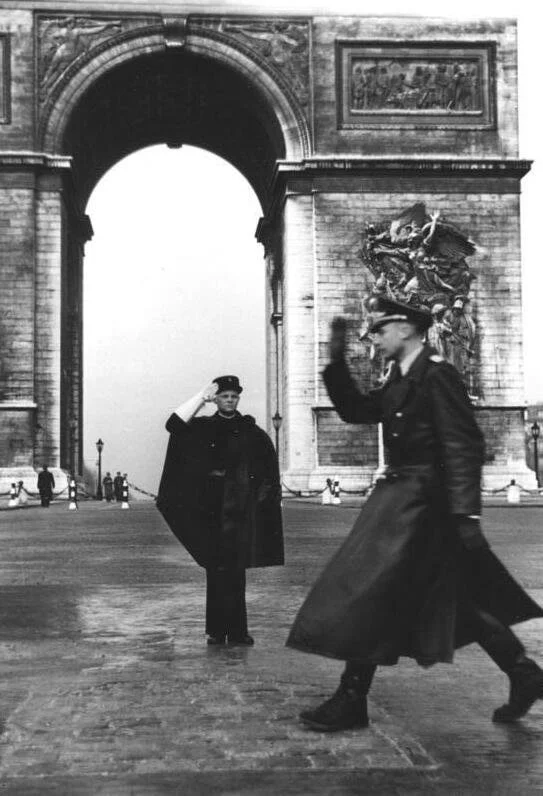
French gendarme and German officer in front of the Arc de Triomphe in Paris in 1941. Bundesarchiv, Bild 146-1978-053-30 / Jäger, Sepp / CC-BY-SA, available here.
I was not there to witness the worst, only the beginning, and even then, I was embarrassed into a sort of racialism – like being ashamed of belonging to the human race.
Mary Jayne Gold, Crossroads Marseilles 1940
Mary Jayne Gold was hurrying through Marseilles’ Place de la Préfecture, intent on renewing her Vichy-mandated foreign identity card, when a friend came barreling up from behind, bellowing her name. Her pal was panting as he delivered the bad news: local cops had just thrown Gold’s boyfriend and Resistance comrade into jail.
“Some bastard weaseled on him!” the messenger hissed, gulping for air. Then he volunteered that Mary Jayne’s beau had lied and told the authorities that he was engaged to be married. Having a wealthy and attractive American fiancée might help him soften up the police, her boyfriend clearly reckoned.
Gold, a 31-year-old heiress (who pretended to be much younger) from Chicago, had to move fast. People snatched by the Gestapo’s Vichy stooges tended to disappear in the hellscape that was the South of France in 1940. Marseilles was swarming with so many exiles, spies, and street sharpies that it inspired the ersatz “Casablanca” that took root on the back lot of Warner Brothers two years later. The city reeked of cheap perfume, human excrement, and backstabbing.
For weeks, the Evanston debutante turned European socialite and her colleagues in the Marseilles-based American Emergency Relief Center had managed to keep Adolf Hitler’s sycophants at bay. Even with plainclothes gendarmes hounding them, Gold and company had succeeded in slipping fake identities, food, cash, and escape-route maps to refugees desperate to flee the Third Reich. Most were Jewish. But there were Christians, Muslims, agnostics, and atheists seeking sanctuary from the Nazis, too, some with spouses and children in tow, their eyes wide with fear.
Such artists as Marc Chagall, other surrealist painters and sculptors, and writer-philosopher Hannah Arendt had been plotting their escapes through the rescue committee. The group was headed by American journalist and academic Varian Fry and underwritten by U.S. philanthropists and anti-Fascists.
Now Fry’s Scarlet Pimpernel operation, which hinged on a nascent Resistance ring that stretched across both sides of the Mediterranean, was imperiled by the arrest of Gold’s lover. He was sure to be interrogated; if tortured and broken, he could compromise the entire network.
Her paramour was a half-American, half-French hoodlum turned French Legionnaire named Raymond William Couraud. He was a slippery character with back-alley connections to the Riviera’s criminal underground. Certain mob leaders had, thanks to Gold’s pocketbook and Couraud’s slick machinations, switched allegiances from the Nazis to the Allies. The gangsters’ cooperation was proving crucial in sneaking people and things away from Vichy’s prying eyes.
Everything was on the line when Gold learned that Couraud was being charged with desertion and detained on suspicion that he was abetting the forbidden Resistance. As he was being marched to his jail cell, Couraud, who was just 20 (but pretended to be much older), had the presence of mind to insist that he be allowed to see his “fiancée.” The cops agreed to send a car to bring Gold to the station.
Mary Jayne had nicknamed Couraud “Killer,” not because of his (literal) cutthroat tendencies, but because of the way he mangled the English language. Weeks earlier, Killer had forged phony Legion discharge papers. One of the arresting officers had removed the papers from Couraud’s coat pocket and put them on a desk. Somehow, without being detected, the onetime pickpocket had snatched them back. If he’d been caught with fabricated discharge documents, he knew he would have faced a long prison term, possibly a firing squad, given his ties to crime chieftains and the hated Fry. That’s why he needed Gold to show up – and in a hurry.
Mary Jayne at that moment knew nothing of Killer’s sleight-of-hand but sensed what needed to be done. She ran back to her suite at the Hôtel Continental and changed into a demure beige dress, chose a diamond ring for her left ring finger, and applied just enough makeup and Chanel to cause a French detective’s head to turn. She glanced at herself in the mirror before going downstairs to climb into the Citroěn.
“I looked as if I had just come from a smart ladies’ luncheon,” she remembered four decades later. “I was just the kind of girl you hoped your son would marry: pretty, respectable, and rich.”
On the way to the station, Gold blithely chatted, en française, about her love for her “darling” fiancé, claiming that she couldn’t understand how he could be considered a deserter if France had already surrendered. She was hoping to butter up the cops, still fearful that they could turn nasty. Gold couldn’t help but think about the stories of people vanishing overnight while in Vichy or Gestapo custody.
When she and her two male friends arrived at what turned out to be a suspiciously makeshift jail, they discovered Killer standing in the middle of a room flanked by two detectives. He was flush-red, theatrically biting his lip and fighting back tears. Suddenly Killer burst toward Gold, begging, in French, for Mary Jayne not to forget about him.
“I was totally unprepared for this public display but, given the circumstance, I murmured softly, ‘Of course not, darling, mon pauvre cheri,’” Gold remembered. “Our bodies were close together, his back toward the policemen. He held me in this embrace and then I could feel his hand slipping between my thighs. This was no time to begin erotic games; I slid my hand down to play interference.”
She instantly felt the “faint crinkle” of papers touching her lingerie. A moment later he was kissing her neck, then whispering in her ear, “My fake discharge papers. Here, destroy them.”
As he sleuthed the crumpled paper into her hand, she stage-whispered, in French, “My love, my only joy, I will never abandon you.”
The Vichy officials were bemused and perhaps a bit aroused by the spectacle. “They understood these things in Marseilles: love and the flesh,” Gold wrote.
Now the challenge for Gold was how to dispose of the forgery. Once Killer was taken back to his cell, she asked for permission to use the restroom. She was chagrined to discover it was a “Turk” – a lavatory without individual commodes. Given the debris clogging the drain, she didn’t think torn-up paper would make it through.
Instead, she returned to the station’s main room and – when the cops were distracted – palmed the papers to her two pals, who happened to be Couraud’s fellow Legionnaires. Since they were American nationals, however, they weren’t considered deserters. The men’s lavatory was also a Turk, but the drain was less congested. They tore the paper into tiny pieces and watched them disappear.
Couraud would be incarcerated for the next four months, but thanks to a pile of francs that Gold slipped to a crony of the presiding judge, Raymond averted a lengthy sentence or an appointment with the executioner.
Mary Jayne Gold and Raymond William Couraud – rebels, spies, torrid lovers – had dodged another Axis bullet. For Couraud, it would be far from the last. He would go on to become one of the most heavily decorated Allied commandos of WWII, a saboteur who specialized in behind-enemy-lines bushwhacking and an assassin entrusted with directing one of the war’s biggest hush-hush operations, the attempted July 1944 kidnapping of German Field Marshall Erwin Rommel in Normandy.
Couraud was also a crook, a bigamist, a mercenary drummed out of Britain’s two leading special ops forces, and, at the end of the war, a soldier accused of collaborating with a suspected enemy agent. Like his wartime lover, his life unspooled as if it were a Saturday matinee thriller: one do-or-die cliffhanger moment after another, peppered with plenty of forbidden romance and a contempt for authority.
Did you find that piece interesting? If so, join us for free by clicking here.
About the Author
Timothy M. Gay is the author of two critically acclaimed books on World War II: Assignment to Hell: The War Against Nazi Germany with Correspondents Walter Cronkite, Andy Rooney, A.J. Liebling, Homer Bigart, and Hal Boyle(NAL/Penguin, 2012) and Savage Will: The Daring Escape of Americans Trapped Behind Nazi Lines (NAL/Penguin, 2013). Tom Brokaw called Assignment to Hell, which was nominated for a Pulitzer, a Bancroft, and an American Book Award, “a book every modern journalist – and citizen – should read.” Historian Marcus Brotherton wrote that Savage Will was “powerful, intriguing, well-researched, and fierce.”
Gay’s lengthy article on the citizen response to the Nazi U-boat threat in U.S. waters early in WWII was featured in a pandemic-inspired special issue of American Heritage called “America in Crisis.”
He has been featured on PBS’ “History Detectives” and contributed on-camera and off- to two documentaries – one on Walter Cronkite’s coverage of the Kennedy assassination, the other on Lyndon Johnson’s legacy on civil rights – which have appeared in Britain and the U.S.
His latest book is RORY LAND, a biography of golf superstar Rory McIlroy. It looks at McIlroy’s life through the prism of Ireland’s sectarian Troubles that devastated both sides of his family.