
During the Cold War, the United States and the Soviet Union competed to spread their influence and ideologies. During the 3rd century BC, there was a similar power struggle between an economic superpower and a military giant. The struggle was for control over the Mediterranean, which was during ancient times and still is today the highway for trade. Whoever controls the Mediterranean controls the flow of commerce. The world we see today would be so very different if Rome had lost this decisive engagement.
The Punic Wars were a clash of the giants. Rome and Carthage were the superpowers of the Mediterranean during the 3rd century BC. The term “Punic” is derived from the Latin word “Punicus”, meaning “Phoenician” in reference to the Carthaginian ancestry. Carthage was a wealthy naval power in the Mediterranean. Rome, on the other hand, was a new power eager to expand its borders and influence.
Sudhir Devapalan explains.
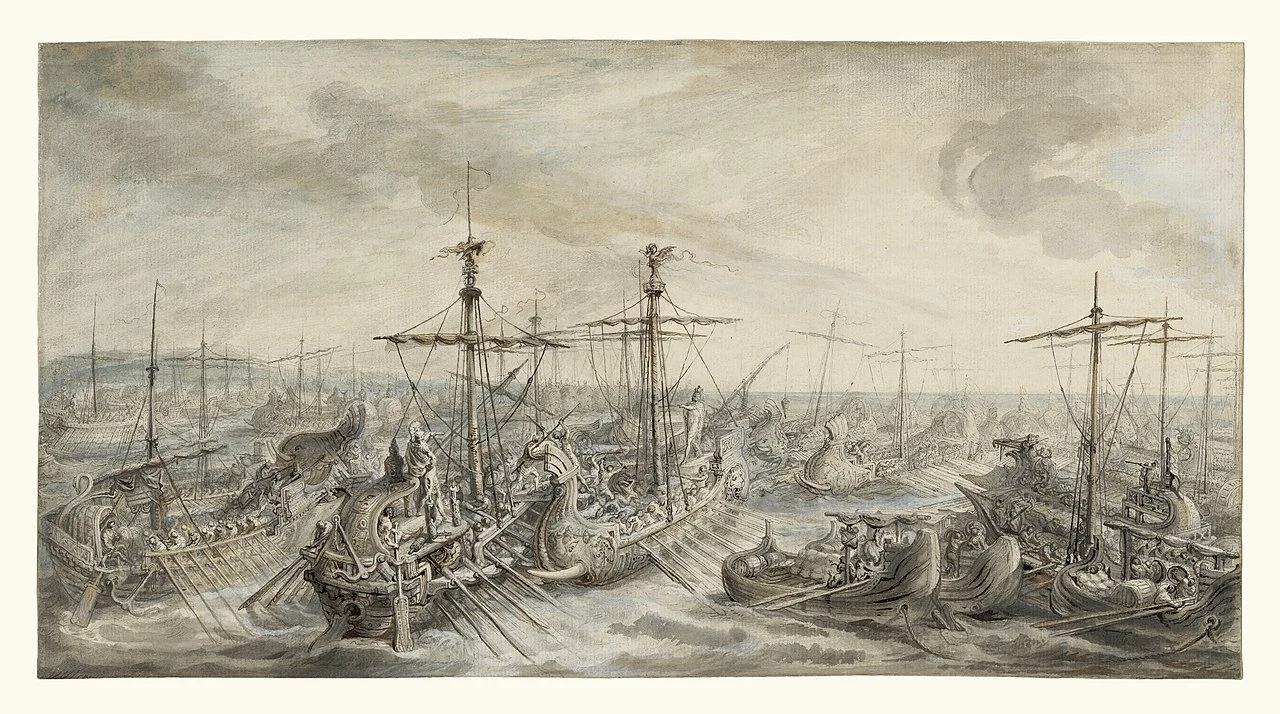
The Naval Battle Near Ecnomus (256 BC) by Gabriel de Saint-Aubin.
The Roman Empire During the Early 3rd Century BC
Rome was not an Empire at this time but rather a quickly expanding Republic. It was trying to exert its dominance on the Italian peninsula as well as the Mediterranean. Although Rome was strong and rapidly expanding, it was only a regional superpower, not a behemoth yet. They had a strong, professionally trained army, but they had no navy or experience in naval warfare, which restricted them to being a regional power. But this would soon change after the Punic Wars.
The Romans' idea of war was vastly different from the perception of the Carthaginians. For the Romans, wars had to be won despite the cost. Failures and losses were inevitable, but final victory was mandatory. They would never give up or surrender. They did not worry about the cost of war or whether it was not profitable for them. They were proud to fight in the army and gain glory through victory.
The Carthaginian Empire
Carthage was a major naval and commercial empire in the Mediterranean. It was centered around the city of Carthage, which was one of the largest and richest cities in the ancient world. Carthage’s strategic location gave it access to major maritime trade routes that brought in a lot of wealth through the trade of agricultural products and other manufactured goods. Carthage did not field citizen soldiers unless the city of Carthage was under threat, and they were not well-trained. Predominantly, Carthage relied on mercenaries to fight its battles.
The Carthaginians were more calculative towards the concept of war. They were traders, not conquerors. They would wage war if it would profit them, but would sue for peace the moment things didn’t go right. Huge losses were not acceptable or sustainable for the Empire. This lackluster approach to waging war would end up costing them the war, not once but twice.
The Casus Belli
The First Punic War was caused by a dispute over the control of the islands of Corsica and Sicily. These two islands were strategically important to exert control over the Mediterranean. In 264BC, the Mamertines, a band of mercenaries, were hired to protect the city of Messina in Sicily, but instead they massacred the population and took over the city. They were then besieged by Hieron II of Syracuse to liberate the city. Hieron II defeated them decisively in the Longanus River. The Mamertines, in desperation, called on the Romans as well as the Carthaginians for military aid. It was the Carthagians who arrived first and made a deal with Hieron. This, however, did not prevent the Romans from trying their luck. They eventually got a foothold on the city after the Carthaginians were forced to withdraw. This act of aggression started a war with Carthage.
The Battle of Agrigentum
The Battle of Agrigentum was the first major battle of the war. Carthage and Syracuse began a joint attack on Messana, but this was easily repelled by the Romans. In 263BC, the Romans mounted an attack on Syracuse and forced them to sue for peace and ally with them. They then laid siege to Carthage’s main base at Agrigentum. A large Carthaginian force was sent to lift the siege, but was soundly defeated by the Romans in the Battle of Agrigentum. The Carthaginians lost 3,000 infantry, 200 cavalry, and 8 elephants. However, during the siege, the Romans lost one-third of their army, losing 30,000 infantry and 540 cavalry. The Carthaginian army stuck inside the city also managed to escape by filling Roman trenches with straw. Although the Romans won and captured the city, it was not a complete success as most of the enemy had escaped unscathed.
After the battle, the Romans sacked the city and sold the entire population into slavery. This sort of brutality would be a common tactic used by the Romans. It, however, did not have the intended effect as most of the towns refused to ally with the Romans. Although this was not a big military victory due to the escape of the Carthaginian army, it was the first large-scale victory for the Romans outside of the Italian mainland. This boosted their confidence to expand their influence more in the Mediterranean.
The Battle of Akragas
Most of the battles between 264 and 256 BC were fought in Sicily, and due to its hilly and rugged terrain, this favored defense over offense. Most of the fighting was limited to sieges and small skirmishes due to the difficult terrain. Following the defection of Syracuse, many of the small Carthaginian cities in Sicily switched sides. Carthage then used Akragas, a port city, as its strategic center. In 262 BC, the Romans besieged Akragas. The Romans had supply issues due to Carthaginian naval superiority and resorted to foraging and harvesting crops in the area.
The Carthaginians, however, raised an army of 50,000 infantry, 6,000 cavalry, and 60 Elephants and sent them to Sicily under Hanno. He trained his army in Sicily for 2 months and on 261 BC attacked the Romans. The Carthaginians were soundly defeated in the battle, but the garrison troops managed to escape. The Romans then captured the city and sold the entire population of 25,000 inhabitants into slavery. The Romans won another victory in the Battle of Panormus in 250 BC. However, apart from these two victories, no other major battles were fought in Sicily. The Romans wanted to shift their focus to the navy and target mainland Carthage. To do this, they had to build their navy from scratch.
The Whale (Roman Army) and the Elephant (Carthaginian Navy)
The Romans were the masters on land and had a stronger, more disciplined army. Roman citizens were mandated to serve in the army and were well-trained. Most Roman citizens would serve as infantry, with a few wealthier citizens serving as cavalry. The Romans fielded a professional army year-round and were deadly in battle. They had helped Rome take control of the Italian peninsula and crush any external threats. The Carthaginians relied on mercenaries who were hired as and when needed. The Carthaginian navy, however, was undefeated at sea and a force to be reckoned with. The Quinquereme was the battleship of the ancient era, and the Phoenicians were experts in naval warfare.
The Romans were new to naval warfare and did not have a strong navy. They could defeat the Carthaginians on land, but at sea, they were vulnerable. This led to a stalemate with the Romans being stronger on land and the Carthaginians being stronger at sea. Neither could challenge the other in their own domain. The status quo would soon change with the invention of the Corvus.
Roman Ingenuity: the Corvus
The Romans initially lacked the technical expertise to build large warships like the Quinquereme. They then copied the designs of a captured Carthaginian ship and built their own navy. However, they were not expert sailors and not proficient in naval warfare like their adversaries. Naval tactics of the era included taking out the enemy ship’s oars or ramming the ships with skillful maneuvers. The Romans knew that they could not fight on equal footing with the Carthaginians in conventional naval warfare.
Therefore, they came up with an innovation that helped turn the tide of battle, the Corvus. The Corvus (“crow” in Latin) was a ship-mounted ramp or drawbridge. The ramp could swivel from side to side and had an iron hook at the end to latch onto enemy warships. Once latched on, the ramp was used by Roman legionnaires to board the enemy ship. Once the ship was boarded, the Romans used their strength in numbers (the Roman ships had far more soldiers) to overpower and capture the enemy ships. The Romans were able to win a string of naval victories thanks to this innovation.
The Corvus, however, was not without its weaknesses. The additional weight on the ship made it very unstable and hard to control. This meant that the ships were not as maneuverable as their Carthaginian counterparts. A skilled enemy crew could outmaneuver the ships due to their lack of control. Another major flaw was the ship’s stability in bad weather. This would be the reason for discontinuing its use in later years.
The Battle of Cape Ecnomus
The Battle of Cape Ecnomus was arguably one of the largest battles in ancient history, with a combined total of some 680 warships and 290,000 sailors and marines taking part in the battle. The Romans had about 330 ships, while the Carthaginians could muster 350 warships. The battle was fought off the coast of southern Sicily, with Rome coming off as the clear victor.
The Roman Quinqueremes were bulkier and slower than their Carthaginian counterparts and therefore less maneuverable. Due to the lack of expertise in naval warfare, the Romans were at a disadvantage. The Carthaginians, who had recently raised a larger navy, also did not have skilled seamen and were not as competent as they expected them to be. The Carthaginians hoped to use their superior sailing skills to decisively defeat the Romans. The Roman ships were initially rammed and sunk. On the other hand, the Romans were able to use the Corvus to board the enemy ships and capture or sink them. After a hard-fought battle, the Carthaginian center began to lose heart and fled. The Carthaginians lost 30 ships sunk and 64 captured, to Roman losses of 24 ships sunk. The Carthaginians also lost 30,000 to 40,000 men, mostly captured, to 10,000 Roman casualties.
Carthage Sues for Peace
After the Roman victory in the Battle of Cape Ecnomus, the Romans under Regulus landed in North Africa. The invasion went well initially, and in 255 BC, the Carthaginians sued for peace. The terms offered by Regulus were so harsh, however, that the Carthaginians refused to accept them and continued the fight. The Carthaginians were defeated again in the Battle of Cape Hermaeum and lost 114 ships. The Romans, on the other hand, were devastated by a storm and lost 384 ships and 100,000 men. The use of the Corvus made the Roman ships unstable in rough weather, which may have contributed to such heavy losses. The Corvus was never used again.
Rome Rebuilds Its Fleet Again
The war raged on with neither side gaining an advantage. The Carthaginians attacked and recaptured Akragas, but razed the city to the ground as they could not defend it. The Romans, on the other hand, rebuilt their navy, adding 220 more ships, but 150 of them were lost in a storm. The Romans slowly captured most of Sicily but were defeated by the Carthaginian navy at the Battle of Drepana in 249BC. Following up with their victory, the Carthaginians defeated the remaining Roman ships in the Battle of Phintias. The Romans had vast reserves of wealth to fund their war and a large pool of manpower to recruit from. This helped them stay afloat in the war despite their losses.
The Final Defeat
After several years of stalemate, the Romans rebuilt their fleet again in 243BC and blockaded the remaining Carthaginian garrisons in Sicily. The Carthaginians assembled a fleet to relieve them, but were defeated in the Battle of the Aegates Islands in 241 BC. The surrounding Carthaginian troops in Sicily were forced to sue for peace. As per the treaty signed, Carthage was forced to pay large reparations to Rome, and Sicily was annexed as a province of Rome. Rome rose as the dominant military power in the Mediterranean.
The key factors that led to the victory of Rome were the mentality of the Romans. Carthage would wage war if it was profitable. If the war became untenable, they would quickly sue for peace. However, defeat was not an option for the Romans. They would win no matter the cost, and they would never give up. The huge effort of building 1,000 warships laid the foundation for Rome’s dominance at sea for the next 600 years. This would not be the last time Rome and Carthage would face off against each other, and Hannibal Barca would bring the fight to the Roman heartland soon. Roman grit and conviction would be tested once more in the Second Punic War.
Did you find that piece interesting? If so, join us for free by clicking here.
References:
https://dcc.dickinson.edu/nepos-hannibal/first-punic-war
https://en.wikipedia.org/wiki/First_Punic_War