Among the many distinguished soldiers produced by the British Army in the twentieth century, few lives were as remarkable—or as unusual—as that of Philip Neame. An accomplished engineering officer, decorated combat leader in two world wars, and later a colonial governor, Neame occupies a unique place in British military history. He remains one of the very few recipients of the Victoria Cross ever to have been captured by the enemy. His life and career spanned some of the most turbulent decades of modern history, from the trench warfare of the First World War to the sweeping mechanized battles of the Second World War and finally into the complex post-war world of reconstruction and public service.
Terry Bailey explains.
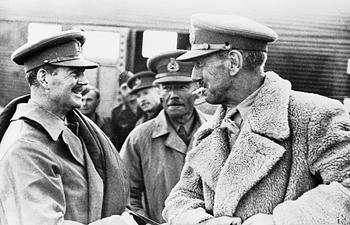
Shown here are Philip Neame (centre), Brigadier John Combe (left), and Major-General Michael Gambier-Parry (right) following their capture in North Africa.
Philip Neame was born on the 12th of September 1888 in London, England, into a family rooted in professional achievement and intellectual discipline. His father, Charles Neame, was a respected barrister, and the household environment emphasized education, responsibility, and public duty. As a boy Neame was educated at Cheltenham College, one of Britain's leading public schools, where he demonstrated particular ability in mathematics and engineering. These subjects would strongly influence the path he later chose in the army.
In 1907 Neame entered the prestigious Royal Military Academy Woolwich, the institution responsible for training officers for technically demanding branches such as the artillery and engineers. Upon graduating the following year he received his commission in the Royal Engineers. The Royal Engineers were responsible for a wide range of essential tasks, including fortifications, bridge construction, demolitions, reconnaissance, and communications. Officers in this corps were expected not only to possess physical courage but also technical competence and analytical skill. Neame's early career consisted largely of training, professional development, and routine engineering duties—experiences that prepared him well for the far greater challenges soon to come.
When the First World War erupted in August 1914, Neame was among the many young officers who found themselves rapidly deployed to the Western Front. The initial mobile phase of the war soon gave way to the entrenched stalemate that would define the conflict. Vast networks of trenches stretched across northern France and Belgium from the North Sea to the Swiss frontier. Breaking through these defenses required enormous artillery bombardments and carefully coordinated infantry assaults, supported by engineers who cleared obstacles, constructed positions, and carried out reconnaissance under fire.
Engineer officers frequently operated close to the front line, where they doubled their responsibilities by observing enemy positions and coordinating artillery fire. By 1915 Neame had become involved in this hazardous work, acting as a forward observation officer. Such duties required an officer to expose himself to enemy fire to accurately observe targets and direct artillery batteries located miles behind the lines.
It was during the Battle of Neuve Chapelle that Neame performed the extraordinary actions that would earn him Britain's highest decoration for bravery. The battle took place in March 1915 in northern France and represented one of the first major offensives launched by British forces during the war. The objective was to break through German defensive lines near the village of Neuve Chapelle and potentially open the way toward the strategically important Aubers Ridge.
The attack began with a powerful artillery bombardment designed to destroy German trenches and barbed wire defenses. In its early stages, the bombardment proved remarkably effective, allowing British infantry to achieve a significant breakthrough. However, the initial success quickly gave way to confusion. Communications between units broke down, German resistance stiffened, and reinforcing troops struggled to exploit the gap in the enemy's defenses.
On the 12th of March 1915, amid fierce fighting and intense machine-gun fire, Lieutenant Neame was attached to forward infantry units to observe enemy positions and direct artillery fire. Operating from an exposed observation point, he maintained visual contact with German defenses and transmitted corrections to British artillery batteries. This task demanded remarkable composure, as enemy fire constantly swept the area and communication equipment was primitive by modern standards.
As the battle intensified, British troops encountered a strongly defended German trench position that threatened to halt the advance. Recognizing the danger, Neame took decisive action. Gathering a small group of soldiers and armed with grenades, he personally led an assault on the enemy trench. Charging forward under heavy fire, he and his party overwhelmed the defenders, killing or driving out several of them and capturing others.
Even after being wounded during the attack, Neame refused to leave the battlefield. Instead, he continued moving along the line, encouraging troops and coordinating artillery fire while still exposed to enemy fire. His determination and leadership helped maintain momentum during a critical moment in the fighting.
The official citation for his award praised his "most conspicuous bravery," noting how he repeatedly exposed himself to intense fire while directing artillery and assisting infantry operations. By neutralizing the German position and maintaining effective observation of enemy defenses, Neame played a significant role in the temporary success achieved during the battle.
For these actions, he was awarded the Victoria Cross, the highest award for gallantry available to British and Commonwealth servicemen. The decoration recognized acts of exceptional courage performed in the face of the enemy, his conduct at Neuve Chapelle perfectly embodied the spirit of the award. Neame continued to serve with distinction throughout the remainder of the First World War. His leadership and professional ability earned him further recognition, including the Distinguished Service Order. By the end of the war in 1918 he had established himself as both a brave combat officer and a capable professional soldier with valuable operational experience.
The years between the wars saw the British Army attempt to adapt to a rapidly changing technological and strategic environment. Mechanization, improved communications, and the increasing role of air power forced military planners to rethink traditional methods of warfare. During this period Neame held a variety of staff and command positions that drew upon both his combat experience and his technical background as an engineer. He gained a reputation as a thoughtful and reliable officer, steadily rising through the ranks as the army modernized its structures and doctrine.
When the Second World War began, Neame was already a senior officer. By 1941 he had reached the rank of lieutenant-general and was given command of British and Commonwealth forces operating in Cyrenaica in North Africa. At that time the desert war was entering a dramatic new phase with the arrival of German forces under the dynamic leadership of Erwin Rommel.
Rommel's Afrika Korps launched a rapid and aggressive offensive that caught Allied forces off balance. The speed and scale of the German advance produced confusion along the front, forcing British and Commonwealth troops into a difficult withdrawal across the Libyan desert.
During this chaotic withdrawal in April 1941, Neame was travelling in a convoy with several other senior officers near the coastal town of Derna. In the fluid and rapidly collapsing front line, their vehicles unexpectedly encountered advancing German units. Surrounded and unable to escape, the group was captured.
The incident was extraordinary in military terms. It resulted in a serving lieutenant-general—who also happened to be a Victoria Cross recipient—becoming a prisoner of war. Neame spent the remainder of the war in German captivity, held in special prisoner-of-war camps reserved for senior Allied officers.
Life in these camps was restrictive but intellectually active. Senior officers organized lectures, discussions, and educational programs in an effort to maintain morale and discipline. Neame participated in this environment, helping sustain the professional spirit among prisoners who were determined to endure captivity with dignity.
When Germany surrendered in 1945, Neame was finally liberated after four years as a prisoner. He returned to Britain having experienced both the highest honor of military distinction and the hardships of imprisonment during wartime.
Following his retirement from the army, Neame entered a new phase of public service. In 1948 he was appointed Governor of Guernsey, becoming the Crown's representative on the island. The Channel Islands had endured German occupation during the war, and the post-war years required careful reconstruction of local institutions and infrastructure. Neame's leadership, discipline, and administrative experience proved invaluable in guiding the island through this period of recovery.
Over the course of his long life, he received numerous awards recognizing his service to the nation, including appointment as a Knight Commander of the Order of the British Empire and Companion of the Order of the Bath. Yet despite these distinctions and his high military rank, he was most often remembered for the extraordinary bravery he displayed as a young engineer officer during the desperate fighting on the Western Front. Lieutenant-General Sir Philip Neame died on the 28th of April 1978 at the age of eighty-nine. His life spanned the dramatic transformation of the British Empire and the upheavals of two world wars. Few soldiers experienced such a varied and remarkable career: a decorated hero of trench warfare, a senior commander in the desert war, a prisoner of war, and finally a respected public servant.
His story remains one of the most distinctive in British military history and evidence of courage, resilience, and a lifelong commitment to duty in the service of his country.
In conclusion, the life of Philip Neame offers a striking illustration of the many different forms that service and leadership can take across a lifetime shaped by war and responsibility. His career began in the technical world of military engineering, a profession that demanded precision, intellect, and calm judgment. Yet it was on the battlefield, under the intense pressure of combat, that Neame demonstrated the extraordinary personal courage that earned him the Victoria Cross. The actions he displayed at Neuve Chapelle were not merely a moment of bravery, but a reflection of character, an ability to act decisively and selflessly when circumstances were at their most dangerous and uncertain.
What makes Neame's story particularly compelling is the remarkable contrast between the various chapters of his career. In the First World War, he was a young officer exposed to the brutal realities of trench warfare, directing artillery fire and leading men in close combat under relentless enemy fire. By the time of the Second World War, he had risen to one of the most senior ranks in the British Army, entrusted with the command of major formations during a complex and rapidly evolving campaign in North Africa. That such a senior officer—and a holder of the empire's highest award for gallantry—should later spend years as a prisoner of war illustrates the unpredictable and often unforgiving nature of modern conflict.
Yet captivity did not diminish Neame's sense of duty or professionalism. Like many senior officers held in German prisoner-of-war camps, he helped maintain discipline, morale, and intellectual activity among fellow prisoners. These camps often became improvised centers of learning and discussion, where officers sought to preserve the values and traditions of their service despite the limitations of imprisonment. Neame's participation in this environment reflected the same quiet determination and resilience that had defined his earlier military career.
His post-war appointment as Governor of Guernsey represented another form of service, one that required administrative ability, patience, and diplomacy rather than battlefield leadership. The Channel Islands had endured the hardships of German occupation, and the process of recovery demanded careful guidance and stability. Neame's experience, integrity, and sense of responsibility made him well-suited to this task. In this role, he demonstrated that leadership forged in war could also be applied to rebuilding communities and restoring civil institutions.
Looking back across the decades of his life, Philip Neame's career forms a remarkable arc that mirrors many of the defining experiences of the twentieth century. He witnessed the transformation of warfare from the static trenches of the Western Front to the fast-moving mechanized campaigns of the desert war. He experienced both the triumph of heroic recognition and the hardship of long captivity. Finally, he devoted his later years to the quieter but equally important work of public administration and post-war recovery.
Few individuals embody so many contrasting experiences within a single lifetime. Soldier, engineer, commander, prisoner, and governor, Neame's life demonstrates the enduring values of courage, adaptability, and dedication to public service. More than half a century after his death, his story continues to stand as a reminder that true distinction in military history is not measured solely by rank or decoration, but by the consistency of character shown across every challenge that history presents.
The site has been offering a wide variety of high-quality, free history content since 2012. If you’d like to say ‘thank you’ and help us with site running costs, please consider donating here.
Notes:
Other notable VC holders who ended their conflict as prisoners:
Group Captain Gilbert Insall VC: He is noted as a unique case for having both won a Victoria Cross and successfully escaped from a German prisoner-of-war camp during the First World War.
Charles Hazlitt Upham VC & Bar: A New Zealand soldier who was awarded the Victoria Cross twice (the only combatant to do so) during the Second World War. He was wounded and captured by the Germans in July 1942 and was later sent to Colditz Castle prison, where he remained until his liberation in 1945.