
On March 25, 2021, the Modern Greek State celebrated the 200th anniversary of the War of Independence, which ultimately led to its establishment. It is thus an excellent opportunity to reconsider some of the main events of Greek history over these 200 years and how they shaped the character of modern Greece.
This series of articles on the history of modern Greece started when the country was celebrating the 200th anniversary of the War of Independence. This article looks at what happed from the late 1990s and the following decade – and how institutions lead to failure in Greece. Thomas P. Papageorgiou explains.
You can read part 1 on ‘a bad start’ 1827-1862 here, part 2 on ‘bankruptcy and defeat’ 1863-1897 here, part 3 on ‘glory days’ 1898-1913 here, part 4 on ‘Greeks divided’ 1914-22 here, part 5 on the issues of clientelism here, part 6 on World War2 and a new divide here, part 7 on the road to dictatorship and retreat here, and part 8 on the changing 1980s and 1990s here.
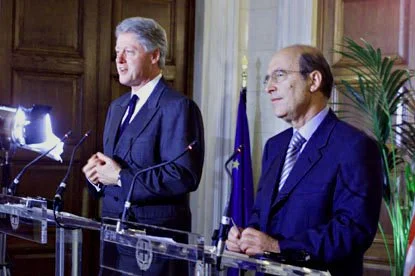
Costas Simitis, Greek Prime Minister from 1996 to 2004, with U.S. President Bill Clinton.
The central claim in this series of articles on the history of the modern Greek state is that at the core of its problems stand its political and economic institutions. I have often referred to the theory of Acemoglu and Robinson regarding extractive institutions and their effect on a nation’s growth and prosperity. (Acemoglu & Robinson, 2013) The period before the most recent economic crisis of Greece, starting in 2008, offers an excellent opportunity to present this claim in detail.
I Definitions
Institutions are defined as the rules of the game in society or otherwise as the organization of restrictions of human origin that define human relationships. (Petrakis, 2012, p. 157)
Different patterns of institutions today are deeply rooted in the past because once society gets organized in a particular way, this tends to persist. (Acemoglu & Robinson, 2013, p. 44)
The political institutions of a society are the rules that govern incentives in politics. They determine how the government is chosen, and which part of the government has the right to do what. Political institutions determine who has power in society and to what ends that power can be used. (Acemoglu & Robinson, 2013, p. 80)
If the distribution of power is narrow and unconstrained, then the political institutions are absolutist. Under absolutist political institutions those who can wield this power will be able to set up economic institutions to enrich themselves and augment their power at the expense of society. (Acemoglu & Robinson, 2013, p. 80) Thus, we call the latter extractive political institutions. The term exclusive has also been used in this series to point out the exclusion of the rest of the society from power.
In contrast, political institutions that distribute power broadly in society and subject it to constraints are pluralistic. Institutions that are not only pluralistic, but also sufficiently centralized to guarantee the rule of law and order, provide public services and encourage and regulate the economic activity are called inclusive political institutions. (Acemoglu & Robinson, 2013, pp. 80-81)
It is the political process that determines what economic institutions people live under, and it is the political institutions that determine how this process works. (Acemoglu & Robinson, 2013, p. 42)
Economic institutions can be described in terms of three main concepts: property rights, the quality of market functioning (i.e., good, moderate or poor) and contractual organization methods. There are two types of economic institutions: contracting institutions and property rights institutions. The first type of institutions facilitates the establishment of relations between lenders and borrowers, of which the financial system is the most typical example. The other type concerns the institutional structures that limit the imposition of the government and powerful oligarchies and their exploitation of the less powerful. These institutions protect property rights. (Petrakis, 2012, p. 157)
Inclusive economic institutions are those that allow and encourage participation by the great mass of people in economic activities that make best use of their talents and skills and that enable individuals to make the choices they wish. To be inclusive, economic institutions must feature secure private property, an unbiased system of law, and a provision of public services that provides a level playing field in which people can exchange and contract; it also must permit the entry of new businesses and allow people to choose their careers. (Acemoglu & Robinson, 2013, pp. 74-75)
We call institutions, which have opposite properties to those we call inclusive, extractive economic institutions (the term exclusive has also been used interchangeably with extractive in this series)-extractive because such institutions are designed to extract incomes and wealth from one subset of society to benefit a different subset (with the latter thus excluded from prosperity). (Acemoglu & Robinson, 2013, p. 76)
Extractive economic institutions naturally accompany extractive political institutions. (Acemoglu & Robinson, 2013, p. 81)
II Political institutions
The restoration of democratic institutions, the adoption of a new Constitutional Charter (1975), the smooth transition of governments (1981), the further deepening of democracy and the country’s accession to the European Union provided a stable system of political institutions, after the collapse of the dictatorship in 1974. In fact, this stability was unprecedented in Greek history, considering what we have seen in this series so far. (Petrakis, 2012, p. 194)
Stability was not accompanied by political pluralism though, as is evident in the country’s bipolar party system. On one pole are the two ‘power parties’, as we have seen, (Papageorgiou, 2025) PASOK and New Democracy (ND) alternating in positions of government and converging on similar ideological and political positions. On the other pole, we find the smaller, in terms of electoral influence, political parties, which do not affect the formation of governments and are characterized by divergent, clear, ideological and political positions. (Petrakis, 2012, pp. 195-196)
The reproduction of the dominant positions of the two ‘power parties’ is favored by the electoral system. Indeed, as we have also often seen in this series, adopted systems have complied with the rationale of a powerful government as a fundamental condition for a smooth and stable political life. (Petrakis, 2012, p. 196)
Nevertheless, the political power of the ‘power parties’ is mainly due to their connection to the state and the sequential distribution of economic resources. In fact, despite their initial theoretical differentiations, the two power parties consolidated their dominance through clientelism by managing the state resources towards which they are constantly oriented. Their gradually increasing influence and prevalence are not the result of clear ideological and political plans designed to express specific class and social interests but of their ability to handle public funds. (Petrakis, 2012, pp. 196-197)
The way of staffing the public sector is a characteristic example of this approach. It has already been discussed how the ‘power parties’ have used the public sector and public enterprises to ‘accommodate’ (hire) their ‘clients’. (Papageorgiou, 2025) By 2008, the number of civil servants was estimated to app. 1,250,000 (27.4% of the workforce) out of which 550,000 with fixed-term contracts (Petrakis, 2012, p. 205) in direct dependence from the government for their renewal. Data for the 2000 – 2004 period show that most of the civil servants were secondary or compulsory school graduates (app. 70%). (Petrakis, 2012, pp. 207-208) Their educational level is a critical variable affecting quality, which in turn is illustrated in the efficiency of the public sector. Indeed, financially, in the period 2002 -2008 the average general government expenditure as percentage of GDP was 45.2%, whereas the general government revenue was 40%, while the EU-27 average was 46.4% and 44.6% respectively. At the same time, the contribution of general government to GDP was 18.5%, close to the Mediterranean countries’ average, but significantly lower than the 25% of the more effective Northern European countries. (Petrakis, 2012, pp. 201-202) Public enterprises were not more efficient showing cumulative damages between 2005 and 2008 of more than 5.5 billion Euro. (Petrakis, 2012, p. 211)
The goal of political dominance for PASOK and ND was thus achieved in this way through clientelism. The system was in fact so effective that in the period 1981 – 2007 more than three quarters of the electorate supported both ‘power parties’. (Petrakis, 2012, p. 196) Thus, to the extent that their electoral influence depends primarily on the distribution of state resources and benefits, there is no strong reason to divert these resources to promote a particular political and economic direction. Their actions are directed mostly at balancing conflicting interests, rather than methodically planning and implementing reformatory plans, which involve costs for some social groups and thus political costs for the ‘power parties’ themselves. The reformatory plans, to the extent that these exist, represent the top of the party hierarchy rather than collective projects formed in conditions of political participation. The personalization of politics, which is enhanced by modern ‘telecracy’, culminates in the case of political leaders, who traditionally enjoy a hegemonic position within PASOK and ND. (Petrakis, 2012, p. 197)
In fact, a primacy of the executive power (government) was established, which creates significant institutional problems. The degradation of the parliament (legislative power) and weaknesses regarding the function of the justice system (cases of corruption or biased decisions) constitute an unbalanced institutional reality with significant effects on the equitable distribution of political power. (Petrakis, 2012, p. 195)
Indeed, the inability of the parliament to exercise substantial control over the executive power has dire consequences for political life, such as poorly designed legislation and, consequently, disrespect for the law. This is reflected in the general disregard for the members of parliament. They seem to merely ratify laws, some of which they admit they have not even studied, and they appear in parliament only when necessary (the phenomenon of empty seats). Paradoxically, political parties reinforce skepticism about the capacity of their members of parliament, especially in times of crisis, when they seek individuals outside parliament for important ministries. The role of the opposition in parliament is similarly extremely limited. David Close, in his book on the post-World War II period, notes that between 1974 and 1987, the percentage of laws proposed by opposition parties and approved by the parliament in Greece was only 0.1% (!) compared to 30.2% in Italy, 60.2% in Portugal, and 10.5% in Spain. (Close, 2006, p. 227) There has been no significant change since then.
The imbalance in the distribution of political power and its impact on decision making increases if the weak nature of the domestic ‘civil society’, the limited presence of truly independent administrative authorities and the partisanization of all institutional expressions of collective action (real syndicalism) are considered. In fact, considering the hegemonic position of the party leaders within PASOK and ND discussed above, the primacy of the executive power is summarized in a model of decision making centralized around the Prime Minister. (Petrakis, 2012, p. 195)
However, accession to party leadership and, following an electoral success, to premiership has often been a family business, as nepotism is ever-present in the Greek political scene. Costas Simitis succeeded Andreas Papandreou in the leadership of PASOK and premiership in 1996 (Papageorgiou, 2025) only to be replaced by the latter’s son Georgios in 2004. As we have seen, Georgios’ grandfather with the same name was also Prime Minister. The latter collaborated with Sofoklis Venizelos, the son of former Prime Minister Eleftherios Venizelos, who, in turn, also became Prime Minister. And if we go back to the foundation of the state, Harilaos Trikoupis, the son of Spiridon Trikoupis, the first Prime Minister of modern Greece, also become Prime Minister. Today’s Prime Minister Kyriakos Mitsotakis, coming from ND, is the son of former Prime Minister Konstantinos Mitsotakis, who was the arch-rival of Andreas Papandreou. (Papageorgiou, 2025)
In a nutshell, the convergence of the ‘power parties’ is characterized, among else, by the continuing weakening of the ideological and political character of the party, the eminence of the party leadership compared to the ordinary party members, nepotism, the development of links with specific interest groups, the party’s conversion into supporters of government policy and an ever-growing connection to the mass media to disseminate positive images, making it easier for them to win and maintain government authority. (Petrakis, 2012, p. 198) Indeed, the absence of distinct political plans that are promoted consistently by candidates and party staff results in the evaluation of candidates being connected predominantly to their ‘visibility’. The latter is effectively promoted by television and other mass media. (Petrakis, 2012, p. 197)
The above discussion indicates that political institutions in Greece are of poor quality. Organizations, like the World Bank, use indicators such as ‘voice accountability’ (the extent to which citizens of a country are involved in the government selection process and the degree of freedom of expression of the press and association), ‘political stability’, ‘government effectiveness’, ‘regulatory quality’, ‘rule of law’ and ‘control of corruption’ to measure the quality of institutions. Studying the evolution of Greece’s performance from 1996 to 2008, we observe that (except for the political stability index) the quality of all domestic political institutions progressively worsened. In fact, Greece’s position as regards the quality of political institutions in 2008 compared to other EU countries shows that Greece presented worse quality indicators for political institutions in relation to other countries. (Petrakis, 2012, pp. 199-200)
As already noted, the quality of political institutions has a significant impact on economic growth. Policies that channel the social product to groups with disproportionate political influence over others contribute to the devaluation of the political system. This effect annuls any efforts to reform the economy to allow it to adjust to the demands of international competition. The possibility of long-term growth is restricted. This vicious cycle is completed by the formulation of incentives for counterproductive and shadow economic activity as positive expectations are lacking. Economic institutions and human incentives will be the subject of the following sections.
III Economic institutions
As stated in Section I above, the political institutions determine the economic institutions people live under. Thus, the lack of pluralism discussed for political institutions is also evident for Greece’s economic institutions. Indeed, by applying the sectoral concentration ratio to data of companies operating in the Greek economy, we observe a high concentration in sectors of industry (tobacco, tobacco products, petroleum products and coal, liquified petroleum bottling, drinks, footwear), in the trade of minerals and ores, postal services, energy, telecommunications, entertainment (cinema, theaters), radio-television companies and the banking sector. (Petrakis, 2012, p. 168)
This oligopolistic concentration has serious implications on the economy. It may be related to the rising energy and fuel prices, which in turn affect prices in the Greek economy upwards. In the first quarter of 2006, for example, while the gasoline price in the EU-25 dropped, in Greece it rose by 5%. In Greece, two refineries control 100% of refining and market supply, thus imposing their own prices. The increase of their profits by 77% in the first quarter of 2008 and by 90% in the fourth quarter of 2007 is another example of the consequences of this oligopolistic structure. (Petrakis, 2012, pp. 169-170)
The banking sector – including alternative forms of financing such as factoring, leasing and mutual funds, investment trusts and real estate investment companies- presents also a high degree of concentration. (Petrakis, 2012, p. 178) This is important because the Greek economy is based almost exclusively on the intermediary function of the banking system and much less on the ‘invisible hand’ of the market. In fact, given the growth of the country (Leounakis & Sakellaris, 2014) in the period studied here, and before that, one would expect that the relative importance of the money market compared to the banking sector to increase. In reality, what happened was exactly the opposite. A study by the International Monetary Fund showed that the relative importance of money market transactions in the decade 1995-2004 increased in all of the examined economies, with the exception of Greece, where the role of the banking system to providing financing to the Greek economy was strengthened. (Petrakis, 2012, pp. 175,177)
On the other hand, economies that rely to a greater extent on the ‘invisible hand’ of the money market are better equipped to respond to major technological changes and adopt innovations. Typically, these economies are more dynamic and enjoy higher growth rates because of their ability to invest in more promising technologies and adopt innovations, often changing the structure of their productive activity. (Petrakis, 2012, p. 175) In fact, the inability of the Greek financial system to channel funds to the most dynamic part of the business sector was confirmed by a 2008 study of The Foundation for Economic & Industrial Research in which 30% of the prospective entrepreneurs responding highlight the difficulty of finding funding as one of the major problems when starting a new business venture (Petrakis, 2012, p. 179) (as startups, for example, usually lack the collaterals and guarantees usually required by banks for financing). This percentage is far higher than the values recorded for barriers to entrepreneurship such as bureaucracy and the amount of tax and social security contributions. (Petrakis, 2012, p. 161)
The difficulty of ensuring the proper financing of the private sector, especially for small and medium enterprises, forces businesses to look elsewhere for the necessary support. Therefore, friends and relatives of the prospective entrepreneur apart, it is not unlikely that a significant proportion of economic activity could depend on financing from funds derived from shadow activities – which include the production of goods and services, legal or illegal (e.g. drug trafficking), which escape detection and consequently are not calculated in the official Gross Domestic Product (GDP) (Petrakis, 2012, p. 58) – and thus feedback into the huge parallel economy. (Petrakis, 2012, p. 179) Indeed, as we have seen previously, the size of the shadow economy in 1987, when VAT was introduced in Greece, was estimated to 40% of the GDP, (Papageorgiou, 2025) whereas more modest estimations in 2008 reduce this number to 20.97%, which is still very significant. (Petrakis, 2012, p. 58) In fact, estimations of the size of the shadow economy in Greece and various OECD countries suggest that Greece has the largest shadow economy among the examined countries with its estimated size increasing over time. (Petrakis, 2012, p. 59)
Shadow economy results in the decrease of tax income – estimated at 4.9% of GDP in 2005 and 4.7% of GDP in 2008-limiting the government’s capacity to make public expenditures and deprives the insurance system of the resources that secure its viability. Data on the extent of contribution evasion are enlightening. It is estimated that the latter reached 3% of the GDP in 2005 and 2.8% in 2008. Consequently, the overall effect of fiscal needs should be calculated at 7-8% of GDP or 18 billion Euro. (Petrakis, 2012, p. 60) This decrease in revenues because of tax and contribution evasion causes an increase in the tax burden on the official economy. Indeed, the tax system in Greece is characterized by frequent restructuring and complicated transaction methods. The frequent changes (usually increases) of the tax rates for natural and legal persons are perhaps the simplest form of ‘expropriation’ of income rights. (Petrakis, 2012, p. 166)
The whole situation concerning property rights is even more problematic as indicated by the fact that in World Bank’s ‘Doing Business 2011’ Greece ranked amongst the ten countries with the most property vesting procedures. (Petrakis, 2012, p. 164) Confusion is not limited to personal property (with real estate being another characteristic case) but spreads across the whole spectrum of economic activity. Apart from the frequent changes and difficulty in transactions with the tax system, mentioned above, other critical cases of confusion over property rights include:
(i) The establishment of a restricted number of jobs for certain professions (e.g. taxis and public use trucks for the domestic and international transport of goods) that leads to the formation of property rights on those jobs by persons, who, for whatever reason, were given access to them (excluding the rest). (Petrakis, 2012, p. 165)
(ii) Copyright infringements. In a study on the use of pirated software, for example, Greece ranked first among the examined countries. (Petrakis, 2012, p. 166)
(iii) The development of legal entities of public jurisdiction. The need of economic institutions to ‘produce’ these organizations stems from the need to consolidate the efficiency of public spending through the enlargement of the division of work and the development of executives who would represent long term choices for the management and implementation of specific projects. The number of these entities expanded rapidly upon the need to manage the allocation of European Structural Funds, i.e., after 1980. Nevertheless, the results of such organizations have always been a source of confusion over property rights. This problem is magnified in cases of management of public funds agencies, particularly in the case of funds originating from the European Structural Funds. Essentially, this confusion has led to the development of mechanisms for the management of funds outside public control. These were used to channel these funds to the political parties’ clientelist audiences and away from the rightful recipients with detrimental effects on the achievement of sustainable growth. (Petrakis, 2012, pp. 167-168)
(iv) Areas of deliberate obfuscation of property rights with the most typical case being that of the Greek television stations after 1989. Indeed, the operating system of private television was based on the institutional conception of ‘temporary legitimacy’, launched for political reasons in 1989. This means, that in the period under consideration here, television stations, making up a market of 1 billion Euro annually, were operating under lawful conditions, albeit illegally. This is definitely unique and unprecedented in the global political, economic and television reality. Overall, the landscape of illegally operating media was governed by the powerful laws of the so called ‘interwoven interests’ between media and political powers. (Petrakis, 2012, pp. 165-166) The situation did not allow for a more open and pluralistic system, where independent media would flourish. Thus, it was impossible for groups that have an interest in the development of inclusive institutions to become aware and organize against threats to such institutions. (Acemoglu & Robinson, 2013, p. 309)
IV Human incentives
In society, the economic and political institutions form the structure of behavior incentives of the people. What kind of incentives are then formed based on the institutions described in the previous sections? In a nutshell, Greek society is characterized, among other cultural dimensions, by uncertainty avoidance, orientation towards the present, projection of collectivism to the detriment of privacy, acceptance of power distance, masculinity and, of course, lack of confidence. The existence of this set of stereotypes does not mean that the Greek cultural background lacks contradictory dimensions (e.g., preference for the future, confidence). However, the above dimensions seem to prevail in terms of values in the cultural background of the members of Greek society. (Petrakis, 2012, p. 238) In the following, we will discuss these features and some of their consequences in more detail.
Uncertainty avoidance
Acemoglu and Robinson point out that extractive institutions, by creating unconstrained power and great income inequality, increase the potential stakes of the political game. Because whoever controls the state becomes the beneficiary of this excessive power and the wealth it generates, extractive institutions create incentives for infighting in order to control power and its benefits. (Acemoglu & Robinson, 2013, p. 344) In this light, the evolution of the modern Greek history, characterized by events that mainly contribute to the growth of the country’s systemic risk, becomes obvious. The title of the book by G. B. Dertilis says it all: ‘Seven Wars, Four Civil Wars, Seven Bankruptcies 1821-2016’. As a result of the related suffering and uncertainty comes the longing for certainty.
It goes without saying, that uncertainty avoidance feeds and is fed by the clientelist state described above, as individuals, for example, bargain with those in power for a permanent position in the public sector in exchange for their support.
It is also worth noting that the need for assurance against future developments is covered to some extent through the particular preference of the Greek society for a specific investment form: housing. This is why there are very high percentages of owner-occupied dwellings in Greece, and, of course a great part of personal wealth takes the form of investments in housing. (Petrakis, 2012, p. 240)
Orientation towards the present
It becomes clear from the above descriptions that the Greek political institutions are mostly oriented towards short term gains. Similarly, we saw that the organization of the economy favors established entities rather than the realization of future oriented innovative ideas. These and the resulting often political and economic upheavals described in the previous section made the Greeks present oriented. Indicative resulting consequences are discussed below.
First, savings as a percentage of the available income are particularly low. Although the issue of the income level in relation to the basic subsistence needs cannot be ignored, the perception of the future plays an important role. If this perception is limited, then the need for normalizing consumption during the individual’s life span does not seem significant. Thus, this savings behavior may be explained mainly based on the preference for the present and the existence of high uncertainty levels in Greek society. Under these circumstances, saving for the future makes no particular sense. This situation has a significant negative impact on the balance of payments and, of course, on the Greek economy’s self-financing capacity. From one point of view, the income percentage placed in savings could be one of the key factors with important potential for explaining both the Greek economic problem and its future development. (Petrakis, 2012, pp. 239-240)
Second, considering that innovative activity is linked to a clear orientation towards the future among businessmen, given that the innovation results are not immediately perceived, the businessman should have a certain interest in the future, when the results of the present business actions will become visible. At the same time, individuals engaged in innovative business activities are expected to undertake reasonable levels of risks. (Petrakis, 2012, p. 245) Thus, orientation towards the present and the previously discussed uncertainty avoidance have devastating effects on entrepreneurial activity.
Third, orientation towards the present also results in time immobilization. A typical example of this is the delayed response to the modification of education opportunities. For instance, it is quite clear that medical (not nursing) studies produce degree holders who, due to over-production, are hard to absorb under the circumstances of the Greek market. Nonetheless, the pressure to enter similar schools is particularly high. In other words, even though, for years, there has been a communication signal stating that this particular choice entails many difficulties, this signal is not transformed into a guiding force that would change the model of educational services demand. Thus, the Greek society, given that it has no future horizon and is characterized by time immobilization, uses the projection of the past as an exclusive substitute for predicting the future. The explanation of this behavior relies on the perseverance on the present and on the predominance of uncertainty for the future. In such a context, the past becomes a valuable source of information because it bears, above all, the element of certainty. (Petrakis, 2012, p. 241)
Projection of collectivism to the detriment of privacy
The above analysis justifies why the Greeks distrust governments, parties, the TV, ministries and banks. (Petrakis, 2012, pp. 199-200) Thus, they need to build and rely on support networks outside the official institutions. In the section on economic institutions, for example, we briefly implied the importance of friends and family for the prospective entrepreneur, because of the difficulty of ensuring the proper financing of the private sector. A more distorted result of this distrust is clientelism, an attempt to reap benefits from a political party in exchange for the voter’s loyalty and support. These are examples of in-group collectivism.
The aspect of in-group collectivism relates to the different treatment of members of a group versus individuals who do not belong to it. In-groups could include family, relatives and friends, party members or supporters, and in-group members enjoy protection, trust and support while providing faith, devotion and sacrifice in exchange. On the other hand, individuals who do not belong in this group are treated with suspicion and animosity. (Petrakis, 2012, p. 143)
Thus, as explained above, extractive institutions create incentives for infighting in order to control power and its benefits and, at the same time, extractive institutions, through in-group collectivism, create the factions that participate in the fighting. Other, less lethal consequences of in-group collectivism include, for example, the entrapment of youngsters in their family cycles, where they are forced to continue a family business against their lickings or potential talents. This is another expression of time immobilization described in the previous section.
Acceptance of power distance
To understand power distance let’s consider for a moment the role of family networks in Greece mentioned previously as examples of in-group collectivism. Family networks in Greece play a crucial role. The absence of an extended social state and its services is, in essence, compensated for by family care, leading to an important decrease in the demand for public services such as kindergartens, old-age homes and unemployment coverage. This structure broadens social coherence and intra-family social capital to the degree that trust and the mutual accommodation of family members increase while offering grounds for the exercising of family entrepreneurship based on autonomous intra-family planning. However, family networks also engage an important part of the active workforce, such as women for child care, who are severed from the labor market, leading to multiple social and financial consequences. (Petrakis, 2012, p. 147) In fact, the CLOBE research on Greek culture demonstrates that there is extensive inequality between men and women in Greek society. (Petrakis, 2012, p. 143) The term ‘power distance’ refers exactly to the inequalities arising from extractive institutions.
Studies actually show that Greece can be considered a typical Mediterranean country in terms of its cultural values. The analysis furthermore compares the cultural models between Greece, Turkey, and the Mediterranean, Northern European and Arab countries. It shows that the Turkish cultural model is very similar to that of Mediterranean countries. Moreover, the Mediterranean countries’ model is much closer to that of Arab countries than is to that of Northern European countries. Northern European countries accept less the existence of inequalities. (Petrakis, 2012, pp. 139-141)
Masculinity
The domain of ‘masculinity/femininity’ captures the degree to which ‘masculine’ values, such as good performance, success and competition, dominate over ‘feminine’ values, e.g. quality of life, preservation of good personal relationships, convenience, care for the feeble and solidarity. (Petrakis, 2012, p. 138)
A typical aspect of the masculinity of the Greek society is the in-group collectivism, described above, promoting competition towards other groups. Indeed, if one looks at institutional collectivism this time, that is the degree to which the society as a whole favors collective over individual behaviour, research reveals the individualistic nature of the Greeks. In institutional collectivism, Greece is at the bottom of the list of the countries investigated. Greeks find it difficult to operate as a team. (Petrakis, 2012, p. 142)
Another example relates to the ‘feminine’ societies’ emphasis on social relationships and helping one another, as might be reflected in public policies that favor income redistribution and increased social spending. Income redistribution is affected by different mechanisms included primarily in the tasks of fiscal policy. More specifically, these mechanisms are divided into: (i) Transfer payments: unemployment benefits, disability benefits, social security schemes, pensions. (ii) Progressive taxation, whereby higher incomes correspond to higher tax levels. (iii) Public provision of social services: the main examples of social services in Greece are education and health care. According to OECD statistics Northern and Central European countries have higher levels of social transfers as a percentage of GDP and comparatively lower levels of uneven distribution of income. Greece, in relation to other European countries investigated, has a highly uneven distribution and lower social spending. (Petrakis, 2012, pp. 226-227)
Lack of confidence
Coming to the close of this article, from what has been described so far, Greeks do not have much to be confident or optimistic about. The pessimism observed in Greek society is connected to the lack of future orientation (although it is difficult to understand whether the lack of future orientation and pessimism are connected through a causal relationship or if they simply coexist as two situations with probably common origins). Specifically, a significant pessimism towards the future is observed in Greece, as expressed through the predominance of bleak opinions about the financial situation and unemployment. As portrayed in Eurobarometer’s research between 2000 and 2008, the percentage of Greeks expecting a better outcome in all issues has decreased steadily. (Petrakis, 2012, p. 153)
V Conclusions
The period just before the most recent, and therefore most known, Greek economic crisis starting in the year 2008 offers an excellent opportunity to study more clearly what I have been suggesting throughout this series of articles as the reason behind the maladies of the modern Greek state: extractive political and economic institutions.
But is it reasonable to suggest that Greece, a member of NATO and the European Union (including the Euro zone), whose per capita GDP ‘exploded’ after 1953 from ca. 2,000 US dollars to more than 16,000 US dollars in 2008 (Petrakis, 2012, p. 129) a failed state, as it is at least suggested by the title of the book of Acemoglu and Robinson (Acemoglu & Robinson, 2013) for countries governed by extractive political and economic institutions?
For sure Greece is not like Zimbabwe or Sierra Leone. Greece is a case of a country that shows growth under extractive political and economic institutions. Indeed, the theory suggested by Acemoglu and Robinson does not suggest that extractive political and economic institutions are inconsistent with economic growth. On the contrary, every elite would, all else being equal, like to encourage as much growth as possible in order to have more to extract. Extractive institutions that have achieved at least a minimal degree of political centralization are often able to generate some amount of growth. What is crucial, however, is that growth under extractive institutions will not be sustained, for two key reasons. First, sustained economic growth requires innovation, and innovation cannot be decoupled from creative destruction, which replaces the old with the new in the economic realm and also destabilizes established relations in politics. Because elites dominating extractive institutions fear creative destruction, they will resist it, and any growth that germinates under extractive institutions will be ultimately short lived. Thus, the multiple economic crises over the modern state’s history. Second, the ability of those who dominate extractive institutions to benefit greatly at the expense of the rest of society implies that political power under extractive institutions is highly coveted, making many groups and individuals fight to obtain it. Thus, the multiple upheavals (including civil wars) over the modern state’s history. (Acemoglu & Robinson, 2013, p. 430)
An indicative proof of the above claim is the fact that despite high growth rates, during the period studied here, Greece still has one of the highest poverty rates in the European Union. In fact, between 1994 and 2007 the percentage of the population below the poverty line has been relatively stable between 20% and 23%, among the highest in the Eurozone. The figure indicates that high growth rates have had little impact on both the levels and the risk of poverty and on the uneven distribution of income in Greece. (Petrakis, 2012, p. 228)
The site has been offering a wide variety of high-quality, free history content since 2012. If you’d like to say ‘thank you’ and help us with site running costs, please consider donating here.
References
Acemoglu, D., & Robinson, J. A. (2013). Why Nations Fail. London: Profile Books ltd.
Close, D. (2006). Greece since 1945: Politics, Economy and Society. Thessaloniki: Thyrathen (in Greek, available also in English by Routledge).
Dertilis, G. B. (2020). Seven Wars, Four Civil Wars, Seven Bankruptcies 1821-2016. Athens: Gutenberg (in Greek).
Leounakis, N., & Sakellaris, P. (2014, December). Athens University of Economics and Business. Retrieved from https://www.dept.aueb.gr/sites/default/files/econ/dokimia/AllDP162014.pdf
Papageorgiou, T. P. (2025, May 8). History is Now Magazine. Retrieved from https://www.historyisnowmagazine.com/blog/2025/5/8/the-modern-greek-state-19751996-three-elephants-two-tigers-and-a-lioness?rq=Papageorgiou
Petrakis, P. (2012). The Greek Economy and the Crisis, Challenges and Responses. Berlin Heidelberg: Springer-Verlag.