There have been many recounts and analyses of how then-U.S. President John F. Kennedy responded to the Cuban Missile Crisis – the name given to the 13 days in October 1962 that were rife with political and military tension between the United States and the Soviet Union regarding Soviet missiles in the Caribbean country, leaving many fearing nuclear war was imminent.
The true intent of Soviet Premier Nikita Khrushchev has not been given as much attention in the West. Janel Miller reviewed a handful of contemporary newspaper articles from the time of the crisis and later journal articles reflecting on the ordeal to provide readers with some insights – albeit a few of which conflict with the passage of time – into the lesser-known point of view.
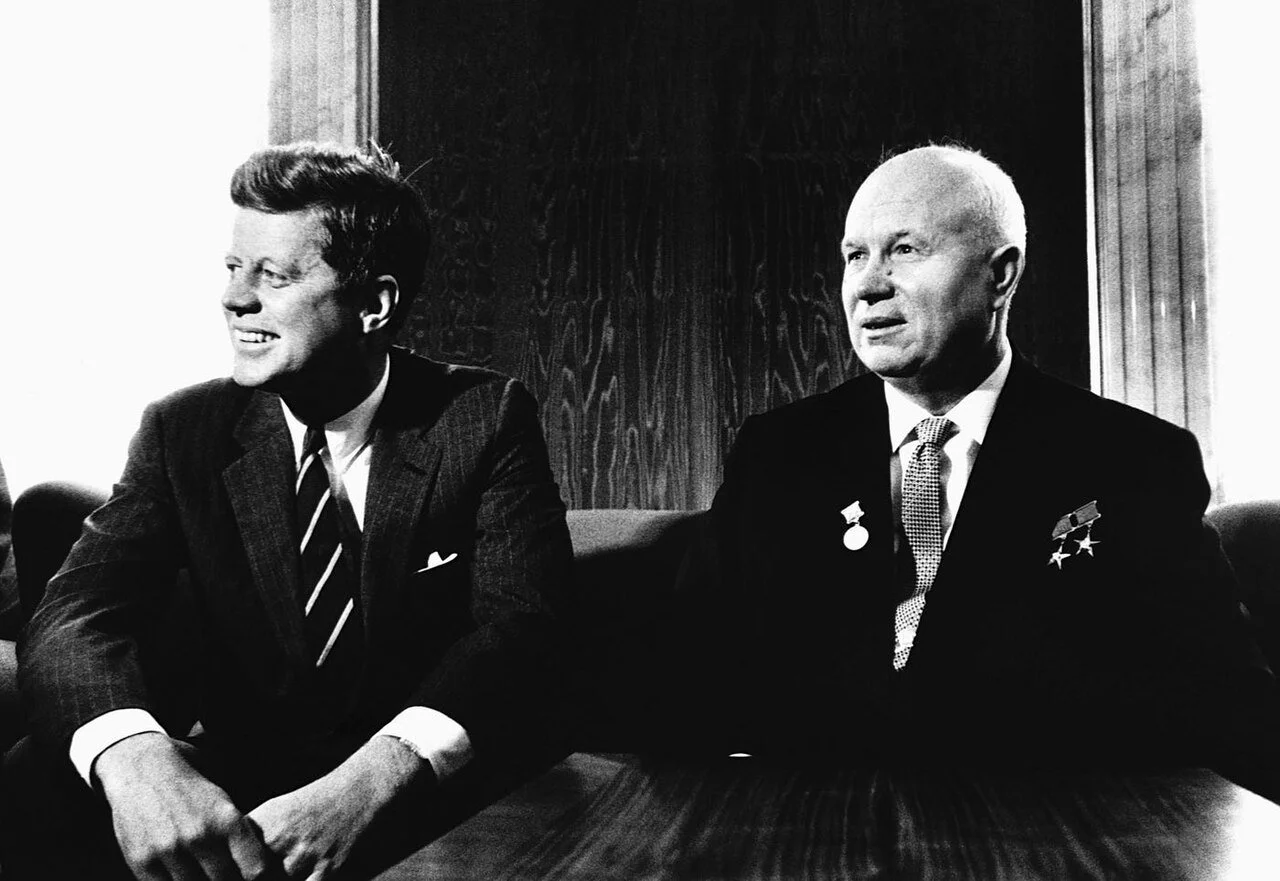
John F. Kennedy and Nikita Khrushchev in 1961.
As the 1960s began, Soviet Premier Nikita Khrushchev was seemingly well aware of the United States increased nuclear weapons production and its positioning in places like England, Italy, and Turkey that placed these weapons increasingly closer to his country’s borders.
Even so, Khrushchev may not have wanted to commit the necessary funds to bring his country on par with the United States. At least one report from the 2000s indicates “the cost of U.S. defense programs exceeded the dollar equivalent of Soviet programs by roughly one-fifth” from 1951 to 1964. Another report claims that when the Soviets did put their missiles in Cuba, it only had about 75 intercontinental ballistic missiles, compared with the between 450 and 500 of these missiles the U.S. was said to have at the time.
However, contemporary reports differ. Roughly a month before the Cuban Missile Crisis reached its October tipping point, a newspaper article quoted sources in Washington, D.C. who claimed the Soviet Union not only had more nuclear weapons that could be “city-killers” than the United States at that time, but the country was increasing that lead.
The balance of the evidence reviewed before writing this essay suggests the contemporary report may have been an exaggeration or perhaps even a ploy to earn the United States’ support on an uncomfortable topic. According to at least two authors’ interpretations, decades later, of Robert McNamara, Kennedy’s Secretary of Defense, comments during a 1964 hearing suggested that the United States’ superiority in nuclear weapons was the sole reason Khrushchev backed down.
Impact
To interject a perspective that might help explain the fear the Cuban Missile Crisis instilled around the world, intercontinental ballistic missiles are said to have a range of more than 3,500 miles (roughly 700 more miles than a car trip from New York City to Los Angeles in the United States or nine round-trip car trips by car from London to Manchester in the United Kingdom).
Decades after the crisis was averted, an author noted that until Cuba, Khrushchev had not placed any nuclear missiles outside the Soviet Union’s extensive border. By doing so, Khrushchev may have felt that what he lacked in numbers, he made up for it in the amount of security the move provided Cuba’s residents and the amount of fear the missiles' closeness to the Caribbean country instilled in Americans. It should be noted that a different author, writing in the 1980s, felt that a “considerably smaller” number of missiles than those observed in the photographs that sparked the conflict would have achieved this result.
Returning to a contemporary news report, shortly after Khrushchev agreed to have the missiles removed from Cuba, said he did so because he felt confident Kennedy would not invade Cuba. Khrushchev added that “the motive which prompted us to give aid of this nature to Cuba is no longer valid.”
Dangers
Speaking to a Kiwanis Club in the middle of the tense 13 days, Henry Shapiro, who was then well into his second decade of a three-decade career covering Moscow for United Press International and said to provide Khrushchev with informal feedback regarding how Americans would respond to Soviet actions, implied Khrushchev knew the dangers of nuclear war and thus never intended to start one.
Shapiro, besides alluding to some theories mentioned in this essay, also stated that Khrushchev may have – as other leaders before him such as George McClellan’s incorrect assumption regarding the number of Confederate troops during the Civil War’s Battle of Antietam or Mark Antony’s overreliance on the wind during his doomed attempt to win the Battle of Actium – underestimated the power of U.S. nuclear weapons but also knew that he had some pretty powerful weapons as well.
More recently
Khrushchev’s own son, in remarks made almost 40 years to the day of the event, said the Soviets’ actions in Cuba were merely to save face, and that simply trying to resolve differences between the United States and the Soviet Union verbally would make those within the Kremlin look weak.
At least one other author in more recent times has offered that if Kennedy had been the leader who backed down first, rather than Khrushchev, the Soviets’ decision to stockpile missiles in Cuba might also have provided Khrushchev with a few additional Latin American and South American allies.
Also in recent years, another author has suggested that the Soviet Union’s actions were to showcase its strength to China, a country that Fidel Castro was said to be keen on winning over. In stockpiling missiles so close to America, the Soviets hoped China would forgo building nuclear weapons and depend on the Soviets if ever threatened.
In addition, recent authors have wrote that Kennedy backing down first may have also given Khrushchev the upper hand in a much closer rivalry than those in the Northern Hemisphere and in Asia – the German city of Berlin, which the year before became divided in two by miles and miles of concrete walls of varying height up to 15 feet disfigured by barbed wire and under constant watch by guards, structures holding guns, and mines.
In Context
It has often been said that there are two sides to every story. I sometimes tell others that there are actually three sides to every story. There is one person’s account, the other person’s account, and then what truly happened (although I, by no means, believe I have coined the phrase).
More so than any other topic I have written about for History Is Now’s website, does the adage and my take on it ring true. Perhaps for that reason, the greatest takeaway from a situation as serious as the Cuban Missile Crisis was, is that every reason and scenario possible must always be explored before action is taken, especially when it is regarding something as consequential as nuclear war.
Find our more on the Cold War in our book here.
References
History.com Editors. “Cuban Missile Crisis - Causes, Timeline & Significance.” https://www.history.com/articles/cuban-missile-crisis. History.com. Accessed April 13, 2026.
Kahan, Jerome H. and Long, Anne K. “The Cuban Missile Crisis: A Study of Its Strategic Context.” https://www.jstor.org/stable/2148197. Political Science Quarterly, Vol. 87, No. 4 (December 1972), pp. 564-590. Accessed March 20, 2026.
Center for the Study of Intelligence. “Analyzing Soviet Defense Programs, 1951-1990.” https://nsarchive2.gwu.edu/NSAEBB/NSAEBB493/docs/intell_ebb_012.PDF. The National Security Archive, The George Washington University. Accessed April 13, 2026.
Pollard, Robert A. “The Cuban Missile Crisis: Legacies and Lessons.” https://www.jstor.org/stable/40256375. The Wilson Quarterly, Vol. 6, No. 4 (Autumn, 1982), pp. 148-158.
Accessed March 20, 2026.
Myler, Joseph L. “Russians Extend Lead in Testing N-Weapons.” https://www.newspapers.com/image/534344939. The Scranton Times (Pennsylvania). September 20, 1962, Page 2. Accessed April 13, 2026.
Kahan, Jerome H. and Long, Anne K. “The Cuban Missile Crisis: A Study of Its Strategic Context.” https://www.jstor.org/stable/2148197. Political Science Quarterly, Vol. 87, No. 4 (December 1972), pp. 564-590. Accessed March 20, 2026.
Brittanica.com Editors. “ICBM.” https://www.britannica.com/technology/ICBM. Brittanica.com. Accessed April 13, 2026.
MapQuest.com Editors. “Directions from New York, NY to Los Angeles, CA. https://www.mapquest.com/directions/from/us/new-york/new-york-ny-282040974/to/us/california/los-angeles-ca-282039899?scheduleType=leave-now. MapQuest.com. Accessed April 13, 2026.
UKCityMap.com Editors. “Distance from London, Greater London, to Manchester, Greater Manchester, England.” https://www.ukcitymap.com/distance-from-london-greater-london-england-to-manchester-greater-manchester-england.html. UKCityMap.com. Accessed April 13, 2026.
Kahan, Jerome H. and Long, Anne K. “The Cuban Missile Crisis: A Study of Its Strategic Context.” https://www.jstor.org/stable/2148197. Political Science Quarterly, Vol. 87, No. 4 (December 1972), pp. 564-590. Accessed March 20, 2026.
Pollard, Robert A. “The Cuban Missile Crisis: Legacies and Lessons.” https://www.jstor.org/stable/40256375. The Wilson Quarterly, Vol. 6, No. 4 (Autumn, 1982), pp. 148-158. Accessed March 20, 2026.
Syvertsen, George. “Nikita Quits Brink, Recalls Rockets.” https://www.newspapers.com/image/80332793/. The Oregon Statesman. October 29, 1962, Page 1.
Colwell, Mike. “Nikita Expected to Back Down.” https://www.newspapers.com/image/995245702/.
The Berkeley Daily Gazette (California). October 24, 1962, Page 1.
United Press International Editors. “Veteran UPI Foreign Correspondent Henry Shapiro Dead at 84.” https://www.upi.com/Archives/1991/04/05/Veteran-UPI-foreign-correspondent-Henry-Shapiro-dead-at-84/2067670827600/.UPI.com. Accessed April 13, 2026.
Colwell, Mike. “Nikita Expected to Back Down.” https://www.newspapers.com/image/995245702/.
The Berkeley Daily Gazette (California). October 24, 1962, Page 1.
Sears, Stephen W. “McClellan at Antietam.” https://www.battlefields.org/learn/articles/mcclellan-antietam. American Battlefield Trust. Accessed April 13, 2026.
Mark, Joshua J. “Battle of Actium.” https://www.worldhistory.org/Battle_of_Actium/. Worldhistory.org. Accessed April 13, 2026.
Colwell, Mike. “Nikita Expected to Back Down.” https://www.newspapers.com/image/995245702/.
The Berkeley Daily Gazette (California). October 24, 1962, Page 1.
Transcript of October 20, 2002, discussion among James Blight, Chuck Daly, Kenneth Galbraith, Sergei Khrushchev, Arthur M. Schlesinger, Jr., Theodore Sorensen, and Josefina Vidal. “On the Brink: The Cuban Missile Crisis.” https://www.jfklibrary.org/events-and-awards/kennedy-library-forums/browse-all-forums/transcripts/on-the-brink-the-cuban-missile-crisis. John F. Kennedy Presidential Library and Museum. Accessed March 20, 2026.
Kahan, Jerome H. and Long, Anne K. “The Cuban Missile Crisis: A Study of Its Strategic Context.” https://www.jstor.org/stable/2148197. Political Science Quarterly, Vol. 87, No. 4 (December 1972), pp. 564-590. Accessed March 20, 2026.
Pollard, Robert A. “The Cuban Missile Crisis: Legacies and Lessons.” https://www.jstor.org/stable/40256375. The Wilson Quarterly, Vol. 6, No. 4 (Autumn, 1982), pp. 148-158.
Accessed March 20, 2026.
Sears, Stephen W. “McClellan at Antietam.” https://www.battlefields.org/learn/articles/mcclellan-antietam. American Battlefield Trust. Accessed April 13, 2026.
Mark, Joshua J. “Battle of Actium.” https://www.worldhistory.org/Battle_of_Actium/. Worldhistory.org. Accessed April 13, 2026.
Slantchev Branislav L. “The National Security Strategy: The Cuban/Caribbean Missile Crisis, October 1962.” http://slantchev.ucsd.edu/courses/ps142j/lectures/cuban-crisis.pdf. University of California, San Diego. Accessed March 20, 2026.
Kahan, Jerome H. and Long, Anne K. “The Cuban Missile Crisis: A Study of Its Strategic Context.” https://www.jstor.org/stable/2148197. Political Science Quarterly, Vol. 87, No. 4 (December 1972), pp. 564-590. Accessed March 20, 2026.
Brittanica.com Editors. “Berlin Wall.” https://www.britannica.com/topic/Berlin-Wall. Brittanica.com. Accessed April 13, 2026.