
The promise of a better life pledged by advertisements created after mid-1800s events in the United States such as the Homestead Act of 1862 – which offered 160 acres of government-owned land in the Midwest and West for free with the possibility of eventually owning the land outright – did not always become the reality.
Those who took advantage of the opportunity afforded by the act to head to the largely rural Midwest and West faced multiple, likely unexpected obstacles, making survival much more difficult than many of them probably imagined. How did those who made the trek survive? Janel Miller offers some answers in this short piece.
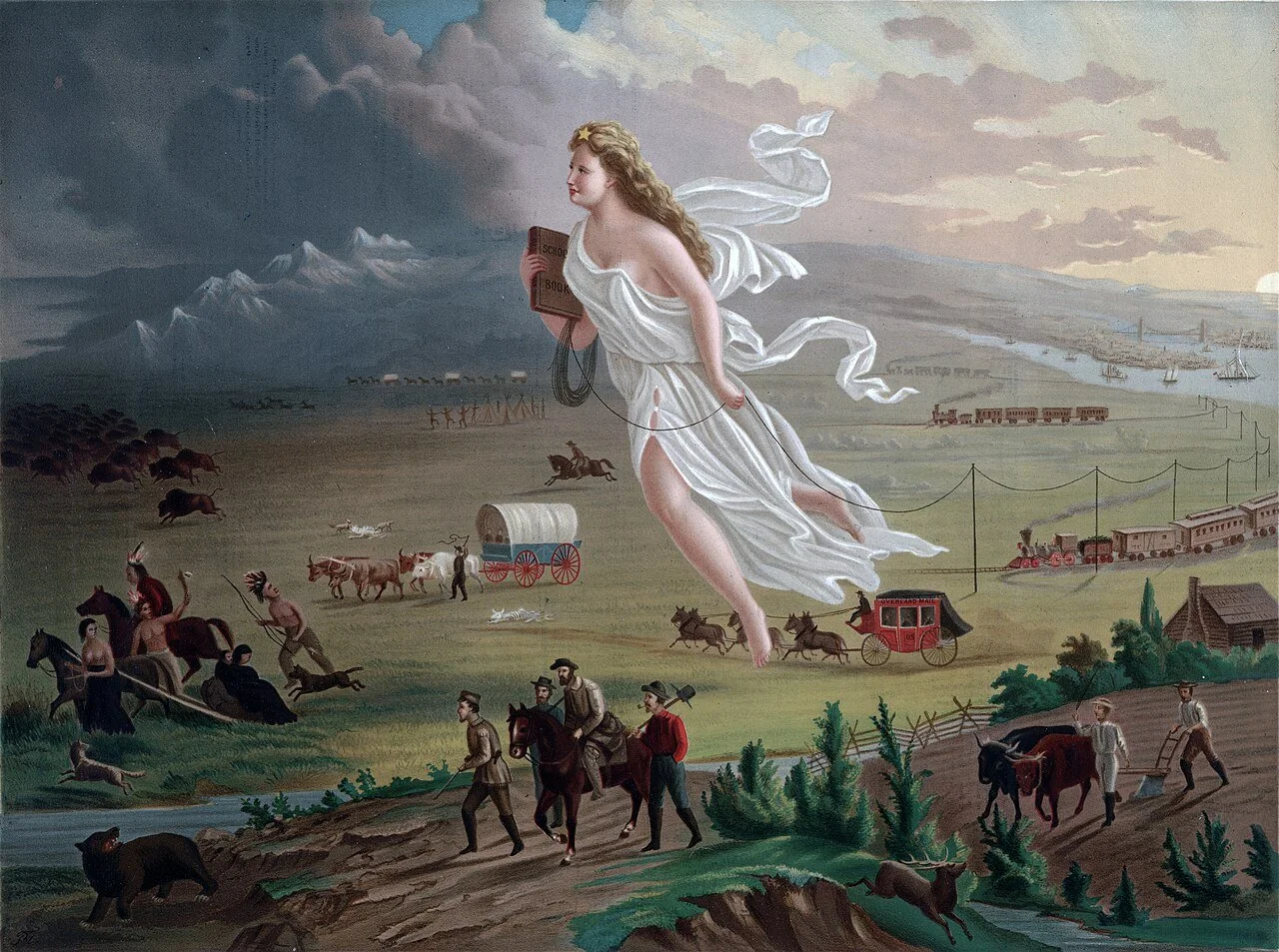
American Progress by John Gast, 1872. In the image settlers are moving west, guided and protected by Columbia.
The saying “Necessity is the mother of invention” is attributed to Plato in 380 B.C. However, it was just as relevant after 1862 when many left their homes in the East to pursue the promise of a better life in the West.
These settlers faced dry and arid conditions that were previously unknown to them. They responded by using newly developed windmills, irrigation systems and drought-resistant crops. Others found ways to enhance existing techniques, such as manufacturing plows with steel and assembling grain into easy-to-transport bundles.
Still other settlers aggressively sought to have the railroad, then in its infancy, come through their town. Those who succeeded in this endeavor gained easier access to food, animals and other goods necessary to endure.
In addition, many settlers worked with their peers to establish organizations, such as Granges, that succeeded in adding agriculture into school curricula, establishing rural mail delivery and the parcel post system.
In Context
The time period covered by this essay has long since passed, but there are still people who desire rural living. The reasons newer generations cite for leaving urban life for a more rural one include a desire for recreational areas and a more affordable cost of living.
Most parts of the United States today offer their residents luxuries such as cell phones, computers and vehicles that the settlers of the American West could likely never have imagined. All the more reason those living today should be in awe of how settlers found ways to survive when they moved to the Midwest and the West.
Did you find that piece interesting? If so, join us for free by clicking here.
References
Griffin, Sean. Chnm.gmu.edu. “What Brought Settlers to the Midwest?” https://chnm.gmu.edu/tah-loudoun/blog/lessons/what-brought-settlers-to-the-midwest/. Accessed January 17, 2026.
Library of Congress Editors. Loc.gov. “Rural Life in the Late 19th Century | Rise of Industrial America. https://www.loc.gov/classroom-materials/united-states-history-primary-source-timeline/rise-of-industrial-america-1876-1900/rural-life-in-late-19th-century/. Accessed January 17, 2026.
Writing Explained Editors. Writingexplained.com. “Necessity is the Mother of Invention.” https://writingexplained.org/idiom-dictionary/necessity-is-the-mother-of-invention. Accessed January 17, 2026.
Friedman, Jordan. History.com. “The Rugged Trades that Drew Settlers to the American West.” https://www.history.com/articles/settler-jobs-american-west-mining-ranching-trapping. Accessed January 17, 2026.
Slatta, Richard W. Chass.ncsu.edu. “Western Frontier Life in America.” https://faculty.chass.ncsu.edu/slatta/cowboys/essays/front_life2.htm#. Accessed January 17, 2026.
Friedman, Jordan. History.com. “The Rugged Trades that Drew Settlers to the American West.” https://www.history.com/articles/settler-jobs-american-west-mining-ranching-trapping. Accessed January 17, 2026.
Library of Congress Editors. Loc.gov. “Rural Life in the Late 19th Century | Rise of Industrial America. https://www.loc.gov/classroom-materials/united-states-history-primary-source-timeline/rise-of-industrial-america-1876-1900/rural-life-in-late-19th-century/. Accessed January 17, 2026.
Gulliver, Katrina. Daily.jstor.org. “The Gift of the Grange.” https://daily.jstor.org/the-gift-of-the-grange/. Accessed January 17, 2026.
Cromartie, John. USDA.gov. “Net Migration Spurs Renewed Growth in Rural Areas of the United States.” https://www.ers.usda.gov/amber-waves/2024/february/net-migration-spurs-renewed-growth-in-rural-areas-of-the-united-states. Accessed January 17, 2026.
Farberov, Snejana. NYpost.com “Why Young Adults Are Moving to Small Towns at the Highest Rate in a Decade.” https://nypost.com/2025/03/14/real-estate/young-adults-are-moving-to-small-towns-at-the-highest-rate-in-a-decade/. Accessed January 17, 2026.
Hughes, Keagan. WAVY.com. “Young Adults Leaving Hampton Roads for Rural Areas Amid Rising Costs.” https://www.wavy.com/news/local-news/young-adults-leaving-hampton-roads-for-rural-areas-amid-rising-costs/. Accessed January 17, 2026.