Jack Cornwell was born on the 8th of January, 1900 in Leyton, then part of Essex, into a working-class family for whom life offered few comforts and little security. He grew up in modest surroundings and attended local schools, where he was remembered as a quiet, unassuming boy rather than an exceptional student or natural adventurer. Like many boys of his generation, Cornwell was drawn to the Royal Navy by a mixture of patriotism, the promise of steady pay, and the romance of the sea. At just fifteen years old he enlisted as a Boy Seaman in 1915, undergoing training at HMS Impregnable before being posted to active service at an age when most of his contemporaries were still in school.
Terry Bailey explains.
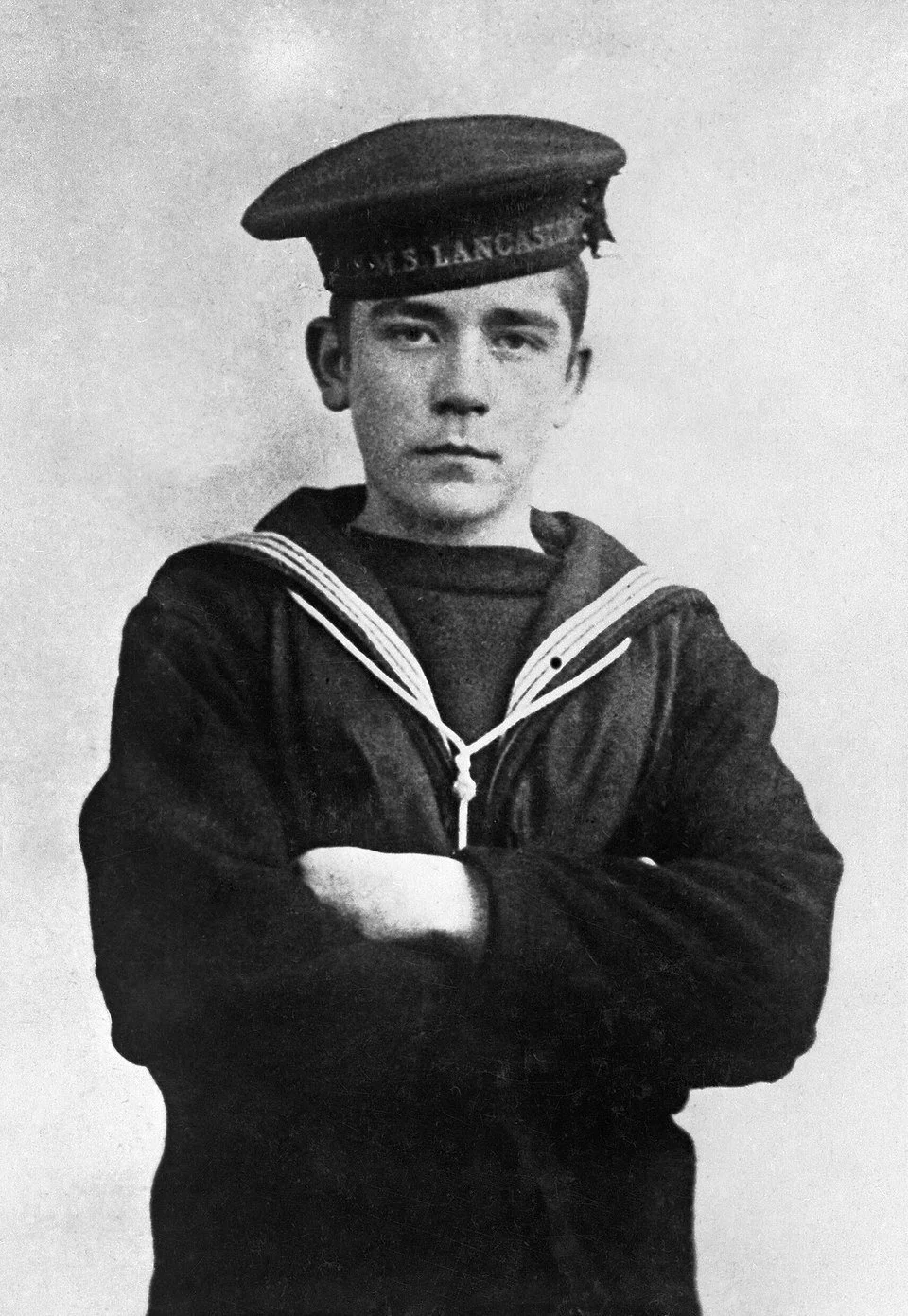
The image of Jack Cornwell as used by the press at the time of his death. It is now thought to show a younger brother.
In early 1916 Cornwell was assigned to HMS Chester, a newly commissioned light cruiser of the Royal Navy's 3rd Light Cruiser Squadron. As a Boy First Class, his duties included serving as a sight setter and loader on one of the ship's 5.5-inch guns, a demanding role that required discipline, precision, and physical stamina. Despite his youth, Cornwell adapted quickly to the routines of naval life and the responsibilities of combat readiness. By the end of May 1916, Chester was operating in the North Sea as part of the British Grand Fleet, soon to be drawn into the largest naval engagement of the First World War.
The Battle of Jutland, fought between the 31st of May and the 1st of June 1916, was the long-anticipated clash between Britain's Grand Fleet under Admiral Sir John Jellicoe and the German High Seas Fleet commanded by Vice-Admiral Reinhard Scheer. Both sides sought to gain decisive control of the North Sea, a strategic prize that would shape the course of the war. The British aimed to maintain their naval blockade of Germany, while the Germans hoped to weaken British sea power by isolating and destroying portions of the Grand Fleet. The battle unfolded amid confusion, smoke, poor visibility, and rapidly shifting tactical situations, with dozens of capital ships and cruisers exchanging fire over vast distances.
HMS Chester became engaged during the early phases of the battle when she encountered a group of German light cruisers. Outgunned and exposed, Chester came under intense and accurate enemy fire. Several German shells struck the ship, causing heavy casualties among the gun crews. One shell burst close to Cornwell's gun position, killing or disabling nearly the entire crew and inflicting severe wounds on Cornwell himself. He suffered multiple injuries to his chest and legs, wounds that would ultimately prove fatal. Despite his pain and loss of blood, Cornwell refused to leave his post. Standing alone amid the wreckage, he continued to load and aim the gun, awaiting orders and prepared to fire if commanded.
Cornwell remained at his station until the fighting subsided and Chester withdrew from the action. Only then was he discovered by officers, still upright beside the gun, gravely wounded but steadfast in his duty. He was taken to the hospital upon the ship's return to port, but his injuries were too severe. Jack Cornwell died on the 2nd of June 1916, just over a day after the battle, at the age of sixteen. His conduct, marked by extraordinary courage, discipline, and devotion to duty in the face of overwhelming danger, was soon reported to the Admiralty.
In recognition of his actions, Cornwell was posthumously awarded the Victoria Cross, the highest award for gallantry in the British and Commonwealth armed forces. The citation emphasized that he "remained standing alone at a most exposed post, quietly awaiting orders," despite being mortally wounded. His youth made his bravery all the more striking, and his story resonated deeply with a nation exhausted by war and loss. Cornwell was given a hero's funeral in London, attended by thousands, and his grave became a site of public remembrance.
The Battle of Jutland itself remains a subject of debate among historians. Tactically, the German Navy could claim a measure of success, having sunk more British ships and inflicted heavier immediate losses. However, strategically, the battle was a clear victory for Britain. The Royal Navy retained command of the sea, and the German High Seas Fleet, though not destroyed, was effectively contained. After Jutland, the German fleet rarely ventured out in strength again, conceding naval dominance to Britain and ensuring that the blockade of Germany remained intact for the remainder of the war.
Jack Cornwell's legacy endures as one of the most powerful symbols of youthful courage in British military history. He was not a seasoned warrior or a decorated officer, but a teenage sailor who, when tested under the most extreme conditions, displayed unwavering resolve and selflessness. His story embodies the quiet heroism of ordinary individuals caught in extraordinary circumstances. It serves as a reminder that courage is not measured by age or rank, but by the willingness to stand fast in the face of fear and duty.
Jack Cornwell's story endures not because it is dramatic in the conventional sense of battlefield heroics, but because of its profound simplicity. In the chaos and terror of Jutland—the smoke-filled decks, the thunder of naval guns, and the sudden loss of comrades around him, Cornwell did not perform a single spectacular act meant to turn the tide of battle. Instead, he did something far rarer and more revealing: he stayed. Mortally wounded, isolated, and fully aware of the danger, he remained at his post, embodying the quiet discipline and sense of duty instilled in him by the Royal Navy and embraced by him as a personal moral code. His courage was not impulsive or reckless, but calm, steadfast, and deeply human.
In a war often remembered for its industrial scale and impersonal slaughter, Cornwell's actions restore the individual to the center of history. He reminds us that the outcome of great events, whether a vast naval engagement like Jutland or the broader struggle of the First World War is shaped not only by admirals, strategies, and fleets, but by the conduct of ordinary men and boys placed in extraordinary circumstances. His youth, far from diminishing his heroism, underscores it, revealing how responsibility and bravery were borne by those scarcely beyond childhood during the conflict.
More than a century later, Jack Cornwell remains a symbol rather than a statistic, a name that speaks to sacrifice without bitterness and courage without bravado. His Victoria Cross represents not only gallantry under fire, but also the enduring values of duty, resilience, and selflessness in the face of overwhelming odds. In remembering Cornwell, we honor not just one young sailor, but an entire generation whose quiet endurance helped shape the course of history, and whose sacrifices continue to resonate long after the guns of Jutland fell silent.
The site has been offering a wide variety of high-quality, free history content since 2012. If you’d like to say ‘thank you’ and help us with site running costs, please consider donating here.