In January 1959 Fidel Castro overthrew the Batista government and became Cuba’s new leader. Che Guevara had been a prominent figure in that revolution and was one of the few surviving guerrillas who had been with Castro from the start. With victory achieved, Che now had to decide on his future direction.
His contribution to Castro’s cause had undoubtedly won him the favor of Cuba’s new leader and assured him of a position among the country’s ruling elite. As the decade went on, however, it became clear that Che had different ideas about his role and future, not just in Cuba but in the wider world. He went on to make a very strange mix of choices in the last years of his life, and those final seven years would be a concoction of bewilderment, excitement and tragedy.
Steve Prout explains.
You can read part 1 on Che’s early years here, and part 2 on the his path to being a Marxist revolutionary here.
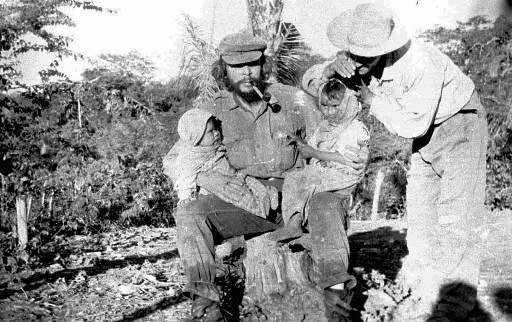
Ernesto Che Guevara in Bolivia in 1967. Source: Public domain, Museo Che Guevara, available here.
Cuba 1960-1964
The Che Guevara of 1959 was a completely different man. He was no longer the “young Argentine vagabond who just happened to have a medical degree scrabbling for work in a foreign country.” He was now a high-ranking official in the new Cuban administration with close access to its leader, Fidel Castro. Over the next few years he would hold several posts: commander of the La Cabaña fortress, where he oversaw the revolutionary tribunals that purged the army of Batista sympathizers; president of the National Bank of Cuba; and Minister of Industries. He had few successes in these roles, and it was at La Cabaña that he acquired his fearsome and ruthless reputation. In the first months after the revolution, Che presided over dozens, and by some accounts hundreds, of executions.
It is a matter of debate whether Che was any more ruthless than other members of the new Cuban government. Neither Che’s own comments nor those of his comrades at the time paint a merciful picture. Asked about Che’s part in the legal process, fellow prosecutor Miguel Ángel Duque de Estrada said simply that “he [Che] was in charge… his word was final.” In the first hundred days of Che’s tenure, no fewer than fifty-five executions were carried out.
His role at La Cabaña, and the vigor with which he applied himself to it, revealed a major change in Che’s personality and moral code. Only six years before the revolution, in 1953, Che had qualified as a doctor, a profession dedicated to the betterment and prolonging of life. By the time he took charge of the tribunals he had clearly abandoned that commitment, privately admitting to his father: “As for my medical career, I can tell you that I deserted it a long time ago.” Perhaps we have our answer. Che could have refused the role, but ambition persuaded him otherwise.
However, the Cuban people were also in a vengeful, unforgiving mood toward the former government, and sought reprisals against those who had supported and carried out the Batista regime’s atrocities. Public demand aside, there was another important reason: Castro needed to ensure that no dissent remained that could undermine his victory in those early, vulnerable days. Che remembered the events that had toppled Jacobo Árbenz in Guatemala in 1954, which he had witnessed first-hand during his second journey through Latin America. In Che’s view, Árbenz had failed to purge his army of dissenters, and they ultimately removed him from power. That mistake could not be allowed to happen in Cuba.
In 1959 the new Cuban government faced a hostile diplomatic environment. The United States was growing increasingly wary of the revolution’s radical direction, and much of Latin America was under heavy US influence. In June 1959 Castro sent Che abroad as an ambassador on a three-month goodwill tour. Like his later tour of 1964–65, it focused on non-aligned countries, which on this occasion included Egypt, India, Japan, Indonesia and Yugoslavia. The priority was to win trade and ease Cuba’s economic vulnerability.
To achieve this, Cuba urgently needed to sell its one major commodity: sugar. Cuba produced around six million tons a year, of which roughly three million tons were sold to the United States under a quota system, a quota the US would cut in July 1960 as relations collapsed. The tour achieved little. It laid some groundwork for trade with Egypt and produced a rice-for-sugar arrangement with Burma, but no major new customers. Some of the fault lay with Che himself. His lack of knowledge of economics and trade put him on the back foot in negotiations, and the outcome was hardly surprising. In short, he was unsuited to the task, though in fairness many others in Castro’s government were probably equally lacking. Cuba would soon turn to the Soviet bloc instead, signing its first major trade agreement with the USSR in February 1960.
On a personal front, Che divorced his wife, Hilda Gadea, and shortly afterwards, in June 1959, married Aleida March de la Torre, whom he had met during the fighting. His marriage to Hilda had been under strain since before the revolutionary campaign in Cuba, and the situation was no doubt exacerbated by Che’s restless ambition. That ambition was undimmed; indeed, he was now heavily focused on a new task: taking revolution to the wider world.
Exporting Revolution
Cuba’s policy of exporting revolution was both a defensive and an offensive strategy. Havana feared that the United States was planning retaliation for Castro’s overthrow of Batista. The US was seeking compensation for American property nationalized by Cuba, valued at around $1.8 billion at the time, and it now had a communist state on its southern flank, an anathema to American ideology. In Castro’s mind, an invasion was only a matter of time, a fear borne out by the CIA-backed Bay of Pigs invasion of April 1961.
In theory at least, exporting revolution was an alternative to the impossible task of taking direct action against the United States. The plan was to create distractions in other countries that would tie up the time and military resources of Cuba’s potential enemies—or, in Che’s later words, to create “two, three, many Vietnams.” If this produced regime changes friendly to Cuba, so much the better. Cuba became a training ground for several clandestine guerrilla organizations preparing to take up arms across the developing world, and it was here that Che believed he had found his new calling.
Between 1960 and 1964 Cuba was actively planning several clandestine operations in Latin America, and those in Argentina and Guatemala reached an advanced stage. From 1962, large numbers of would-be guerrillas from across Latin America arrived in Cuba to train, mentored by Che, seasoned Cuban guerrilla veterans and Eastern Bloc advisers, for example from Czechoslovakia. Che also used the resources available to him at the National Bank of Cuba to fund guerrilla movements in Central America, advancing $20,000 to the Nicaraguans Tomás Borge and Rodolfo Romero, two guerrilla leaders heavily involved in the region.
Argentina was particularly close to Che’s heart as his homeland and the home of his family. Again without Che being present, a Cuban-backed guerrilla force led by the Argentine journalist Jorge Ricardo Masetti was gradually established in Bolivia in preparation for an incursion into northern Argentina. After President Arturo Frondizi was removed by the military in 1962, Che saw an opportunity for such an operation.
By the time the operation began in earnest, however, the political climate in Argentina had changed. The military-dominated interim government had given way to elections in 1963, which brought the centrist Arturo Illia to the presidency, lowering the political temperature and the appetite for revolution. Che’s own opportunity for personal involvement in a campaign was coming, but not close to home. It would be in post-colonial Africa.
The Congo and the Disappearance of Che Guevara
In 1965 Cuba backed the Congo’s various rebel movements against the central government of the Democratic Republic of the Congo, whose army was commanded by Joseph Mobutu. Civil conflict had erupted almost immediately after the country gained independence from Belgium in June 1960, beginning with an army mutiny and the secession of the mineral-rich province of Katanga. The newly elected prime minister, Patrice Lumumba, was unable to contain the unrest. When Belgium sent in troops, Lumumba saw this as a stealthy attempt to preserve its imperial grip on its former colony. He appealed to the United Nations, which sent a peacekeeping force, but when the UN refused to help him end the Katangan secession he turned to the USSR, asking Nikita Khrushchev for assistance, and Soviet aid and advisers were dispatched to the Congo. The Cold War had arrived in Africa, and given the country’s vast mineral wealth—cobalt, copper and much else—this was unacceptable to the West. Lumumba was deposed in September 1960 in a coup led by Mobutu with Belgian and CIA support. After his capture he was handed over to his political rival Moïse Tshombe’s Katangan authorities and brutally murdered in January 1961.
Watching from the sidelines, Cuba believed that the Congo offered an opening for successful regime change. Successes outside the Cuban revolution itself had so far been non-existent, so this time the operation would receive the personal attention of Che Guevara himself. In April 1965 Che was secretly inserted into the country to begin his work. There is little value in recounting the many chaotic engagements of the seven unsuccessful months that followed. Che opened his account of the campaign with the blunt admission, “This is the history of a failure,” and his presence had little or no impact. The diary and other witnesses describe multiple disadvantages: absent leaders, uncommitted fighters, poor logistics, language barriers and insurmountable odds, including Mobutu’s considerable army, supported by the CIA and by elite mercenary units led by the infamous Mike Hoare. Che’s first personal attempt to export revolution had been an abject failure. It was not an auspicious start.
Before his arrival, Che had been given plenty of advice and warnings by African leaders that his venture was highly likely to fail. The Egyptian leader Gamal Abdel Nasser advised him against becoming “a Tarzan, a white man among blacks, leading and protecting them,” as Africa had had enough of white rule and interference. Nasser warned, prophetically, that it would end “badly.”
Nor did his plans convince the African revolutionaries to whom he presented them in detail in Dar es Salaam. The consensus was that they were too ambitious and naive. In Che’s words, the meeting ended “coldly and dismissively,” with his guests “courteously saying goodbye.” His costly idea of using the Congo as an anti-imperialist springboard for guerrilla struggles in neighboring countries was not the kind of revolution that the Congolese, or Africans more widely, desired. He proceeded regardless, and it would not be the last time Che failed to heed advice and warnings.
Che arrived in the Congo in April 1965 and by November had withdrawn to neighboring Tanzania, where he wrote his account of the campaign in Dar es Salaam. If nothing else, it served as a “lessons learned” log for future operations. He was undeterred by the failure and still vehemently supported the idea of exporting guerrilla warfare, but he needed another opportunity. He would get one in Bolivia a year later, but he failed to heed his own lessons, failures and experiences before embarking on that venture.
Mobutu, meanwhile, seized power in a coup in November 1965, just as Che was leaving, and ruled the country (renamed Zaire in 1971) until 1997.
Diplomatic Blunders and a Rumored Rift with Castro
In February 1965, before leaving for the Congo, Che made a public address in Algiers to delegates from across Asia and Africa. The speech was so inflammatory that it riled Cuba’s principal ally, the USSR. In it Che made a series of catastrophic blunders, once again proving that diplomacy was not among his skills.
In the speech Che delivered a clear criticism, if not a rebuke, of the Soviet bloc. He argued that its “mutually beneficial” trade with developing countries was no better than the West’s, and that socialist countries trading at world-market prices were, to a degree, accomplices of imperialist exploitation. By implication he sided with China over the USSR, suggesting that the Chinese displayed a truer socialist morality than the Soviets. Moscow noted his closeness to China and came to see him as “China’s man,” which was unacceptable to the Kremlin.
This rebuke enraged the Soviets, and the ramifications reached Fidel Castro. What was he to do with Che? As it turned out, Che’s own actions provided the solution. Many still wonder whether it was a stroke of good fortune or some stealthy maneuvering behind the scenes that removed Che from Cuban affairs. Che would later regret his actions.
Before Che’s disappearance into the Congo there were rumors of a rift between him and Castro over his open criticism of Moscow. Nothing has been officially confirmed, but the events that followed are suspicious. The rift, if there was one, was driven by a mixture of Che’s loose, tactless tongue and his ardent Marxist beliefs, which put him firmly on China’s side of the Sino-Soviet dispute. Castro shared some of Che’s frustration with Moscow but kept a quiet restraint.
“The Letter” to Castro and the People of Cuba
On April 1, 1965, while preparing for his insertion into the Congo, Che wrote a farewell letter to Fidel Castro. That letter, in Che’s typically flowery prose, would soon work to his detriment. When Castro read it out in public in October 1965 to explain Che’s absence, it effectively detached Che from his comrades: he had renounced all his government titles and his Cuban citizenship, erasing everything he had worked for. In one short letter he had lost his own stage at a time when he arguably needed its support most.
Extracts from the letter read as follows:
“I feel that I have fulfilled the part of my duty that tied me to the Cuban Revolution in its territory, and I now take my leave of you, the compañeros, your people who are now mine.”
If that was not clear enough, he elaborated in true “Che prose”:
“I formally resign my responsibilities in the leadership of the party, my post as minister, my rank as commander and my Cuban citizenship. Nothing legally ties me to Cuba.”
The letter perhaps alludes to tensions with Castro when Che writes: “My only serious failing was not having more confidence in you from the first moments in the Sierra Maestra, and not having understood quickly enough your qualities as a leader and revolutionary.” (The Sierra Maestra mountains were the refuge of Castro and his depleted band in the early stages of the insurgency.) There were suggestions that Fidel had begun to view Che’s activities and position as a diplomatic liability, especially after the Algiers speech angered Moscow. That speech put Castro in a difficult position: although he privately shared some of Che’s reservations about the USSR, it was nonetheless a vital, if not the only, ally on which Cuba depended during its continued international isolation.
Che added, “with a mixture of joy and sorrow,” that “other nations of the world call for my modest efforts” and that he would “carry to new battlefronts” the faith Castro had taught him, to “fight against imperialism wherever it may be.” These hints of grandiosity and egotism show how far Che’s transformation, and perhaps a growing self-delusion, had developed.
The letter was a baffling act, and it leaves readers wondering whether it was driven by an inflated ego, by the fact that Che, given his catalog of failures, was running out of “proverbial rope” as an ambassador and official of the Cuban government, or by both.
Bolivia and the fate of Che Guevara
Cuba was planning a guerrilla operation in Bolivia while Che was busy managing the disaster in the Congo. Cuba had originally planned an operation in Argentina, beginning with small incursions into the north of the country from across the Bolivian border, but the idea had been abandoned after Masetti’s failed attempt of 1963–64 and the change of government in Argentina. By the time Che returned secretly to Cuba in mid-1966, after months in Tanzania and Prague, he had decided to join the new venture. Still smarting from his failure in the Congo, he needed to repair his damaged reputation, both in his own eyes and in those of his peers. He was still traveling incognito and was effectively stateless. The Cuban public was unaware of his return, and his “disappearance” from Cuban life continued.
An advance team of Cuban and Bolivian communists had already established a secret base in Bolivia, on a farm near the Ñancahuazú River. All Che had to do was get into the country, which was no easy task, as his activities and whereabouts were now of great interest to the CIA. Traveling on false papers under an assumed name, Adolfo Mena González, he arrived in Bolivia in November 1966. Little did he know that he was beginning another fruitless and impossible campaign that would end in his capture and death. Masetti himself had disappeared in 1964 and is presumed to have died in the jungle of Argentina’s Salta province, and the authorities were by now aware of Cuban activity in the border regions.
The Bolivian failure
Before Che’s arrival, approaches had already been made to various Marxist groups within Bolivia with a view to creating a united front, but the Bolivian Communist Party did not share the Cuban belief in armed revolution. Che also reportedly received warnings against the whole idea from Argentina’s exiled former president Juan Perón in Madrid. Perón was candid, urging Che to “suspend that plan” and adding: “You will not survive. Search for alternatives.” Once again, however, Che failed to learn from the Congo and proceeded regardless.
Che arrived secretly in Bolivia in November 1966. The Cubans needed the success that had so far eluded them, though it was unclear what form that success would take: outright victory over “US-backed imperialism” or distractions sufficient to tie down US military resources. In the event, the campaign did nothing to slow US efforts against Cuba and Che; if anything, it was an irritation. The USSR, meanwhile, was distancing itself, preferring peaceful coexistence with the West. Cuba’s targets were not ready for revolution, and support for, and belief in, its ambitions were dwindling.
By mid-1967 the situation in Bolivia already looked hopeless. Che and his band were being pursued relentlessly by superior forces—the Bolivian Army, US-trained Bolivian Rangers and their US advisers. His force had dwindled from around fifty men to just over twenty. The local population gave them no support, nor did other communist-aligned groups. Che had no hope of success, and he admitted in his diary that support from the population was non-existent. Of the Bolivian peasants for whom he claimed to be fighting, he wrote: “Talking to these peasants is like talking to statues. They do not give us any help. Worse still, many of them are turning into informants.” Bolivia had already had its own revolution in 1952, which brought land reform and the nationalization of the tin mines, and it wanted any further change to come by peaceful, electoral means, an approach supported even by its own Marxist and communist groups.
The campaign was reminiscent of the Congo in many ways. Che and his small band spent days on the move with little to show for it, and the whole campaign produced no more than a handful of minor victories against small Bolivian patrols, none of which posed any threat to the government. For those interested in every detail, his Bolivian Diary provides it, but it adds little to this article. The Bolivian military redoubled its efforts to eliminate this troublesome individual and his exhausted guerrillas, and to set an example to any would-be imitators.
The Death of Che
On October 8, 1967, after a relentless pursuit, Che was captured by Bolivian forces in the Quebrada del Yuro ravine. A local peasant had revealed the guerrillas’ whereabouts to the army. Che and a handful of his men were taken alive to the nearby village of La Higuera, where he was held under heavy guard, tightly bound, on the mud floor of the village schoolhouse. His captors debated what to do with him as they awaited orders from their superiors. His end would come swiftly.
There are contradictory accounts of Che’s last moments. One is that he died bravely, looking his executioner in the eye in the La Higuera schoolhouse and daring him with the words, “Shoot, coward, you are only going to kill a man.”
Another account concerns his capture the previous day: that he surrendered, calling out to his captors that he was “worth more to you alive than dead.” We will never know the full truth of his final hours. Certainly, photographs taken after his capture show a man visibly shaken and exhausted by his physical ordeal, a far cry from the self-assured diplomat who had graced the world stage.
The last images of him alive unsurprisingly show him dirty, bloodied and barefoot. According to witnesses, including Félix Rodríguez, a Cuban-born CIA officer working alongside the Bolivian Army, Che was disillusioned but unrepentant. He blamed the “provincial mindset of the Bolivian Communist Party” for his failure and hinted that the Bolivian venture had been a mistake. His spirit was not entirely broken: he resisted interrogation and, to the very end, refused to denounce Castro or renounce his beliefs.
Che’s end could have been different. According to Rodríguez, there is credible evidence that the CIA wanted Che taken alive and flown out of Bolivia to Panama for interrogation. This makes sense: Che’s death risked creating a martyr for the communist cause and giving a boost to growing left-wing movements at home and abroad, whereas his capture and imprisonment would have been a significant setback to the revolutionary cause.
The US did not make the final, fateful decision. According to Rodríguez, it was the Bolivian president, René Barrientos, who ordered Che’s execution, which was promptly carried out. Barrientos was determined to deliver a stark warning to other revolutionary groups. Che was executed on October 9, 1967. His bullet-riddled body was flown to Vallegrande and photographed before being buried in a secret location, where it lay undiscovered until 1997. His hands had been cut off for identification purposes. In a sense, this was not the end of Che Guevara. A man of that name had been killed on October 9, 1967, but in his place an iconic image had been born, one that would prove impossible to erase from history.
Assessing Che: Conclusion
It goes without saying that Che’s death immortalized him, and myth and fact soon became blurred. He remains a polarizing historical figure, a dubious honor that comes with a wide mix of supporters, worshippers and critics.
Che Guevara was undoubtedly a remarkable man, but also a restless one. He never appeared to have a life plan beyond seeking greatness and personal triumph. He achieved this, in the enduring image of the anti-imperialist Marxist, on the back of Fidel Castro’s success, almost as if he had simply stumbled upon the opportunities presented to him.
He rarely stayed in any profession or vocation for long. He abandoned his hard-earned medical qualification for the revolutionary adventure with Fidel Castro in Cuba, a country that was not his birthplace. After the fighting, the revolution led him into government and diplomacy, for which he was ill-suited, and his record of achievement there is unimpressive. His two personal attempts at “exporting revolution,” in the Congo and in Bolivia, failed disastrously, the second leading to his death.
We must also never overlook one vital fact: Che was committed to the Marxist cause and closer to the Chinese model of communism, seeing the Soviet version as a diluted form of the doctrine. Whatever its rhetoric, Che’s and Cuba’s anti-imperialism did not deliver freedom: it meant supporting regimes, Cuba’s own included, that were themselves oppressive. The image some retain of Che as a Third World freedom fighter deserves some reflection.
Now, read our highly-rated, fast-paced book on the Cold War here.
Sources
I Embrace You with All My Revolutionary Fervour – Ernesto Che Guevara – Collected letters 1947-1967 – Penguin Modern Classics
Che Guevara – A Revolutionary Life – Jon Lee Anderson – Penguin – 1997
Back on the Road – A Journey into Central America - Che Guevara – 2000 – Vintage Uk
Revolution in the Air – Max Elbaum – 2018 – Verso
The African Dream – Che Guevara – 1999 – Harvill Press
Bolivian Diary – Che Guevara – 2004 – Pimlico