
Aviatrix Mary Jayne Gold came from a prominent Chicago family. Under the Gestapo’s nose in Marseilles, she helped save thousands from Hitler’s concentration camps, all while carrying out a brazen l’affaire de guerre with a cutthroat French-American commando. Timothy M. Gay explains.
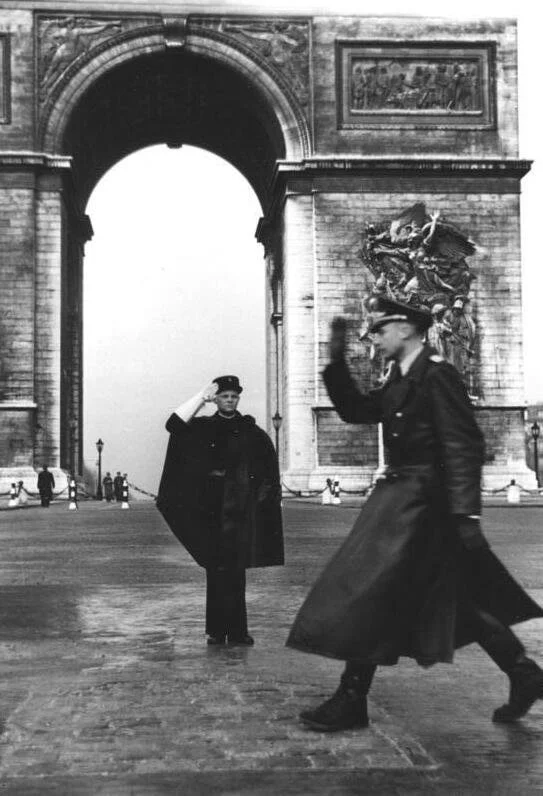
French gendarme and German officer in front of the Arc de Triomphe in Paris in 1941. Bundesarchiv, Bild 146-1978-053-30 / Jäger, Sepp / CC-BY-SA, available here.

I was not there to witness the worst, only the beginning, and even then, I was embarrassed into a sort of racialism – like being ashamed of belonging to the human race.

Mary Jayne Gold, Crossroads Marseilles 1940


Mary Jayne Gold was hurrying through Marseilles’ Place de la Préfecture, intent on renewing her Vichy-mandated foreign identity card, when a friend came barreling up from behind, bellowing her name. Her pal was panting as he delivered the bad news: local cops had just thrown Gold’s boyfriend and Resistance comrade into jail.  

“Some bastard weaseled on him!” the messenger hissed, gulping for air. Then he volunteered that Mary Jayne’s beau had lied and told the authorities that he was engaged to be married. Having a wealthy and attractive American fiancée might help him soften up the police, her boyfriend clearly reckoned.

Gold, a 31-year-old heiress (who pretended to be much younger) from Chicago, had to move fast. People snatched by the Gestapo’s Vichy stooges tended to disappear in the hellscape that was the South of France in 1940. Marseilles was swarming with so many exiles, spies, and street sharpies that it inspired the ersatz “Casablanca” that took root on the back lot of Warner Brothers two years later. The city reeked of cheap perfume, human excrement, and backstabbing.

For weeks, the Evanston debutante turned European socialite and her colleagues in the Marseilles-based American Emergency Relief Center had managed to keep Adolf Hitler’s sycophants at bay. Even with plainclothes gendarmes hounding them, Gold and company had succeeded in slipping fake identities, food, cash, and escape-route maps to refugees desperate to flee the Third Reich. Most were Jewish. But there were Christians, Muslims, agnostics, and atheists seeking sanctuary from the Nazis, too, some with spouses and children in tow, their eyes wide with fear.

Such artists as Marc Chagall, other surrealist painters and sculptors, and writer-philosopher Hannah Arendt had been plotting their escapes through the rescue committee. The group was headed by American journalist and academic Varian Fry and underwritten by U.S. philanthropists and anti-Fascists.

Now Fry’s Scarlet Pimpernel operation, which hinged on a nascent Resistance ring that stretched across both sides of the Mediterranean, was imperiled by the arrest of Gold’s lover. He was sure to be interrogated; if tortured and broken, he could compromise the entire network.

Her paramour was a half-American, half-French hoodlum turned French Legionnaire named Raymond William Couraud. He was a slippery character with back-alley connections to the Riviera’s criminal underground. Certain mob leaders had, thanks to Gold’s pocketbook and Couraud’s slick machinations, switched allegiances from the Nazis to the Allies. The gangsters’ cooperation was proving crucial in sneaking people and things away from Vichy’s prying eyes.

Everything was on the line when Gold learned that Couraud was being charged with desertion and detained on suspicion that he was abetting the forbidden Resistance. As he was being marched to his jail cell, Couraud, who was just 20 (but pretended to be much older), had the presence of mind to insist that he be allowed to see his “fiancée.” The cops agreed to send a car to bring Gold to the station.

Mary Jayne had nicknamed Couraud “Killer,” not because of his (literal) cutthroat tendencies, but because of the way he mangled the English language. Weeks earlier, Killer had forged phony Legion discharge papers. One of the arresting officers had removed the papers from Couraud’s coat pocket and put them on a desk. Somehow, without being detected, the onetime pickpocket had snatched them back. If he’d been caught with fabricated discharge documents, he knew he would have faced a long prison term, possibly a firing squad, given his ties to crime chieftains and the hated Fry. That’s why he needed Gold to show up – and in a hurry.

Mary Jayne at that moment knew nothing of Killer’s sleight-of-hand but sensed what needed to be done. She ran back to her suite at the Hôtel Continental and changed into a demure beige dress, chose a diamond ring for her left ring finger, and applied just enough makeup and Chanel to cause a French detective’s head to turn. She glanced at herself in the mirror before going downstairs to climb into the Citroěn.   

“I looked as if I had just come from a smart ladies’ luncheon,” she remembered four decades later. “I was just the kind of girl you hoped your son would marry: pretty, respectable, and rich.”

On the way to the station, Gold blithely chatted, en française, about her love for her “darling” fiancé, claiming that she couldn’t understand how he could be considered a deserter if France had already surrendered. She was hoping to butter up the cops, still fearful that they could turn nasty. Gold couldn’t help but think about the stories of people vanishing overnight while in Vichy or Gestapo custody.

When she and her two male friends arrived at what turned out to be a suspiciously makeshift jail, they discovered Killer standing in the middle of a room flanked by two detectives. He was flush-red, theatrically biting his lip and fighting back tears. Suddenly Killer burst toward Gold, begging, in French, for Mary Jayne not to forget about him.  

“I was totally unprepared for this public display but, given the circumstance, I murmured softly, ‘Of course not, darling, mon pauvre cheri,’” Gold remembered. “Our bodies were close together, his back toward the policemen. He held me in this embrace and then I could feel his hand slipping between my thighs. This was no time to begin erotic games; I slid my hand down to play interference.”

She instantly felt the “faint crinkle” of papers touching her lingerie. A moment later he was kissing her neck, then whispering in her ear, “My fake discharge papers. Here, destroy them.”

As he sleuthed the crumpled paper into her hand, she stage-whispered, in French, “My love, my only joy, I will never abandon you.”

The Vichy officials were bemused and perhaps a bit aroused by the spectacle. “They understood these things in Marseilles: love and the flesh,” Gold wrote.

Now the challenge for Gold was how to dispose of the forgery. Once Killer was taken back to his cell, she asked for permission to use the restroom. She was chagrined to discover it was a “Turk” – a lavatory without individual commodes. Given the debris clogging the drain, she didn’t think torn-up paper would make it through.

Instead, she returned to the station’s main room and – when the cops were distracted – palmed the papers to her two pals, who happened to be Couraud’s fellow Legionnaires. Since they were American nationals, however, they weren’t considered deserters. The men’s lavatory was also a Turk, but the drain was less congested. They tore the paper into tiny pieces and watched them disappear.

Couraud would be incarcerated for the next four months, but thanks to a pile of francs that Gold slipped to a crony of the presiding judge, Raymond averted a lengthy sentence or an appointment with the executioner.  

Mary Jayne Gold and Raymond William Couraud – rebels, spies, torrid lovers – had dodged another Axis bullet. For Couraud, it would be far from the last. He would go on to become one of the most heavily decorated Allied commandos of WWII, a saboteur who specialized in behind-enemy-lines bushwhacking and an assassin entrusted with directing one of the war’s biggest hush-hush operations, the attempted July 1944 kidnapping of German Field Marshall Erwin Rommel in Normandy.

Couraud was also a crook, a bigamist, a mercenary drummed out of Britain’s two leading special ops forces, and, at the end of the war, a soldier accused of collaborating with a suspected enemy agent. Like his wartime lover, his life unspooled as if it were a Saturday matinee thriller: one do-or-die cliffhanger moment after another, peppered with plenty of forbidden romance and a contempt for authority.


Did you find that piece interesting? If so, join us for free by clicking here.


About the Author

Timothy M. Gay is the author of two critically acclaimed books on World War II: Assignment to Hell: The War Against Nazi Germany with Correspondents Walter Cronkite, Andy Rooney, A.J. Liebling, Homer Bigart, and Hal Boyle(NAL/Penguin, 2012) and Savage Will: The Daring Escape of Americans Trapped Behind Nazi Lines (NAL/Penguin, 2013). Tom Brokaw called Assignment to Hell, which was nominated for a Pulitzer, a Bancroft, and an American Book Award, “a book every modern journalist – and citizen – should read.” Historian Marcus Brotherton wrote that Savage Will was “powerful, intriguing, well-researched, and fierce.”

Gay’s lengthy article on the citizen response to the Nazi U-boat threat in U.S. waters early in WWII was featured in a pandemic-inspired special issue of American Heritage called “America in Crisis.”

He has been featured on PBS’ “History Detectives” and contributed on-camera and off- to two documentaries – one on Walter Cronkite’s coverage of the Kennedy assassination, the other on Lyndon Johnson’s legacy on civil rights – which have appeared in Britain and the U.S.

His latest book is RORY LAND, a biography of golf superstar Rory McIlroy. It looks at McIlroy’s life through the prism of Ireland’s sectarian Troubles that devastated both sides of his family.

Posted
AuthorGeorge Levrier-Jones

Operation Frankton was a covert military operation carried out by the Royal Marines during the Second World War and was one of the most audacious and daring raids in military history. The raid was executed in December 1942 and targeted the German-occupied French port of Bordeaux, a crucial hub for the Axis powers, which facilitated the movement of supplies critical to the German war effort. The operation, led by a small group of commandos, was remarkable not only for its boldness but also for its significant impact on the war effort. Delving into the main reasons behind the mission, the key figures involved, and the importance of the operation, it is also possible to lightly explore the separately planned parallel mission by the Special Operations Executive (SOE) against the same targets.

Terry Bailey explains.

Tannenfels, a German blockade runner which was sunk.

The Strategic Importance of Bordeaux

Bordeaux, located in southwest France along the Garonne River, was a vital port for the Axis powers during the Second World War. Following the fall of France in 1940, the German military took control of the port and used it to facilitate the movement of supplies utilizing blockade runners. The port was especially important for the transit of rubber, which was essential for manufacturing tires and other military equipment. The loss of Bordeaux would disrupt the supply lines and put a significant strain on the German war machine, making it a prime target for Allied forces.

The British Admiralty recognized the strategic value of targeting Bordeaux early in the war. However, conventional bombing raids were deemed too risky to the civilian population and ineffective due to the heavy defenses surrounding the port. The need for a more unconventional approach led to the conception of Operation Frankton, a mission designed to strike at the heart of the German supply chain with minimal resources.


The Planning of Operation Frankton

The idea for Operation Frankton was conceived by Major Herbert "Blondie" Hasler, a Royal Marines officer with a background in unconventional warfare and small boats. Hasler, who had previously served as a fleet landing officer in Scapa Flow, was then sent to Narvik in support of the French Foreign Legion in the Norwegian campaign, for which duties he was appointed an Officer of the Order of the British Empire (OBE), mentioned in dispatches, and awarded the French Croix de Guerre.

He was known for his innovative thinking and determination and believed that a small, highly trained team could infiltrate the heavily guarded port using kayaks, plant explosive charges on the ships, and escape undetected. The operation would rely on stealth, surprise, and the ability to navigate the treacherous waters of the Gironde estuary.

Hasler's plan was initially met with skepticism by some members of the Admiralty, who viewed it as too risky and unlikely to succeed. However, Hasler's persistence, coupled with the lack of viable alternatives, eventually won over his superiors. The operation was given the green light, and Hasler was put in charge of selecting and training the men who would carry out the raid.

The men Hasler recruited became part of the Royal Marine Boom Patrol Detachment which was part of combined operations. The group who carried out the raid consisted of 13 Royal Marines, including Hasler himself, 6 two-man teams plus one reserve. The men were chosen for their physical fitness, mental toughness, and ability to operate under extreme conditions. They underwent rigorous training in kayaking, explosives, and navigation, practicing initially in the waters in southern England, and eventually in the cold and treacherous waters off the coast of Scotland.

The operation was set to take place in December 1942, during the winter, when the long nights would provide the cover of darkness needed for the raid. The men would use specially designed folding kayaks, nicknamed "cockles," to navigate the Gironde estuary and reach the port of Bordeaux. Once there, they would attach limpet mines to the hulls of the German blockade-running ships and then attempt to escape through France to Spain, with the help of the French Resistance.


The Execution of the Raid

The operation began on the night of the 7th of December, 1942, when Royal Navy submarine HMS Tuna sailed from Holy Loch in Scotland with the six kayaks and raiders on board, where the men were dropped off the coast of France, near the mouth of the Gironde estuary. The plan was for the men to paddle their kayaks up the estuary, cover a distance of around 70 miles, and reach the port of Bordeaux within four nights.

The hull of Cachalot was damaged while being passed out of the submarine hatch, leaving just five kayaks to start the raid. The reserve member of the team, Colley, was not needed, so he remained aboard the submarine with the Cachalot crew Ellery and Fisher.

The first night of the mission was fraught with difficulties. The strong currents and freezing temperatures took a toll on the men, fighting against strong cross tides and cross winds, Coalfish became separated. The remaining kayaks then encountered 5 ft (1.5 m) high waves and Conger capsized and had to be scuttled, once it became apparent that it would not be possible to bail it out, Sheard and Moffatt held on to two of the remaining kayaks, which carried them as close to the shore as possible, then had to swim for it, the remaining kayaks then came across the separated Coalfish.

As the conditions deteriorated Mackinnon and Conway in Cuttlefish became separated from the other kayaks in the group. After reaching the shore, MacKinnon and Conway evaded capture for four days but were betrayed and arrested by the Gendarmerie and handed over to the Germans at La Reole hospital 30 miles southeast of Bordeaux, while attempting to make their way to the Spanish border.

The 3 remaining kayaks, Catfish, Crayfish and Coalfish, covered 20 miles in five hours landed near St Vivien du Medoc, and laid up through the day, however, while resting during the day and unknown to the others, Wallace and Ewart in Coalfish had been captured at daybreak near the Pointe de Grave lighthouse where they had come ashore, now they were only 2.

The second night, 8/9 December, the two remaining kayaks Catfish and Crayfish paddled a further 22 miles in six hours. On the third night, 9/10 December, they paddled 15 miles and on the fourth night, 10/11 December, because of the strong ebb tide they only managed to cover 9 miles.

Hasler's original plan was for the raid to be carried out on the 10th of December, but now Hasler had to change his plan, due to the strength of the ebb tide they still had a short distance to paddle, so the remaining commandos laid up for another day, setting off to and reach Bordeaux on the night of 11/12 December.

On the night of the 11th of December, 1942, after four grueling nights of paddling, avoiding German patrols, the surviving commandos reached the port of Bordeaux. The men split into two teams, with Hasler and Marine Bill Sparks in the kayak Catfish taking one side of the port and Corporal Albert Laver and Marine William Mills in the kayak Crayfish taking the other side of the port. Using limpet mines, the teams successfully attached explosives to the hulls of six German ships. The explosives were set to detonate in the early hours of the morning, ensuring the commandos had time to extract themselves from the immediate area.

The raiders then made their escape, splitting up into pairs and heading in different directions to avoid capture. Hasler and Sparks managed to make contact with the French Resistance and began their journey south towards Spain. Laver and Ellery, however, were not as fortunate. They were captured by the Germans a few days later and executed, as part of Hitler's infamous commando order. Hasler and Sparks, after a harrowing journey through occupied France, eventually reached Spain and were repatriated to the United Kingdom via Gibraltar in April 1943.


The Aftermath and Impact of Operation Frankton

Operation Frankton was a tactical success, with 2 ships sunk, 2 ships several damaged and a further 2 ships slightly damaged. The damage to the ships and the resulting disruption to German supply lines had a significant impact on the war effort. The raid also had a profound psychological effect, demonstrating that even heavily guarded ports were vulnerable to small, highly trained commando units.

However, the mission came at a high cost. Of the 10 men who set out on the raid, only 2 survived, Hasler and Bill Sparks, 6 were captured and executed by the Germans, while 2 were lost at sea. Despite these losses, the bravery and determination of the Royal Marines became a symbol of courage and ingenuity.


Winston Churchill, the British Prime Minister, later praised the operation, stating that it shortened the war by six months. While this claim is difficult to verify, there is no doubt that Operation Frankton had a significant impact on the course of the war, both strategically and symbolically. The Germans defined the raid as the most daring raid of the Second World War.


The Parallel Mission by the Special Operations Executive (SOE)

While Operation Frankton is the most well-known raid on Bordeaux, it is important to note that the SOE had also planned a 2 part parallel mission against the same targets. The SOE, a British organization responsible for conducting espionage, and sabotage in occupied Europe, recognized the importance of disrupting German supply lines in Bordeaux.

A team led by Claude de Baissac of the Special Operations Executive were preparing to take explosives onto the ships when he heard the explosions of Hasler's limpet mines. The loss of the opportunity for Hasler and de Baissac to work together to strike a harder blow against the Germans was a hard lesson.

The other aspect of the SOE's plan was codenamed "Operation Josephine B," which involved a sabotage mission aimed at destroying the electricity supply to the port of Bordeaux. The mission was to be carried out by a team of SOE and French resistance, who would infiltrate the power station and plant explosives to disable the facility. The objective was to cut off electricity to the port, rendering the German ships and facilities inoperable.

Operation Josephine B was planned to take place around the same time as Operation Frankton, this aspect of the SOE mission was delayed due to difficulties in securing the necessary explosives and logistical support. By the time the mission was ready to go ahead, Operation Frankton had already been executed.

Despite the delay, Operation Josephine B was eventually carried out in June 1943, and the power station was successfully sabotaged. The mission achieved its objective, but the impact was somewhat mitigated by the fact that the ships in the port had already been severely damaged by Operation Frankton. The SOE's mission, while important, is often overshadowed by the daring and dramatic nature of the Royal Marines' raid.

The SOE was aware of the Royal Marines' mission, but the Royal Marines were unaware of the SOE mission due to SOE's secrecy policy. However, after Operation Frankton a clearing and controlling house was set up that would coordinate all special operations in the future ensuring that missions did not clash, this process is still in place today.

In conclusion, Operation Frankton stands as a testament to the courage, ingenuity, and determination of the Royal Marines during the Second World War. The raid on Bordeaux, carried out by a small team of commandos using unconventional methods, dealt a significant blow to the German war effort and demonstrated the vulnerability of even the most heavily defended targets.

The operation also highlighted the importance of coordinated efforts in warfare, as the separately planned SOE mission against the same targets showed. While both missions were successful in their own right, the lack of coordination between these missions is a reminder of the challenges faced by Allied forces in executing complex operations during the Second World War and the loss of a greater blow to the Germans.

The legacy of Operation Frankton lives on, not only in military history but also in the broader narrative of the Second World War. The bravery and sacrifice of the Royal Marines continue to inspire generations of military personnel and serve as a powerful example of what can be achieved through courage, ingenuity, and determination in the face of overwhelming odds.


The site has been offering a wide variety of high-quality, free history content since 2012. If you’d like to say ‘thank you’ and help us with site running costs, please consider donating here.


Notes:

The Bordeaux raiding team consisted of:

A Division

Blondie Hasler and Marine Bill Sparks in kayak Catfish.

Corporal Albert Laver and Marine William Mills in kayak Crayfish.

Corporal George Sheard and Marine David Moffatt in kayak Conger.


B Division

Lieutenant John Mackinnon and Marine James Conway in kayak Cuttlefish.

Sergeant Samuel Wallace and Marine Robert Ewart in kayak Coalfish.

Marine W. A. Ellery and Marine E. Fisher in kayak Cachalot.

A thirteenth man was taken as a reserve, Marine Norman Colley.


Blockade runner

A blockade runner is a light fast merchant vessel used to evade a naval blockade of a port or strait. In addition to, speed it uses stealth, blockade runners transport cargo, such as food or arms to a blockaded city.


The Special Boat Service

The Special Boat Service (SBS) is a special forces unit of the United Kingdom under the control of Royal Navy admiralty and part of the Royal Marine Commando.

The SBS traces its origins back to the Second World War when the Army Special Boat Section was formed in 1940 as a sub-unit of the Special Air Service, (SAS). However, after the Second World War, the Royal Navy through the Royal Marines commando formed the SBS special forces, initially as the Special Boat Company in 1951 then re-designated as the Special Boat Squadron in 1974—until on the 28th of July, 1987 the unit was formally renamed as the Special Boat Service, bringing it inline from a naming point of view with the army special forces unit the Special Air Service, (SAS), warranting the SBS its own budget.

The reformation of the SBS after the Second World War as part of the Royal Marine Commandos is in part due to Operation Frankton by the Royal Marine Boom Patrol Detachment (RMBPD).


Words of Lord Mountbatten, the commander of Combined Operations

Mountbatten's words are carved into a stone at the Royal Marine Commando base in Poole, Dorset, (the current headquarters of the SBS).

"Of the many brave and dashing raids carried out by the men of Combined Operations Command none was more courageous or imaginative than Operation Frankton".


Point of interest:

The reader may be interested to know that the author of this article personally met and knew both Blondie Hasler and Bill Sparks in the early 1980s.


Herbert George "Blondie" Hasler, DSO, OBE

Herbert George "Blondie" Hasler, DSO, OBE (27 February 1914 – 5 May 1987) served as an officer in the Royal Marines and retired as a Lieutenant Colonel.


He was recommended for the Victoria Cross, for Operation Frankton, however, he was not eligible as his actions were not "in the face of the enemy" as required for that decoration.


William, (Bill), Edward Sparks DSM

William, (Bill), Edward Sparks DSM (5 September 1922 – 1 December 2002) was a British Royal Marine Commando in the Second World War.

He volunteered for hazardous service as a way of avenging his brother Benny who had died on the cruiser HMS Naiad.

One of his three sons Terry Sparks, became a Captain in the Royal Marine Commandos


Corporal Albert Laver and Marine William Mills

Corporal Albert Laver and Marine William Mills in the kayak Crayfish were also recommended for the DSM which at the time could not be awarded posthumously, so instead were mentioned in dispatches.