By the mid-1920s, one in six American families owned a car, and the Federal Highway Act of 1921 had funded a national network of roads suitable for automobiles. Europe lagged far behind. Automobiles were still largely a status symbol and even major roads were woefully unsuited for long journeys by car. In the rest of the world, automobiles were rare, and the roads on which to drive them were limited to the areas in and immediately around major cities. Most people in rural India, China, and elsewhere had never seen a car, and the roads they used to get from place to place were suitable only for foot traffic and carts.  But driving became intoxicating for a small number of auto enthusiasts who decided it would be possible to travel the world by car, and both of the serious global circumnavigation efforts in the 1920s involved women who felt born to drive.

Laurel Corona explains.

Laurel has written the book Aloha Wanderwell Takes the Wheel (Amazon US | Amazon UK)
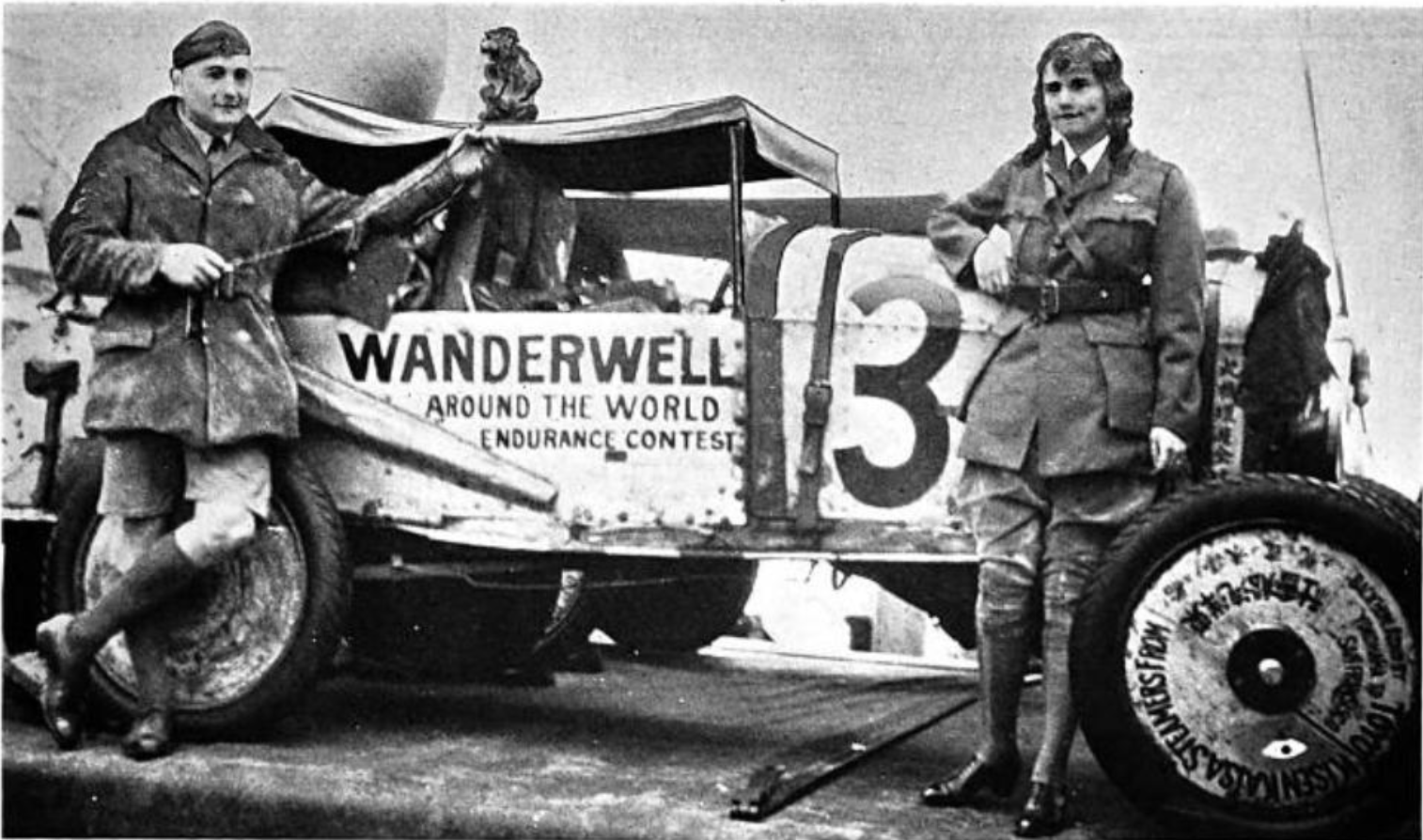
Walter and Aloha Wanderwell with their Ford car. Source: Public domain, "Greetings and Goodbyes" Japan Overseas Travel Magazine 14 (March 1925): 47. Available here.

The Guinness Book of World Records acknowledges that the first woman to drive around the world was Aloha Wanderwell. She was born Idris Hall in Winnipeg in 1906 and spent her childhood in Qualicum Beach, on Vancouver Island, British Columbia. While Idris was in her teens, her mother relocated the family to France, and while in boarding school in Nice, Idris ran across an advertisement Walter “Cap” Wanderwell had put in the local paper for a woman with “Brains, Beauty, and Breeches” to join his around-the-world expedition by automobile. Though only sixteen, Idris got her mother’s permission to join for the short time the expedition would be in France. She changed her name to Aloha Wanderwell and never looked back.

Walter Wanderwell was a pioneer. In addition to his groundbreaking expedition, he was the first to underwrite a travel adventure by making films (in his time still silent and black-and-white) of his travels. At a time when most people did not venture far from their place of birth, audience paid a small admission fee to see his films of faraway parts of the world, while youthful and attractive expedition members hawked brochures and postcards for a little extra cash outside the theaters. Cap was a brilliant, self-taught engineer. Though his cars were called Model Ts, they really were Wanderwell cars. He built the cars using a Model T chassis, relying on Ford parts because Ford had by far the largest distribution around the world and it would make getting parts easier in remote locations. He built them with extra storage for supplies and fuel, and in a later model, a built-in darkroom that could be pulled out on hinges from the trunk to develop their film before they reached their next stop. Construction from aluminum and other lightweight materials made the cars easier to push or drag across inhospitable terrain. This made them painfully bouncy, and the substitution of a tarp for a roof made the journey even more uncomfortable. Most crew quit within a few months from the hardship of the road, but Aloha would continue traveling with Cap for the next decade, eventually marrying him.


Aloha and Walter Wanderwell’s Route Around the World

The route around the world was not meant to be in a straightforward line, and they set no timetable, or even a concrete plan for much of it. In fact, they spend one entire year driving around Europe before setting out for Egypt. After driving the length of Egypt, they went by steamer to India, and she and Cap, now in two cars and without any other crew, drove 1100 miles across India. Teams of oxen dragged them across rivers and marshes, and they battled deserts, monsoons, and nearly impenetrable terrain. From India they went by steamer to Malaysia and after a stop in Singapore they began their drive the length of eastern China. Eventually they arrived in Vladivostok, where Aloha celebrated her eighteenth birthday. They continued on through Japan, Hawaii, and across the United States to Detroit, where the expedition officially ended.


Later Travels

Aloha and Cap went on to travel nearly the entire length of Africa on their “Cape to Cairo” expedition, but were stopped by a murderous civil war in Sudan and ended their African adventure in Mombasa. Next, they undertook another daring expedition in South America, driving from Buenos Aires across the Andes to Lima, where the crew disbanded. Cap and Aloha made the rest of the drive by themselves up through Central America to the United States. It would be their last adventure together. Wanting to try something new, Cap bought a schooner to sail around the world, but in December 1934, an assailant came aboard and killed him. The murder and subsequent trial were the subject of a devastating tabloid frenzy for Aloha, made worse by the insinuations that she was involved, and the shocking acquittal of the obvious suspect. Aloha tried to continue the travel film adventures without Walter, but wasn’t able to adapt to the new technologies of sound and color, and audiences for her personally narrated films waned when she was no longer an ingenue. She married again and settled into a comfortable life in Newport Beach, California, where she died in 1996 shortly before her ninetieth birthday.


Clärenore Stinnes

The other person to lay claim to the title of first woman to drive around the world is Clara Eleonore Stinnes, who went by the name Clärenore. She was the daughter of a wealthy German industrialist, who in her twenties took up auto racing as a hobby. When she began winning shorter races, she decided to enter endurance contests, and in 1925 she became the only woman to win a 2600-kilometer race across western Russia. It was on that race that she decided she wanted to drive around the world. Clärenore had substantial backing for her project, including a cash reserve, a diplomatic passport, two mechanics, a supply truck, and supplies of gasoline and spare parts that were pre-ordered and waiting for her on her scheduled stops along her route. Traveling with her was Carl-Axel Söderström, a Swedish film maker. Their route took them by land across Asia to Beijing. After being stranded for months in the Russian winter, they resumed the drive to Beijing, and returned by ship via Japan, Hawaii, and the United States. Two years after setting out, they returned to Berlin.  Stinnes and Söderström married in 1930, and were done with their world travels, retreating to Sweden, where they bought a farm and raised their children. She lived to be 89, dying in 1990.


The Two Journeys Compared and Contrasted

While the hardships of driving in much of the world were comparable, the logistics were different. Clärenore’s journey was planned out meticulously and well financed. The Wanderwell expedition made its way by raising money on the spot. They had only a general sense of their itinerary and often took side trips when they heard about something out of the way that sounded worth exploring. Clärenore’s itinerary was designed to take her in as straight a route as possible. Clärenore and Aloha’s roles were different as well. Clärenore was clearly in charge of her project, and although the strikingly beautiful Aloha was the star of the Wanderwell expedition, Cap was its undisputed leader. Although Clärenore was quite young, still in her twenties at the time she set out, Aloha was only sixteen when she joined the Wanderwell expedition, and her extreme youth is another differentiating factor.  Aloha and Cap thrived on the fame and attention they received, whereas Clärenore was more focused on succeeding at the task she had set for herself. And of course, a final difference is that when Clärenore succeeded, she was finished. Cap and Aloha went on to travel the world for ten years total, across five continents, before Cap’s murder put an end to their life together.


Who Was First?

The question of whether Aloha or Cläremore deserves acknowledgment as the first woman to complete an around-the-world expedition by automobile has been contentious. At first glance, it would appear that Aloha is the clear winner, because her journey was complete before Clärenore even set out.  However, Clärenore’s journey from Europe to China was entirely by land, and the Wanderwells took freighters from Aden to India and from India to Penang, Malaysia. Because of a civil war in China, one stretch was taken by train for safety. Therefore, Clärenore’s journey was more completely done by car. Some argue, however, that because the oceans make it impossible to drive around the world anyway, the important thing is who got back to their starting point first after driving across every land mass they encountered on whatever route they chose. A semantic argument has arisen as well over what constitutes an expedition. Some argue that because Clärenore’s sole purpose was to drive in as direct a manner as possible around the world, her journey might more properly be called an expedition. The Wanderwells took their time and did so much else along the way that perhaps theirs should be called something else, like a global travel adventure. In fact, in promotional materials for the expedition, Cap gave the dates as “1921-?” Indicating that its purpose went far beyond making the most direct circuit around the globe. Hair splitting aside, the important thing is that the first two successful circumnavigations of the globe both had women at the wheel. Aloha and Clärenore defied the gender expectations of their time and did something thought impossible even for men of their day. Though there is no evidence they ever met, they are clearly kindred spirits who leave behind one of the most fascinating but underappreciated stories in automotive history.


Laurel’s book is out now: Aloha Wanderwell Takes the Wheel (Amazon US | Amazon UK)

Fordlândia was an idea of the great carmaker Henry Ford in the 1920s. He set-up a base in the Brazilian Amazon with the aim of producing rubber for car tires. In this excellent piece, Felix Debieux looks at what happened at Fordlândia – and how grand ambitions ultimately turned to failure.

Water tower and warehouse building in Fordlândia, Brazil in 2010. Source: Amit Evron, available here.

What do Ford, Firestone and Goodyear have in common? You would be right to say that they are all major players in today’s automotive industry. What is not so well remembered, however, is their shared historical interest in the Amazon rainforest. In the second half of the 1920s, clandestine explorations were conducted by engineers and geologists from Britain and North America who hoped to find oil, precious minerals, and promising locations for rubber plantations. Each sought to tempt the automotive giants to the jungle with land capable of growing the crucial raw material they needed to make their product: tires. 

Following negotiations with Amazonian state governments for concessions, each speculator was convinced that they had secured the rights to exploit the most valuable territory. By 1927, one speculator successfully acquired 2.5 million acres – an area 82% the size of Connecticut - on the Tapajós River in the Amazonian state of Pará. As an indication of the vastness and remoteness of the area, he not only managed to plant half a million rubber seedlings, but also arranged for an armed security force to protect the operation from rival speculators. Later, this land was acquired by American industrial magnate Henry Ford who set out to grow a new supply of rubber. Rubber, however, is only part of the story. Indeed, this marked the beginning of a bizarre socio-economic experiment in the Amazon spearheaded by America’s premier innovator. In his day, Ford’s name was every bit as evocative as the glimmering promise of technological revolution as Elon Musk or Mark Zuckerberg, and he planned to build an American city smack in the middle of the jungle. Like other empire builders preceding him, he would name the city after himself: Fordlândia. 


Ford’s motivation: an industrialist in the jungle

Henry Ford’s foray into the jungle was, first and foremost, a pragmatic move. In 1922, exports of rubber from Asian plantations were made much more difficult by the Stevenson Plan. Concocted by British and French planters, the Stevenson Plan created an artificial global rubber shortage and succeeded in inflating its price on the international market. As the consumer of 70% of the world’s rubber supply, manufacturers operating in North America were left with little choice but to seek alternative sources. While Firestone decided to invest in Liberian plantations, and Goodyear planted in Sumatra and the Philippines, Ford cast his eye on South America. 

In growing his own supply, Ford believed that he could establish a rubber autarchy: a system of total self-sufficiency from rubber seedling through to tires. For Ford, this must have seemed entirely feasible. After all, the Ford Motor Company during the 1920s controlled nearly every raw material that constituted the manufacture of a motorcar. The glass, the wood, the iron; everything except latex produced by rubber trees. Alongside Ford’s other innovations, anything must have seemed possible. Indeed, this was the man who:

§  Had by 1926 established the Ford Air Transport Service: the first private contractor to deliver mail for the U.S government.

§  Had transformed a bankrupt Michigan railway into a temporarily successful operation.

§  Had developed revolutionary new glassmaking techniques. 

§  Had improved coalmining technology.

How hard could running a rubber plantation be?


Doomed from the start? A legacy of failure in the Amazon

Preceding Henry Ford’s Amazonian enterprise was a catalogue of foreign projects aimed at extracting the region’s wealth. Many of these schemes were highly problematic but did not register in Ford’s planning. Take Lt. Matthew Fontaine Maury as an example. Back in the 1850s, the Director of the U.S. Naval Observatory promoted North American occupation of the Amazon drainage as a dumping group for southern planters and their slaves. At a time when Brazil guarded its northern regions from foreign trade and navigation, Brazilians suspected that Maury’s ideas would mean the forceful opening of the Amazon to U.S. colonialism. 

Suspicions of colonialism continued into the 1860s, when a scientific expedition led by Louis and Elizabeth Agassiz influenced Emperor Dom Pedro II to open up the Brazilian Amazon to international trade and navigation. The threat of foreign exploitation emerged again at the turn of the century, when the Anglo-American ‘Bolivian Syndicate’ put forward an idea to develop a rich rubber territory disputed by Bolivia and Brazil. While Brazilian’s were certainly wary of North American colonialism, there was also a legacy of disappointment rooted in the repeated failure of development projects. At best, foreign projects were over-ambitious and ill-conceived. At worst, they were exploitative.

Ford remained oblivious to the enduring stigma of failure surrounding the region’s development. Indeed, several calamitous infrastructure projects pointed to major geographical and public health obstacles inherent to the Amazon. Perhaps the best example of the difficulties a foreign enterprise might encounter was the 226-mile Madeira-Mamoré Railway. During the construction of what became known as the ‘Devil’s Road’, a combination of malaria, yellow fever and other causes claimed the lives of anywhere between 6,000 and 30,000 men. Of greater relevance to Ford, however, was the bad reputation, which Amazonian rubber production had acquired among Brazilians. Labor exploitation, whether through debt peonage or outright slavery, played a major part in the industry’s notoriety. Again, the region’s history did not bode well for Ford.


Putting the conscience in capitalism

Given the stigma surrounding North American interest in the Amazon, it is not surprising to learn that Brazilians questioned Henry Ford’s motives. Many feared that Ford might use the contractual privileges of his concession to undermine national and state sovereignty. What distinguished Ford from other foreigners, however, were his reputation as a reformer of industry and his enlightened social and economic ideas. Indeed, his biography My Life and Work (published in Portuguese in 1926) went a long way to reassure literate Brazilians that Ford represented capitalism with a conscience. 

Emphasizing Ford’s benevolent intentions for the region were his allies in the Brazilian government and the press, who helped to cultivate the image of Ford as a reformer. It was claimed that Ford would transform the Amazon and bring about unprecedented benefits for its impoverished workers. Ford packaged his offer with a promise to develop the region and to manufacture tires and other rubber articles in Brazil. A little showmanship, too, was considered. Reportedly, Ford toyed with the idea of journeying to Pará with Charles Lindberg, who at the time was planning a 9,000-mile tour of Latin America aboard his famous plane: The Spirit of St. Louis. Ultimately, a combination of lobbying and a careful public relations campaign helped to convince Brazilians of Ford’s honest intentions. 


A sign of things to come

In December 1928, Henry Ford’s freighters – the Lake Ormac and the Lake Farge – arrived at the site of what would become Fordlândia to begin construction. On board the ships were an entire railway, a disassembled warehouse, a tugboat, and an arsenal of equipment needed to build a self-sufficient rubber plantation. It was not long before the first signs of trouble appeared. When the plantation manager quit his post and returned home to the U.S., the project was left in the hands of Danish sea captain Einard Oxholm who knew nothing about growing rubber. Ford, who wholeheartedly believed that any man could quickly master a field outside of his own expertise, decided that the Dane was the right person for the job. Unfortunately for Oxholm, his reputation for integrity gave Brazilian and European entrepreneurs all the encouragement they needed to overcharge the plantation for key supplies and services. 

Just one month later, Ford had already spent more than $1.5 million and had virtually nothing to show for it. What is more, 95% of the rubber tree seedlings planted by the end of 1929 were either dying or dead. These were huge problems which defied a solution. Indeed, even the very land on which Fordlândia was constructed was a poor choice. The site, again chosen by a man with zero agricultural experience, was hilly, prone to erosion, and miles away from any settlement. Instead of kitting his plantation with managers and every piece of available technology, Ford would have been better served had he employed biologists who understood the rainforest. Not a single one was consulted in the planning process.

During this period of waste and incompetent management, Brazilian officials struggled to reconcile Ford’s reputation for efficiency with the chaos on show at Fordlândia. How was Ford, an industrial genius, making such a hash of this project? One observer reported that:

There is a complete lack of organisation at the property. No one knows what the whole picture should be. Waste is terrible… I can well understand the Minister of Agriculture in Rio should think we are crazy… At present, it is like dropping money into a sewer”.


While the physical plantation reached impressive proportions, this was in reality a façade for a failing operation.


Experimenting with an agro-industrial utopia

While the rubber plantation continued to stutter, Henry Ford pushed for a diversification of activities at Fordlândia. Seeking to deliver his promised social and economic benefits, Ford’s plantation would boast comfortable employee housing, a school, a well-equipped modern hospital, a power plant, a sanitary water supply, thirty miles of road and reportedly the largest sawmill in Brazil. Plans were made to export lumber, to produce wooden auto parts for export, and to manufacture tiles and bricks. In addition, there were also plans for both a tire factory and a city with the capacity for 10,000 Brazilians. By the end of 1930, Fordlândia’s landmark structure was complete: a water tower, which stood as a beacon of Ford’s ‘civilizing’ project. This increased breadth of operations represented key pillars of Ford’s personal philosophy: small-town America, and the marriage of agriculture and industry. 

Ford’s nostalgia for an agrarian, small-town America was a prevalent feature of Fordlândia. While he certainly did promise to develop the Amazon, the improved life he envisioned for his workers was very specific and closely resembled the Midwestern towns of his childhood. Having grown up on a farm, the industrialist believed that there was a symbiotic relationship between agriculture and industry. Mechanization, he thought, would not only reduce the waste and drudgery of antiquated farming, but it would also free up the farmer to work in the factory and provide spare time for agricultural pursuits. Fordlândia presented an opportunity to make his unique vision of an agro-industrial utopia a reality. As Ford himself put it in his Ford Evening Hour Sermonettes, this would be a world in which workers had “one foot in industry and one foot on the land”. However, he would eventually learn that the culture he longed for could not so easily be transplanted into the jungle.


Rumble in the jungle: a clash of cultures

For all their suspicions of U.S colonialism, Brazilians and their dependents living at Fordlândia did receive the amenities and provisions promised to them. Indeed, Fordlândia was always about much more than rubber, with Henry Ford seeking to recreate an idyllic American society founded on his own morals and values. Amazonians employed by Ford received a free home, free medical and dental care, recreational facilities, and a wage ranging from the equivalent of thirty-three to sixty-six cents per day. This was at least twice the wages paid elsewhere in the region. Furthermore, workers were able to buy food and other supplies at prices subsidized by Ford. Other free provisions included pasteurized baby milk and burials at the company cemetery. From cradle to grave, workers could expect to live comfortably under Ford’s paternalism.

On the face of it, Fordlândia represented a capitalist’s paradise. However, Ford never succeeding in imposing his alien philosophy on the Amazon; the region’s ingrained cultural and economic traditions were not so easily replaced. Indeed, Brazilians simply did not understand Ford’s idealized vision of small-town America. One example is Ford’s attempt to supplant the traditional role of patrão, which in Brazilian society served as both boss and indulgent parent to the workers. The patrão not only held workers in debt servitude, but he also supported as a godfather and protector figure. The position certainly did not fit the Ford mold of efficiency, and was not suited to the modern employer-employee relationships which Fordlândia hoped to instill. 

Brazilian work culture remained an enigma to Ford. His obsession with timesaving and efficiency served only to annoy his workers who would not accept a rigid work regime. Most disliked the way they were treated - being required to wear ID badges and work through the afternoon under the sweltering sun - and refused to work. Unfamiliar food, such as canned goods and hamburgers, caused further discontent. The tipping point came in 1930 when the plantation dining hall shifted from waited service to cafeteria-style self-service. This change, intended to reduce lunch breaks, would quickly backfire. Workers queuing in line with their trays complained that they were not waiters. Foremen were equally furious, realizing that the new system meant eating in the same manner as their workers. Anger descended into rioting. Workers, armed with shotguns and machetes, and proceeded to rampage through the plantation and chase Fordlândia’s managers (and the town’s cook) into the jungle for a few days until the Brazilian Army arrived to quash the revolt. 

Not understanding Brazilian dining preferences was one thing, but there were other facets of the local culture which persistently baffled Ford. High wages, for instance, failed to ensure that workers would stick around because there was no consumer society in the Amazon on which to spend hard-earned cash. Workers might commit for a few weeks but would then disappear back into the rainforest to work on their own land. While this infuriated Fordlândia’s managers, the cultural disconnect was just as glaring outside of the workplace. Indeed, Ford had very specific ideas about how a society should function, and the sorts of activities people should enjoy. One example was square dancing. Having met his wife at a square dance, Ford decided it would be a good idea to build a large dance hall at the plantation. Although this proved to be unpopular, it was not as unpopular as Ford’s decision to prohibit alcohol. Even though drinking was perfectly legal in Brazil, Ford was a teetotaller and did not see a place for alcohol in his utopia. Like many cultural impositions in Fordlândia, prohibition failed too. Workers continued to drink their customary cachaça, and many travelled down river to a nearby bar and brothel on the aptly named ‘Island of Innocence’.


A predictable end

What became of Fordlândia? After the riot, Fordlândia experienced somewhat of a change in fortune. At long last a successful manager was found in Archibald Johnston, who pushed forward with the construction of housing, and the roads needed to link Fordlândia to the huge territory Ford had acquired inland from the river. Johnston even managed to implement some of Ford’s social ideas, including an emphasis on gardening and strict diets. None of this, however, could compensate for the elephant in the room: Fordlândia was not producing any rubber. Acre after acre of jungle was cleared to make room for rubber trees, but this yielded very poor results. Even when did trees did take root they quickly succumbed to disease. 

Still, Ford did not give up on his vision of rubber self-sufficiency. He hired James Weir, an expert botanist, whose insistence on extravagant planting methods left Johnston exasperated. The biggest demand on Johnston’s list was the construction of a second plantation within Fordlândia, which meant relocating much of the project downstream to Belterra where better growing conditions could be found. Despite the attempt to inject new life into Fordlândia, Weir abandoned the project without notice just a year later. Around the same time, industry advances in the production of synthetic rubber reduced the global demand for natural rubber. 

The close of the Second World War represented a clear turning point for Fordlândia. By then, Ford himself was in poor health and so management of the company fell to his grandson. Henry Ford II, seeking to rein in the company’s spiraling costs, decided to amputate any underperforming assets. This included Fordlândia, which was sold back to Brazil for just a fraction of the purchase price. Perplexed Brazilian residents looked on as their neighbors quickly packed up and headed back home. In stark contrast to the publicity and excitement surrounding Fordlândia’s creation, the project ultimately died a very quiet death. 

While no man better exemplified American ingenuity and industry, Ford’s planned utopia proved to be a colossal error.  It is unfortunate that it took Ford nearly two decades to recognize the error and cut his losses. Left to vandals and to rust in the humid Amazon air were the generator, the sawmill and much of the equipment. The landmark water tower still stands today, although the Ford logo which once represented ‘civilization’ has long since faded. While there has in recent years been a surge in Fordlândia’s population (in 2017 a population of approximately 3,000 people was recorded), the city today is arguably more useful as a parable. As historian Greg Grandin puts it: 

“It’s a parable of arrogance, but the arrogance isn’t that Ford thought he could tame and conquer the Amazon. He had his sights on something actually much bigger. He thought he could tame and conquer capitalism, industrial capitalism. That didn’t happen”.


What do you think of Fordlândia? Let us know below.

References

Industrialist in the Wilderness: Henry Ford's Amazon Venture, John Galey, Journal of Interamerican Studies and World Affairs, Vol. 21, No. 2, May 1979, pp. 261-289.

Ever Heard of Henry Ford's Colossal Failed City in the Jungle?Entrepreneur Europe, 16 January 2019.

Episode 298 Fordlândia99% Invisible.

Henry Ford built 'Fordlândia’, a utopian city inside Brazil's Amazon rainforest that's now abandoned — take a look aroundBusiness Insider, 10 February 2020.

Lost cities #10: Fordlândia – the failure of Henry Ford's utopian city in the AmazonThe Guardian, 19 August 2016.

Fordlândia: The Rise and Fall of Henry Ford's Forgotten Jungle City, Metropolitan Books, Greg Grandin, June 2009. 

Beyond Fordlândia: An Environmental Account of Henry Ford’s Adventure in the Amazon, Claremont McKenna College, Marcos Colón, 27 April 2021.

Deep in Brazil’s Amazon, Exploring the Ruins of Ford’s Fantasyland, Exploring the Ruins of Ford's Fantasyland, New York Times, 21 February 2017.

Ford Rubber Plantations in Brazil - The Henry Ford, The Henry Ford.

The Amazon Awakens, produced by Walt Disney for the U.S. Coordinator of Inter-American Affairs, 29 May 1944. 

Fordlândia is a reminder of how the Amazon rainforest resists business interests, Financial Times, 3 November 2021.

Fordlândia and Belterra, Rubber Plantations on the Tapajos River, Brazil, Joseph A. Russell, Economic Geography, Vol. 18, No. 2, April 1942, pp. 125-145.

Posted
AuthorHistory Is Now Magazine