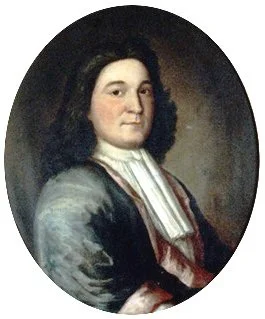
William Phips.
The opening lines of Sir John Clapham’s authoritative history of the Bank of England (1944) articulate a general and particular truth: ‘The establishment of the Bank of England (1694) can be treated like so many other historical events both great and small, either as curiously accidental or as all but inevitable’.[1] It is a wonderfully paradoxical sentence balancing accident and inevitability, chance and intention. ‘Curiously accidental’ conjures an intriguing sense of the uncanny, suggesting that the accidental may not be quite so accidental - was it really accidental or was there an invisible hand at play? There is no doubt that a central bank of some kind would have emerged eventually. But this particular bank was helped into being by a sequence of accidents, chance events and encounters. These are part of its story. So too are deceit, political conniving and sophisticated skills in telling a good story.
Val Hamilton explains. Val is the author of a recently published book on the subject (Amazon US | Amazon UK).
The Age of Projecting
The Governor and Company of the Bank of England was founded in 1694 by William Paterson. He was a remarkable man and his story is representative of this remarkable period, dubbed ‘The Age of Projecting’ by Daniel Defoe. This was a period of extreme instability set in motion by the political strife of the century. Traditional sources of authority, i.e. the monarchy and the Church, had been challenged. The brute facts tell the story. The execution of Charles I in 1649 somewhat conclusively challenged the divine right of kings, and ushered in the republicanism of Cromwell resulting in the growth of Parliament’s power. In 1660, the English, rather apologetically, restored the monarchy, crowning Charles II King. But the genie was out of the bottle. Authority could no longer be seen as ‘invested’ in a person by God but was understood to have been created, or at least given, by some form of ‘the people’. Thus, when Catholic James II succeeded Charles and began to modernize the state, centralizing power, the English organized a rebellion. The protestant William III from Holland and his English wife Mary II, took the throne. England became part of Dutch history, constantly at war with France over control of Europe and the Americas. By the 1690s William was desperate for money to fund this war. This can be seen as the primary driver for the founding of a bank at this time. But this particular bank came about because of a Spanish shipwreck, and the vision of William Paterson.
La Señora de la Concepcion
The Bank of England could not have emerged without a storm off the Bahamas in 1641. The Señora de la Concepcion, a Spanish galleon, had set sail from Havana, weighted to the gunnels with gold and silver looted from the Americas along with a myriad of treasures from the Orient. It was returning to Spain. However, the galleon was not in great condition; it had already been forced to turn back once for repairs. This had delayed its departure and brought its journey into the risky hurricane season. The Señora was caught in a terrible storm which split the ship asunder; the wreckage and its treasures sank to the bottom of Silver Banks, north of what is today the Dominican Republic. Over the next 45 years many treasure hunters tried to find it, including a Captain Phips from Maine, New England. But with no success. Then Phips came into some new information and decided he was going to give it another go. He needed financial backing - an expedition would be expensive. He sailed to England to raise funds for this venture. It was a hugely risky project, with very little hope of success. Daniel Defoe singles this project out as one of the riskiest ventures: ‘it was a mere project; a lottery of a hundred thousand to one odds; a hazard which had it failed Everybody would have been ashamed to own themselves concerned in; a voyage that would have been as much ridiculed as Don Quixote’s adventure upon the windmill.’[2]
Phips struggles to find backers for such a long shot until he comes across Christopher Monck, a dissolute aristocrat who had gambled away the fortune left to him by his father, the Duke of Albermarle. Monck was on his uppers and in one last throw of the di, backed Phips’s venture to find shipwrecked treasure. Without this money, the voyage could not have taken place. Phips organized the venture as a joint-stock company, a relatively new model of business. Everyone who put money in would, hopefully, receive a percentage of the profit to match.
Phips and his crew set sail in 1686. At first they had no luck, searching in vain. Apparently they were using the latest technology, a diving bell, which was little more than an upturned barrel which trapped air allowing the explorers to stay underwater a little longer. By the beginning of 1687 they had exhausted their resources. Phips had to admit defeat. They would head for home. It would be another ignominious return. Andrew Forrester shares a lovely account of their final day:
‘On that last day, some of the divers went looking for mementoes of the trip. As they explored a relatively shallow reef close to the shore they chanced upon a spectacular plume of coral reef…they decided to take pieces of it home…But when they dived to look more closely they saw beneath it the unmistakable shape of a large cannonball…The Señora de la Concepcion had been found’.[3]
The treasure
It was sheer chance that the treasure was found, as always. An enormous amount of gold and silver was brought to the surface. We will never really know how much. There are wildly differing claims. Clapham reports that ‘the company paid 10,000 percent and divided a sum equal to a fifth of the national revenue’.[4] It flooded London with gold and silver and ‘pieces of eight’ minted in Mexico. The success of this project set in motion a chain of events which led to the formation of the Bank of England. Firstly, it emphasized the need for a Bank. The goldsmiths in London who had traditionally stored gold and silver could not cope with such large amounts. Secondly, the success of such a risky project fired up the imagination and the frenzy of projecting, symptomatic of this age, increased even further. A bank was needed to fund these projects which were too large for individuals or even wealthy families to fund. A bank was needed to provide credit. Thirdly Phips was knighted for his success and propelled onto the public stage. He seems to have been a charismatic and ‘colorful’ character. It is at this point that a friendship between Phips and William Paterson becomes significant in the history of the Bank.
William Paterson
Paterson was born in Skipmyre, Dumfriesshire in 1658, the son of a small scale farmer. Little is known of his early life; he attended a local parish school and then as a young man was sent to live with an aunt in Bristol. Paterson’s father was a covenanter, a type of religious dissenter in Scotland. After the Restoration Charles II tried to restore the Bishops to the Church of Scotland. Those who resisted were known as Covenanters. They refused to cross the door of any Church run by a government appointed Bishop and instead held services in secret in the hills. Such action put William’s father and his family at risk. It also meant that his son would have to find his own way in life. Paterson would have been blocked from attending University, for example. Like so many other dissenting young men, Paterson made his own way in trade.
He turns up in Jamaica in 1673 although in what capacity is not clear - speculation ranges through merchant, pirate, buccaneer and missionary. There is a degree of prejudice exhibited in these early accounts of Paterson. He is referred to as an ‘upstart’ and, the historian Macaulay comments, that some may have disliked him simply for being a Scot. By the 1670s he appears to have a home in the Bahamas and be married to Elisabeth Turner, the widow of Thomas Bridge, a minister of the Gospel in New England. Elisabeth died in the Bahamas. Andrew Forrester suggests that Paterson would have acquired a reasonable dowry and ‘nest-egg’ from the marriage.
During this time Paterson was sailing or trading between the Bahamas and New England and came into contact with William Phips. There are similarities between the two men. Phips was one of 12 children and began his career as a ship’s carpenter. He sailed between the Bahamas, New England and London. He married a widow and also came into a reasonable dowry. Paterson and Phips were later to be co-projectors, trying to find investment for various enterprises in both England and America. At this time, these men would have been known as projectors, the modern equivalent being entrepreneurs. Their friendship was to facilitate the founding of the Bank.
By the late 1680s Paterson was based in London; there is a record of him having been admitted to the livery of The Merchant Taylor’s Company on 21st October, 1689. By the early 1690s he is a prosperous and recognized merchant in the City. His ardent biographer Saxe Bannister reports that he lived in a well-appointed house in Queen Square, Westminster and had a handsome horse and carriage with his own emblem.[5] During these years Paterson was trying to find investment to establish a trading route through the area we now call Panama in order to fulfil his life’s ambition of facilitating trade between the East and the West. This ambition was later to prove his downfall in the Darien Enterprise (Hamilton, 2025). In the early 1690s he recognized the need for a Bank as a reliable source of credit:
‘The want of a Bank, or public Fund, for the convenience and security of great payments, and the better to facilitate the circulation of Money, in and about this great and opulent City, hath in our time, among other Inconveniences, occasion’d much unnecessary Credit, to the loss of several Millions, by which Trade hath been exceedingly discourag’d and obstructed’.[6]
Paterson had invested in Phips’ venture to find the Señora de la Concepcion. He made a great deal of money which further enhanced his status in London as a projector; he had been clever or lucky, either would do. Paterson’s confidence and influence must have grown. He managed to pull together a group of people who met in the Sun Tavern close to The Exchange to try to get a bank off the ground. Paterson called it ‘the Society’. Some high-profile people were needed to give the Society clout. Paterson co-opted his old friend Phips. He was the first titled person to join the Society.
With Paterson’s increased wealth and status, and with Sir William Phips on board, The Society was gaining a foothold. On 21 October 1691 Paterson made a real breakthrough and recruited six new members into the Society, among them another knight of the realm, Sir John Houblon. He was a highly respected merchant and was to become the first Governor of the Bank of England. The Society was being taken seriously.
Luck and accident had set the scene and the conditions for a possible bank, now Paterson and the Society needed to employ pure deceit, political conniving and persuasive storytelling to get the actual Bank up and running.
Deceit
All innovative projects require at the very least a certain fictionality and necessary deceit. They are, initially, fictions that will only work once we believe in them. The entrepreneurs or projectors are, after all, making them up as they go along. Paterson and the Society were making the Bank up as they went along. Paterson’s first plan had failed - it had been too daring. In 1694 the Society put forward a second plan for the Bank of England. Some sleight of hand, some devious doings, were required to get this plan across the line. Paterson himself later confesses that the situation ‘produced certain narrow and sinister designs no way becoming so noble and universal a work as this’. [7] One of the most sinister strategies was to remove all mention of a bank from the Bill that was put before parliament to approve the creation of the Bank. The proposal was tagged on to the end of an ordinary finance bill and bears the following title:
‘An Act for granting to their Majesties several Rates and Duties upon Tunnage Of ships and vessels, and upon Beer, Ale and other Liquors: for securing certain Recompenses and Advantages, in the said Act mentioned, to such persons as shall voluntarily advance the sum of £1,500,000 towards carrying on the War against France’.[8]
This is a deceit; the Bank is slipped in under the disguise of taxes on beer and wine to fight the French. The subscriptions were to be lent to the King to fight the war and the interest on the loan would be paid out of beer and wine taxes. They failed to mention that a bank would be established to manage the subscriptions and much more. There is no mention at all in the Act of any Bank. As Paterson later explains:
‘the very names of a bank or corporation was avoided, though the nature of both was intended, the proposers thinking it prudent that a design of this nature should have as easy and insensible a beginning as possible, to prevent…and remove the prejudices and bad impressions commonly conceived in the minds of men against things of this kind before they are understood’.[9]
The bill was put forward at the end of the parliamentary session when many MPs had retired to the country and had to be summoned back. Parliament was appeased by the insertion of a clause in the bill to say that the Bank could not provide funds for the King without the assent of Parliament.
When it comes to the actual opening of the Bank it is sheer theatre and storytelling. The stage is set at Mercer’s Hall, where the Book of Subscriptions is opened. Commissioners have been appointed by a Bank, which does not yet exist, to monitor the subscriptions and provide detailed accounts. The first subscribers are the King and Queen who subscribe £10,000. This is something of a boomerang subscription as the new Bank is going to lend the money to the King to fight France. They are followed by 1,267 individuals. Their subscriptions are written down on vellum paper and signed by the Commissioners. The seal uses a newly invigorated image of Britannia to stamp these dealings with truth and authority.
It is hard looking back now to comprehend what a huge risk this project was. The Bank could have failed at any time. It could have been challenged by other banks, and indeed was. The King could have reneged on the promise to support the Bank. England could have lost the war with France. But it did succeed, against very high odds, and continues to be, as Adam Smith noted, a great engine of state. The Bank of England is the oldest most continuously operating central bank in the world and is one of the UK’s most prestigious institutions.
This brief glimpse into its beginnings suggests that accident and chance played their part in its creation and should not be left out of the story. Deceit, political conniving and the skills of the storyteller were required to get the Bank up and running, and are still required to keep it running. William Paterson appears to have ridden the waves of a chance storm and of the Projecting Age in which he lived, combining ability and eloquence with a determined will to achieve his vision. He did, and this institution sits at the heart of our financial, economic and political systems.
This article is drawn from Pirates, Punters and Politicians, How the Bank of England was Founded, Val Hamilton. London: Chronos Publishing, 2025. (Amazon US | Amazon UK)
And from
Daniel Defoe and the Bank of England, The Dark Arts of Projectors, Valerie Hamilton and Martin Parker. Winchester UK: John Hunt Publishing, 2016.
[1] Clapham, John. The Bank of England, A History, Volume 1 1694-1797. Cambridge: University Press, 1944, p1.
[2] Defoe, Daniel. An Essay Upon Projects. London: Bibliobazaar, 2008 (1697), p26.
[3] Forrester, Andrew. The Man who saw the Future. US:Thomson, 2004, p53.
[5] Bannister, Sax. ( ed.) The Writings of William Paterson, Founder of the Bank of England, 3 vols. British Library. 1858. Preface.)
[6] Paterson, William.’A Brief Account of the Intended bank of England’,1694, E.Huntingdon Library and Art Gallery, EEBO, 2012.
[7] Paterson, William, ‘A Brief Account of the Intended Bank of England’, London, 1694, Accessed EEBO Warwick University 2012, p5.
[8] Giuseppi, John. The Bank of England, London: Evans Brothers Ltd., 1966, p11.
[9] Bannister, Saxe. ‘A Brief Account of the Intended Bank of England’, London: Randall Taylor, near Stationers Hall. 1694 accessed EEBO, Warwick University, p5.