
In 166 CE, an ambassador described in Chinese sources as having come from "Andun, King of Da Qin", almost certainly referring to a Roman ruler, traditionally identified as Marcus Aurelius Antoninus, arrived at the court of Emperor Huan of the Eastern Han Dynasty. Although modern historians debate whether these envoys were official Roman diplomats or merchants presenting themselves as such, their appearance in Chinese court records represents one of the most intriguing episodes of long-distance contact between the Mediterranean world and imperial China. The mission is described primarily in the Hou Hanshu (Book of the Later Han), which notes that the newcomers travelled by way of Rinan (in modern Vietnam), bringing ivory, rhinoceros horn, and tortoiseshell, luxury items more typical of Southeast Asian trade networks than of Roman industry. This mixture of goods has led scholars to argue that the delegation may have originated from Roman trading communities in the Indian Ocean rather than from Rome itself, yet the Chinese understood it as Rome's first formal attempt to open relations with the Han state.
Terry Bailey explains.
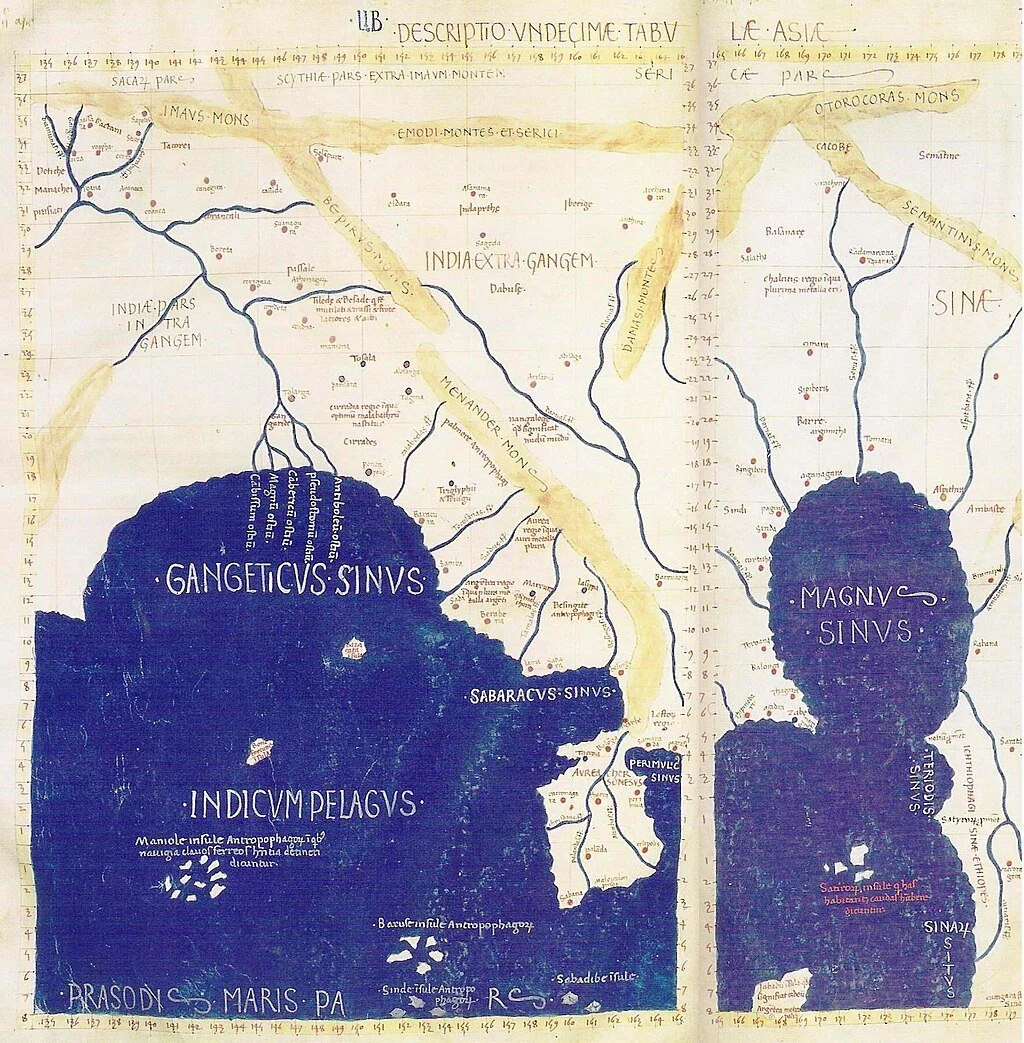
A Renaissance view of Ptolemy's 11th Asian regional map.
The commercial motive behind the ambassador’s extraordinary journey was unmistakable. By the 2nd century CE, Rome had an enormous appetite for silk, a commodity so prized that Seneca and other Roman writers complained that the elite spent too freely on it. Roman merchants already operated in Indian Ocean ports such as Barygaza, Muziris, and Arikamedu, where intermediaries brought silk from Central Asia and China. Direct access to China promised greater profit and prestige. From the Chinese perspective, Roman glassware, metalwork, Mediterranean wines, and high-quality woolen textiles were especially valued. Although the Hou Hanshu does not record a specific trade treaty resulting from the encounter, it emphasizes that the presence of the envoys was understood to signal Rome's wish to establish direct commercial relations, bypassing the Parthian Empire, whose control over the Silk Road had long restricted contact between the two great civilizations.
Chinese records further suggest that relations were warm, with the emperor receiving the envoys, accepting their tribute, and permitting them to trade. The Han state typically treated foreign embassies as part of a tribute-exchange system rather than as partners in bilateral treaties of the Roman type. Thus, while no formal treaty is mentioned, participation in the tribute system effectively functioned as a state-sanctioned trade agreement, allowing the envoys to exchange their offerings for Chinese goods at highly favorable rates. The mission therefore symbolized an official acknowledgment—at least from the Chinese perspective—of the desirability of regular exchange between the two imperial powers.
Documentary evidence for the expedition is strongest on the Chinese side. The Hou Hanshu entry is concise but unambiguous, describing Da Qin (Rome) as a powerful, wealthy empire and emphasizing the significance of the envoys' arrival. Roman sources, by contrast, are silent. This absence has various explanations: the original embassy may not have been dispatched by the imperial government at all; Roman historians may not have considered a distant eastern diplomatic venture noteworthy; or the mission may have been too commercially oriented to appear in official state records. Nevertheless, Roman coins have been found across India and Southeast Asia, including 2nd-century gold aurei of Marcus Aurelius, confirming extensive Roman presence and trade in the regions through which the so-called embassy would have travelled. At the opposite end of the route, excavations in China have uncovered small quantities of Mediterranean glass, Roman-style metal vessels, and even a few Roman coins, demonstrating that Roman luxury items did reach Han territory through long-distance exchange, even if not in large volume.
Archaeological evidence from Central Asia enriches this picture of indirect but persistent contact. Finds of Roman glassware and silver in sites along the Tarim Basin and in Gansu province echo the Hou Hanshu's descriptions of Da Qin goods. Meanwhile, discoveries in Roman Egypt—including papyri from the Red Sea ports of Berenike and Myos Hormos—record thriving trade with India, where Chinese goods were already appearing by the 1st and 2nd centuries CE. This network of merchants, brokers, and maritime middlemen produced the logistical conditions that allowed the 166 CE envoys to reach the Han court, whether as imperial ambassadors or ambitious traders seeking official recognition.
The benefits of this encounter were largely symbolic, yet they had real economic implications. For China, the visit confirmed Da Qin as a prosperous and orderly counterpart at the other end of the world, one worthy of direct ties. For Rome—or at least the Roman merchants operating in the Indian Ocean—the embassy provided access to China's tribute-exchange market, which offered silk, lacquerware, and fine ceramics unattainable elsewhere. The long-term impact was limited, partly because both empires soon faced internal crises—the Marcomannic Wars and plague in Rome, and the weakening of Han authority in China—but the 166 CE contact remains a remarkable moment in ancient global history. It represents the closest documented diplomatic interaction between the westernmost and easternmost great empires of antiquity, an episode that highlights the sophistication, ambition, and connectivity of the ancient world.
The encounter of 166 CE stands as a moment when two vast imperial spheres—Rome and Han China—briefly became aware of one another not merely as distant rumors but as tangible participants in a shared, if fragile, network of exchange. Whether the envoys were official diplomats or merchants cloaking commercial aims in the language of statecraft, their presence at the Han court demonstrates the remarkable reach of long-distance travel and trade in the ancient world. The episode underscores how economic desire, particularly the Roman pursuit of silk and the Chinese appreciation for Mediterranean luxury goods, drove interactions across thousands of kilometers of land and sea. It also reveals how differently the two empires conceptualized diplomacy: Rome through formal treaties, China through the fluid but highly structured tribute system that simultaneously affirmed hierarchy and facilitated commerce.
Although the immediate outcomes of the mission were modest, the event's significance lies in its symbolic power and the archaeological traces that corroborate its plausibility. Roman coins in India, Mediterranean artefacts in China, and evidence of thriving Indo-Roman trade networks together paint a vivid picture of the interconnectedness that made such a journey possible. In this light, the 166 CE embassy becomes less an isolated curiosity and more a visible crest in a broader tide of Afro-Eurasian exchange.
Ultimately, the mission's legacy is one of potential rather than transformation. Political upheaval soon curtailed any sustained effort at direct engagement, yet the recorded meeting between Da Qin and the Han remains a testament to the ambitions of traders, the curiosity of distant courts, and the permeability of ancient borders. It highlights a world far more cosmopolitan and commercially intertwined than earlier scholarship often assumed, reminding us that even at the farthest edges of their domains, Romans and Chinese were participants—however intermittently—in a shared antiquity shaped by movement, commerce, and the enduring human impulse to bridge the unknown.
The site has been offering a wide variety of high-quality, free history content since 2012. If you’d like to say ‘thank you’ and help us with site running costs, please consider donating here.
Notes:
The Han dynasty's tribute-exchange system
The Han dynasty's tribute-exchange system was a central mechanism through which China managed foreign relations, trade, and diplomacy. Rather than treating other states as equal partners in bilateral agreements, the Han court conceptualized the world as a hierarchical order with the emperor—"the Son of Heaven"—at its apex. Foreign envoys who arrived at the imperial court were therefore understood not as negotiators from sovereign states, but as representatives of peripheral regions seeking recognition and favor. Their offerings were formally described as tribute, gestures symbolizing respect for Han authority. Yet this ritual submission was only part of the process. Once tribute was presented, the Han court customarily returned gifts of far greater value. This exchange produced an officially sanctioned economic interaction embedded within a diplomatic framework that reinforced imperial prestige.
In practice, the tribute-exchange system functioned as a highly regulated form of international commerce. For many foreign groups, especially those from Central Asia, Southeast Asia, and beyond, participation in the system was motivated as much by economic opportunity as by diplomacy. The Han state maintained strict controls over who could trade, what goods could be exchanged, and the scale of the transactions, often limiting commercial contact to the moments when an embassy formally arrived. Because the gifts issued by the court in return for tribute were exceptionally valuable—silk, lacquerware, metalwork, and other refined goods—foreign envoys frequently profited from their participation. The Han state, meanwhile, benefited from controlling the flow of luxury goods, securing access to rare products from distant regions, and projecting an image of universal kingship.
The system also served strategic purposes. By incorporating nomadic tribes, oasis kingdoms, and distant polities into a structured network of ritual exchanges, the Han dynasty established a buffer of cooperative or dependent states along its borders. This helped stabilize frontier regions and reduce the likelihood of conflict. The economic incentives embedded in the system encouraged peaceful interaction and often tied the interests of foreign elites to the continued strength of the Han court. Even powerful states like the Kushan Empire—and, as Chinese records suggest, the Roman Empire (Da Qin)—were described within this conceptual framework, not as rivals on equal footing, but as distant participants acknowledging the splendor of the Han.
In essence, the tribute-exchange system blended diplomacy, trade, ideology, and economic policy into a single structure. It allowed the Han dynasty to engage in far-reaching commercial networks while upholding a worldview in which China was the cultural and political center of civilization. Although the system did not resemble Western notions of international treaties, it effectively enabled vibrant long-distance exchange, demonstrating the flexibility, confidence, and sophistication of Han statecraft.