The Autumn leads to changes in America – and the start of a major American sporting tradition. Michael Thomas Leibrandt reflects.
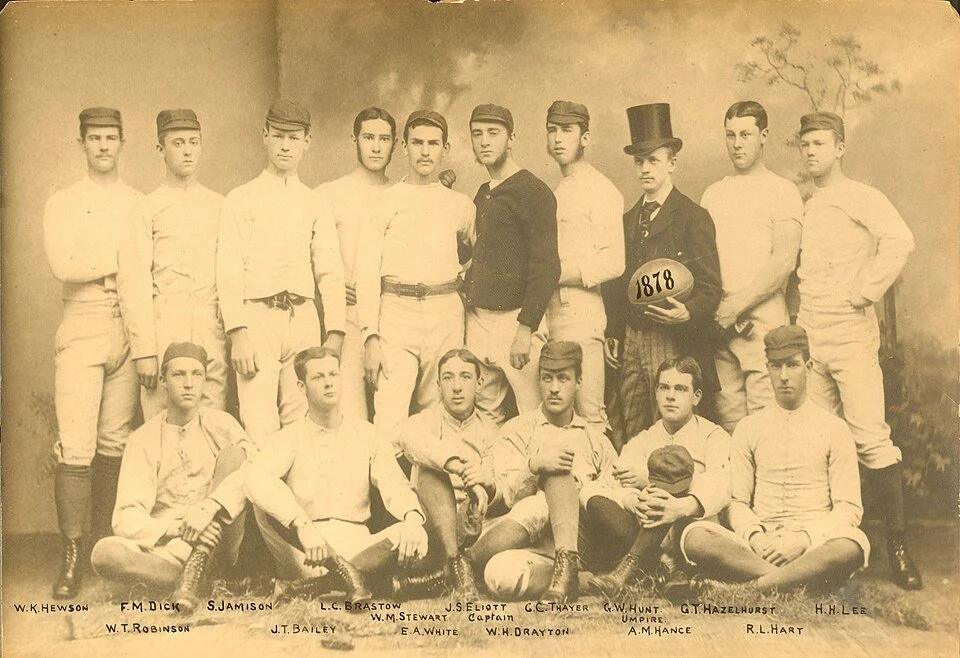
The University of Pennsylvania football team, the Penn Quakers. Source: public domain, University of Pennsylvania Archives, available here.
It’s a lesson that I learned - first from my grandpop and then was emphasized by my father. Fall may be many things; evenings by the outdoor firepit, the turning of the leaves, and cool weather. All of these are all equally enjoyable after a long, hot summer season.
Fall in America — well — that is football.
And while mid-September may be the kickoff of NFL games around the country — college football has two weeks to display the satisfying thrill of its contests onto millions of spectators both at the game and watching remotely before the competition beings on Sundays. Saturdays — belong to college football.
It’s the perfect pairing of the gift of limitless, American athletic ability combined with all of the advantages of youthful energy. Each autumn — around the country as in Philadelphia — thousands of college football players unleash a combination of both for all to enjoy.
When I was old enough to behave myself for a few hours (outside of boundless and barely controlable cheering, that is) I was headed to historic Franklin Field to see an early autumn University of Pennsylvania Football Game at the oldest college football stadium still in use in all of America. It was both the start of a new season and honoring history — long before the NFL captured the hearts and minds of the City first with the Yellow Jackets from Frankford and then the Eagles — the City had a love for college football.
This fall — the University of Tennessee takes that incredible combination to another level by starting true freshman Faizon Brandon as the youngest quarterback in program history. It’s been 22 years since Tennessee started a freshman — and has happened so infrequently in fact — that rare examples have included Adrian Pederson, Trevor Lawrence, and Herschel Walker.
One hundred and fifty years ago — the University of Penn started another true freshman in offensive guard in T. Truxton Hare. At that point — University of Pennsylvania football was capturing not only the hearts and minds of Philadelphia — but of the nation. T. Truxton Hare would go on to play every minute of every game from 1897–1900 for the University of Penn. He would compile a 47–5–2 record, would become a College Football Hall of Famer and an Olympic Silver Medalist in 1900.
He was a national champion for Penn in 1897 and a member of powerful University of Penn teams in 1898, 1899, and 1900 when the University of Pennsylvania was in contention for a championship during all three seasons.
Fifteen years after Hare played his last game for the Quakers — another freshman started for Penn Football. Before his military service and eventually winning a City Championship in the 1920s — Bert Bell played for University of Pennsylvania Football.
By the time that I arrived at Franklin Field — the great national championship years of Penn Football were long gone as was T. Truxton Hare— remembered only in record books and the championship banners fluttering in the fall winds at Franklin Field. Providing confidence to NCAA freshmen like Faizon Brandon. Still — the weight of the history of being in that stadium was not lost on me.
Thomas Truxton Hare went on to practice law before retiring in 1941. Bert Bell went on to do some impressive things as well. When the Frankford Yellow Jackets went bankrupt and Bell was one of the investors who bought their rights in 1933 — he didn’t just bring back the Frankford team. Instead he created another team that would become a football obsession.
The Philadelphia Eagles.
Michael Thomas Leibrandt lives and works in Abington Township, PA.