The Confederate victory at Second Manassas, August 28-30, 1862, followed victories in the Valley Campaign and the Peninsula. The casualties incurred by the Army of the Potomac included 14,000 killed or wounded of 62,000 engaged, compared to about half of that for the Army of Northern Virginia. Then, on September 1, Stonewall Jackson defeated a Union cohort retreating from the battlefield at Chantilly. General Pope was relieved of command and sent to Minnesota to deal with the Sioux, and was never again involved in the Civil War. Pope would blame Fitz-John Porter for the loss, even though that wasn’t the case; Porter would be heard from again at Antietam but would go through a devastating court martial soon after. One of Pope’s generals said of him, “Suffice to say ... that more insolence, superciliousness, ignorance, and pretentiousness were never combined in one man.”

In this multi-part series, here Lloyd W Klein looks at what happened during the Battle of Antietam itself.

Read part 1 on the background here, and part 2 on General McClellan’s Response to Finding the Lost Order here.

The Charge across the Burnside Bridge by Edwin Forbes. Source: Public domain, US Library of Congress, available here.

McClellan was now in a position to destroy Lee’s divided army. Knowing they were being pursued, Lee's army set up defensive positions behind Antietam Creek. Lee expected a battle, but the half of his army under Jackson was still in Harper’s Ferry.

The first two Union divisions arrived on the afternoon of September 15 and the bulk of the remainder of the army late that evening. McClellan's limited activity on September 15 after his victory at South Mountain gave Lee time to unite his scattered divisions at Sharpsburg.

On the morning of Tuesday, September 16, McClellan had nearly 60,000 soldiers facing Lee’s 15,000. His heavy 20-pound Parrott rifles were sending case shot across the creek, feeling out the enemy. As Longstreet ordered a vigorous response – more for bluff than effect – Lee realized his one chance for salvation lay with McClellan’s reverting to his old, timid behavior. McClellan did not disappoint him. By noon, Jackson and Brig. Gen. John Walker began to arrive, taking up the Confederate line on the left along the Hagerstown Pike near Dunker Church, north of town, then sweeping southeasterly to a worn farm lane on the Mumma property a mile away.  On the left flank, Maj. Gen. J.E.B. (‘Jeb’) Stuart placed Brig. Gen. Fitz Lee’s cavalry brigade with his three batteries of Captain John Pelham’s Horse Artillery and three additional batteries on an unpretentious hillock known locally as Nicodemus Hill. East of the Hagerstown Pike, Brig. Gen. Evander M. Law’s brigade had taken position in the East Woods. Law sent his videttes well to the north and east, keeping a close eye on the Upper Bridge.

Once again, the traditional history doesn’t do McClellan justice. What is said in the books: If he had attacked either of those days, the war might have ended in September 1862 with a definitive victory. Having arrived on the afternoon of September 15, he delayed his attack until September 17. He outnumbered Lee by as much as 2:1 all that time, and what he was waiting for is unclear. He somehow didn’t know that Jackson was still in Harpers Ferry, so he was facing just half of Lee’s divided army.

But the reality was a lot more complex than it seemed from that summation. By the afternoon of September 15, McClellan found himself confronted by two significant Confederate forces flanking Elk Ridge, a geographical feature extending north to south, located west of South Mountain. To McClellan's right, Lee and Longstreet commanded an indeterminate number of troops, while to his left, McLaws and Anderson operated under the overall leadership of Stonewall Jackson. With Jackson positioned on one side and Lee on the other, it was prudent for McClellan to take a moment to assess which of the opposing forces represented a greater threat. Franklin had indicated that he was up against an enemy force that was twice the size of his own. If McClellan accepted Franklin's assessment, it suggested that the Confederate troops in Pleasant Valley exceeded 25,000, a formidable adversary.

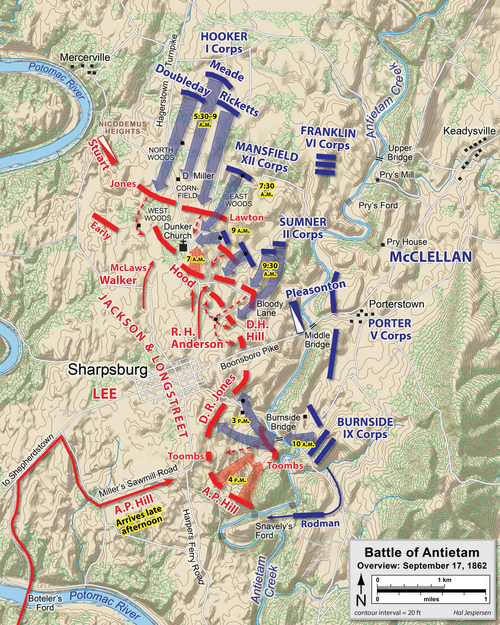
Map of the Battle of Antietam by Hal Jespersen. Source: Map by Hal Jespersen, www.posix.com/CW, Creative Commons license 3.0, available here.

Initially, Lee and Longstreet seemed to be retreating toward Virginia, but as the afternoon progressed, it became clear that Lee had opted to hold his position in Maryland. Concurrently, the Confederate forces in Pleasant Valley, located to McClellan's left, began their withdrawal back to Virginia. The dynamic nature of the battlefield, coupled with the challenges of maneuvering large troop contingents along generally inadequate roads, made September 15 an unfavorable day for launching an offensive.

September 16 presented a different scenario for McClellan. Aware that Lee had gathered his troops around Sharpsburg, McClellan planned to launch an attack with his largely unified forces in the morning. However, dense fog obscured his view of the Confederate positions. By 8:30 to 9:00 a.m., the fog dissipated, revealing that Lee's forces remained in their locations. Nevertheless, McClellan was still unable to identify the Confederate left flank. For three and a half hours, he scoured the area along Antietam Creek in search of the enemy's line. Ultimately, realizing that only direct engagement would reveal their position, he instructed Hooker to move his First Corps across the creek at 12:30 p.m. Federal cavalry began patrolling the western bank of the creek shortly after 1:00 p.m. It took an additional four hours for Hooker to position his troops for the attack that commenced later that evening. In summary, the variable conditions hindered McClellan's ability to launch an assault on September 15, leading to a delayed attack on September 16.

Despite the traditional narrative, the Union army was not fully prepared for combat on September 16. On the afternoon of the 15th, Richardson and Sykes, with approximately 6,700 infantry, arrived at the Portertown bridge. Hooker's 1st Corps, consisting of 8,600 infantry, reached the area in the early evening and established a position near the Pry House. Meanwhile, Sumner's two additional divisions were stationed along the Keedysville Road. The 12th Corps was positioned at Boonsboro, the 9th Corps was located around Appletown, roughly six miles away, and the 6th Corps was in Pleasant Valley. Morell and Weber remained at Frederick or Middletown.

On the morning of the 16th, Sumner successfully moved his remaining two divisions to Keedysville, allowing McClellan to muster around 25,000 effective infantry by mid-morning. However, Burnside was still lagging; his Corps did not arrive at Portertown until noon and subsequently camped about two miles from the battlefield. Burnside advanced to receive orders regarding the placement of his corps, but by dusk, only three brigades had managed to reach the bluffs overlooking the Rohrbach Bridge. The balance of the corps was a couple of miles east and didn't break camp until 0900 on the 17th. The 12th Corps marched from Boonsboro and approached Keedysville quite late in the afternoon. As they arrived, McClellan ordered them to cross the creek and support Hooker. Morell's division and Weber's brigade are behind them. Any attack on the 16th would have been fought solely by the 1st and 2nd Corps, and Sykes' division.

It may have been to his benefit to attack immediately, although McClellan would have had to advance troops in fog and against an opponent he believed outnumbered him. Had he pushed Sumner’s Second Corps across the Middle Bridge at daybreak, regardless of the fog, it probably would have forced Lee to withdraw his troops from the heights opposite the Rohrbach Bridge, where Ambrose Burnside and Jacob Cox waited with the Ninth Corps. They could then have crossed against the Confederate right. Hooker could have crossed on the Confederate left and engaged Jackson’s men there. Pursuing a strategy such as this would have likely stretched Lee’s force thin in multiple places, allowing the Federals to punch through. I doubt that in this type of scenario, Lee could have held his position for longer than 24 hours.

Lee intuited that the initial attack would be on his left. Intelligence came in all day on September 16, indicating a Federal advance on the left, but little activity on the right and in the middle. Concentrating forces against the Confederate left focused Lee there as well. All he needed to do was shift men from the right and center until a threat materialized in those sectors, and that did not occur until later in the afternoon on September 17.

Lee cornered himself on purpose, unlike what some historians suggest. He did so because his campaign objective was to fight and win a battle north of the Potomac that would fulfill the promise of protection his proclamation of Sept. 8 gave to Marylanders in favor of secession. His plan to fight north of Boonsboro had unraveled when Jackson took a day longer than Lee anticipated to capture Harpers Ferry, and because McClellan had unexpectedly attacked the South Mountain gaps. This left Lee with no choice but to move back toward Virginia to bring the army's various pieces closer together. Sharpsburg was the last place Lee could find with somewhat advantageous terrain. However, his left was vulnerable to a large-scale attack, which is exactly why McClellan struck there.

McClellan did not appear to have “the slows” in his approach to Antietam. This is yet another tenet of the history of the battle that does not hold up to scrutiny. This has been a persistent myth since Sears & Catton. Its origin was the 1864 Lincoln election propaganda campaign. McClellan's army did not fully arrive until September 17. By the end of the day on the 15th, his corps was stretched out on the road back over South Mountain. McClellan also faced the possibility that Jackson commanded the portion on his left flank, where the Sixth Corps was, and Lee the portion on the right flank at Sharpsburg. Being between these two commanders is not an enviable position.

By the morning of Sept. 16, McClellan hoped to attack, but could not see the enemy's lines. He therefore scouted along them for a better idea, but did not glean one. It is only after these scouting missions that he ordered Hooker to cross the creek and develop the Confederate left flank, something that could only be done through contact. Sure, McClellan could have ordered Hooker across earlier and had more daylight, but it is unclear what that might have accomplished. We need to remember as well that McClellan believed his army to be outnumbered. We know that is false, but no commander in his right mind would push his force into unknown territory while facing a stronger opponent. That said, McClellan did make a mistake by not sending the Twelfth Corps along with Hooker, and perhaps the Second Corps as well.

Exactly what McClellan was thinking on September 17th is anyone’s guess. McClellan, of course, has been skewered throughout history for generating a piecemeal attack. But his actual plan was to attack en echelon, Napoleon style.  But, if a commander follows such a plan to stretch enemy defenses, the key to victory is to commit the reserves in a timely fashion: “a mass of decision.”  This was the Napoleonic principle.  He utterly failed in this last and most crucial aspect of his plan. The Tactic of a Napoleon-era en echelon attack was to advance at different times to create a "pressure point" on the enemy's line and to follow up any breakthrough with reserve troops.

True to form as we saw in the Seven Days, his headquarters was over a mile away from the battlefield. That would guarantee that he had no clue what was happening on the field in real time. Communication would be delayed, and any momentary opportunity lost. And I think that is exactly what happened.

McClellan failed to commit his reserves for several reasons. 1).  Located at the Pry house, he was on the wrong side of Antietam creek and thus was removed from the battlefield.  2).  Burnside was supposed to be coming up from the south in behind Gen. D.H. Hill once Burnside's men cross the bridge and start rolling up the Confederate army from South to North.  However, Burnside failed in his mission because of extremely slow development of his attacks.  3).  Gen. Fitz Porter supposedly reminded Mac, when Mac was contemplating sending in Porter's men, that "His Corps represented the last troops of the Army of the Potomac".  It was a subtle reminder of how Napoleon sent in his only reserve of the Guard at Waterloo and was soundly defeated, which is all Mac needed to hear to become timid and afraid of failure.

McClellan had a long history of delaying attacks. Maybe he thought that he had to plan in great detail before launching them. But these delays were never beneficial and never justifiable. Perhaps:

·       McClellan didn’t really know the size of the army in his front at Antietam and therefore, he was being prudently cautious in moving slowly before starting his attack. https://www.historynet.com/mcclellans-war-winning-strategy/

·       He had an inability to create original or innovative ideas, even though he was tremendously smart and a quick study.

·       He might have been incapable of responding creatively to the real time exigencies of battle.  He could not creatively adjust his plan. Thus, at Antietam, when his plan of assault did not unfold like a predetermined Napoleonic success, Mac was unable to develop any new concepts on the spot to adapt to the changed circumstances.

·       My own opinion is that McClellan was more concerned with not losing than with winning. In his mind, as the fate of the Union rested on his shoulders, he could not allow a defeat.

·       Cpl Thomas Pressnel of Co D, 1st Minnesota said on Sept 18, the day after Antietam:  "McClellan is either a fool or a traitor." https://www.hhhistory.com/2019/05/antietam-bloodiest-day.html


McClellan telegraphed that he was going to start the attack on Lee’s left. His artillery opened up all afternoon September 16 in that area. Hooker was sent there. Lee saw all of this. Lee’s ranks had been thinned by casualties, sickness and large-scale desertions, but he had the advantage of position. He’d selected an excellent defensive field in which to fight. The lay of the land permitted the Rebels the opportunity to transfer troops under cover and allowed them to select the most advantageous artillery positions.

Antietam Creek is pretty shallow in most places, ranging from 60 to 100 feet in width, and was fordable in several places. It was crossed by three stone bridges each a mile apart. The bridges over Antietam Creek would be crucial. The top two for Union units to enter the battlefield, the bottom one, a stone bridge, for the final act.

At the Battle of Antietam, more Americans died in battle (September 17, 1862) than on any other day in the nation's history. The bloodiest battle in American history was Gettysburg, but its more than 46,000 casualties occurred over three days. Antietam ranks fifth in terms of total casualties in Civil War battles.


The Cornfield

On the morning of September 17th, a 30-acre cornfield owned by David R. Miller lay between the two armies. The cornstalks were turning from green to brown, ready to be harvested, 30 acres of corn fodder. None of it would exist by that evening. One general remarked, “Every stalk of corn in the northern and greater part of the field was cut as closely as with a knife.” Thousands of men would lie dead in that cornfield, the site of some of the most ferocious, confusing, and deadly fighting of the war.

At first light (around 5:30 a.m. on September 17, 1862), Maj. Gen. Joseph Hooker’s I Corps struck the Confederate left along the Hagerstown Turnpike, aiming for the plateau crowned by the small whitewashed Dunker Church. Hooker’s roughly 8,600 men pressed forward against Stonewall Jackson’s 7,700 defenders, deploying Abner Doubleday on the right, James Ricketts into the East Woods, and George Meade’s reserves in the center. As Union infantry emerged into the Cornfield below the church, an artillery duel erupted: Confederate horse batteries under J.E.B. Stuart to the west and four guns under Col. Stephen D. Lee to the south traded shots with nine Federal batteries behind the North Woods and distant Parrott rifles. Fierce musket­ry and close‐quarters fighting swirled around the church itself, with repeated advances and withdrawals in the fields and woods before fresh Confederate brigades under McLaws and Hood counterattacked shortly after 7 a.m., stabilizing Jackson’s line near the landmark.

At dawn, a Union corps assaulted Lee's left flank across Miller's Cornfield. The battle began when Hooker’s I Corps attacked around 5:30 a.m. As the Union moved forward, they were met by withering fire from Confederate infantry and artillery, including Stonewall Jackson’s men positioned in the West Woods and behind a fence at the southern edge of the corn. The cornfield turned rapidly into a killing field. The tall corn created a kind of fog of war—soldiers couldn’t see well and often blundered into enemy fire at close range. Units were slaughtered in rows, sometimes without even seeing who was shooting them. Men layed prone and shot at legs through the stalks; if they stood up they couldn’t see and more apt to be killed. Fighting surged back and forth repeatedly, with Union troops advancing, getting repulsed, and attacking again.

At 7AM, Mansfield’s XII Corps brought in fresh troops, hoping to support Hooker, but was mortally wounded. His men also suffered heavy casualties as they entered the killing zone.

Next, General John Bell Hood’s division, including the famed Texas Brigade, launched a devastating counterattack, pushing Union troops back out of the Cornfield temporarily. Hood’s men took over 60% casualties—he later said his division was “dead on the field.” Control of the field changed hands perhaps 6 to 8 times in three hours. Casualties mounted on both sides—some regiments lost over half their men in minutes. By 9:00 a.m., the Cornfield fight had run its course; the area was covered with bodies. As regiments and brigades entered the Cornfield, only to be demolished in waves of attacks and counterattacks, a layer of smoke covered the field so that no one could see what was happening. Soldiers later related that they lay on the ground and shot at the legs of their enemies

Perched roughly three‑quarters of a mile southwest of the North Woods, the knoll known as Nicodemus Hill (or Heights) was crowned by more than a dozen Confederate cannon placed there overnight by J.E.B. Stuart’s cavalry artillery, under the direct command of Maj. John Pelham. From this vantage the guns enfiladed the right flank of Hooker’s advancing columns as they poured out of the woods into the open terrain toward the Cornfield and Dunker Church. Pelham’s batteries swept the ground with shell and canister, inflicting severe casualties and helping to check the Union drive long enough for Jackson’s infantry to form a defensive Stonewall Jackson held the Confederate lines, and the Union suffered heavy casualties. Neither side seemed able to gain the upper hand, and one witness described the clash as "Artillery Hell."

2) While numerous countercharges held off Union advances, this Union division commander ordered yet another attack, resulting in Jackson’s left and center being in imminent danger. 3) Then this illustrious Union brigade charged parallel with Hagerstown Pike, sweeping the field. 4) His lines collapsing all around him, and out of men on the line, Stonewall Jackson turned to this general, his last reserve, being held after his men were in the center of the battle at Harpers Ferry.5) Which Confederate troops advanced in a desperate situation to save the southwest corner of the field? 6) After all of the intense action, which Confederate brigade held the line? 7) Both Hooker and Jackson each had one more brigade to throw into this killing field. Who were they led by? Which Union General led the attack? Hint: This general seemed to be everywhere Jackson’s men were during the war. 8) At the end of the fighting, who held the Cornfield? What was the staggering toll of casualties in just this one part of the field? 9) When did Jackson arrive at Sharpsburg?

Joseph Hooker was the Union corps commander that led the attack on the Cornfield. John Gibbon bravely led the first wave of that attack. The Iron Brigade struck hard at Jackson’s line and advanced deep into the Cornfield. Despite success, they met withering Confederate counterfire and were eventually pushed back. Units like the 6th Wisconsin and 2nd Wisconsin suffered casualty rates over 50%. Still, they inflicted enormous damage and helped set the stage for XII Corps’ later advance. You will notice that many of those who rose to high command later in the war courageously led in smaller roles in this battle. Arguably, that is why the tide of the war turned eventually: the cream rose to the top. 2) Abner Doubleday. 3) The Iron Brigade. 4) John Bell Hood. 5) Hays’ Louisiana Brigade. 6) The Stonewall Brigade. 7) Maj Gen Joseph KF Mansfield vs General DH Hill. Alpheus Williams led the 1st Division, XII Corps. His contributions to this campaign were enormous. He would go on to be a lawyer, judge, journalist, and later U.S. Congressman. His division had been defeated twice by Stonewall Jackson, once in the Valley and once at Second Bull Run. At Antietam, his division, which had found Special Order 191, had 25% casualties against Jackson’s Division. He would meet Jackson’s men again at Chancellorsville, where his men entrenched and stopped Jackson’s offensive, with heavy casualties. Williams finally stopped Jackson’s corps, without Jackson, of course, on Culp’s Hill. 8) It hardly mattered at that point, but the Army of the Potomac did hold part of it, however tenuously. Estimates suggest 8,000–10,000 men were killed or wounded in or near the Cornfield in just those few hours.9) It is so important to note that Longstreet was the only corps commander through South Mountain, and that Jackson wasn’t there because he was capturing Harpers Ferry, which he accomplished on September 15. Jackson then pushed his men to join the rest of the army at Sharpsburg, Maryland. Jackson arrived in time to bear the brunt of the Federal advances on the northern end of the battlefield in the morning phase. https://www.historynet.com/battle-of-antietam-carnage-in-a-cornfield/?f


The Sunken Road

The focus of battle swung southeast from The Cornfield to Bloody Lane. This sunken dirt farm road had been used by local farmers to bypass the town, and its level was below the fields around it due to use and rain. The Confederates fortified it, using the sunken road as a natural trench. This part of the battle occurred roughly between 9:00 a.m. and 1:00 p.m. Around 9:00 a.m., Union II Corps under Gen. Edwin Sumner attacked. Led by Gen. William H. French’s division, then Gen. Israel Richardson’s, they hit the lane from the east in wave after wave. The Confederates poured musket fire into the advancing Federals from the cover of the lane. Union troops returned fire, turning the area into a brutal stand-up firefight, lasting hours.

Casualties were enormous on both sides. Bodies piled up in the narrow lane—thus the name “Bloody Lane.”

Maj. Gen. Daniel Harvey Hill placed his division of approximately 2,600 men along the road, piled fence rails on the embankment to further strengthen the position and waited for the advance of the Union army. As Federal troops moved to reinforce the fighting in the West Woods, Union Maj. Gen. William H. French and his 5,500 men veered south, towards Hill's position along the Sunken Road. As French's men approached the Sunken Road, the Confederate troops staggered them with a powerful volley delivered at a range of less than one hundred yards.

Union and Confederate troops dug in. For nearly four hours, from 9:30 a.m. to 1 p.m., bitter fighting raged along this road as French, supported by Gen. Israel B. Richardson`s division, sought to drive the Southerners back. Outnumbered but with a well-defended position, the Confederates in the road stood their ground for most of the morning. Eventually, a gap opened in the Confederate line due to miscommunication and shifting reserves. Union troops flanked the lane, firing down its length, turning it into a death trap. Confederate resistance collapsed, and survivors fled toward Sharpsburg.

After the Union broke through the Sunken Road around 1:00 p.m., there was a real opportunity to split Lee’s army in two and possibly end the battle—and maybe the war—right there. An opportunity to crush Lee’s army was missed.

2) 3) 4) At the critical moment, as the Sunken Road collapsed, the Confederate Army was in great danger of being overrun. Why didn’t he throw in his reserves at this desperate time as Jackson did? 5) Who led the brigade that broke the defense of the Sunken Road? 6) How severe were the casualties?

The great Union heroes of this portion of the battle were immigrants from another country who came here seeking a better life and escape from a famine. The Irish Brigade (New York and Massachusetts Irish Americans) advanced upon Confederate troops who had taken up a position in No fewer than eight times were the colors of the Irish Brigade struck down, but nine times they were taken up and carried forward. Men sacrificed their lives to rush a fence and tear it down rather than have the entire brigade take fire through being slowed by the barricade. The Irish Brigade advanced under heavy fire, living up to the Gaelic phrase written upon their regimental colors: “Riamh Nar Dhruid O Spairn lann”, “Who never retreated from the clash of spears”.

Eventually, the Irish Brigade was able to flank the sunken road, and rather than facing entrenched riflemen head-on, they were then able to shoot down the Sunken Road, so effectively that The Sunken Road became The Bloody Lane. Union assaults against the Sunken Road carried the Confederate center, but the resulting advantage was squandered. The two remaining divisions of Sumner's corps that had not attacked the Hagerstown Road. They had entered the field through the North bridge then divided up.

DH Hill’s division had already intervened in the fluid battles near the East Woods, so even though it held a strong position in the sunken road, the division was somewhat weakened. The Union general who led the attack that broke the line was Francis Channing Barlow, who would go on to fame on Day 1 at Gettysburg and become one of the great heroes of the war, and a division commander under Hancock in the Overland Campaign.

Colonel John B Gordon was wounded 6 times that day, might have drowned in his kepi from his blood that collected in it, and had a facial scar forever. He promised General Lee "The men are going to stay here, General, till the sun goes down or victory is won!"

McClellan has been criticized ever since for advancing portions of his line at different times rather than at once and holding back an entire corps entirely.  At the moment when the battle was hanging in the balance, McClellan did not send in an entire corps he held in reserve, which might well have won the battle and perhaps the entire war that very day. The infamous story is that the reserve troops belonging to McClellan’s most trusted corps commander, Gen. Fitz-John Porter, were ready to take the field at the Sunken Road. For a brief moment, McClellan seemed ready to commit the V Corps reserves and looked to Porter, his most trusted subordinate. Porter is said to have slowly shaken his head with disapproval and is purported to have said to McClellan, “Remember, General! I command the last reserve of the last army of the Republic.” Modern scholarship suggests that this never happened, and that Porter was blamed after the fact, before his court-martial set up by Pope. It would take many years for Porter to get justice, and he would never command again. I have never believed that story. I think McClellan was so far away from the battlefield, the only time he left his HQ was to scout the far right near Nicodemus Heights around 2 pm, that by the time he was informed of the opportunity, Lee had already moved reinforcements to plug the hole in the center. Troops under Gen. James Longstreet and others helped stabilize the line, and the artillery was the real savior. That gave the Confederate army time to regroup and survive the day. This was his story to protect his reputation.

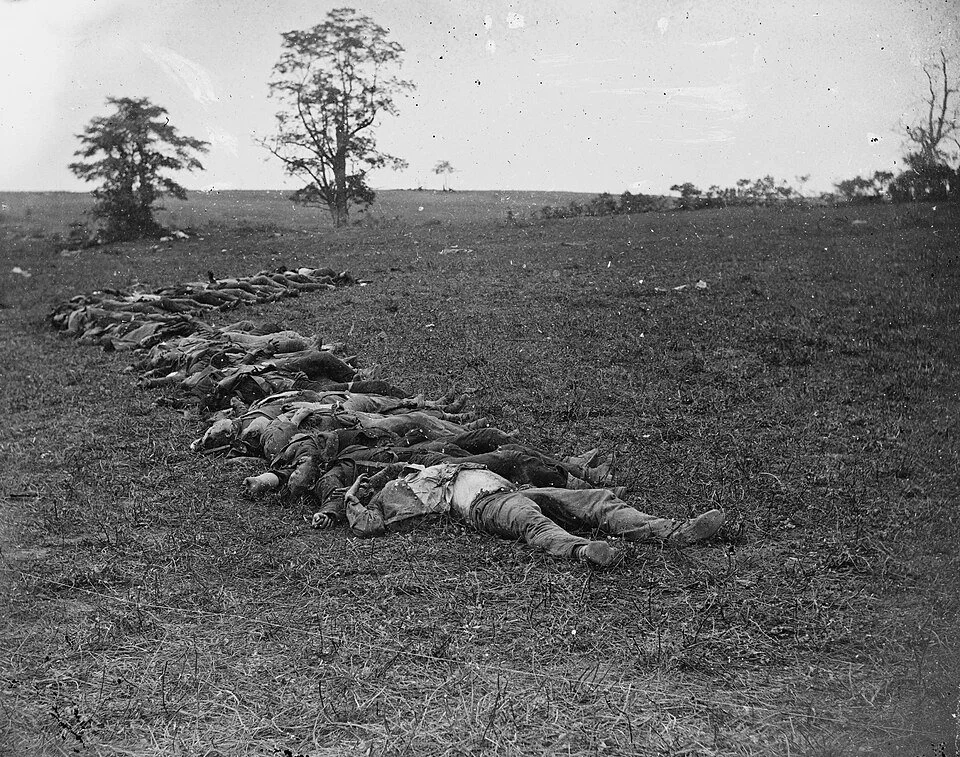
There were roughly 5,600 total casualties in this phase alone. The road remained choked with the dead and wounded for hours—an iconic image of Civil War carnage.

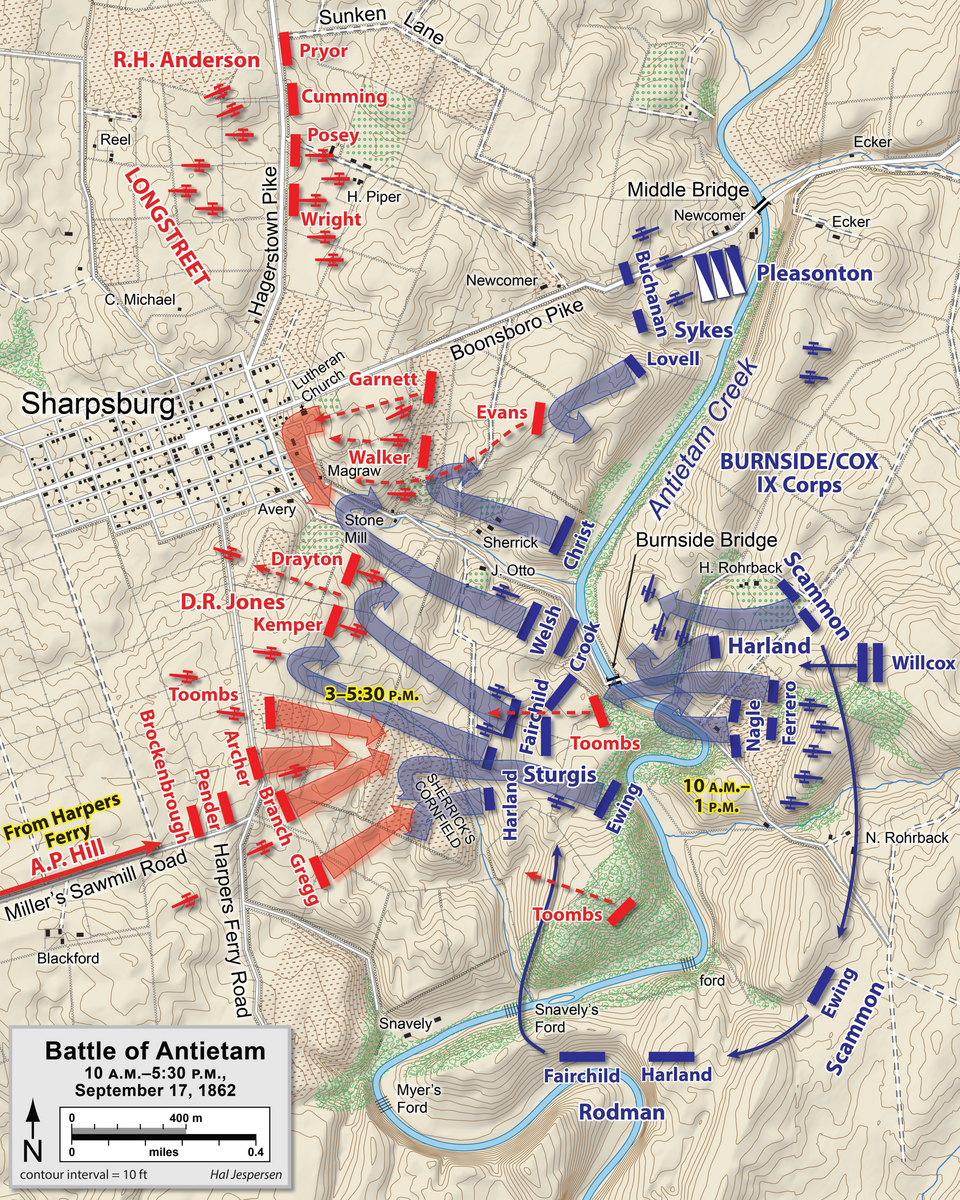
Map of Burnside Bridge by Hal Jespersen. Source: Map by Hal Jespersen, www.posix.com/CW, Creative Commons license 3.0, available here.

The Burnside Bridge

Late in the afternoon, the fiercest fighting again switched, now to the south part of the field, the Union left.  There, General Ambrose Burnside and XI Corps had been attempting for hours to cross Antietam Creek via a narrow stone arch bridge called the Rohrbach bridge at that time, and which would later bear the name Burnside Bridge. Hartwig claims that this name change was intended derisively and mockingly. This the site of one of the most dramatic and frustrating episodes of the war. Burnside is often criticized for his action, or lack thereof, to cross the creek for hours when doing so would have flanked Lee’s position. It is often said that his failure to perform a proper reconnaissance caused him to not realize there were several other places to ford his troops.

Burnside spent hours trying advance his troops through the bottleneck bridge under the accurate and deadly fire of Confederate sharpshooters. The bridge was defended by just 500 Confederate sharpshooters, who had terrific position to attack anyone trying to cross. They held the bluffs above the bridge, giving them a commanding view and position. From this high ground, they rained down musket and artillery fire on any Union troops attempting to approach.

Burnside had three divisions (thousands of men) but committed them in piecemeal assaults. Rather than flanking the bridge with a quicker ford (there were two nearby), he focused on direct frontal assaults. His troops tried repeatedly to storm the narrow bridge, each time taking heavy losses. After more than three hours, the Union finally succeeded around 1:00 p.m., with Brig. Gen. Edward Ferrero’s brigade (including the 51st Pennsylvania and 51st New York) storming the bridge. Once across, Union troops pushed back the Confederates, climbing the heights and threatening the Confederate right.

It looked like a Union victory was inevitable. Just as Burnside’s men were preparing to roll up Lee’s right flank, Gen. A.P. Hill’s division arrived from Harpers Ferry after a forced march. At this critical moment, with the Confederate line breaking, A. P. Hill's division arrived after a forced march from Harpers Ferry and launched a surprise counterattack. They slammed into Burnside’s left around 3:30 p.m., halting and driving back Burnside.

Ambrose Burnside typically receives criticism for his slow advance at Antietam (and in other battles). Sears is especially critical, opining that his delay here had a serious impact on the battle and the war, which cannot be overstated. He wrote that Burnside should have found a way to cross the creek much earlier.

The opposite bank of the bridge was held mainly Georgians under Brig. Gen. Robert Toombs, the former Confederate Secretary of State, who had warned President Davis not to fire on Fort Sumter. He then resigned and took division command. He was wounded in action that day.

Stephen Sears, in his authoritative book Landscape Turned Red, makes the case that Ambrose Burnside’s sluggish performance at Antietam was at least partly due to his frustration with the command structure, especially with how McClellan treated him. Before Antietam, McClellan had organized his army into “wings” rather than corps directly under army command. Burnside was given command of the right wing, which included IX and I Corps. But just before the battle, McClellan reassigned I Corps to Hooker, leaving Burnside with just IX Corps—effectively demoting him in all but name. Sears argues that this shift bruised Burnside’s ego and left him resentful and confused about his role. He suggests Burnside was “acting out” in response by dragging his feet, waiting for more direct orders. Rather than taking initiative, as a wing commander might have done, Burnside behaved like a corps commander waiting for instructions—possibly as a passive protest. But while this interpretation is widely cited, this is entirely Sears’ own interpretation, with no source whatsoever. Hartwig doesn’t even mention it.

There has also been some controversy whether Antietam Creek had several areas that were easily crossed on foot, rendering the bridge much less important It’s fascinating to remember that Henry Kyd Douglas first said this, the man who might have been the courier who lost the Special Order. Hartwig notes that this was disingenuous because the creek was much deeper than that, and the entire bank was covered by Confederate troops. Hartwig notes that McClellan did not criticize Burnside until a year later, when he blamed Burnside for the delay. He also notes that the IX Corps Commander mostly ran the action, and that he tried very hard to cross the creek, had called for reinforcements, which McClellan would not send, instead shoring up his right flank. McClellan’s criticisms of Burnside as he was preparing to run for president. The fact is that Burnside faced severe resistance that day.

AP Hill was in Harpers Ferry, paroling prisoners. His entrance just when he did save the day for the Confederates. Just as it looked like the battle would be lost when Burnside's men began to turn the right of the Confederate line, A.P. Hill, leading the last elements of Jackson's Corps, arrived on the field from Harpers Ferry and stopped the Federal Advance. I am guessing that the reports of Lee’s final words about how AP Hill must come up, which I don’t think really happened, relate to this moment.


Did you enjoy the piece? Join us on X here to receive regular updates: @HistoryIsNowMag

Posted
AuthorHistory Is Now Magazine

The Confederate victory at Second Manassas, August 28-30, 1862, followed victories in the Valley Campaign and the Peninsula. The casualties incurred by the Army of the Potomac included 14,000 killed or wounded of 62,000 engaged, compared to about half of that for the Army of Northern Virginia. Then, on September 1, Stonewall Jackson defeated a Union cohort retreating from the battlefield at Chantilly. General Pope was relieved of command and sent to Minnesota to deal with the Sioux, and was never again involved in the Civil War. Pope would blame Fitz-John Porter for the loss, even though that wasn’t the case; Porter would be heard from again at Antietam but would go through a devastating court martial soon after. One of Pope’s generals said of him, “Suffice to say ... that more insolence, superciliousness, ignorance, and pretentiousness were never combined in one man.”

In this multi-part series, here Lloyd W Klein looks at General McClellan’s Response to Finding the Lost Order.

Read part 1 on the background here.

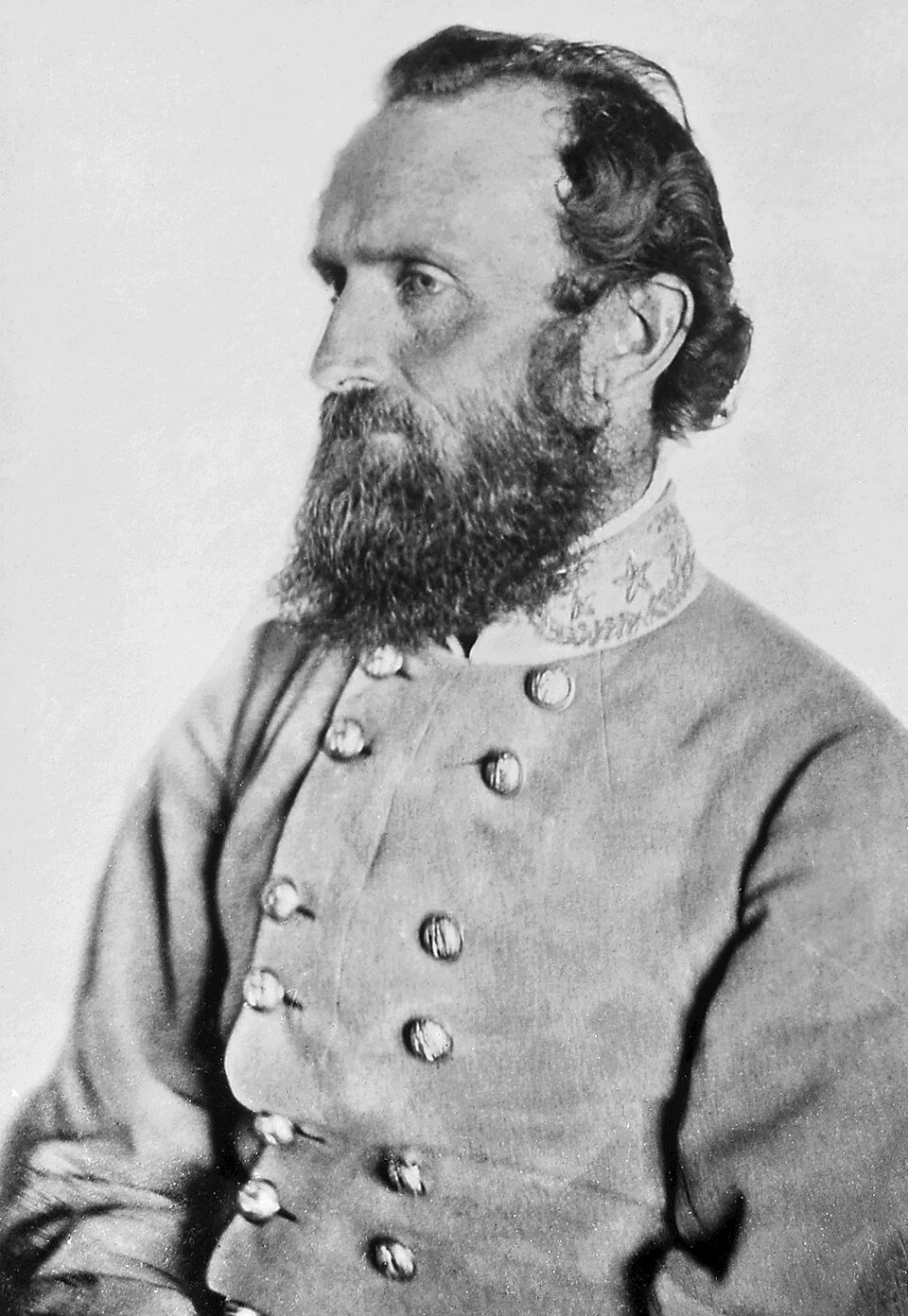
Major General Thomas Stonewall Jackson. Source: Public domain, unknown author, available here.

When General McClellan came into possession of Special Order No. 191, he had an accurate and timely picture of exactly where the components of the Confederate army were located and what routes they were going to be using in the next several days. He knew that the Confederate army was divided, and he knew exactly where they were. Lee had dangerously split his army into five parts, although the orders only mentioned four columns. Three columns had converged on Harpers Ferry to capture the Federal garrison there, a fourth column was near Hagerstown, and a fifth column was acting as a rear guard near Boonsboro, MD.


Why did it take so long for McClellan to respond?

This is one of the great fables of the battle. McClellan had the “slows” in many instances, but not in this one. In the week it took for Lee's army to march to Frederick, McClellan's army traveled an equal distance to redeploy on the north side of Washington. This was accomplished as he reshuffled commands, had his officers under charges reinstated, and prepared to fill out his army with untrained recruits. He really was a very good administrator.

Most traditional histories of the Antietam Campaign assert that McClellan was given Gen. Robert E. Lee’s plans in Frederick, Md. before noon on September 13. The traditional narrative states that he waited 18 hours before acting on the find. By waiting before taking advantage of this intelligence and repositioning his forces, he squandered the best opportunity in the war to defeat Lee definitively.

McClellan did not have possession of the order until later in the afternoon not earlier. The evidence indicates that Barton Mitchell of the 27th Indiana Volunteers discovered the order shortly before noon on September 13. Following this discovery, it took an additional one to two hours for the orders to reach McClellan. It is estimated that McClellan received the orders sometime between 1:00 and 2:30 p.m. on that day.

These criticisms stem from the belief that McClellan moved too slowly and cautiously to attack Lee. They assert that when a copy of Lee’s plans fell into McClellan’s hands, the Union general wasted 18 precious hours before advancing. Politicians from the 1860s onward and countless historians have claimed he could have easily destroyed Lee’s army during the campaign and ended the war in 1862, sparing the country another two and a half years of bloody conflict.

Some historians believe that for this reason, the loss of the Special Order #191 wasn’t as decisive as history makes it out to be. That it had in fact little impact on subsequent events. I strongly disagree, in that McClellan otherwise would have had no clue where Lee was going.

A more recent re-evaluation disputes this sequence of events entirely, citing long overlooked evidence that McClellan moved quickly and there was no 18 hour delay. Gene Thorp in a 2012 article in The Washington Post cited evidence that the vanguard of Army of the Potomac was in motion all day on the 13th due to orders McClellan issued. After the war, McClellan held to the claim that he acted immediately to put his armies on the move. It is this view that we want to explore today.

The story starts out without controversy. Early in the morning of Sept. 13, most of the Union army was on the move to Frederick, Md., including McClellan, who was relocating his headquarters there from Urbana. At the conclusion of the march, a copy of Lee's orders was found in an open field. What time this "Lost Order" was found, and when McClellan received it, has been relatively unchallenged until recently. We will address this in detail tomorrow.

In "Landscape Turned Red," Stephen Sears asserts that McClellan verified before noon that the papers were legitimate, then exhibited his usual excessive caution and failed to move his army for 18 hours. To back up this theory, Sears cites a telegram that McClellan sent to Abraham Lincoln at "12 M" — which Sears says stands for meridian or noon — in which McClellan confidently informs the president that he has the plans of the enemy and that "no time shall be lost" in attacking Lee.

In summary, the traditional view is:

1.     McClellan had the Lost Order by noon as is proven by the telegram from him to Lincoln that is dated "12M" for Meridian.

2.     McClellan waited 18 hours before moving his troops after finding the Lost Orders


The updated view is far different. Dr. Rossino contends that successive generations of authors harboring animosity towards McClellan have damaged the general's reputation. His research provides a detailed account of the actual sequence of events that transpired on September 13, extending into the early hours of September 14. Between 1:00 and 2:30 p.m., McClellan received the Lost Orders. By 3:30 p.m., he had sent a copy of these orders to Alfred Pleasonton, requesting confirmation of the marching instructions contained within. From 5:30 to 6:20 p.m., McClellan drafted orders for William Franklin, the commander of the Sixth Corps, outlining the planned assault on the South Mountain passes for the following day. Subsequently, from 6:30 to 11:00 p.m., orders were dispatched to mobilize troops en route to Frederick, particularly those under Joseph Hooker's command, while soldiers already in the vicinity continued their march through the city until after midnight. At 8:00 p.m., Pleasonton finally replied, affirming that he believed the marching orders in the Lost Orders were accurate, although McClellan had already initiated his attack plan for September 14. By midnight, Federal troops were still converging in the city as they moved westward. At 1:00 a.m. on September 14, the last regiments set up camp west of Frederick, and by 3:00 a.m., the sound of reveille signaled the army's renewed advance towards South Mountain.

In fact, McClellan responded immediately and efficiently. He continued marching his troops all day and into early the following morning. Even Franklin moved a brigade of the Sixth Corps over the Catoctins after dark on September 13. If McClellan hadn’t moved with energy, there would not have been battles for the gaps in South Mountain early the following day.


Rossino believes that the discovery of the Lost Order had several important effects:

1) It clarified for McClellan the piecemeal intelligence he had received suggesting Lee had divided his army. This prompted George the Timid to design and execute two major attacks against Confederate defenders at Crampton's and Turner's Gaps.

2) McClellan's attacks inflicted thousands of casualties on Lee's already depleted force, weakening the opponent. They also thwarted a trap Lee had laid for McClellan along the heights of Beaver Creek, 2.5 miles north of Boonsboro. Had Lee been able to fight there, McClellan would have encountered a position stronger than that taken by Lee at Sharpsburg. Largely because Lee's flanks would have been anchored against South Mountain and the heights along Lappans Road, not vulnerable as his left flank was at Sharpsburg.

3) Lee's design stymied, he fell back toward Virginia to move his portion of the army closer to that of Stonewall Jackson coming up from Harpers Ferry. This caused Lee to take position along the heights behind Antietam Creek, which looked similar in some respects to those behind Beaver Creek.

4) The reverse at South Mountain also forced Lee's army to reassemble before Lee wanted, which further reduced his effective combat strength.

5) McClellan ran for president 2 years later. This may well have been political bunko that has become American historical lore.


In short, the discovery of the Lost Orders and McClellan's use of them forced Lee to take up a less desirable position at Sharpsburg than Lee had planned to take at Beaver Creek. Furthermore, he did so with his army in a weakened state from forced marches and straggling. Lee himself referred to the position at Sharpsburg as a "bad one." These advantages make McClellan's mixed success on the field even more perplexing.

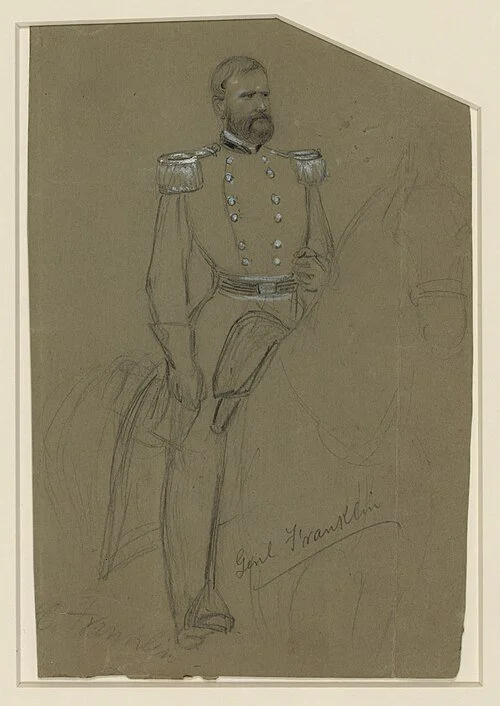
Major General William B. Franklin by Waud, Alfred R. (Alfred Rudolph),. Source: Public domain, Library of Congress, available here.

McClellan’s Pursuit

The controversy started with Stephen Sears. In "Landscape Turned Red," Sears asserts that McClellan verified before noon that the order was legitimate, then exhibited his usual excessive caution and failed to move his army for 18 hours. To back up this theory, Sears cites a telegram that McClellan sent to Abraham Lincoln at "12 M" — which Sears says stands for meridian or noon — in which McClellan confidently informs the president that he has the plans of the enemy and that "no time shall be lost" in attacking Lee.

In summary, the traditional view is: McClellan had the Lost Order by noon, as is proven by the telegram from him to Lincoln that is dated "12M" for Meridian. Then McClellan waited 18 hours before moving his troops after finding the Lost Orders. Why? Because he had the “slows”.

Rossino has demonstrated that the original telegram received by the War Department is distinctly marked as being sent at "12 Midnight." Following the publication of Sears' book, researcher Maurice D'Aoust uncovered the original telegram receipt within the Lincoln papers housed at the Library of Congress. This document indicates that the telegram was dispatched at midnight—spelled out in full—contradicting Sears' earlier assertion by a full 12 hours.

In the contentious telegraph, McClellan informed Lincoln that "We have possession of Catoctin [Mountain]," a significant detail since the Confederates still controlled those two passes at noon. The Braddock Pass was not secured until 1 p.m., and the Jefferson Pass, located further south, was not captured until nearly sunset. This timeline serves as evidence that no message was sent at noon. Additionally, McClellan was reportedly riding through Frederick at 11 a.m., greeted by enthusiastic crowds eager to see him, which raises questions about the feasibility of receiving and relaying orders to President Lincoln in such a short timeframe. The Lost Order was not found until after the 12th Corps, of which the 27th Indiana Regiment belonged, ended its morning march. At least five accounts show that the Corps completed its march about noon, which would make it impossible for McClellan to have written and sent a telegraph that contained information about the Lost Order at the same time it was found. The commander of the unit that found the order notes that it was found after its march ended at noon and that it was carried to army staff soon thereafter.

McClellan issued orders at 3 p.m. for his cavalry chief to verify that the Lost Order was not a trick. It seems out of character for someone who is normally considered so cautious to confidently inform Lincoln of the find three hours before he tried to confirm the accuracy of its contents. From this, we can deduce that McClellan had the orders at 3 pm or sooner but after noon.

The Signal Corps reported that "in the evening" it transmitted a message from Lincoln to McClellan, and a return message from McClellan to Lincoln. The report mentions no other transmittal of information between the two men at any other time of the day.

McClellan had the vanguard of the army, Burnside's 9th Corps, on the move at 3:30 p.m. These men filled the road west to Lee's rear guard at South Mountain well into the night. Near sundown, at 6:20 p.m., he began to issue orders for the rest of his army to move, with most units instructed to be marching at sunrise. (They were roused from sleep at 3 a.m.) In the midst of this activity, at midnight, the general telegraphed the president to tell him what was going on.

By 9 a.m. on Sept. 14, the first troops had climbed South Mountain and met the Confederate rear-guard in battle. By nightfall, McClellan's army carried the heights and forced a defeated Lee to find a new defensive position along Antietam Creek. McClellan pursued the next morning and within 48 hours initiated the Battle of Antietam, which forced Lee back across the Potomac River. This seems like a pretty expeditious sequence of events, not a delay.

Additionally:

A detachment of the 9th Corps in conjunction with cavalry marched from Frederick and took the southern Catoctin pass at Jefferson before sunset.

The 6th Corps, about 12,000 men, marched from Buckeystown to the gap in the Catoctin at Jeffersonville, from the evening until at least 10 p.m. A night march beyond that point would have been risky since it was not known precisely where the Confederates were in the valley beyond.

The 1st Corps, about 10,000 men, marched to Frederick the evening of Sept. 13. to be ready for an advance on the Confederate rear-guard the following morning.

The Sept. 13 timeline that Gene Thorp and Alex Rossino detail in The Tale Untwisted is as follows:
1) The leading elements of the XII Corps reach the outskirts of Frederick City around noon.
2) Shortly thereafter, Barton Mitchell finds the packet of 2 cigars wrapped in the 2 page orders.
3) Mitchell reads the orders. His sergeant John Bloss reads the orders. Col. Silas Colgrove reads the orders. BG George H. Gordon reads the orders. Samuel Pittman reads the orders at XII Corps HQ. MG Alpheus Williams reads the orders at XII Corps HQ. Pittman attempts to scratch out a copy of the orders, but Williams stops him. All of this takes time, perhaps as long as an hour.
4) Williams' courier starts out for McClellan with the orders in hand. The streets of Frederick are crammed with marching troops and spectators.
5) The orders probably reach McClellan between 1:30 and 2:30 p.m.
6) McClellan orders a copy made and sent to Pleasonton at 3:00 p.m. with instructions to verify the order of march as best Pleasonton can.
7) Around 5:00 or so, McClellan still has not heard back from Pleasonton. He decides to issue attack order to Franklin anyway, w/o having verified the lost orders are authentic.
8 Federal troops march through Frederick to the west all day and into the night. The procession finally comes to an end around midnight.
9) Commanders rouse their troops between 2:00-3:00 a.m. to get back onto the road.


Harper’s Ferry

There were two significant engagements in the Maryland campaign before the Battle of Antietam. Both directly impacted the major battle to come. Maj. Gen. Thomas J. "Stonewall" Jackson's captured Harpers Ferry on September 12. This is important because Jackson’s Corps, a large portion of Lee's army, was absent from the Battle of South Mountain and AP Hill’s Corps was not present at the start of the Battle of Antietam, attending to the surrender of the Union garrison..

The Battle of Harpers Ferry took place over 4 days. Stonewall Jackson found Maryland Heights stoutly defended but brigades led by Barksdale and Kershaw attacked strongly, with retreat of the Union troops across the Potomac the next day. On September 14, the rest of his infantry arrived and found Loudon Heights undefended. Jackson placed his artillery on these heights while his infantry confronted the Union army on Maryland Heights. An attack on the Union left flank was threatened by AP Hill while 50 guns began a bombardment. The Union commander realized the situation was hopeless and surrendered.

Colonel Dixon Miles was the union commander at Harper’s Ferry.. At age 58 he was the oldest active colonel in the Union army; a West Point graduate, he led a division at First Manassas but was held in reserve on account that he was drunk. A court of inquiry confirmed this, but he was given command of Harpers Ferry instead of a court martial. Miles was given orders on September 5 by Maj Gen John Wool: "you will not abandon Harpers Ferry without defending it to the last extremity." Wool sent another saying "there must be no abandoning of a post, and shoot the first man that thinks of it". The likelihood that the town would be attacked was appreciated by the Union leadership. Why they sent no more men to defend it isn’t clear, Why Miles kept his men in the town and not positioned on the heights isn’t comprehensible. Miles was mortally wounded in the artillery barrage.

Following his feud and threatened duel with General Longstreet after newspaper articles concerning the Battle of Glendale, AP Hill was transferred to Jackson’s command. He had performed magnificently at Second Manassas. But he clashed with Jackson during the march in Maryland, who had Hill arrested and charged him with eight counts of dereliction of duty after the campaign. For this reason, Jackson left him behind when Harper’s Ferry was captured to process the POWs.

It’s hard to see how things could have been done any faster. Had Miles positioned his troops with more thought, it would have taken even longer. Had Jackson considered this in his placement of the troops around the town? Did Lee make an error in not taking charge of this mission himself instead of giving it to an independent Jackson?  Was this really worth the time it took? The answers to these questions remain unclear, but it is noteworthy to keep in mind that Lee didn’t try to take Harpers Ferry in the Gettysburg invasion. And that neither Hooker nor Meade were interested in defending the town.

The implications were enormous. Recall that Special Order 191 was written September 9 but not retrieved by Union forces until September 13. Even though the intelligence was four days old, McClellan knew that Jackson was behind schedule at Harper’s Ferry, which was surrounded but not yet taken, and that Lee’s army was divided and separated over miles of Maryland countryside. Aware that a portion of Lee’s army was now vulnerable to attack, McClellan advanced toward the South Mountain range to attack Lee’s forces there.

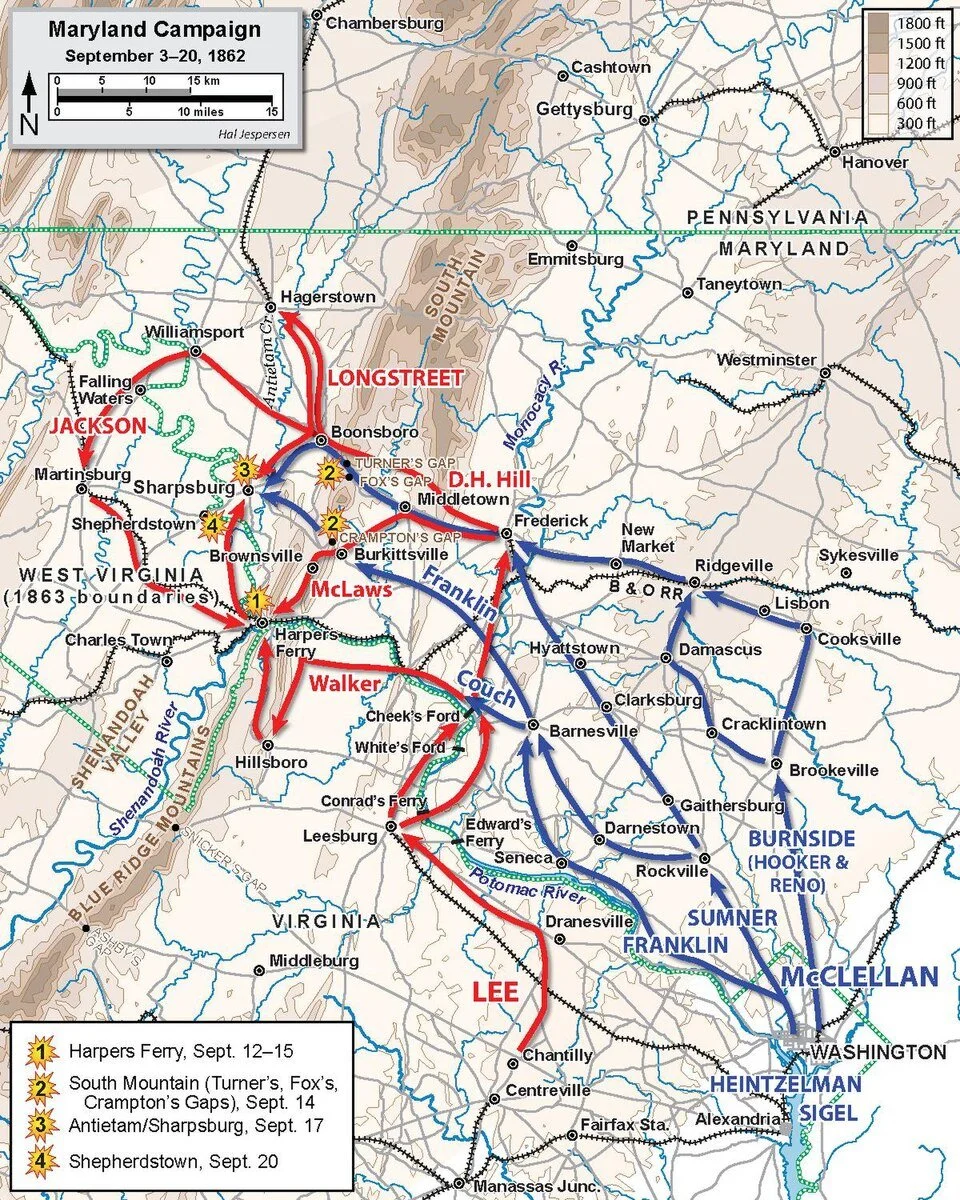
Maryland Campaign of the American Civil War, September 1862. Source: Hlj, available here, reproduced according to Creative Commons Attribution-Share Alike 4.0 International.

South Mountain

The Battle of South Mountain took place on September 14, 1862. It is very important to re-emphasize that the Lost Orders were given to McClellan on September 13, and a battle occurred the very next day. How slow is that?

McClellan had followed Lee’s army based on the routes identified in Special Order 191. Union forces attempted to break through South Mountain to advance toward Lee's army, which would eventually concentrate near Sharpsburg. Lee was surprised that the lethargic McClellan had caught up with him so rapidly. He did not know at that time about Special Order 191. Jackson was just wrapping up Harpers Ferry. He only had Longstreet and DH Hill to defend the passes.

Although the Confederate troops ultimately had to retreat, they put up a strong resistance and delayed the Union's progress, giving Lee valuable time to reposition his forces.. While Union forces were able to gain control of the mountain, they could not stop Lee from regrouping.  Confederate defenses delayed McClellan's advance enough for Lee to concentrate the remainder of his army at Sharpsburg, setting the stage for the Battle of Antietam three days later.

During the Battle of South Mountain, engagements took place at various passes and gaps within the South Mountain range. The passes and gaps of South Mountain, particularly Turner's Gap, Fox's Gap, and Crampton's Gap, offered natural defensive positions. Lee was using South Mountain as a screen, but McClellan had pursued faster than was anticipated. With Jackson at Harpers Ferry, Lee fell back along the roads that led mainly to the northern gaps.

The Union forces, commanded by General George B. McClellan, aimed to seize control of the mountain passes and break through the Confederate defensive positions. In the battle, Union army attacked at 3 gaps.

Longstreet was atop South Mountain at Turner’s Gap, the northernmost pass. Lee ordered Longstreet back to the mountain from around Hagerstown after he heard cannon fire on the morning of September 14. Given that Lee and Longstreet knew only about the main gap that carried the National Road over the mountain, it made sense for Longstreet to join D.H. Hill there.

DH Hill had been the rear guard and naturally came to these 2 passes. Hill situated his headquarters at the stone house that sits in the middle of Turner’s Gap. Longstreet joined him there later and used the same house for his headquarters.

The first fighting broke out at Fox’s Gap, about one mile south of Turner’s Gap.

Fox's Gap: Located just south of Turner's Gap, Fox's Gap saw intense fighting between Confederate forces commanded by General Samuel Garland and Union troops led by General Jesse Reno. The Union forces eventually managed to seize control of this pass. Federal troops with Jesse Reno’s Ninth Corps attacked Confederates under Sam Garland there. That fight gradually went against the Confederates as the Federals forced them back. A single 5,000-man Confederate division under D.H. Hill protected Fox’s and Turner’s Gaps at South Mountain. Early on September 14, Union Gen. Jacob D. Cox’s Kanawha Division of the Union IX Corps launched an attack against Samuel Garland’s brigade at Fox’s Gap. Cox’s 3,000 Ohioans overran Garland’s North Carolinians, driving the Southerners from behind a stone wall and mortally wounding Garland. However, by nightfall, Confederate soldiers still held the western edge of Fox’s Gap.

By nightfall, Reno’s men controlled the gap and the Old Sharpsburg Road running through it.

Turner's Gap: This was the northernmost and most heavily defended pass. Confederate forces, under the command of General D.H. Hill, held strong defensive positions on the slopes of Turner's Gap, while Union troops, led by General Joseph Hooker, made determined efforts to dislodge them. Turner’s Gap saw heavy fighting. A brigade of men under the command of John Gibbon attacked the gap late in the day on September 14, but darkness fell before that attack could carry the gap (see #5). At Turner’s Gap, Union Maj. Gen. Joseph Hooker’s I Corps arrived on the steep mountainside near Frostown, and divisions under George G. Meade and John P. Hatch made relentless charges on the gap’s northern edge. After a brutal firefight along a cornfield fence, Hatch broke through the Rebel line. Only the timely arrival of reinforcements from Longstreet prevented the Confederate line from collapsing. By nightfall, the Confederates still maintained control of Turner’s Gap.

Lee never intended to defend the gaps in South Mountain. His decision to do so was primarily influenced by two factors: Jackson had not yet compelled the surrender of Harpers Ferry, and McClellan launched his attack sooner than Lee anticipated. If Jackson had completed his mission by September 14, Lee would likely have instructed his troops in Maryland, positioned near Harpers Ferry, to cross into Virginia and regroup with the rest of the army to the west of South Mountain. Additionally, Lee would have repositioned D.H. Hill to the elevated terrain north of Boonsboro at Beaver Creek, which was the site where he intended to engage in a decisive confrontation with McClellan’s forces, rather than at South Mountain.

It was here that the iron Brigade made its name. This was the brigade that was part of General John Gibbon’s division of I Corps, composed of 5 Midwestern regiments: 2nd Wisconsin, 6th Wisconsin, 7th Wisconsin, 19th Indiana and later joined by the 24th Michigan. They wore distinctive black Hardee hats, which were regulation dress hats (unlike the more common kepis). These black hats made them instantly recognizable on the battlefield—and helped them stand out even more due to their discipline and performance. They fought a fierce uphill battle against Confederate forces under D.H. Hill, taking heavy fire from wooded ridges and stone walls. They helped push the Confederates off the ridge by late evening, though at a steep cost. General McClellan exclaimed, “They must be made of iron!” and the nickname “Iron Brigade” stuck.

The Battle of Crampton’s Gap is typically overlooked by Civil War enthusiasts as merely a prelude. In fact, Antietam happened precisely because of this battle. Fighting at the third gap, Crampton’s Gap, near Burkittsville, located five miles south of Turner’s Gap, proved to be the most decisive, as McClellan had intended it to be. Around 1,500 Confederate troops there attempted to hold off the entire Union Sixth Corps of around 13,000 men. Franklin began his attack very late in the afternoon on September 14, which was a mistake on his part. If anyone on the Federal side dawdled during the campaign, it was William B. Franklin. Nevertheless, he had the gap in hand by nightfall and had pushed men into Pleasant Valley beyond it. McClellan ordered Franklin to attack the Confederates where he found them, but Franklin believed he was outnumbered 2-1 and declined to do so on the morning of September 15.

McClellan ordered Maj. Gen. William Franklin and his VI Corps to set out for Burkittsville from his camp at Buckeystown 9/14 at daybreak, with instructions to drive through Crampton's Gap and attack McLaws' rear. Although he sent the order immediately, by allowing Franklin to wait until morning to depart, his order resulted in a delay of nearly 11 hours. When the Federals reached Burkittsville around noon, the Confederate artillery opened up. In Burkittsville, while under artillery fire, Franklin assembled his troops into three columns. At 3 p.m., after a delay of nearly 3 hours, the VI Corps finally began its assault. The reason for the delay has never been ascertained, but it would prove costly.

The Confederate force consisted of one battery of artillery, three regiments of infantry under Brig. Gen. William Mahone, one brigade under Brig. Gen. Howell Cobb, and a small cavalry detachment under Col. Thomas T. Munford. After the report of a very large number of camp fires indicating a much larger Union force than anticipated, General Lee recognized the threat this posed to his split forces, so the order was sent down to General Cobb to ..."hold the gap if it cost the life of every man in my command".

Only about one thousand Confederates defended Crampton's Gap, the southernmost of the South Mountain passes. At around 4:00 p.m., Maj. Gen. Henry Slocum's division charged into the gap and dislodged the Confederates from the protection of a stone fence. The arrival of four regiments under Gen. Howell Cobb did little to stem the Union tide. Reinforced by a brigade of Vermonters, the Federals made a second attack and drove the remaining Confederates down the western slope of South Mountain, leaving the VI Corps in possession of Crampton's.

The Union attack broke the makeshift rebel line, but not until 6 pm, too late for a follow-up attack. This gave Lee a chance to salvage his army.

Crampton's Gap: Situated south of Fox's Gap, Crampton's Gap was the southernmost pass where significant fighting occurred. Union troops, led by General William B. Franklin, engaged Confederate defenders commanded by General Howell Cobb. The Union forces successfully captured Crampton's Gap, further pressuring the Confederate positions. When Crampton’s Gap was taken, the other gaps were indefensible. Roads behind South Mountain were such that once one gap fell, the rest were in danger of being encircled. Once any gap is in Union hands, a road connects it to all of the roads behind the mountain, and so Hill and Longstreet can be surrounded.  Turner’s and Fox’s Gap were held by the Confederates at the end of the day but had to be abandoned. By sunrise on September 15, the Confederates had completely withdrawn.

There are 2 roads leading west from Frederick; one goes to the north gaps to Hagerstown and one goes south toward Williamsport. Lee left the southern gap exposed, likely due to limitations on manpower and supplies.

Now read part 3 on the Battle of Antietam here. 

The site has been offering a wide variety of high-quality, free history content since 2012. If you’d like to say ‘thank you’ and help us with site running costs, please consider donating here.

The Confederate victory at Second Manassas, August 28-30, 1862, followed victories in the Valley Campaign and the Peninsula. The casualties incurred by the Army of the Potomac included 14,000 killed or wounded of 62,000 engaged, compared to about half of that for the Army of Northern Virginia. Then, on September 1, Stonewall Jackson defeated a Union cohort retreating from the battlefield at Chantilly. General Pope was relieved of command and sent to Minnesota to deal with the Sioux, and was never again involved in the Civil War. Pope would blame Fitz-John Porter for the loss, even though that wasn’t the case; Porter would be heard from again at Antietam but would go through a devastating court martial soon after. One of Pope’s generals said of him, “Suffice to say ... that more insolence, superciliousness, ignorance, and pretentiousness were never combined in one man.”

In a multi-part series, here Lloyd W Klein looks at the background to Antietam and the Maryland Campaign.

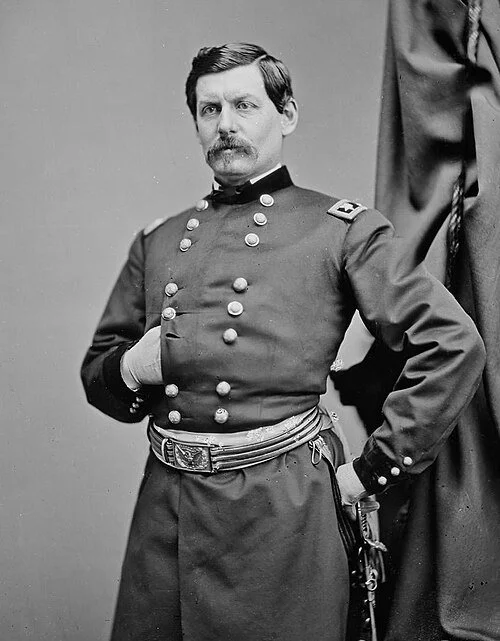
General George B. McClellan. Source: Public domain, available here.

Situation: The Union

It would be hard to imagine what President Lincoln was going through after these battlefield defeats. After a year and a half of fighting, none of his generals had ever defeated the Rebels in the Eastern Theater, although General Halleck had done well enough in the west, thanks in large part to a crazy general named Sherman and a drunken one named Grant. The backbiting in the army was at full swing, the blockade was having only a moderate effect, and his diplomat to Britain, Charles Francis Adams, was afraid that PM Gladstone would force negotiations to end the conflict. The soldiers who had been enlisted for one year had now swerved their commitment, unless they wanted to re-enlist. Casualties were high, and there was a pervasive sense of incompetence at the top of the military leadership.

And even worse, General Lee was rumored to have crossed the Potomac on September 3rd. The United States was being invaded, the Union army had no commander, and the national mid-term elections were coming up in 2 months. No other POTUS has ever faced a crisis this serious, but then, no other president was Abraham Lincoln.

Lincoln had removed McClellan as general-in-chief after the Peninsula Campaign and brought in John Pope from the west. McClellan had remained Commanding General of the AoP. In the early stages of his command, McClellan was able to build the Union army into a more powerful unit than the Confederacy had faced at Bull Run. He was a brilliant administrator, and he had created a well-trained and supplied army, had planned a clever strategy to take Richmond, and his army greatly admired him. Despite these organizational successes, his apparent slowness, almost an unwillingness, to fight a battle slowed the war beyond what Lincoln could politically accept. His repeated unforced retreats in the Peninsula led to a lack of confidence. Moreover, McClellan had shown great disrespect for Lincoln. Most presidents would not have made this decision. But now, Lincoln needed a general to meet an imminent threat, and he went back to McClellan as the best man available. McClellan was very popular among the soldiers and the officers. The parallels are very interesting with the one at the onset of the Gettysburg campaign, when Hooker was dismissed on the eve of battle during an invasion following a devastating loss in Virginia. But now, 6 months later, Lincoln grudgingly gave McClellan command of the full eastern theater. Give Lincoln credit: he chose the best man available, even though they didn’t mesh well.

Some believe that McClellan purposely withheld his men from helping Pope at Second Manassas.  In late August, two full corps of the Army of the Potomac had arrived in Alexandria, but McClellan would not allow them to advance to Manassas because of what he considered inadequate artillery, cavalry, and transportation support. He was accused by his political opponents of deliberately undermining the Pope's position. But he is especially criticized by historians for his letter to his wife on August 10, "Pope will be badly thrashed within two days & ... they will be very glad to turn over the redemption of their affairs to me. I won't undertake it unless I have full & entire control." He told Abraham Lincoln on August 29 that it might be wise "to leave Pope to get out of his scrape, and at once use all our means to make the capital perfectly safe". After his severe defeat, Pope was relieved of command, and McClellan was reinstated. Lee invaded Maryland. Antietam occurred just 3 weeks later.


Situation: General Lee

After Second Manassas, General Lee enjoyed widespread popular acclaim in the South, and the confidence of the president and his cabinet. He had thus far turned every battle into a victory, even those where he lost more men percentage-wise, defeating two Union commanders in just a few months. While supplies and armaments were in short supply, at this stage they seemed adequate.  It was a propitious moment to plan an invasion of the north. But with Autumn coming, Lee had to move quickly and efficiently.

He had two excellent Corps Commanders in Longstreet and Jackson. His division commanders were highly competent, but they were also high-spirited, and their personalities clashed with their superiors. Lee was a highly perceptive judge of people. Lee recognized that Stonewall Jackson thrived on independent action, especially attack situations, and he would place him in that position in the campaign. He also saw Longstreet as embodying an attacking defender, and used him for the main base of the army for that purpose.

After Second Manassas, the ANV could not be supplied by the farms in Northern Virginia. The Orange and Alexandria RR did not have the capacity; critical bridges were down. The Manassas Gap was nonfunctional from Front Royal in the Valley. A large Army could not be sustained any longer on the land of northern Virginia. Lee had to go somewhere else. Lee had these objectives with an invasion of the North:

·       to move the focus of fighting away from the South and into Federal territory, to feed and clothe the troops.

·       To forage for supplies

·       To recruit in western Maryland and bring secession-leaning citizens hope

·       Achieve a military victory in the north: Lee believed he could outwit McClellan on any battlefield, and that the right opportunity would show itself.

·       Confederate success would also influence impending Congressional elections in the North, perhaps forcing a negotiated settlement

·       Persuade European nations to recognize the Confederate States of America. 


His objectives were political and logistical, not military. Lee did not have on his immediate agenda an attempt to raid or capture Baltimore or Washington, D.C. This makes it appear as if Lee was merely wandering aimlessly around western Maryland. But there were insufficient resources to take and hold any northern city. In an insurgency, it isn’t necessary to do so.

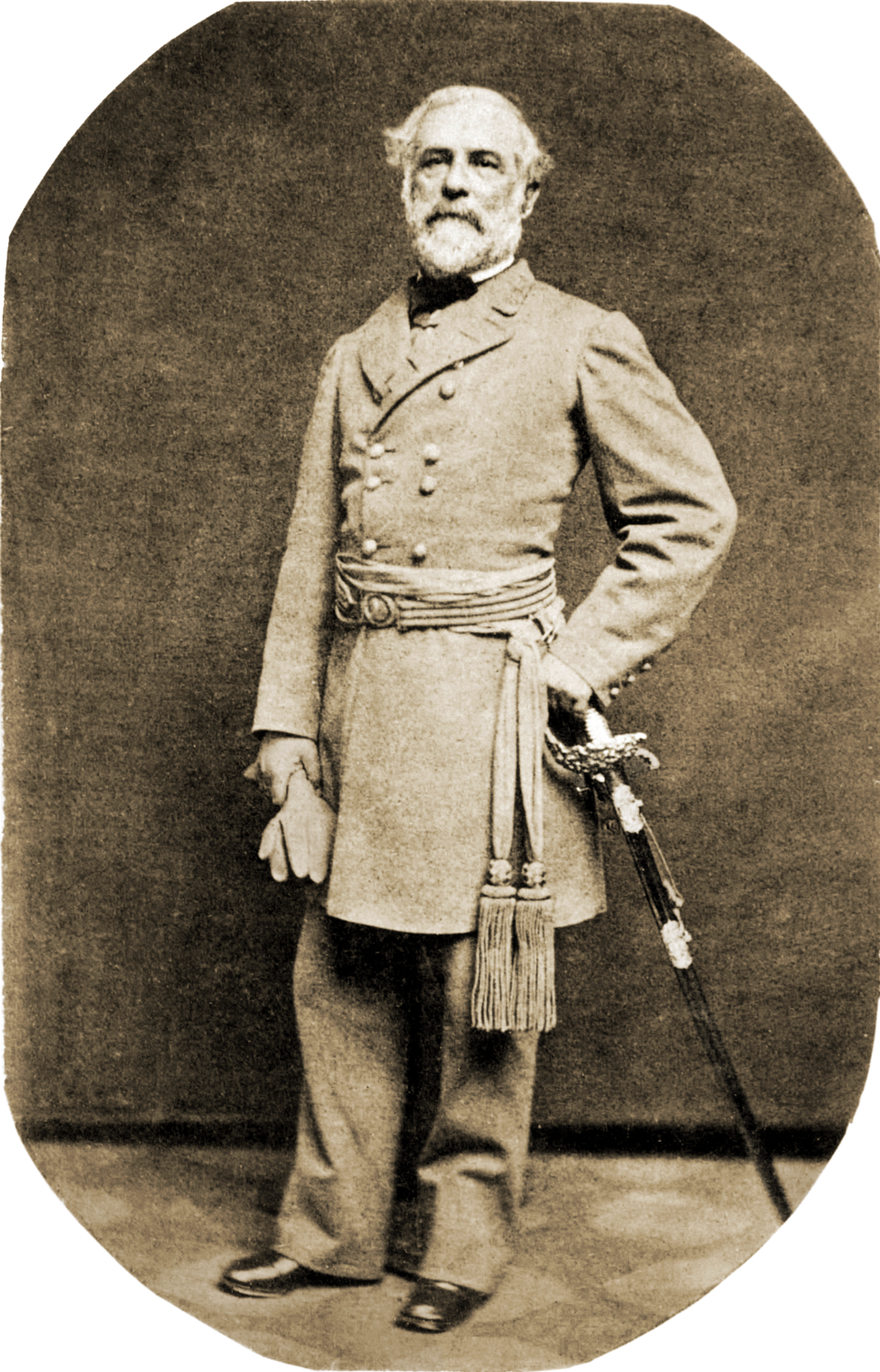
Robert E Lee. Source: Public domain, available here.

Traditionally, General Lee has been given the credit for planning. Rossino has recently found evidence that the campaign was the culmination of planning that had been discussed at the highest levels in Richmond since June-July 1861, and that the invasion was ordered by Jefferson Davis to fulfill a mandate issues by the Confederate Congress in December 1861.


Although the idea for the invasion was well-conceived, many modern-day civil war enthusiasts think this was a terrible idea because the Confederacy should have stayed on defense, not fritter away its resources. But the period after 2nd Manassas was the single moment of the war that was their best window for a chance at achieving a military victory, when Lee was truly in the ascendancy. Indeed, if he hadn’t tried, history would judge him harshly. This likely was the real high-watermark of the Confederacy, a moment when another Confederate victory might have brought huge dividends.

Lee crossed the Potomac at two fords west of Washington.  His army moved to Frederick, camping in a field 2 miles south of the town at Best’s Farm. Lee started on September 4 by sending D.H. Hill’s division across the Potomac about 5 miles north of Leesburg. Stonewall Jackson followed Hill across the river on September 5, and led the march to Frederick, near which he camped on September 6.

As far as anyone knows, Lee didn’t have a defined military objective for the campaign. His issuance of a movement order after reaching Frederick is the only existing tactical plan. The rest is speculation, and he may well have thought that the Union Army was so disorganized that he could run wild in western Maryland for a long while. The Army of Northern Virginia’s objectives at the time of the Maryland operation included feeding and clothing the troops, in addition to attracting recruits from among Marylanders sympathetic to the Confederacy. General Lee also initially planned to forage for supplies in southern Pennsylvania until winter brought an end to the campaigning season, but he abandoned that goal within 48 hours of crossing the Potomac River.

Militarily speaking, Lee endeavored to draw the Federals out of Virginia by threatening Washington from the northwest. This he accomplished by forcing George McClellan to shift his men from northern Virginia to positions around D.C. above the Potomac. Lee then hoped to engage the Federals in a clash that would decide the end of the war.

These are the goals that Lee and others wrote about, but there was yet another overriding objective - pulling Maryland out of the Union. The Confederate government had made accomplishing this an explicit political goal in December 1861, when it passed a resolution relating to Maryland which Jefferson Davis signed. Lee also appears to have initially believed - as did many in his army - that simply marching into Maryland would encourage Secessionists in the state to rise up against the Lincoln administration.

The invasion was made based on tactical considerations only. Lee believed he could easily flank the enemy by crossing the Potomac upriver from Washington and marching the Army of Northern Virginia through Maryland. A short thrust into Union territory would not be enough; a prolonged, several-month stay would be the key to Confederate success. Lee hoped to keep his army on United States soil through much of the autumn, not to capture and hold territory but to gather resources and create chaos before returning to Virginia as winter approached.


Lee Invades the North

Lee wanted to use Leesburg as his stepping-off point to get to Frederick. The turnpike leading out of Snickers Gap goes to Leesburg. This turnpike was an old Indian trail that white settlers had widened and had become the main thoroughfare between the Shenandoah and Loudoun County. Up to this point, Lee was using main roads for supply lines, which was clever strategically, as there were no railroads except as connected to Harper’s Ferry.

Frederick, Maryland, is centrally placed between Washington and Baltimore. The Baltimore and Ohio Railroad  set up a supply line to that town. It is also well located to Harper’s Ferry. And, it was the new capital of Maryland when it was removed from Baltimore. There is good water nearby at the Monocacy River, and there is abundant farmland, so it is a great base.

In September 1862, Confederate forces crossed the Potomac River at several places. Here are the main crossing points utilized by Lee's army before the Battle of Antietam:

·       White's Ford: Located near Leesburg, Virginia, White's Ford was the major crossing point used by Lee's army as they entered Maryland (see drawing). They crossed the Potomac River here on September 4-6, 1862, and began their advance into Union territory.

·       Cheek’s Ford: Upstream of White’s Ford, was used by DH Hill’s forces.

·       Noland's Ferry: Situated downstream from White's Ford, Noland's Ferry was another crossing point used by Lee's forces. They crossed the Potomac here on September 7-8, 1862, continuing their movement into Maryland.


McClellan Responds

General McClellan assumed command of an army that was truly leaderless. Lincoln had intentionally diffused power so that no single mistake could be ruinous, but that had led to no one being capable of bold action. When McClellan took charge of the Union forces on Sept. 2, he inherited four separate armies, thousands of untrained recruits, and numerous other small commands that needed to be made ready in a hurry. To further complicate matters, three of the AoP’s senior commanders had been relieved of duty, charged with insubordination.

McClellan knew that Lee was in his northwest and moved in that direction. By the time he arrived in Frederick on September 13, Lee had been gone for 4 days. Classic histories portray McClellan's army as moving lethargically, averaging only 6 miles a day.

Lee was moving west to attack Harpers Ferry, which is west of Frederick. He was not moving east to advance on the big eastern cities. Had General Lee attacked any of the major cities, his lack of resources would have been immediately obvious. His supply lines were too tenuous to try: he couldn’t have held these cities, in any case. His goal was to goad Union generals into battles.

Harpers Ferry was a critical strategic point early in the war. It was the north-south crossroads from the Shenandoah Valley to Western Maryland, and the joining of the Potomac and Shenandoah Rivers. It contained a large arsenal and was a concentration for military manufacturers. All of these factors played key roles in why it was a crucial military goal. In fact, control of the town changed 8 times during the war, remaining in Union control for most of it.

Surrounded on three sides by steep heights, the terrain surrounding the town made it nearly impossible to defend; all one had to do with take the heights and shell the town until it surrendered. Stonewall Jackson once said he would rather “take the place 40 times than undertake to defend it once.”

The Baltimore and Ohio Railroad and the Chesapeake and Ohio Canal were crucial supply lines connecting the east with the west, and they ran right through town. These assets were the real reasons why Harpers Ferry was so strategically important.  If you take Harpers Ferry, the railroad is cut in half and supplies can’t be moved to the west without a large detour. And most importantly, Lee could then use this town as his supply depot for further operations deeper into Maryland.

McClellan commanded in theory 28 cavalry regiments. But the disastrous Manassas campaign had worn out the horses of almost half the Union regiments, while most of the remainder were stranded at Hampton Roads by gale-force winds. For the first week of the campaign, McClellan could only count on perhaps 1,500 cavalry from two regiments and a few scattered squadrons from his old army to challenge some 5,000 Confederate cavalry soldiers screening Lee’s army.General Franklin’s Sixth Corps troops captured the signal station atop Sugar Loaf Mountain on September 11. By that time, information had already come in from other sources, including Governor Andrew Curtin of Pennsylvania, reporting that Lee’s army had marched away from Frederick in the direction of Hagerstown. McClellan knew within 24 hours, or perhaps even less, that Lee’s army was on the move.

First Battle of Bull Run (First Manassas), Virginia, 1861. Source: Public domain, available here.

Special Order Number 191

Lee and a large part of the Confederate Army bivouacked on the Best Farm, about 4 miles south of Frederick, near the Monocacy River. This site would 2 years later be the location of the Battle of Monocacy, but on September 9, 1862, the Union army was not close to Frederick. General Lee set up headquarters in an oak grove on the farm and dictated orders to a subordinate who laid out the campaign for the next week. Numbered Special Order No. 191, headquarters distributed these orders using couriers who brought copies to the commanders of the army’s wings and divisions.

General Robert E. Lee issued Special Order No. 191, known as “The Lost Order”, on September 9, 1862, during the Maryland Campaign to his corps commanders directing their movements. In Special Order #191, General Lee outlined the routes to be taken and the timing for the attack of Harpers Ferry. It provided specific details of the movements his army would take during the invasion of Maryland.


******************************************************************************

“Special Orders, No. 191

Hdqrs. Army of Northern Virginia

September 9, 1862


The citizens of Fredericktown being unwilling while overrun by members of this army, to open their stores, to give them confidence, and to secure to officers and men purchasing supplies for benefit of this command, all officers and men of this army are strictly prohibited from visiting Fredericktown except on business, in which cases they will bear evidence of this in writing from division commanders. The provost-marshal in Fredericktown will see that his guard rigidly enforces this order.

Major Taylor will proceed to Leesburg, Virginia, and arrange for transportation of the sick and those unable to walk to Winchester, securing the transportation of the country for this purpose. The route between this and Culpepper Court-House east of the mountains being unsafe, will no longer be traveled. Those on the way to this army already across the river will move up promptly; all others will proceed to Winchester collectively and under command of officers, at which point, being the general depot of this army, its movements will be known and instructions given by commanding officer regulating further movements.

The army will resume its march tomorrow, taking the Hagerstown road. General Jackson's command will form the advance, and, after passing Middletown, with such portion as he may select, take the route toward Sharpsburg, cross the Potomac at the most convenient point, and by Friday morning take possession of the Baltimore and Ohio Railroad, capture such of them as may be at Martinsburg, and intercept such as may attempt to escape from Harpers Ferry.

General Longstreet's command will pursue the same road as far as Boonsborough, where it will halt, with reserve, supply, and baggage trains of the army.

General McLaws, with his own division and that of General R. H. Anderson, will follow General Longstreet. On reaching Middletown will take the route to Harpers Ferry, and by Friday morning possess himself of the Maryland Heights and endeavor to capture the enemy at Harpers Ferry and vicinity.

General Walker, with his division, after accomplishing the object in which he is now engaged, will cross the Potomac at Cheek's Ford, ascend its right bank to Lovettsville, take possession of Loudoun Heights, if practicable, by Friday morning, Key's Ford on his left, and the road between the end of the mountain and the Potomac on his right. He will, as far as practicable, cooperate with General McLaws and Jackson, and intercept retreat of the enemy.

General D. H. Hill's division will form the rear guard of the army, pursuing the road taken by the main body. The reserve artillery, ordnance, and supply trains, &c., will precede General Hill.

General Stuart will detach a squadron of cavalry to accompany the commands of Generals Longstreet, Jackson, and McLaws, and, with the main body of the cavalry, will cover the route of the army, bringing up all stragglers that may have been left behind.

The commands of Generals Jackson, McLaws, and Walker, after accomplishing the objects for which they have been detached, will join the main body of the army at Boonsborough or Hagerstown.

Each regiment on the march will habitually carry its axes in the regimental ordnance—wagons, for use of the men at their encampments, to procure wood &c.

By command of General R. E. Lee

R.H. Chilton, Assistant Adjutant General”

******************************************************************************

The point of these movement orders was to put Lee’s invasion into motion. Jackson was to take Harpers Ferry while the rest of Lee's army was posted at Boonsboro under the command of Maj. Gen. James Longstreet. DH Hill was designated to guard the rear. General Longstreet was to encircle the towns and roads leading to Harpers Ferry. The places where parts of the army were sent controlled the roads into and out of Harpers Ferry. Martinsburg holds the road across from Whites Ford. Boonsboro hold the road north of Harpers Ferry.  Once Lee’s various divisions were in place, Harpers Ferry was in essence surrounded.

Lee hoped that after taking Harper's Ferry to secure his rear, he could create chaos in western Maryland, wrecking the Monocacy aqueduct, before turning his attention to Baltimore, Philadelphia, or Washington, D.C. itself. Lee did not expect to be attacked by McClellan at this vulnerable moment. He was hiding at Boonsboro precisely to keep McClellan guessing. He could not know that McClellan knew where he was. Lee is not looking to bring on a large battle, and he knew McClellan must be somewhere behind him, so he was going in the opposite direction. What Lee would like is to operate surreptitiously and attack bits and pieces of the Union Army.


The Lost Order

Soldiers of the Union Army found a copy of this order in a field on September 13. The military intelligence gained allowed General George McClellan to advance his army with confidence, and thus was a decisive element in the Battles of South Mountain and Antietam.

In Special Order #191, General Lee outlined the routes to be taken and the timing for the attack on Harpers Ferry. It provided specific details of the movements his army would take during the invasion of Maryland. The crucial point was that Lee divided his army, which he planned to regroup later.  The order directed Major General Stonewall Jackson to move his corps to Martinsburg while McLaws's and Walker's divisions "endeavored to capture Harpers Ferry." Major General James Longstreet was to move his corps northward to Boonsborough. Major General DH Hill's division was to act as rearguard on the march from Frederick.

DH Hill’s camp was just over one mile to the southwest of Lee’s HQ, along a small watercourse named Ballenger’s Creek. To be clear, there is no evidence that Lee’s HQ sent a courier to Hill bearing a copy of Special Orders No. 191. The traditional story differs greatly from what recent scholarship by Alex Rossino has more recently uncovered.

Traditional Story: Lieutenant Colonel Robert H. Chilton, Lee’s assistant adjutant general (chief of staff), wrote out 8 copies of the order, 1 to each of the generals named and 1 to President Davis. At the time that Special Order #191 was written, Hill was under the command of Jackson, his brother-in-law. Jackson personally copied the document for Hill because once the army crossed into Maryland, the order specified that Hill was to exercise independent command as the rear guard. For this reason, Jackson copied and sent Hill the order because he didn’t know if Chilton had done so. But, since Special Order #191 conveyed Hill’s having an independent command once entering Maryland, Chilton had in fact sent Hill a copy. DH Hill received only the copy from General Jackson, in the general’s writing, and never received the copy written by Chilton. Since he had received his orders, no one was concerned at the time that a copy had been lost. The traditional story is that somewhere in that 1 mile ride, a courier delivering Lee’s order to DH Hill somehow lost it.

Updated Version Uncovered by Dr Rossino: Contrary to the assertions found in numerous texts, the lost copy was not dispatched by Lee. It is claimed that McClellan verified its authenticity based on the signature of Robert Chilton, which would have originated from Lee's headquarters. The version sent by Jackson successfully reached its destination, enabling Hill to understand his directives; however, this also contributed to the Confederates' unawareness of the lost copy from Lee. The lost document consisted of movement orders for D.H. Hill issued from army headquarters but was never transmitted. Research by Rossino indicates that the copy was likely created by Armistead L. Long rather than Robert Chilton, as the handwriting and signature on the lost document do not correspond with the official records that Chilton authored and signed. The reason for the creation of this additional copy remains unclear, although it is posited that Long either prepared it for Jeb Stuart or was instructed by Lee to do so when the cavalry commander visited headquarters on the afternoon of September 9. Stuart subsequently misplaced the order on September 12, yet he was not held accountable for this oversight since Hill's name was affixed to the document.

Np one really knows who lost the order found by the Union soldiers. In the traditional story, only Chilton’s courier, Hill’s staff, or Hill himself could have been the culprit who lost the orders. A frequently postulated possibility is that Hill did receive both orders and lost one of them.  After the war, this was the standard belief, but Hill always denied it. He even sent a letter to General Lee after the war detailing the events and asking for clarification, as he did not know what happened. Hill defended himself after the war vociferously. He knew his orders would come from Jackson, so the fact that none came from Lee did not surprise him. Hill famously carried the copy he had received in his pocket to show to everyone that he, indeed, had kept his copy of the orders. He claimed that he had pinned his version in his pocket, knowing of its importance. His chief of staff always maintained that only one version was received.

It seems self-evident that the critical clue is this: How did such an important document end up in a field wrapped around three cigars, still in the original envelope? A logical conclusion is that the last person to possess these items must have been a cigar smoker, which DH Hill was not. Several individuals, including myself, have speculated that Henry Kyd Douglas, a courier on Jackson’s staff, is the most likely suspect; he was known to smoke cigars and was present in Lee’s camp. However, in his memoirs, he made no mention of that particular day. Ultimately, this identification hinges on the existence of a courier.

That morning, the 27th Indiana rested in a meadow which had served as the site of a Confederate camp a few days before. It was there that the infamous envelope was discovered. Two Union soldiers, Corporal Barton W. Mitchell and First Sergeant John M. Bloss of the 27th Indiana Volunteer Infantry, found an official-looking envelope wrapped around 3 cigars. Around noon on September 13, a Union soldier on a skirmish line found an envelope. On opening it, Corporal Barton W. Mitchell of the 27th Indiana Volunteers, part of the Union XII Corps, found 3 cigars inside wrapped in a note. Mitchell did not read every word, but he noticed that it concluded with the phrase "By command of General Robert E. Lee” and was signed “R.H. Chilton, Assistant Adjutant General".

Mitchell recognized the significance of the document and showed it immediately to Sergeant John M. Bloss. The note was elevated up the 27th Indiana's chain of command: to Captain Peter Kop, Colonel Silas Colgrove, then to Brigadier General Alpheus Williams, commander of the 1st Division,  XII Corps. I told you we would hear from him again. And we are not yet done with his contributions.

Now read part 2 on General McClellan’s response to the Lost Order here.

The site has been offering a wide variety of high-quality, free history content since 2012. If you’d like to say ‘thank you’ and help us with site running costs, please consider donating here.

The American Civil War was one of the defining conflicts fought in American history. Not only did it threaten to divide the nation, but it also challenged the very foundation of American institutions. It would go on to define the morals by which future generations would judge the United States of America. Between 1861 and 1865, the Union and Confederate states engaged in crucial battles that would determine the outcome of the Civil War. From the First Battle of Bull Run (1861) to the Battle of Antietam (1862) and the Battle of Gettysburg (1863), each would have its place in American history for shaping the Civil War's military, political, and moral course.

Caleb Brown explains.

Battle of Antietam by Thure de Thulstrup.

First Battle of Bull Run

On the morning of July 21, 1861, Union forces led by General McDowell would meet with Confederate troops led by Generals Johnston and Beauregard for what would be the first battle of the Civil War, the First Battle of Bull Run.[1] The Union, having high hopes for a quick victory, would see its hopes fade as Union soldiers, lacking proper military training, became weary and began to retreat.[2] Hoping to see a crushing win, many civilians who had come to spectate the battle were also caught up in the confusion as they, along with the Union soldiers, retreated toward Washington.[3] The Confederate victory at the First Battle of Bull Run would shatter the hopes for a short war and boost the morale of the South. As a result of the Northern defeat, General George B. McClellan would rise to command and would write in a letter to his wife, "I am here in a terrible place, the enemy have from 3 to 4 times my force the President is an idiot, the old General in his dotage they cannot or will not see the true state of affairs. Most of my troops are demoralized by the defeat at Bull Run, and some regiments are even mutinous. I have probably stopped that, but you see my position is not pleasant."[4] As a result of Bull Run, the Union now had to concede that the war would not be quick, and more preparation was needed.


Battle of Antietam

On September 17, 1862, America would lay witness to what would be the single bloodiest battle in American history. By day's end, 22,717 Northern and Southern troops would be dead, wounded, or missing as a result of the Battle of Antietam, which was fought in the Union territory of Maryland.[5] The Battle of Antietam would be a result of General Robert E. Lee's plan to invade the North for the first time in the war. Lee, however, would fall victim to the “Lost Dispatch,” which was a copy of Lee’s military plans that would fall into the hands of Union soldiers. The resulting battle would lead to the bloodiest single day in American history, a tactical draw between the North and the South; however, Lee would retreat, handing the Union a strategic victory. The battle would effectively stop the Confederates’ momentum in the eastern theater of the war and give President Abraham Lincoln the victory he needed to announce his plans for the Emancipation Proclamation. The Confederates would also lose the much-needed foreign recognition from Britain and France.[6] So, although the battle may have been a tactical draw, the South would suffer a significant defeat that it would not be able to overcome.


Battle of Gettysburg

The most famous battle of the American Civil War, at least in popular culture today, is the Battle of Gettysburg, which took place in Adams County, Pennsylvania, in July 1863, with Lee's army facing General George G. Meade.[7] The Battle of Gettysburg would be a turning point in the Civil War, and between July 1 and July 3, 50,000 casualties would lie dead, wounded, or missing as a result.[8] General Lee would continue north into Union territory in hopes of a victory that would force an end to the conflict. The battle would unfold over three fierce days of fighting, taking place on geographical terrain known as Little Round Top, Culp’s Hill, and the Cornfield. General George E. Pickett would lead what would become known to history as “Pickett’s Charge,” resulting in a failed attack and a 60% casualty rate for the Confederates.[9] This would be the final push for Lee at the Battle of Gettysburg. Facing staggering losses, Lee would retreat to Virginia, and the hopes of a Confederate States of America along with him. 


Conclusion

In conclusion, every battle fought throughout the Civil War has its place in history and contributed to shaping the war's outcome in one way or another. The First Battle of Bull Run would serve as a wake-up call for the North, and as a result of the defeat, the Union would make changes to its army going forward. Many more troops would be requested, and training would improve. The Battle of Antietam would provide a political victory rather than a military victory for the Union. As a result of the bloodiest day in American history, President Lincoln would have cause to reveal his plans for the Emancipation Proclamation. Finally, the Battle of Gettysburg, although not the final battle of the Civil War, would see Lee’s army of Northern Virginia suffer a massive defeat on the fields of Gettysburg, effectively dashing the hopes of a successful invasion of Northern territory. Seeing every battle for its military, political, and moral implications helps provide a broader picture of the American Civil War.


Did you find that piece interesting? If so, join us for free by clicking here.

Bibliography

The Battle of Antietam, May 28, 2019. https://www.proquest.com/docview/2230470087?pq-origsite=summon&accountid=12085&sourcetype=Newspapers.

“First Bull Run." American Heritage.” First bull run, 2011. https://go.gale.com/ps/i.do?p=BIC&u=vic_liberty&id=GALE%7CA271594560&v=2.1&it=r&sid=summon&aty=shibboleth.

“Gettysburg.” American Battlefield Trust. Accessed November 13, 2025. https://www.battlefields.org/learn/civil-war/battles/gettysburg.

Woodworth, Steven E. This great struggle: America’s Civil War. Lanham, Md: Rowman & Littlefield Publishers, 2012.


[1] Steven E. Woodworth, This Great Struggle: America’s Civil War (Lanham, Md: Rowman & Littlefield Publishers, 2012), 47.

[2] Ibid. 49.

[3] Ibid.

[4] “First Bull Run, American Heritage,” 2011, https://go.gale.com/ps/i.do?p=BIC&u=vic_liberty&id=GALE%7CA271594560&v=2.1&it=r&sid=summon&aty=shibboleth.

[5] “The Battle of Antietam,” May 28, 2019, https://www.proquest.com/docview/2230470087?pq-origsite=summon&accountid=12085&sourcetype=Newspapers.

[6] Ibid.

[7] “Gettysburg,” American Battlefield Trust, accessed November 13, 2025, https://www.battlefields.org/learn/civil-war/battles/gettysburg.

[8] Ibid.

[9] Ibid.

Here Jeb Smith argues that General George B. McClellan was the most underrated army commander of the Civil War. While he does not consider him to be a great general or military genius, he thinks the common portrayal of him as a terrible commander is unjust. No other Northern general, people say, exemplifies the stereotype of an incompetent and timid leader as McClellan does. The author argues that this is an unwarranted perception.

Abraham Lincoln and George B. McClellan in the general's tent during the Battle of Antietam on October 3, 1862.

No other general in the war commanded more respect and admiration from his men than George McClellan.”

-John Cannan The Antietam Campaign


Remember that your only foes are the armed traitors,–and show mercy even to them when they are in your power, for many of them are misguided” and later “Bear in mind that you are in the country of friends, not of enemies,–that you are here to protect, not to destroy.”

-George B McClellan May 26 1861 and June 25 1861


Northern Democrats did not see the South as the spawn of Satan but rather as fellow Americans who, in fact, had produced most of the Union leaders up to that point. General McClellan, a Democrat, held tolerant views of the South and sought to avoid needless bloodshed. These perspectives stand in contrast to those of many modern historians and the Republicans of the time, who shaped the narrative to justify the massacres that would follow, as well as the total warfare of 1864 and 1865.


West Virginia and Promotion

Harley six weeks had elapsed... and in that time he had actually created an army and began the first campaign.”

-George b McClellan Commanding General U.S army May 26 1861


George B. McClellan, nicknamed “Young Napoleon” or “Little Mac,” graduated second in his class of 59 at the U.S. Military Academy in 1846. His class included 20 future full-rank generals, and he later returned to West Point as an instructor.

After the war began, he excelled at organizing militia from three states into a cohesive fighting force and saw his first action as a commander of Union forces in what is now West Virginia. This was a departure from his later reputation as a slow-moving, timid general. During a successful campaign in the mountainous region he launched aggressive attacks, dislodged Confederate forces, and captured key positions. He forced the retreat of Confederate troops fortified in the mountain terrain, all while taking minimal losses and securing large supply bases and many prisoners. This success helped preserve the future West Virginia for the Union and prevented the destruction of the Baltimore and Ohio Railroad. President Lincoln was very impressed, which led to McClellan’s appointment to replace McDowell after the latter’s defeat in the Battle of First Manassas[1], and later as the commander of all Union forces.


Organization of the Army of the Potomac

“In a very real sense, McClellan rescued the Union in these early days from dependency and fear. Someone had to rebuild the army and show the country that there was great hope for the future.”

-S.C. Gwynne Rebel Yell: The Violence, Passion and Redemption of Stonewall Jackson Simon and Schuster 2014


The nonmilitary press and President Abraham Lincoln, who was pressured for political reasons, wanted quick action and a fast end to the war. Part of what fueled this was the North's inability (even after First Manassas) to see how determined the South was. They thought this would be a quick, easy conflict. They underestimated the South's resolve to fight and ability to wage war. So, while the press and Lincoln called on Mac for fast action, as a military man Mac understood that the demoralized citizen army needed discipline, training, and organization. He provided these, got rid of poorly-performing generals and instilled spirit and pride in the soldiers while increasing their morale. He came to be loved and revered by his men.

One thing even those who are critical of him admit is that he was a first-rate organizer of the army. Mac took a defeated militia force and turned it into a professional army.


McClellan had started with…a collection of undisciplined, ill-officered, and un-instructed men, who were, as a rule, much demoralized by defeat and ready to run at the first shot. He ended with the finest army ever seen on the North American continent.”

-James V. Murfin Battlefields of the Civil War


Had the North attacked before they were ready, as Lincoln and the press called for, the result would likely have been further defeats and a shattering blow to national morale. As General Sherman stated, Napoléon took three years to build an army, yet “here it's expected in ninety days, and Bull Run is the consequence.”

Mac's offensive plan, as called for by many in the North, was to mass a large army, some said up to 200,000, to march on Richmond and end the war. The Northern people wanted no mistakes after First Manassas. This was Mac's general plan; one that would take time and preparation. Mac also constructed large fortifications around D.C., which had been left almost entirely unguarded by McDowell, including 48 forts and 480 guns. Given that Mac had to train, organize, recruit, and supply a massive citizen army and transform it into a world-class professional army, the time he took to do so was entirely reasonable.


When I was placed in command of the armies of the United States, I turned my attention to the whole field of operations, regarding the army of the Potomac as only one, while the most important, of the masses under my command.”

-George B. McClellan 1861


Further, Mac was commander of all armies and planned for a simultaneous synchronized attack across the Confederacy, which would take further time to plan and put in motion. On August 4th, 1861, in a letter to Lincoln, he laid out his plan that included the main attack to be against Richmond but also simultaneously pushing into Missouri and down the Mississippi, and after Kentucky joined the Union to push into Tennessee, seizing Nashville, and also begin capturing coastal cities such as New Orleans, Savannah and Mobile, then move on to Montgomery and Pensacola. Mac wanted one massive assault to wipe out the South and not a prolonged war; this would take time to prepare. In February 1862 he wrote to Secretary of War Stanton, saying “I have ever regarded our true policy as being that of fully preparing ourselves and then seeking for the most decisive results; – I do not wish to waste life in useless battles, but prefer to strike at the heart.” He did not want years of bloodshed to wear down the South, but brief, decisive action to end the war quickly.


Demotion by Lincoln

Just when Mac felt his army was ready, winter had started in, and Mac was bedridden for three weeks around Christmas. Lincoln wanted action now despite the impassable roads (he would not demand Grant move this early in ‘64) and Mac was accused of being timid. This offensive action was attempted in the winter of ‘62 by Burnside, and the results were Fredericksburg and the “mud march,” which ended in Burnside's removal. Grant, in ‘64, would start his spring offensive in April, later than Mac would his Peninsula campaign. As Grant said, the roads in Virginia would not allow large movements of troops before then, leading William Swinton in Campaigns of the Army of the Potomacto write, “It was inevitable that the first leaders should be sacrificed to the nation’s ignorance of war.”

So Mac started at the average time for spring offensives. No other Union army was campaigning during this winter. Yet, because of Lincoln's urgency and what he saw as a too-cautious McClellan, he demoted Mac to simply commander of the Army of the Potomac. Lincoln also forced corps commanders he had chosen on the Army of the Potomac. Mac wanted to wait to promote generals until he had seen them in battle. This was not the last time a politician interfered with Mac's plans.


Peninsula Campaign Begins

Reduced my force by 1/3, after (bless and do not curse) task had been assigned, its operations planned... it frustrated all my plans... it left me incapable of continuing operations which had been begun. It made rapid and brilliant operations impossible.”

-George B McClellan


“Let me tell you that if your government had supported General McClellan in the field as it should have done, your war would have been ended two years sooner than it was.”

-- General Helmuth von Moltke, Chief of Staff of the Prussian Army and one of the leading military experts of the 19th Century


The Peninsula Campaign began with McClellan's strategic plan for an amphibious operation. Leveraging the North's naval superiority to transport and supply his army, he ultimately aimed for Richmond. Mac anticipated having over 150,000 men for the campaign as he set out for the peninsula. However, once he landed, Lincoln would significantly reduce his army with the other troops spread around the valley, D.C., and the Manassas region.

Mac had wanted more men for the offensive, but Lincoln wanted him to hold men back to guard D.C. Lincoln forced Mac to leave McDowell’s I Corps in D.C. along with the garrison already available. Lincoln now had a garrison of around 20,000 in D.C. and up to 74,000 as far as N.Y. that could be shipped/railed/marched to D.C. if it were attacked. Plus, McClellan had set up world-class fortifications. McClellan, McDowell, Winfield Scott, and every corps commander believed this was more than enough men to guard D.C. and supported McClellan's plan to bring more men, but Lincoln would not allow it for fear of D.C. being attacked. Perhaps out of fear of Stonewall Jackson, it was Lincoln, not the general, who, in this instance, was being overly cautious. In Life and Campaigns of George B. McClellan (1864), author George Stillman Hillard wrote, “From the moment the Army of the Potomac landed upon the Peninsula an uneasy sense of insecurity took possession of the minds of the President, the Cabinet, and the members of Congress.

So Mac landed the army, which was slow-moving because it was massive and carried heavy siege equipment. He faced the largest army the South would field during the war, 88,000 (Grant faced 65,000 in ’64, with a more significant force under him than Mac enjoyed). Once his army landed, he was notified that Stanton had closed all the recruiting depots in the Union. His army would now have to do without either replacements or reinforcements during a major campaign.

This was a massive shock to Mac and the generals in the army. He then was told that McDowell's 40,000 men near Manassas could not be used but must help defend against any possible action towards D.C., despite the fact that Confederates showed no signs of attacking and even burned the bridges south of Manassas as they retreated to defend Richmond. McDowell told McClellan this decision (McDowell protested it) was “Intended [as] a blow to you.” Then McClellan was told the garrison of 10,000 men at Fort Monroe would also be withheld. Even critics of McClellan, like General Heintzelman, said it was a “great outrage” to withhold his army from his command. General Wells said it was the Radical Republicans trying to get Mac to resign. Harper’s Weekly stated, “It is impossible to exaggerate the mischief which has been done by division of counsels and civilian interference with military movements.” Once more, Mac was aggressive, Lincoln and the politicians conservative.


In General McClellan’s opinion, the way to defend Washington was to attack Richmond; and the greater the force thrown against the rebel capital, the greater the security of our own.”

-George Stillman Hillard Life and Campaigns of George B McClellan 1864


Mac was now forced to revise his plans because of Lincoln's caution. In the revised plan, McDowell would advance on Richmond from the north with his 40,000 men and better protect against an attack by Confederate General Joe Johnston if he went north to Washington. However, as Mac argued, the attack on Richmond would force the Confederate army to defend their capital rather than launch a desperate attack on D.C. This disagreement delayed the start of the campaign, with Lincoln getting his way.


“Notwithstanding all that has been said and written upon this subject, I have no hesitation in expressing the opinion, that had not the President and his advisors stood in such ungrounded fear for the safety of Washington, and had not withheld McDowell's forces at a time when their absence was a most serious blow to the plans of General McClellan, the close of the year would have seen the Rebellion crushed, and the war ended.”

-- Allan Pinkerton, chief of the Union Intelligence Service, 1861-1862


Yorktown

Mac moved up the peninsula towards Richmond and was promised McDowell’s men if D.C was free of threat. His army's first encounter was with Confederate General John Magruder and a small Confederate force at Yorktown. Magruder skillfully deceived Mac into believing his force was larger than it actually was. He accomplished this by repositioning the same troops in various locations, acting aggressively, continuously moving small units, using ammunition freely, and setting up dummy defensive positions. This convinced Mac that the Confederate force was more significant than it truly was, prompting him to settle in for a siege while he awaited the arrival of his heavy artillery. Mac was concerned that his inexperienced troops might fail in an assault during the first battle of the campaign, which could damage their morale. Mac eventually captured Yorktown and 80 heavy guns without losses, but the delay gave the Confederates time to organize troops to defend Richmond.


Advance on Richmond

Mac then started to push toward Richmond, and the Confederates gave way. The Union army captured both supply and ordnance during this advance. Mac is criticized for slow movement with a smaller Confederate force in front of him, yet he relied upon his friend and “expert” spy Alan Pinkerton, founder of the Pinkerton Detective Agency. Whatever the value of Pinkerton’s other information, one area in which he failed was in accurately assessing enemy troop numbers. He gave Confederate force numbers from various agents as 160,000, 123,000, 180,000, and even 200,000 in Richmond. And on August 6, Federal General Halleck gave estimates of 200,000 around Richmond. Some northern newspapers working independently gave even higher estimates than Mac did. Because of this, Mac actually believed he was outnumbered.

This was common during the war, with generals thinking the force opposing them was more extensive than it really was. Since this was his information, he believed he was not being cautious but aggressive and daring to continue the campaign, even if at a slow/careful pace. At the time, the enemy numbers were not certain. Mac also waited for his heavy siege artillery to come up from the back, as it was needed to attack Richmond's prominent forts at the Confederate capital.

But without a doubt, the advance was working. Richmond was preparing to evacuate. It forced the Confederates to scuttle the ironclad Virginia, which caused a loss of morale throughout the Confederacy. Confederate General Joe Johnston called General Ewell from Jackson to help in Richmond. McDowell was advancing unopposed north of Richmond. Mac had achieved better success than McDowell, Burnside, Hooker, or Meade advancing on Richmond.


“It was not until 1864 that another Union army, led by Grant, would get as close to Richmond as McClellan did in the spring of 1862.”

--Great Campaigns: The Peninsula Campaign David G. Martin Combined Books PA 1992


The next time the Federals would get this close was under their top general, U.S. Grant. They also fought against a weakened Southern army in ‘64 with a much larger Federal army.

But this time, three things saved Richmond and stopped Mac from capturing the Confederate capital and being hailed as a hero. All three had to happen to stop Mac; two of them were very unlikely and could not have been foreseen.


1] Jackson in the Valley

The most significant contrast between the Virginia campaigns of Grant and McClellan is that Early's offensive did not accomplish its ultimate objective–to relieve the pressure on Lee's army at Petersburg, Jackson's campaign in the Shenandoah valley did. Unlike McClellan before him, Grant would not be forced to alter his designs on the James River one iota.

-Thomas Rowland George B. McClellan and Civil War History


Unlike Lincoln, Mac saw Jackson's valley campaign as a diversion by Lee (now in command of the Southern Army) to pull federals away to help protect Richmond. Richmond was saved because of Jackson's brilliance in the valley. He outmaneuvered and outfought a force over three times the size of his own (17,000- 60,000), defeating them in multiple battles while also threatening D.C.

Jackson knew Lincoln was concerned with protecting D.C. Hence, he knew that aggressive maneuvers would pull men from the peninsula and help save Richmond. Jackson kept 71,000 additional men away from the Richmond attack with his victories and aggressive maneuvering. Lincoln was constantly scared by what Jackson might do, and this prevented McDowell and other troops from helping Mac; the withholding of McDowell would prove decisive.


2] Lincoln Recalling Troops to the Valley


“[It was] Jackson's campaign, and the insane terror it inspired in Washington, which was the true cause of the failure on the peninsula.”

-Colonel Ferdinand Lecomte, quoted in George Stillman Hillard Life and Campaigns of George B. McClellan 1864


Because of Jackson, Lincoln recalled troops to defend Washington and the valley. He also held back McDowell's 40,000 from the attack on Richmond. This “Changed the whole nature of the confrontation near Richmond,” and “The Confederacy was truly handed an amazing gift.” Mac would have rather left Jackson to clear out the valley and even attack D.C. if he wished. Mac had built massive forts with a large garrison to protect the capital.


Here is the true defense of Washington, it is here on the banks of the James.”

-McClellan to Halleck August 4th, quoted in George Stillman Hillard Life and Campaigns of George B. McClellan 1864


After Pinkerton reported a large number of enemy forces to McClellan, he paused his attack due to McDowell's absence. McDowell was supposed to launch an assault on Richmond from the north to prevent the Confederates from mounting counterattacks. McDowell described his recall to the valley as “a crushing blow to us.” Even Lincoln told McClellan, “If you believe you are not strong enough to take Richmond, just know that I do not ask you to try. Just know.”


3] Lee Replaces Joe Johnston

General Joe Johnston, the commanding Confederate general, was injured and replaced by Robert E. Lee. This would change the entire campaign. Mac had been slowly pushing Johnston back towards Richmond, but Lee would take the initiative and attack Mac.


Lee vs Mac

Lincoln’s maneuvers significantly reduced the Mac forces near Richmond attempting to trap Jackson in the valley. Heavy rains swelled the Chickahominy River and created a split the Potomac army, and Lee saw his opportunity.

Lee, whom many consider not only the premier general of the South but of the war, recalled Jackson from the valley to help in the offensive vs. Mac, now with a force nearly equal to his.

Lee would strike the smaller portion of Mac's army and threaten its supply line under General Porter. Porter was supposed to be supported by McDowell from the north to meet up with his flank coming south from Manassas. Had Mac's plan been allowed, the attack would not have been possible. However, when Lincoln sent McDowell to the valley to trap Jackson, Porter was vulnerable, and Lee pounced, enabling its strategic success.


General McClellan wished and had advised that reinforcements should be sent him by water, as their arrival would be more certain. Now that the James River was open, they might have been sent by that route... Richmond could have been approached by the James, and we should have escaped the delays and losses incurred by the bridging of the Chickahominy, and should have had the army massed in one body instead of necessarily being divided by that stream... the capture of Richmond could not be carried out because to the president’s distempered fancy Washington was not safe... McClellan was commanded to extend his right wing to the north of Richmond, in order to establish the communication between himself and General McDowell. This was running a great risk in case General McDowell should not come, because it exposed our right in a way no prudent officer would have done; and, as General McDowell did not come, the enemy did not fail to take advantage.”

-George Stillman Hillard Life and Campaigns of George B. McClellan 1864


Lee attacked in multiple bloody battles, resulting in high losses on both sides. Mac would cause high casualties to Lee during the campaign, inflicting more losses than he received. However, Mac, going from “expert” information, believed he was outnumbered and was in danger of being cut off without help from the north. With Lincoln recalling so many of his troops, he ordered a retreat off the peninsula. Mac telegraphed D.C., stating, “If I save this army now, I tell you plainly I owe no thanks to you or to any other persons in Washington...you have done your best to sacrifice this army.”

The retreat on the peninsula was dangerous, yet McClellan and Porter skillfully conducted it to save their forces from disaster. Mac would withdraw by night and defend a favorable position by day. It was a major strategic victory for the South yet a tactical victory for the Union. Lincoln called it a “half defeat.” Given the force size and causalities suffered, Mac performed better than the future Union commanders of the Army of the Potomac.


-Peninsula campaign stats

-Union Forces 105,000 Casualties 23,900 approx.

-Confederate Forces (inc. Jackson) 88,500 Casualties 29,600 app.


Antietam/Mac Takes Command

I must have McClellan to reorganize this army and bring it out of chaos...there is no man in this army who can man these fortifications and lick these troops into shape half as well as he can.”

-Abraham Lincoln


General McClellan has again assumed the supreme command of the army... His reception by the officers and soldiers was marked by the most unbounded enthusiasm. In every camp his arrival was greeted by hearty and prolonged cheering... Already his... visit to our camps has wrought a remarkable change in the soldiers. His presence seemed to act magically upon them; despondency is replaced by confidence, and all are glad that McClellan will, hereafter direct them.”

-Ellis’s Leaves from the Diary of an Army Surgeon, p. 214, quoted in George Stillman Hillard Life and Campaigns of George B. McClellan 1864


Lincoln's selection of the aggressive Republican general John Pope to lead the army led to the embarrassment at Second Manassas. Pope was then exiled to Minnesota to fight Indians, and Lee turned his attention to an invasion of the North. Meanwhile, Mac had to reorganize Pope’s defeated, demoralized army that was integrated into his command and try to restore morale. Mac was reinstated in command of Pope's army and the Army of the Potomac on September 2nd.  The effect was immediate:


The effect of the news was instantaneous. All of a sudden the federals forgot their defeat, weariness, and hunger and exploded into triumphant hurrahs, multitudes of caps were thrown in the air.”

-John Cannan The Antietam Campaign


Slow to Meet Lee?

A common criticism of McClellan during the Antietam campaign is that he was slow to move the army out to confront Lee's invasion, which allowed Lee to enter Maryland. Lee entered Maryland around September 4-7. Mac had just taken control of a disorganized, defeated army on the 2nd, and “worked a minor miracle in the next few days as he restored the army's morale and organization, and equally significant, its pride and sense of purpose.” No other man in the army could have restored morale and cohesion as quickly as Mac did before the Battle of Antietam. He had reorganized his army and marched to meet Lee by September 9th. Lee had expected a longer time for Mac to prepare, and his fast reaction spoiled Lee's plan to capture Harrisburg, Pennsylvania. In his article Showdown on South Mountain historian Dennis Frye wrote, Pennsylvania was Robert E Lee's target in September 1862. But Maryland and George McClellan got in the way.”


Mac had other reasons to be cautious. General Halleck advised General McClellan to be watchful regarding Washington, D.C., and to wait until General Lee's intentions were fully understood. Halleck believed that Lee was attempting to draw McClellan out, rather than planning a direct attack on D.C. Additionally, McClellan received continual reports from his cavalry regarding enemy troop strength, estimating between 60,000 and 120,000 soldiers. General Porter estimated Lee's army to be 100,000, while General Sumner's assessment was 130,000. This information was accepted by the Union high command, who believed that Lee must have been reinforced in preparation for an invasion.

Mac moved west, forcing Lee to fall back to link with Jackson from Harpers Ferry. Mac helped lead the attack at the Crampton’s Gap, Turner’s Gap and Fox's Gap battles—all victories. At Turner's Gap, CSA losses were 2,300 and USA losses 1,800, even though the attack was up a mountain and through rough terrain. On Sep 16th, Mac trapped Lee by a flank maneuver on Lee's left and captured the road to Hagerstown, forcing Lee's northern invasion to end. Frye wrote, “Lee saw his invasion crumbling. The most important matter now was not Pennsylvania, but preservation of the army.” Mac even took the unpredictable and aggressive General Stonewall Jackson off-guard, causing him to say “I thought I knew McClellan, but this movement puzzles me.”


The Battle of Antietam

The two armies met near Sharpsburg, Maryland, on September 17th. The “cautious” Mac would assault the Confederate lines, leading to the bloodiest day of the war. Mac's plan was to attack both the Confederate left and right simultaneously, followed up with a massive reserve attack in the center.

While not a complete failure the attack failed to destroy Lee, partly due to Burnside's late arrival at the battle. Burnside delayed his assault on the Confederate right, “throwing off the whole plan,” and allowing Lee to shift reinforcements along his line to meet Union forces in the center and left. McClellan sent a half dozen couriers to Burnside to push him to strike more swiftly and threatened to relieve him of command. Yet, Lee's army was nearly breaking in all three sectors.

Mac did not show tactical genius and made some mistakes, but in the end, it was a strategic victory for the North and a tactical draw. He rested on the 18th to resupply (artillery near out of ammo) and gave orders to attack come daylight on the 19th, but the Confederates had left. The battle sent Lee's wounded army back to Virginia and, more importantly, ended any hopes the Confederacy had for European involvement in the war. Thus Frye wrote that “George McClellan saved the union.”


“A man who could take a demoralized army, as McClellan took the combined forces that had been defeated under Pope in front of Washington at the second Bull Run, restore its discipline by the magic of his name and his swift reconstruction of its shattered organizations, and then lead it to victory within fourteen days, after an almost unexampled celerity of movement against the enemy who had crushed it two weeks before--such a man is not to be spoken of or thought of as wanting in the force and vigor of a great general.”

-- George T. Curtis, U.S. Commissioner, historian


Antietam stats

Union Forces 87,000 Casualties 12,401

Confederate Forces 47,000 Casualties 10,316


McClellan Allowed Lee to Escape?

Lincoln heavily criticized Mac for not destroying Lee's army and not following him back into Virginia. However, Mac had sent Porter to harass the enemy retreat, which had initial success, capturing 40 Confederate artillery pieces. However, A.P. Hill counter-attacked, pushing the Union men back across the Potomac. Hill said it was “The most terrible slaughter...a lesson to the enemy, and taught them to know it may sometimes be dangerous to press a retreating army.”

Often, retreating armies fought significant rearguard actions to prevent their own destruction. Civil War battles rarely ended with the destruction of one or other army, only in 1865 when the South was near defeat was an army nearly annihilated. The assumption it could happen in 1862 points more to the expectations of the early-war North than realistic military goals. When the army was criticized for not destroying Lee's forces, a soldier in the Army of the Potomac replied. “Think the rebel army can be bagged? Let them come and bag them. Easy to talk about.” Historian John Cannan said the counter attack showed the federals that the rebels “still had a formidable bite.” Dennis Frye, who studied the Antietam campaign for over 50 years, wrote that ideas that Lee could be easily destroyed were “Myths created by politicians” not accurate judgments based on historical truth.

Further, the Federals were low on supply and had just fought two large-scale engagements. Lee knew where Mac would be unable to supply his army and planned his withdrawal accordingly. Mac was also working off his cavalry’s and Pinkerton's estimates of the Confederate strength. Thinking the Confederates still had equal force, he chose not to push the attack or risk a loss on Maryland soil that would endanger D.C. and the outcome of the war.

Far from defeated, after Lee had fallen back to Virginia he planned to continue the attack again. He sent Stuart’s Cavalry to create a bridgehead at Williamsport, Maryland, to renew the invasion. However, Mac had anticipated this move and sent his own cavalry along with the 6th Corps to prevent such a move. As argued by Dennis Frye, Mac outthought Lee in Maryland.

Later in October, Mac's quick and aggressive move into the Warrenton, Virginia area surprised Lee, splitting Lee's army. Both Lee and Longstreet were concerned. However, Lincoln had given the order two days before, and Mac was removed from command.


Conclusion

“There are strong grounds for believing that he was the best commander the army of the Potomac ever had.”

-Francis Palfrey Antietam, Fredericksburg


While I would not go as far as the above quote does, I would say Mac was the most underrated general of the war. He does not get credit where he should and gets the blame where he should not. I do not see Mac as cautious to a fault as claimed. It was often Lincoln, Stanton, and Halleck being over-cautious about protecting D.C. that interfered with Mac's plans. And his military intel let him down, not his over-cautious nature.


“Look at his campaign in Western Virginia in 1861,–a part of his military career conveniently ignored by his enemies. Here he had a separate command, a defined field of action and was not hampered and trammeled by interference from Washington; and do we see any signs of indecision and want of promptness here? On the contrary, we observe the happiest combination of judgement in design and vigor in execution: one skilful and powerful blow was instantly followed by another, and the result was absolute and permanent military success.”

-George Stillman Hillard Life and Campaigns of George B. McClellan 1864


Lincoln and the press wanted aggression, and the results were First Manassas, Burnside at Fredericksburg, Pope at Second Manassas, and later Hooker at Chancellorsville. No general of the early war could handle the tandem of Jackson and Lee. Extreme events withheld Mac from the capture of Richmond in ‘62.

A fair critical comparison between Mac and Sherman/Grant is favorable to Mac. Later, when Grant/Sherman gained victories, it was more because of the Confederate armies' reduced capability to offer resistance than their ability to be outgeneral Mac.

I believe the real reason for Lincoln's disappointment with Mac was the North's high expectations. Underestimating the resolve of the South and their leadership, the North desired one battle and one victory in Virginia, which would win the war for them. But it took years for them to realize their error, though doubt began early as Lincoln wrote to his friend Carl Schurz in 1862, “I fear we shall at last find out that the difficulty is in our cause rather than in particular generals.”


McClellan's relationship with Lincoln is central to any understanding of why historians judge him as a flawed personality...Lincoln has attained a stature that sets him apart from other mortals”

-Thomas J Rowland George B McClellan and Civil Har History: In the Shadow of Grant and Sherman Kent State University Press


Historians may have viewed McClellan negatively because he opposed and disagreed with Lincoln. He committed the “unpardonable sin” of running against Lincoln in the 1864 election on a peace platform aimed at ending the bloodshed. In 1864 George Stillman Hillard wrote, “The real reasons for which General McClellan was removed were political, and not military.” Historian Dennis Frye said “The Republicans could not allow McClellan to be a victor. They could not allow that to happen. They needed to do everything they could to smear McClellan.”


However patriotic the abolitionist radicals in the north may have been, the very last thing they wanted was for Little Mac to win in the battle for Richmond....the abolitionists would lose their influence.”

-S.C. Gwynne Rebel Yell The Violence, Passion, and Redemption of Stonewall Jackson Simon and Schuster 2014


There is a political element connected with this war which must not be overlooked.”

-Congressional Committee on the Conduct of the War Dec 26 1861 quoted in George Stillman Hillard Life and Campaigns of George B. McClellan 1864


Lincoln acknowledged that he made many errors that undermined McClellan's chances for success. After McClellan, Lincoln refrained from becoming directly involved with his generals. It appears that some historians have unfairly attributed Lincoln's military shortcomings to McClellan.


At this moment a considerable portion of his countrymen have their minds barred against all arguments and considerations in defense of General McClellan, by political prejudice. To deny him all military capacity is part of the creed of a great political party. Most supporters of the present administration hold it to be a point of duty to disparage and decry him.”

-George Stillman Hillard Life and Campaigns of George B. McClellan 1864


Jeb Smith is the author of four books, the most recent being Missing Monarchy: Correcting Misconceptions About The Middle Ages, Medieval Kingship, Democracy, And Liberty. Before that, he published The Road Goes Ever On and On: A New Perspective on J. R. R. Tolkien and Middle-earth and also authored Defending Dixie's Land: What Every American Should Know About The South And The Civil War, written under the name Isaac C. Bishop. Smith has authored dozens of articles in numerous publications, including History is Now Magazine, The Postil Magazine, Medieval History, Medieval Magazine, and Fellowship & Fairydust, and has been featured on various podcasts.


Major Battles and Casualties of Union Generals vs Lee

Union commander/ Battle/ Union Losses/ Lee loses/ Union causality per confederate causality

Pope- Second Manassas 13,879 Lee 8,353 1.65 per

Hooker- Chancellorsville 17,100 Lee 12,151 1.43 per

Burnside- Fredericksburg 13,353 Lee 4,576 2.95 per

Grant- Wilderness 18,400 Lee 11,400 1.61 per

Grant- Spotsylvania 18,000 Lee 12,000 1.5 per

Grant- Cold Harbor 12,737 Lee 4,594 2.8 per

Grant- Total 49,100 Lee 27,900 1.75 per


Meade- Gettysburg 23,049 Lee 28,063 .82 per

Meade- Total [above/Grant] 72,049 Lee 55,963 1.29 per

McClellan- Peninsula 15,849 Lee 20,133 .78 per

McClellan - Antietam 12,401 Lee 10,316 1.2 per

McClellan - Total 28,250 Lee 30,449 .92 per


McClellan was the only Union general to give more casualties than taken when faced with Lee. His average over two battles was only bested once by a Union commander, by Meade (who performed worse overall) at Gettysburg. Mac fought against Lee with, if anything, less of a manpower advantage than Grant would have later on. He also faced the Army of Northern Virginia while it had Jackson, was well supplied, and the South had high national morale, unlike what Grant faced.

How many other Union commanders can claim over two battles with Lee to have won a tactical victory on the first and a strategic victory and a tactical draw on the second while inflicting heavy losses? It is no wonder Lee said Mac was the best he faced. And famed Confederate John Mosby, the “gray ghost of the Confederacy,” said that McClellan was the best Union commander “by all odds.”


[1] The two battles at the same site were referred to as First and Second Manassas by the Confederacy, First and Second Bull Run by the Union. I will stick to Manassas throughout, except that where quotations from the Union side refer to Bull Run this will be left unchanged.

Posted
AuthorHistory Is Now Magazine
5 CommentsPost a comment