When strolling through hot sandy Malta, strange are the sights that might startle a tourist, especially those of us with an interest in Anglo-Irish history. Among the sacred sites of domes and steeples there’s an occasional red object that resembles and shares the shape of icons back home in the damp cool British Isles.
Here, John O’Dowd looks at history in Ireland and Malta.
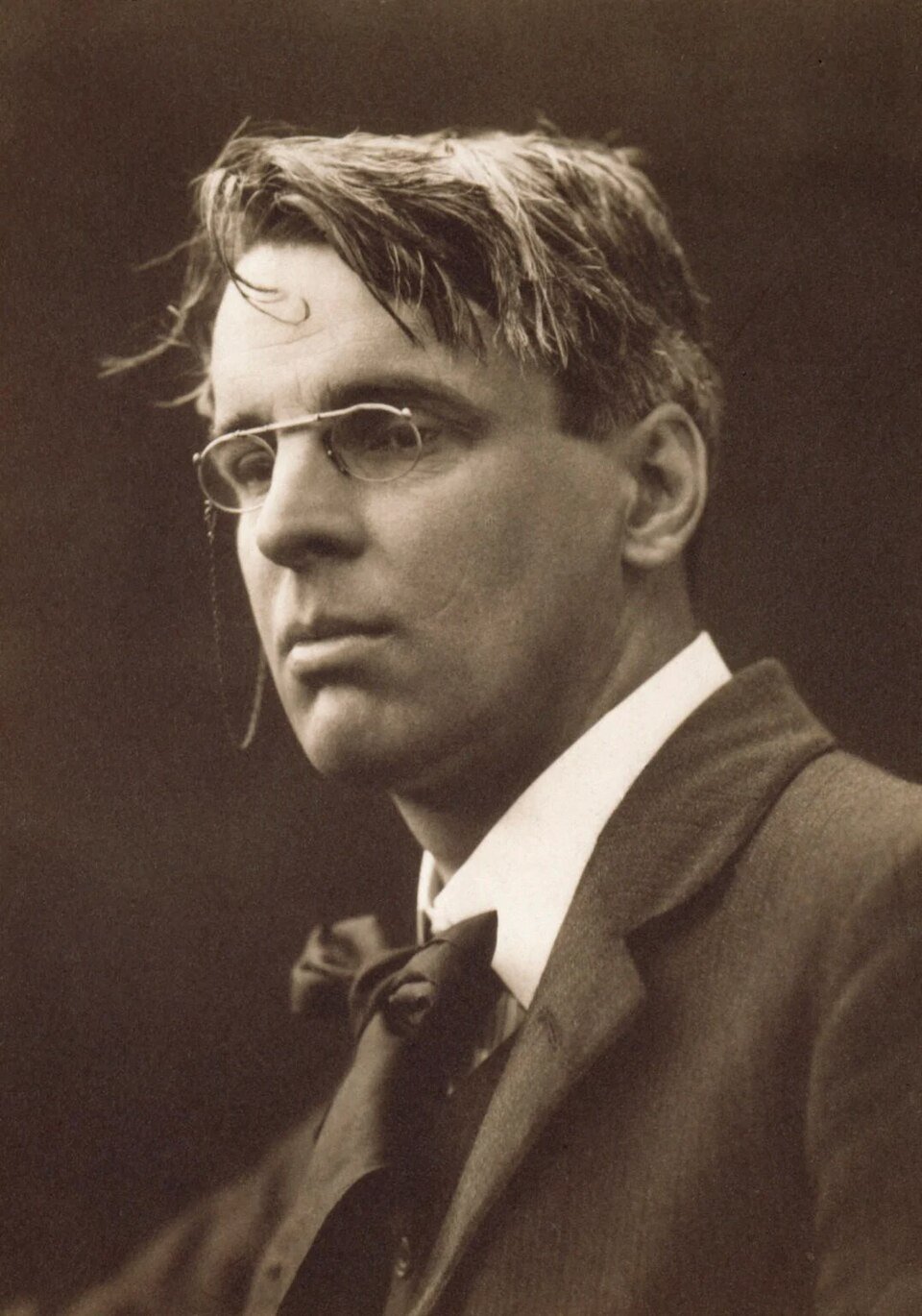
WB Yeats by George Charles Beresford. Source: Public domain, National Portrait Gallery, available here.
Yes, Malta is a warm dry dusty paradise; a pearl in the Mediterranean. It’s so far south that it almost touches Africa. On the contrary, for an example, Ireland is an emerald on an opposite edge of Europe, shivering and glittering with wet jagged cliffs reaching towards America. Even in summer, it’s bashed by the cold Atlantic and stung with a razor-sharp wind. The only image nature shares with both outposts is the sky and endless sea, albeit, one island is surrounded with deep growling colours and the other illuminated with sunnier shades.
So, to find a common denominator, some might note that both islands were graced with Ireland’s Nobel-winning poet, WB Yeats. Known for rebellious theatre and love letters, it’s rumoured that he meandered through Malta’s capital, Valetta. However, Yeats wasn’t fit for much walking and was on the resort to see a doctor. It’s understood that he was suffering from Malta Fever, and didn’t do much writing either. However, a first edition of his work was prized and lovingly kept at a local library. To this day, his poetry is read, studied and celebrated in Malta but no, Yeats poetry or any other Irish writing is not what jumps out immediately at Irish tourists as they ramble through sun-drenched streets. Rather, it’s something much more objectively physical and British that stirs an interest in visitors. It’s a chunk of metal, a bit of a bulk that’s cemented into the ground.
As bold as the burning sun, blatantly Britannic icons are the attraction: a British post-box and phone kiosk! These relics of empire stand to attention on Mediterranean squares and street corners. They’re blazingly stark naked in bright royal red polished paint beside palm trees. These metal icons are moulded with a monarch’s mark and standing tall with an imperialist stance. For any historian rambling through Malta, squinting at majestic buildings and dazed by illuminated limestone, the abrupt spasms of royal red metallic street furniture are a feast for the eye.
Visitors are often in awe with these colonial relics of ingenuity, marvelling at how polished they are; such a shine to put councils back home to shame. A child might think of Postman Pat with his black and white cat; children throughout Malta and the world are familiar with the cartoon characters serving the Royal Mail.
Irish streets also inherited such iconic furniture but the sculptured structures were painted green or matching shades of cream long ago. Both Malta and the Emerald Isle are adorned with these metallic monuments to a British monarch, as are numerous other ex-colonies and crown territories throughout the world. Gibraltar is another Mediterranean example but remnants of the late-empire’s infrastructure don’t stop there. A red phone-box buried in jungle has startled many travellers in Africa. Treading through growth in Sierra Leone, a hiker could come upon a British phone-box in need of a coat of paint. It’s indeed red, though blistered by sun but standing tall against towering greenery that threatens to devour it. Neglected and long out of order but, like the metal monuments in Malta, and Postman Pat, it’s loved. It seems that the whole empire, or its remnants, is littered with icons from yesteryear: post-box, kiosk, clock tower, a road sign, bus stop, bus shelter with Victorian wrought-iron railings, together with lengths of railway sunk beneath a jungle floor, not to forget the odd statue of Queen Victoria.
Ireland is an oddity because the street furniture is painted green or a matching shade of cream. Sometimes, a heavy repetitive coat of the thick moss colour was pasted onto a post-box. The new colouring for postal and telegraphy infrastructure erupted with Irish independence. In 1922, the Free State set about installing street names in the Irish language, and rechristening train stations to honour revolutionary leaders. However, nothing was more vibrantly stark and as immediate as painting metalwork on a street. The change of sovereignty was heralded with a thick coat of green paint. The painting of hardware in Ireland was described as the first populist act of the new parliament, the Dail Eireann in Dublin. Decoration was easy but the imprinted symbols of British monarchs were more stubborn and refused to budge; crests remained moulded in metal. In Ireland and Malta, and indeed worldwide, lettering for Queen Victoria and King George remain inscribed and alive to this day. History leaves its mark upon the street.
While post-boxes in Ireland are green, those across the sea remain royalist red. However, there’s the overlapping corner on the Emerald Isle where colours clash. It’s where symbols matter. Tribal colours in Ulster are displayed as patriotically as a flag on a lamppost, changing abruptly at the Gerrymandered border: Green or Red, British or Irish, Loyalist or Republican. Some Unionists and observers alike suspect that these team colours could pose a problem if Irish unity was to proceed. History points to Britannic regalia being discoloured and some demolished: Nelson’s Pillar blown-up in Dublin and Queen Victoria’s statue smashed to smithereens. Could Unionists be robbed of their cultural comforts yet again? Surely, they’d see red if anyone was to paint their local post box in Belfast green!
Maybe Malta, an island that’s a thousand miles away, has the amicable answer. It has significantly more in common with Ireland than a post-box, or a phone-box or the love of Postman Pat with his black and white cat. Malta is declared to be the world’s most Catholic country, even more than the Republic of Ireland. This tiny blessed state boasts more papist churches in relation to population than anywhere else. It has a majestic baroque cathedral that makes the Vatican look like a mere garden shed. This is where Europe stood against Arab invaders, resisted the Otterman Empire, flew the flag and held the frontline for Christendom. The course of Europe’s history was decided in Malta. Ever since establishing a home for Christian knights, a springboard for crusades, and hosting the Order of Saint John, they’ve been blessing themselves and going to a Catholic mass, to confession and kneeling for the Angelus at six o’clock. Like children throughout Ireland, youngsters in Malta will prepare for their First Holy Communion and go on to get married in a Catholic church and maybe receive Last Rites from a priest at the end of their lives.
In a further similarity with republican Ireland, Malta had its own rebellion against British rule, during the time of the Irish Troubles. The bloody Sette Giugnio riots occurred in 1919. This resulted in, initially, a harsh suppression by the colonial authorities and then self-government being reluctantly granted in 1921. The two islands seemingly moved in similar steps at, roughly, the same time. As with the Easter Rising being commemorated in Dublin, Malta marks Sette Giugnio every year.
So, did Malta remove British icons or, maybe, go paint a post-box? No, not a bit of it. Despite its rebellion and papist allegiance, Malta was fighting for empire and its Protestant king a few years later. It held the fort for the Mother Country throughout World War Two. The island garrison in the Mediterranean was under siege. Again! Its history is littered with bombardments because of its strategic location: before and during the Roman Empire, then an Arab conquest and throughout the time of the Ottermans. As late as 1800 the island was blockaded during Napoleonic wars. So, in the early Forties it was rewarded yet again for its stubbornness, for their Maltese tendency to resist surrender. They were bold and resilient to the end. Being a mighty British defender of the sea resulted in it being bombed and bombed again. It was hit more than any other country on planet Earth. Despite being attacked mercilessly it refused to surrender; as always. It held the record for the most battered place during the war until a nuclear blast elevated poor Japan to take that most unwanted prize. At the end of an awful war the whole island was awarded the George Cross Medal for bravery and loyalty.
Some might have thought that Malta would have had enough of British colours and paraphernalia and all things empire. But no! Catholic Malta’s fondness for the red British post-box and kiosk is as staunch as the Irish Protestant’s appreciation for the Orange Lodge; loved, as children would love Postman Pat with his black and white cat.
Unionist or Nationalist, British or Irish, planter or Gael, take heed of Catholic rebels in Malta, proud of their Anglican steeple dominating the Valetta skyline. The tall stout Protestant church, Saint Paul’s, is just down the street from scores of Catholic churches and Saint John’s cathedral. Could Malta be a model for Ulster, a Catholic gesture and promise not to paint the town green again? Could voters for Irish unity still cherish nostalgia and appreciate the British post-box?
It’s an important question because symbols matter. To this day, tribes fight over colours and words in Ulster, tearing down flags to burn and spit on, and whitewashing road signs into oblivion. A visitor to Malta, Carl Jung, psychologist and author of Man And His Symbols, unfolds the significance of steeples, statues, spirals and the like. Jung had an interest in the miss-mash of sacred sites on the island dating back centuries beyond the arrival of the British or any other empire. Today’s tourist is presented with both prehistoric and post-Roman religious symbols. The sacred structures sit happy alongside icons of Twentieth-century modernity and telepathy. They document religion’s history with domes and spikes, the symbols that Jung wrote about. It seems he did not write about the Great British phone-box, not a mention of its ornate crest to honour a monarch, but disciples of Jung regard technology as an emerging religion, as they did capitalism and all things money. They believe every religion has its symbols. Joseph Campbell, the writer and Jung-follower, suggested that modern structures, such as boastful tech towers and financial skyscrapers, reflect beliefs and are up there with the domes and steeples. Or maybe down there on a street with a red British phone-box.
Despite tourist hotels, Valetta has been spared the latest fashion in high-rise structure. It’s skyline and street scene has everything it needs to reflect ancient gods, Christendom and Twentieth-century modernity. The Internet, digitalisation and virtual space-age clouds may have rendered the post-box and phone-box redundant but the old street icons demand their slot in history. They stand there, alongside church and cathedral, not in a museum. Or is Malta a living museum? Regardless of a visitor’s belief, whether its ancient, modern or futuristic, there’s plenty to entertain the eye of today’s historian, tourist, dreamer, whoever.
Today, visitors walk in the footsteps of both Jung and Ireland’s writer of love letters. Yeats is regarded as the most all-time poetic client of the Royal Mail or any postal service. He is read and quoted here. Unfortunately, he was delivered late for much of Ireland. He was a true servant to Eire through troubled times, being instrumental in making the Irish Free-state function when, as with Malta, the British released its hold. However, he remained loyal to Protestant tradition. He would probably have voted to keep his local post-box painted red. He insisted on being buried in a Protestant churchyard but despite his allegiance to English tradition he embraced, honoured, promoted and even mourned Celtic culture: faeries, banshee and all. In his famous poem, Easter 1916, he wrote of Irish nationalism:
Wherever green is worn….. A terrible beauty is born.
Maybe Ireland could revisit Yeats poetry, and copy Malta, adopt iconic monuments to a monarch, keep them as an inheritance rather than symbols of suppression. Let all be loved by tourist and locals alike, as Yeats loved Ireland and faeries, as the Maltese cherish symbols of the past, love authentic British icons as children love Postman Pat with his black and white cat.
Enjoyed the piece?
Join thousands of history readers getting occasional updates on new blog posts, books, and video releases — plus a free history book to get you started.