Few American writers wielded prose with the precision—and menace—of Ambrose Bierce. His sentences could be coldly funny, occasionally vicious, and almost always economical. He had little patience for public pieties. Politicians, clergymen, businessmen, and fellow writers all found themselves within range of his criticism.
Brian D’Ambrosio explains.
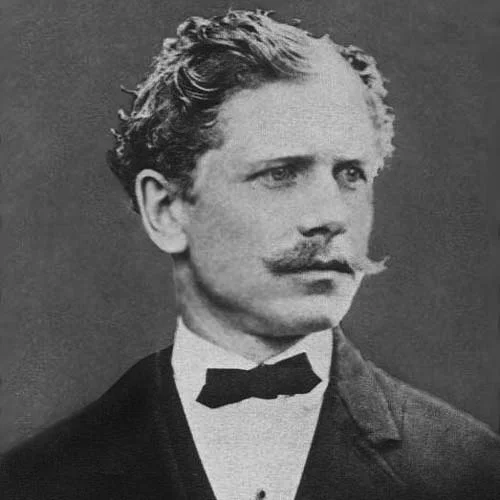
Ambrose Pierce. Source: Public domain, Clifton Waller Barrett Library of American Literature, available here.
Born June 24, 1842, in Meigs County, Ohio, Bierce became one of America's most distinctive journalists, satirists, and short-story writers. His fiction includes An Occurrence at Owl Creek Bridge, Chickamauga, and The Boarded Window. Yet The Devil's Dictionary, his collection of sardonic definitions, offers perhaps the clearest view of his fascination with words and the ways people manipulate them. The book remains an unusually sharp examination of the distance between accepted meanings and actual behavior.
Bierce was the tenth of thirteen children. His family eventually settled in northern Indiana, where he attended high school. As a teenager, he worked as a printer's devil before briefly enrolling at the Kentucky Military Institute in 1859. There he studied military subjects and trained in topographical engineering. He left the institute and returned to Indiana.
The Civil War soon interrupted his plans. Bierce enlisted in the Union Army in 1861 and served through some of the conflict's hardest campaigns. He fought at Shiloh and Chickamauga, among other engagements, and was struck in the head by a bullet at Kennesaw Mountain, Georgia, in June 1864. The wound left him with recurring dizziness and blackouts. He recovered sufficiently to return to duty later that year, but was medically discharged in January 1865. President Andrew Johnson brevetted him major that August.
The war furnished material for some of his finest fiction. In Chickamauga, a young boy wanders onto a battlefield and encounters its aftermath without understanding what he sees. The boy is deaf, a detail that makes the surrounding carnage all the more terrible. An Occurrence at Owl Creek Bridge follows a Confederate civilian facing execution. Its treatment of time and imagined escape remains among the most accomplished narrative experiments in American short fiction. Bierce had witnessed combat firsthand. He had little interest in dressing it up as a pageant of glory.
After the war, Bierce traveled west and eventually settled in San Francisco. Journalism became his profession. He wrote for several periodicals, including the San Francisco Wasp, before joining William Randolph Hearst's San Francisco Examiner in 1887. His columns attacked political corruption and literary pretension. His reputation for caustic criticism earned him the sobriquet "the wickedest man in San Francisco."
The project that would become The Devil's Dictionary began in the Wasp in 1881. Bierce continued adding entries at irregular intervals, publishing them in newspapers and periodicals over the following decades. In 1906, Doubleday issued a selection under the title The Cynic's Word Book. It covered entries from A through L. Bierce had preferred The Devil's Dictionary, but the publisher objected to the name. The expanded alphabetical work appeared under his chosen title in 1911, as the seventh volume of his Collected Works.
The format was simple: a word followed by a definition. Bierce's treatment was anything but conventional. Take his entry for "politics": "A strife of interests masquerading as a contest of principles. The conduct of public affairs for private advantage." The first sentence establishes the contradiction; the second delivers the verdict. Bierce needed no extended argument to make his point.
He reserved a similar joke for the book itself. Under "Dictionary," he wrote: "A malevolent literary device for cramping the growth of a language and making it hard and inelastic. This dictionary, however, is a most useful work." The final sentence turns the definition back on its author. Bierce was making sport of lexicographers while using their format to conduct his own examination of public speech.
His entries depend on the reader knowing the conventional meaning of a word. Without that familiarity, the reversal loses its force. A respectable definition is presented, then bent toward an uncomfortable interpretation. The humor comes from recognizing something one may have witnessed but never quite put into words. Bierce seldom needed a paragraph when a sentence would do.
His newspaper career gave him a daily view of the language of public life. He watched politicians explain their conduct and defend their interests. He also watched journalists, businessmen, and other public figures select words that made their positions sound more respectable. The dictionary extended that scrutiny beyond individual personalities. Its targets included the vocabulary through which people justified themselves.
The same distrust of appearances runs through his fiction. In An Occurrence at Owl Creek Bridge, a condemned man's imagined escape occupies the space between expectation and reality. In Chickamauga, the child cannot comprehend the battlefield he has entered. Bierce was interested in the limits of perception. His stories frequently leave readers confronting information they initially misunderstood.
He also published poetry and essays. His collections include Black Beetles in Amber (1892) and Shapes of Clay (1903). Between 1909 and 1912, the Neale Publishing Company issued his collected writings in twelve volumes. His literary output was considerably broader than the dictionary for which he is now most widely remembered.
In 1913, Bierce traveled through the former Civil War battlefields before heading toward Mexico during its revolution. Surviving correspondence places him in Chihuahua in December of that year. His final known letter, dated December 26, mentions an impending departure for an unknown destination. No reliable account establishes where or when he died. His disappearance remains unresolved.
Perhaps the mystery has attracted more attention than the work itself. Bierce's literary achievement requires no embellishment. The Devil's Dictionary is an exercise in verbal ingenuity, built on an intimate understanding of how words acquire authority and how easily that authority can be abused. He took familiar expressions and made readers look at them again.
Indeed, the book still has teeth. Its jokes depend on human behavior that has changed remarkably little since Bierce's time. His definitions are not always fair, and his cynicism can be excessive. But the best of them possess a precision that is difficult to imitate. Bierce knew how to make a sentence turn on a single word.
Perhaps that is the most enduring measure of his achievement. He left behind a dictionary in which the definitions are often more revealing than the words they purport to explain. Indeed, few American writers have made the ordinary vocabulary of public life seem quite so treacherous.
Brian D'Ambrosio is the author of Montana Eccentrics, New Mexico Eccentrics, Italian-Americana: Explorers, Entertainers, and Eccentrics, and American Eccentrics: Mavericks, Misfits, and Visionaries. Available here: Amazon US | Amazon UK You may follow him on Substack here: (7) Brian D'Ambrosio | Substack
References
American National Biography: biographical and military chronology
Oxford Bibliographies: literary career and background. University of Chicago Press/Bodleian Library
Publishing: dictionary publication history.
The Cynic’s Word Book, 1906: original text and Bierce's preface.
The Devil’s Dictionary, full text: original definitions.
Indiana Historical Society: evidence and qualifications concerning Bierce's disappearance.