Thomas Eugene Kelly was born on the 25th of December, 1919 in Worcester, Massachusetts, and grew up in an America shaped by economic hardship and the lingering trauma of the First World War. Raised during the Great Depression, Kelly belonged to a generation for whom military service was often seen as both duty and opportunity. Following the Japanese attack on Pearl Harbour in December 1941, he enlisted in the United States Marine Corps in April 1942. Like many young Marines, he was forged by demanding training and an unforgiving discipline designed to prepare men for a form of warfare unlike anything the United States had previously faced: amphibious assaults against a determined and well-entrenched enemy across the vast expanse of the Pacific Ocean.

Terry Bailey explains.

Thomas G. Kelley. Source: Johnny Bivera, MilitaryHealth, available here.

By the time Kelly reached combat, the Pacific War had evolved into a brutal contest of attrition. The early Japanese successes of 1941–1942 had been reversed through a relentless Allied counteroffensive, characterized by "island-hopping" campaigns aimed at bypassing strongholds while seizing strategically vital positions. Battles such as Guadalcanal, Tarawa, Saipan, and Peleliu had demonstrated both the effectiveness and the staggering human cost of this strategy. Japanese forces, increasingly isolated and cut off from resupply, fought with extraordinary tenacity, often to the last man, guided by a military culture that emphasized honor, sacrifice, and resistance to surrender. It was into this unforgiving environment that Kelly and the men of the 5th Marine Division were sent in early 1945.

Iwo Jima represented one of the most formidable objectives of the entire Pacific campaign. A small, barren volcanic island located roughly halfway between the Mariana Islands and Japan, it was prized for its airfields, which could support Japanese interceptors and, if captured, provide emergency landing grounds for American B-29 bombers attacking the Japanese home islands. Anticipating an invasion, Lieutenant General Tadamichi Kuribayashi, the Japanese commander on Iwo Jima, rejected traditional beach defense tactics. Instead, he oversaw the construction of an elaborate underground defensive network of tunnels, bunkers, caves, and reinforced pillboxes, allowing his approximate 21,000 defenders to survive bombardment and emerge to fight with deadly efficiency.

When U.S. Marines landed on Iwo Jima on the 19th of February, 1945 they encountered resistance far more intense than expected. The soft volcanic ash slowed movement, while hidden Japanese positions delivered overlapping fields of fire. Casualties mounted rapidly as Marines struggled to advance yard by yard against an enemy that remained largely invisible. Kelly, serving with the 3rd Battalion, 27th Marines, found himself in the midst of this hellish landscape as the battle ground on through late February, with both sides locked in a savage struggle for control of the island's rugged terrain.

On the 25th of February, 1945 Kelly's company was ordered to seize and hold a strategically vital hill that dominated the surrounding area. The position was heavily defended by Japanese troops manning well-camouflaged strongpoints, supported by machine guns and rifle fire that pinned the Marines down and inflicted serious losses. As the attack stalled and the situation grew increasingly perilous, Kelly acted with decisive courage. Without waiting for orders, he moved forward alone, deliberately exposing himself to intense enemy fire as he closed with the Japanese positions.

Armed with grenades and his rifle, Kelly assaulted one fortified position after another at close range. He destroyed enemy emplacements by hurling grenades into firing ports and engaging defenders directly, often within a few yards. During these actions, he was repeatedly wounded, yet he refused evacuation or medical treatment, continuing to advance despite blood loss and physical pain. His fearless movement across open ground drew enemy fire away from his pinned comrades and provided a rallying point for the rest of the company, which began to advance behind his example.

The Japanese soldiers Kelly faced were veteran defenders operating within Kuribayashi's carefully designed defensive system. They were disciplined, well-trained, and resolute, fighting from mutually supporting positions intended to maximize American casualties. Many were armed with machine guns, rifles, grenades, and mortars, and they exploited the terrain expertly. That Kelly was able to overrun multiple such positions single-handedly speaks to both his extraordinary bravery and the ferocity of the resistance he confronted. By neutralizing key enemy strongpoints, he played a decisive role in allowing his unit to secure the hill and hold it against further attack.

At the end of the action, Kelly had personally accounted for a significant number of enemy soldiers and silenced several critical defensive positions. His conduct under fire was not only tactically decisive but psychologically transformative, inspiring exhausted and battered Marines to press on in one of the most grueling battles of the war. For his conspicuous gallantry and intrepidity above and beyond the call of duty, Thomas Eugene Kelly was awarded the Congressional Medal of Honor. The citation emphasized his repeated solo assaults, his refusal to withdraw despite severe wounds, and the inspirational leadership he displayed under the most extreme combat conditions.

The Battle of Iwo Jima ultimately lasted more than a month and resulted in nearly 7,000 American dead and over 26,000 casualties, making it one of the bloodiest engagements in Marine Corps history. Of the roughly 21,000 Japanese defenders, almost all were killed. The battle became emblematic of the Pacific War's final phase, illustrating both the strategic necessity and the immense human cost of the campaign. Kelly's actions stand out even within this context of widespread heroism, representing the individual courage that underpinned American success in the face of fanatical resistance.

After the war, Kelly was discharged from the Marine Corps and returned to civilian life, bearing the lasting effects of his wounds. Unlike many public war heroes, he lived quietly and did not seek fame or attention for his achievements. He remained proud of his service and of the men with whom he had fought on Iwo Jima, viewing his Medal of Honor as a testament to their collective sacrifice rather than personal glory. Thomas Eugene Kelly died on the 9th of March, 1981 and was laid to rest with military honors.

The story of Kelly's actions endures as part of the broader story of the Pacific campaign, a conflict defined by endurance, sacrifice, and extraordinary acts of courage on both sides. On the shattered volcanic slopes of Iwo Jima, his determination and selflessness helped turn the tide at a critical moment, saving lives and securing ground that had been paid for in blood. His story remains a powerful reminder of the human dimension of war, and of how individual resolve can shape the outcome of history's most brutal battles.

In conclusion, Thomas Eugene Kelly's story brings into sharp focus the essential truth of the Pacific War: that its vast strategies and sweeping offensives ultimately depended on the courage of individuals willing to act under unimaginable pressure. On Iwo Jima, a battle defined by attrition, concealment, and relentless violence, Kelly's actions cut through the paralysis of fear and exhaustion at a moment when failure would have meant further loss of life and momentum. His willingness to advance alone against fortified positions, despite repeated wounds, embodied the Marine Corps ethos of perseverance and initiative, demonstrating how a single Marine's resolve could alter the course of a local engagement and, in doing so, contribute to a larger strategic victory.

Kelly's gallantry cannot be separated from the broader human cost of Iwo Jima. The hill he helped secure was not merely a tactical objective but part of a battlefield where every yard of ground was contested at staggering expense. His heroism stands as a representative example of the countless acts of bravery displayed by Marines who fought in conditions of extreme deprivation, uncertainty, and danger. That Kelly later viewed his Medal of Honor as a symbol of collective sacrifice rather than individual achievement underscores the shared burden borne by those who survived and those who did not.

In the decades since the battle, Iwo Jima has come to symbolize both the necessity and the tragedy of total war in the Pacific. Kelly's quiet post-war life, marked by humility rather than self-promotion, reinforces the enduring divide between wartime heroism and peacetime remembrance. He carried the physical and emotional scars of combat without seeking recognition, allowing his actions on the battlefield to speak for themselves. In doing so, he reflected the experience of an entire generation for whom service was a duty fulfilled, not a platform for acclaim.

Ultimately, Thomas Eugene Kelly's legacy lies not only in the Medal of Honor he received but in what his conduct reveals about courage under fire. His story reminds us that history is shaped as much by individual decisions made in moments of extreme peril as by grand strategies and commanding figures. On Iwo Jima, amid ash, steel, and relentless resistance, Kelly's determination saved lives and inspired others to endure. Remembering his actions ensures that the sacrifices of those who fought in the Pacific are neither abstracted nor forgotten, but understood through the lives of the men who bore the war at its most brutal point.


The site has been offering a wide variety of high-quality, free history content since 2012. If you’d like to say ‘thank you’ and help us with site running costs, please consider donating here.
Posted
AuthorGeorge Levrier-Jones

The European scramble for Africa, the period of imperial expansion in the late 19th and early 20th centuries, was motivated by a variety of reasons. An examination of different sources reveals that the driving force behind the colonization of Africa was mainly economic, fueled by the need for raw materials and new markets. Political rivalries, technological advances, and cultural ideologies were contributory factors, but they were ultimately secondary to the overarching economic imperative.  To understand this expansion, one must look at the convergence of the Industrial Revolution’s demands and the geopolitical climate of the era. 

Shubh Samant explains.

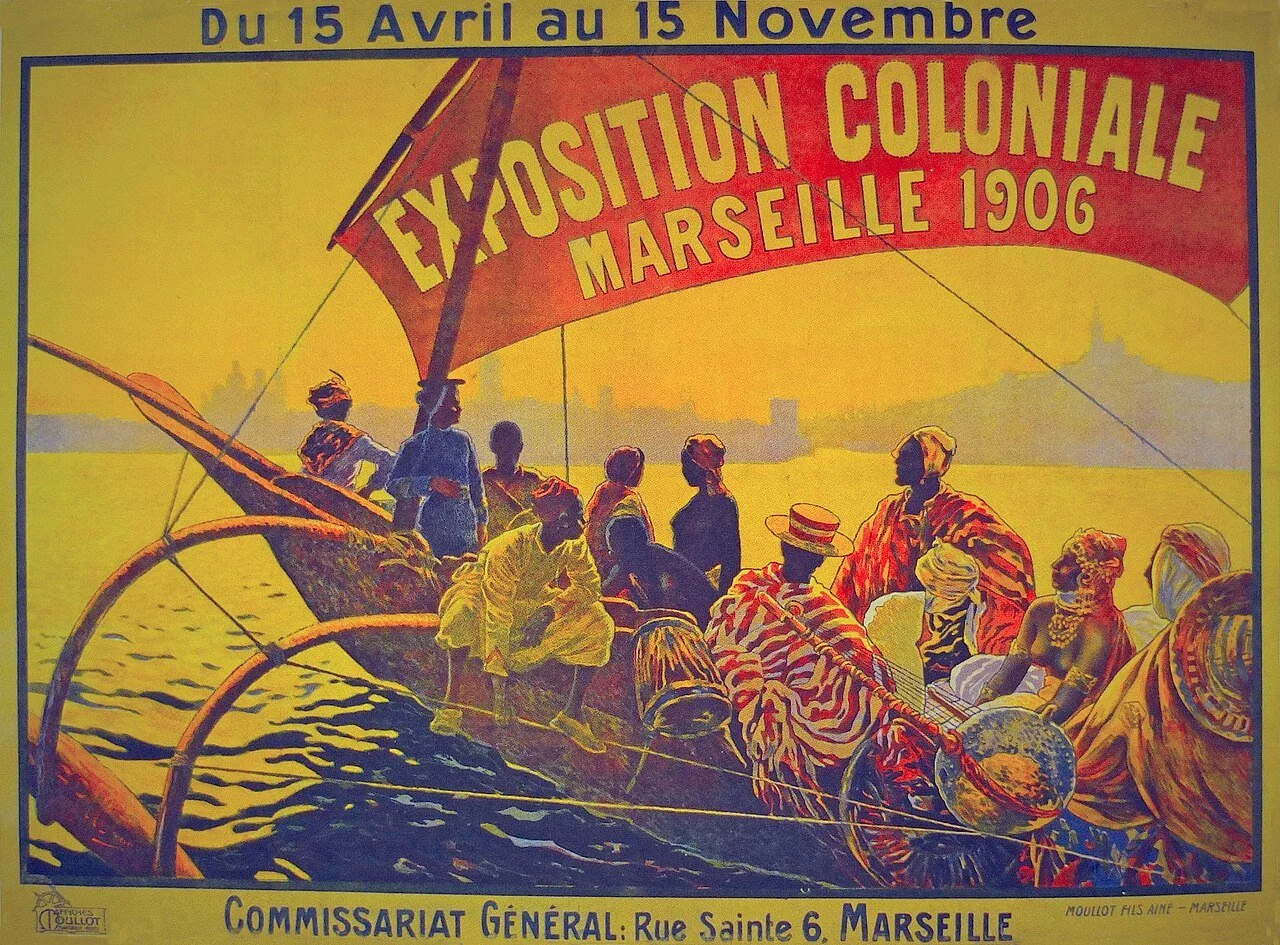
A 1906 Marseille Colonial Exhibition poster. It demonstrates European colonial achievements.

A 1906 Colonial Exhibition poster in Marseille, France.

The Berlin Conference

The term “Scramble for Africa” itself reflects the speed, intensity, and competitive nature of this imperial race. Between roughly 1880 and 1914, European powers carved up nearly the entire continent, often with little regard for existing African societies, cultures, or political boundaries. The Berlin Conference of November 15, 1884 to February 26, 1885, convened by Otto Von Bismarck, symbolized this process, as European nations sat around a table in Berlin and drew borders on maps that would later become the foundations of modern African states. This conference was not about African voices or African agency; it was about European powers negotiating among themselves to avoid conflict while maximizing their territorial and economic gains. The General Act of the Berlin Conference established the principles of "effective occupation," which required powers to demonstrate physical presence and administration to claim sovereignty, further accelerating the rush to the interior.


The Economic Engine

The Industrial Revolution was the force that created an economic push, since it had established an unprecedented need for raw materials. Some examples of natural resources present in Africa included cotton, palm oil, rubber, and minerals. These resources were important to the industries of Europe, and gaining access to them was of the utmost importance. There were economic motivations which pushed the European powers to colonize and tap the wealth of Africa. With the need for new markets in rise, the majority of Africans were perceived as a wonderful opportunity for new markets for European-made manufactured goods. By 1870, industrial output in Europe had reached a point where domestic markets were becoming saturated, leading to a "Long Depression" that made overseas expansion look like a financial necessity.

The economic logic was straightforward: industrial economies in Britain, France, Germany, and Belgium required steady supplies of inputs to sustain production. African rubber fed the tire industry, palm oil was used in soaps and lubricants, cotton supplied textile mills, and gold and diamonds enriched European treasuries. Beyond raw materials, Africa also represented a potential consumer base. Even though most Africans had limited purchasing power, imperialists imagined vast markets where European goods could be sold. This vision of Africa as both a warehouse of resources and a marketplace for manufactured products was central to the imperial project. The discovery of the Witwatersrand gold reef in 1886 transformed South Africa into a focal point of global finance, drawing in billions in European capital and cementing the economic priority of the region.


Political Rivalry and the Rise of Nationalism

While economic reasons were the most significant driver, political rivalry also provoked the scramble for Africa. The extent of European control by 1914 was overwhelming, leaving just two nations (Ethiopia and Liberia) independent. This is indicative of the fierce competition among European nations, each searching for more power and prestige, National pride and the desire to retain power were strong incentives for colonization, as suggested by Freidrich Fabri. Even these political incentives, though, were intertwined with economic ones, as colonies also symbolized a source of wealth and power. Fabri argued in 1879 that for a new nation like Germany, colonial expansion was a vital necessity to maintain its standing among older powers.

Nationalism was a powerful force in late 19th-century Europe. Countries like Germany and Italy had only recently unified, and their leaders sought colonies as a way to demonstrate strength and legitimacy on the global stage. France, still reeling from defeat in the Franco-Prussian War of 1870, looked to Africa to restore its prestige. Britain, already the world’s leading imperial power, sought to maintain its dominance by controlling strategic territories such as Egypt and South Africa. Colonies became symbols of national greatness, and losing ground to rivals was seen as a humiliation. Thus, political rivalry was inseparable from the economic quest, as each empire measured its success not only in wealth but also in the size of its colonial holdings. The "Great Game" was no longer confined to Asia; it had moved to the African continent, where every square mile gained was seen as a blow to a neighbor.


Technological Advancements and Military Dominance

Technological innovations greatly aided European imperialism. Steamships, railroads, etc. allowed Europeans to penetrate into the African interior and overcome the logistical challenges. The invention of the Maxim gun further enhanced European military superiority. These technological innovations were ultimately tools to achieve the economic goals. Without these advancements, the "Dark Continent" would have remained largely inaccessible to large-scale European administration.

The role of technology cannot be overstated. Prior to the late 19th century, much of Africa remained inaccessible to Europeans due to disease, geography, and logistical difficulties. The discovery of quinine as a treatment for malaria reduced mortality rates among Europeans and made deeper incursions possible. Railroads allowed for the rapid transport of goods from the interior to coastal ports, while steamships shortened travel times between Europe and Africa. The Maxim gun, the first fully automatic machine gun, gave European armies overwhelming military superiority over African forces armed with spears, muskets, or outdated rifles. These innovations created the infrastructure and military dominance necessary to sustain imperial control, ensuring that economic exploitation could proceed with minimal resistance. At the Battle of Omdurman in September 02, 1898, British forces used Maxim guns to kill roughly 11,000 Mahdist warriors while losing only 47 of their own men, illustrating the terrifying disparity in power.


Cultural Justifications and Social Darwinism

There were cultural beliefs, such as “The White Man’s Burden” philosophy, that gave a moral reason for European imperialism. These cultural beliefs were used to cover up economic reasons for it. Although there were some Europeans who sincerely believed they were there to civilize the native Africans, they were largely motivated by a desire to acquire wealth and minerals. In general, while the scramble for Africa had a variety of reasons, it was the economic ones which were primary. It was the need for raw materials, markets, and investment opportunities that propelled the rush of the colonization of Africa. Political rivalries, technological changes, and cultural mentality served as underlying factors, but were complementary to the strong economic factors. Social Darwinism provided a pseudo-scientific framework that ranked races, suggesting that the "survival of the fittest" applied to nations and justified the domination of the "weaker" by the "stronger."

The cultural dimension of imperialism was deeply intertwined with notions of racial superiority and paternalism. Rudyard Kipling’s famous poem “The White Man’s Burden” encapsulated the idea that Europeans had a moral duty to “civilize” non-European peoples. Missionaries traveled to Africa to spread Christianity, often believing they were saving souls, but their efforts also paved the way for colonial administrations. Education systems were introduced that emphasized European values, languages, and histories, while African traditions were marginalized or dismissed as primitive. This cultural justification provided a veneer of morality to what was essentially economic exploitation. By framing imperialism as a benevolent mission, European powers could present themselves as altruistic actors, even while extracting immense wealth from African lands. However, the "civilizing mission" often translated into the dismantling of local governance and the imposition of European legal codes that prioritized property rights for settlers over indigenous land use.


African Resistance

As Europeans entered the lands of Africa, so did the Africans resist. African resistance was not a monolith; it ranged from diplomatic negotiation and tactical alliances to full-scale guerrilla warfare and religious uprisings. One of the most significant examples of sustained military resistance was led by Samori Touré, the founder of the Wassoulou Empire. Between 1882 and 1898, Touré utilized a sophisticated "scorched earth" policy and moved his entire empire eastward to evade French forces. His ability to manufacture and repair his own firearms locally allowed him to resist for sixteen years, proving that African states were capable of high-level military organization.

In East Africa, the Maji Maji Rebellion (July 1905 to July 1907) demonstrated the power of spiritual unity. Diverse ethnic groups in German East Africa (modern-day Tanzania) united against forced cotton cultivation. Rebels believed that a sacred water (maji) would turn German bullets into water. While the Germans eventually suppressed the uprising through a manufactured famine that killed hundreds of thousands, the rebellion forced the colonial administration to reform its more brutal labor policies, showing that even "failed" resistance could alter the colonial trajectory.

Perhaps the most striking exception to European dominance was the Ethiopian Empire under Emperor Menelik II. Unlike many of his contemporaries, Menelik II recognized the importance of modernizing his military early. He played European powers against one another to purchase modern rifles and artillery. When Italy attempted to impose a protectorate, the Ethiopian army decisively defeated the Italian forces at the Battle of Adwa on March 01, 1896. This victory ensured Ethiopia remained the only indigenous African state to maintain its independence throughout the Scramble, providing a powerful symbol of hope for future Pan-African movements.

Furthermore, resistance often took place within the colonial system itself. In West Africa, the "Aba Women's War" of November 1929 saw thousands of Igbo women in Nigeria organize mass protests against the British "Warrant Chiefs" and the imposition of new taxes. Through "sitting on" the chiefs, a traditional form of shaming, the women successfully forced the colonial government to drop the tax plans and reform the local administration. These examples illustrate that while the Scramble was a period of intense European aggression, African agency was never extinguished; rather, it adapted to the new realities of imperial rule.


Conclusion

By 1914, Africa was almost entirely under European control, and the continent’s political, economic, and cultural landscapes had been dramatically reshaped. The legacy of this period continues to affect Africa today, as many post-independence states inherited borders, institutions, and economic structures created during colonial rule. The scramble for Africa was not merely a historical episode of conquest; it was a transformative moment that altered global power dynamics, enriched European nations, and imposed lasting challenges on African societies. The transition to independence in the mid-20th century was frequently complicated by these extractive colonial structures, which were not designed for democratic self-governance.

In conclusion, the scramble for Africa was driven primarily by economic imperatives, but it was reinforced by political rivalries, technological innovations, and cultural ideologies. The industrial revolution created the demand for raw materials and markets, nationalism fueled competition among European powers, technology enabled conquest and control, and cultural beliefs provided moral justification. Together, these factors produced one of the most dramatic episodes of imperial expansion in world history. Yet beneath the rhetoric of civilization and progress lay the fundamental reality: Europe’s hunger for wealth and resources was the true engine of colonization. The scramble for Africa was, at its core, an economic enterprise cloaked in the language of politics, technology, and morality. By the time the dust settled, the continent was irrevocably tied to the global capitalist system, a tie that persists in the modern era's neo-colonial economic relationships.


Did you find that piece interesting? If so, join us for free by clicking here.


References

  • Fabri, Friedrich. (1879). Bedarf Deutschland der Colonien? (Does Germany Need Colonies?).

  • Headrick, Daniel R. (1981). The Tools of Empire: Technology and European Imperialism in the Nineteenth Century

  • Hobson, John A. (1902). Imperialism: A Study.

  • Hochschild, Adam. (1998). King Leopold's Ghost: A Story of Greed, Terror, and Heroism in Colonial Africa.

  • Kipling, Rudyard. (1899). The White Man's Burden: The United States and the Philippine Islands.

  • Pakenham, Thomas. (1991). The Scramble for Africa: White Man's Conquest of the Dark Continent from 1876 to 1912.

  • Said, Edward W. (1993). Culture and Imperialism.

Lachhiman Gurung's story cannot be fully understood without appreciating the wider context of the Burma Campaign, one of the most demanding and least forgiving theatres of the Second World War. Fought across dense jungle, steep mountains, monsoon-soaked valleys, and primitive supply routes, the campaign pitted Allied forces against a Japanese army that had already demonstrated its ability to defeat larger, better-equipped opponents through mobility, surprise, and ferocious determination. Within this brutal environment, Gurung's stand in May 1945 represents not just individual heroism, but the culmination of years of attritional warfare in which endurance was often as decisive as firepower.

Terry Bailey explains.

An Inscription of Lachhiman Gurung VC's name on the "Memorial Gates", Constitution Hill, London. Source: Gorkha Warrior, available here.

Born in 1917 in the village of Chhimba in Nepal's Gorkha district, Lachhiman Gurung grew up in a society where military service was both an economic opportunity and a source of deep cultural pride. Gurkha soldiers had been recruited into the British Indian Army since the early nineteenth century, valued for their toughness, adaptability, and fierce regimental loyalty. Gurung enlisted in the 8th Gurkha Rifles, a regiment that had already seen extensive action in both world wars. By the time Japan entered the conflict in Southeast Asia in 1941, Gurkha units were among the most experienced light infantry forces available to the British Empire, well-suited to jungle warfare and long-range patrolling.

The Japanese invasion of Burma in 1942 had driven British and Indian forces into a humiliating retreat to India, but by 1944 the strategic balance had begun to shift. The failure of the Japanese offensives at Imphal and Kohima marked a turning point, after which Allied forces, reorganized and resupplied, began a relentless advance back into Burma. By 1945, the Japanese 15th Army and associated formations were exhausted, understrength, and increasingly isolated, yet they remained dangerous opponents. Japanese doctrine emphasized aggressive night attacks, infiltration, and the willingness of small units to fight to the death rather than withdraw. Defensive positions were often assaulted repeatedly at close quarters, with grenades, bayonets, and hand-to-hand combat playing a decisive role.

It was against this backdrop that Rifleman Lachhiman Gurung found himself holding a forward position near Taungdaw on the night of 12–13 May 1945. His battalion was engaged in clearing remaining pockets of Japanese resistance as Allied forces pushed southwards. Forward positions such as Gurung's were particularly vulnerable, often lightly manned and deliberately exposed to give early warning of enemy movement. Japanese troops, skilled at moving silently through jungle and darkness, frequently attempted to overwhelm such posts with sudden grenade attacks followed by a close assault.

During the night, a determined Japanese attack fell upon Gurung's trench, which he shared with two fellow Gurkhas. Grenades were hurled into the position in rapid succession. When one grenade landed directly among them, Gurung attempted to throw it clear, a reflexive act that likely saved the wider position even as it cost him dearly. The explosion tore off two of his fingers, shattered his right arm, and inflicted multiple wounds to his face and body. His two comrades were killed instantly. In most circumstances, such injuries would have rendered a soldier helpless, if not unconscious, but Gurung remained upright and aware, driven by a sense of duty that overrode shock and pain.

Alone in the trench and severely wounded, Gurung faced repeated Japanese assaults at extremely close range. The attacking soldiers were likely drawn from veteran infantry units accustomed to night fighting, armed with grenades, rifles, and bayonets, and prepared to press home attacks regardless of casualties. Gurung, unable to properly use his damaged arm, adapted with grim ingenuity. Using his remaining hand and his teeth, he picked up grenades and hurled them back at the attackers, while firing his weapon whenever possible. For several hours, he held his position, repelling one attack after another, despite loss of blood, exhaustion, and the knowledge that no immediate help could reach him.

By dawn, the Japanese attacks had ceased. The ground in front of Gurung's trench was strewn with enemy dead, grim evidence of the effectiveness of his solitary defense. More importantly, the position had not fallen. In the tightly interlinked defensive system of jungle warfare, the loss of a forward post could allow enemy forces to infiltrate behind the main line, threatening encirclement or collapse. Gurung's refusal to yield under such conditions almost certainly prevented further casualties among his unit and contributed directly to the success of the local operation.

The award of the Victoria Cross recognized not only the extraordinary courage displayed but also the broader military significance of Gurung's actions. His citation highlighted his "indomitable spirit" and "complete disregard for his own safety," qualities that epitomized the ideal of the Gurkha soldier. At a time when the Burma Campaign was approaching its conclusion, his story resonated strongly with Allied forces who had endured years of hardship in one of the war's harshest environments.

After surviving his wounds, Lachhiman Gurung was discharged from the army with a disability pension. He returned to Nepal, where, like many Gurkha veterans, he lived a modest life far removed from the battlefields that had defined his youth. Despite being one of the few Nepalese recipients of the Victoria Cross, he remained characteristically humble, rarely speaking about his wartime experiences unless pressed. In later years, he was honored at commemorative events and remembered with deep respect within Gurkha circles and beyond. Lachhiman Gurung died in 2004, leaving behind a legacy that stands as one of the most remarkable individual acts of bravery in the Second World War and a powerful reminder of the human endurance displayed during the long and punishing struggle for Burma.

In conclusion, Lachhiman Gurung's Victoria Cross stands not merely as an isolated testament to individual gallantry, but as a lens through which the wider human experience of the Burma Campaign can be understood. His actions on that night in May 1945 encapsulate the defining features of the conflict: the intimacy of jungle warfare, the relentless pressure exerted by an enemy unwilling to concede defeat, and the extraordinary physical and moral resilience demanded of ordinary soldiers. Gurung's stand was not fought on a grand battlefield before massed formations, but in a muddy trench, in darkness and isolation, where survival depended on instinct, courage, and an unyielding sense of responsibility to comrades and unit.

His story highlights the vital contribution of the Gurkhas to the Allied war effort in Asia. Recruited from remote hill villages and serving far from home, Gurkha soldiers endured conditions that tested the limits of human endurance, often with little public recognition at the time. Gurung's conduct exemplifies the ethos for which they were renowned: quiet professionalism, adaptability under fire, and a willingness to hold the line regardless of personal cost. In this sense, his bravery was both exceptional and representative, reflecting the collective sacrifice of thousands of Gurkha soldiers who fought and died in Burma's jungles.

Finally, Lachhiman Gurung's legacy endures because it speaks to something universal in the history of war. His courage was not rooted in ideology or personal ambition, but in loyalty, duty, and an instinctive refusal to abandon his post while others depended upon him. Decades after the guns fell silent in Burma, his story continues to remind us that the outcomes of vast campaigns are often shaped by moments of individual resolve. In remembering Lachhiman Gurung, we honor not only a single hero, but all those whose endurance and sacrifice underpinned victory in one of the Second World War's most arduous and unforgiving theatres.


The site has been offering a wide variety of high-quality, free history content since 2012. If you’d like to say ‘thank you’ and help us with site running costs, please consider donating here.
Posted
AuthorGeorge Levrier-Jones

The Victoria Cross stands as one of the most revered and instantly recognizable military decorations in the world. Awarded "for most conspicuous bravery … in the presence of the enemy," it has come to symbolize the highest ideal of personal courage across the British and Commonwealth armed forces. Yet its creation was not inevitable. The medal was born out of a moment of national self-reflection, forged during a war that exposed the deficiencies of Britain's honors system and the heroism of ordinary soldiers in equal measure. Its conception, minting, and enduring legacy form one of the most compelling stories in military history.

Terry Bailey explains.

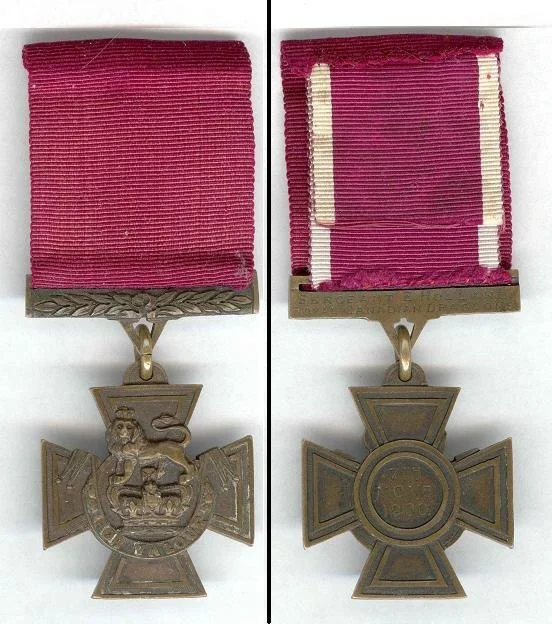
The front and back of Edward James Gibson Holland's Victoria Cross. Source: Royal Canadian Dragoons Archives and Collection, available here.

The Crimean War of 1853–1856 fundamentally reshaped Britain's approach to honoring gallantry. Prior to this conflict, no universal British award existed to recognize personal bravery on the battlefield. Instead, recognition tended to be tied to rank or social position, leaving countless acts of courage by common soldiers formally unacknowledged. The Crimean War changed this. Journalists, for the first time reporting directly from the front lines, brought stories of extraordinary heroism into Victorian homes. Reports of the Charge of the Light Brigade, the defense of the Alma, and the brutal conditions at Sevastopol stirred the public and embarrassed the government, highlighting the lack of a decoration that transcended class.

The idea for a new medal quickly took hold. Prince Albert, the Prince Consort, became one of the strongest advocates for the creation of a simple, egalitarian award. He envisioned a decoration that could be bestowed upon any serviceman—private or general—solely based on merit and bravery. Queen Victoria herself approved his vision, favoring a design that was dignified yet unpretentious. The result was a Royal Warrant issued on the 29th of January 1856, instituting a new honor: the Victoria Cross. It would be awarded sparingly and only for the most exceptional acts of valor performed in the presence of the enemy, making it a truly rare and exceptional distinction.

The first Victoria Crosses were minted in 1856, and the story of their material origin has become a key part of the medal's mystique. Tradition holds that they were made from the bronze of two Russian cannon captured during the Siege of Sevastopol. These heavy guns, relics of one of the fiercest battles of the war were transported to Woolwich, where they were broken down and melted to provide the raw material for the decoration. While later metallurgical examinations have raised questions about whether all the metal truly came from Russian guns, the symbolism of forging gallantry from captured weaponry has endured. The bronze was cast into small ingots, each used to create the distinctive cross pattée that has become synonymous with supreme bravery.

The raw material for the Victoria Cross remains a subject of fascination. A small supply of bronze, approximately 358 kilograms, has been safeguarded for more than a century and a half at the Ministry of Defence's base at Donnington. This stock is used exclusively for the casting of new medals, ensuring that each Victoria Cross shares a tangible connection to its Crimean War origins. Only a few ounces of bronze are needed for each medal, meaning the reserve is expected to last for many more generations of awards. The process of casting, finishing, and engraving each medal remains highly specialized and is carried out with deep respect for its historical lineage, preserving the continuity of tradition that began in the 1850s.

One particularly unusual feature of the first Victoria Crosses lies in their retrospective nature. Although the medal was formally instituted in 1856, the first awards recognized acts of bravery performed as far back as 1854. This meant that the earliest medals minted were created to honor deeds predating the very existence of the decoration. The inaugural investiture took place on the 26th of June 1857 in London's Hyde Park. Before a crowd of thousands, Queen Victoria herself presented sixty-two medals, many of which commemorated actions that had already become legendary in popular imagination. These first recipients set the tone for a decoration defined by humility, sacrifice, and the recognition of courage wherever it was found.

Throughout its history, the Victoria Cross has been awarded a total of 1,358 times since the medal's inception in 1856. This includes 1,355 individual recipients and three bars (second awards) for an additional act of valor. These three men, were Arthur Martin-Leake, Noel Chavasse, and Charles Upham, who all received the medal twice, earning a rare Bar for a second act of extraordinary valor. Their stories represent the pinnacle of human courage, each a testament to unwavering resolve in the face of overwhelming danger. From the trenches of the First World War, to the skies of the Second World War, to modern conflicts in the Falklands, Iraq, and Afghanistan, the medal has remained a constant, awarded sparingly to ensure its prestige and significance remain undiminished.

Today, the Victoria Cross occupies a unique place in the military culture of the United Kingdom and Commonwealth nations. Its design has remained almost unchanged since the first medal was cast. The obverse features a lion standing on the royal crown, above a scroll bearing the simple yet powerful inscription "For Valour." The crimson ribbon was selected by Queen Victoria herself, and its deep color has become iconic in its own right. The reverse of each medal is engraved with the name, rank, and unit of the recipient, as well as the date of the action for which it was awarded, personalizing each decoration as a permanent reminder of individual sacrifice.

The significance of the Victoria Cross extends far beyond its material form. It stands as a monument to the idea that bravery is not confined to rank, status, or background. Conceived at a time when society was rigidly hierarchical, the medal offered unprecedented recognition to ordinary soldiers whose courage would otherwise have gone unrecorded. Its survival into the twenty-first century speaks to the enduring relevance of its core principle: that exceptional valor deserves the highest honor a nation can bestow.

In tracing the history and conception of the Victoria Cross, from the battlefields of Crimea to the secure vaults of Donnington, a story is uncovered, not only of military decoration but of evolving national values. The medal remains a powerful symbol of courage, integrity, and humanity. It is a reminder that in the most desperate moments of conflict, individuals continue to demonstrate a level of bravery that transcends time, forging their place in history and inspiring generations to come.

The Victoria Cross endures because it represents far more than an award for bravery; it embodies a moral ideal that has remained remarkably constant despite profound changes in warfare, society, and the nature of conflict itself. From its origins in the aftermath of the Crimean War to its continued presence in modern campaigns, the medal has consistently affirmed that courage under fire is a universal human quality, worthy of the highest recognition regardless of rank, background, or circumstance. Its careful design, its symbolic material origins, and its deliberately restrictive criteria have ensured that the Victoria Cross has never been diminished by overuse or ceremony, but instead retains an almost sacred authority.

What ultimately distinguishes the Victoria Cross is its unbroken continuity. Each new award draws a direct line back to the first acts of valor recognized in the mid-nineteenth century, both materially through the bronze from which it is cast and philosophically through the values it represents. In an age where military technology and doctrine have evolved beyond anything its founders could have imagined, the essence of the medal remains unchanged: the recognition of selfless courage in the face of mortal danger. This continuity reinforces the Victoria Cross not as a relic of imperial history, but as a living tradition that continues to define the very highest standard of service and sacrifice.

In this sense, the Victoria Cross serves as a bridge between generations. It links the soldiers of Crimea with those of the world wars and the conflicts of the present day, uniting them in a shared narrative of extraordinary human resolve. Each recipient adds a new chapter to this story, yet none diminishes those that came before. Instead, the collective weight of these individual acts strengthens the medal's meaning, ensuring that it remains both a personal honor and a national symbol.

As long as courage is demanded in the service of others, the Victoria Cross will continue to hold its unique place in history. It stands as a quiet yet enduring testament to the capacity for bravery under the most extreme conditions, reminding society that while the circumstances of war may change, the values of courage, sacrifice, and integrity remain timeless.


The site has been offering a wide variety of high-quality, free history content since 2012. If you’d like to say ‘thank you’ and help us with site running costs, please consider donating here.


Note:

The ribbon of the Victoria Cross varies by service branch, with dark crimson traditionally used for the British Army and Royal Marines, (today Royal Marine Commandos, while a deep blue ribbon was originally designated for awards to the Royal Navy. In practice, the crimson ribbon has become standard across all branches since the First World War, reflecting the unification of service distinctions while preserving the medal's historic origins.

During the height of the air war over Europe, large groups of American heavy bombers climbed out of East Anglia almost every morning. For many people living in the region, the sound and sight of those aircraft became a familiar part of the conflict. The United States Army Air Forces depended heavily on the B-17 Flying Fortress and the B-24 Liberator for its daylight strategy, and their departures became routine. What rarely receives the same attention is the role of a handful of older bombers that helped bring order to these departures. These were the assembly ships, painted in bright and sometimes unusual colors so crews could spot them quickly against the English sky.

Richard Clements explains.

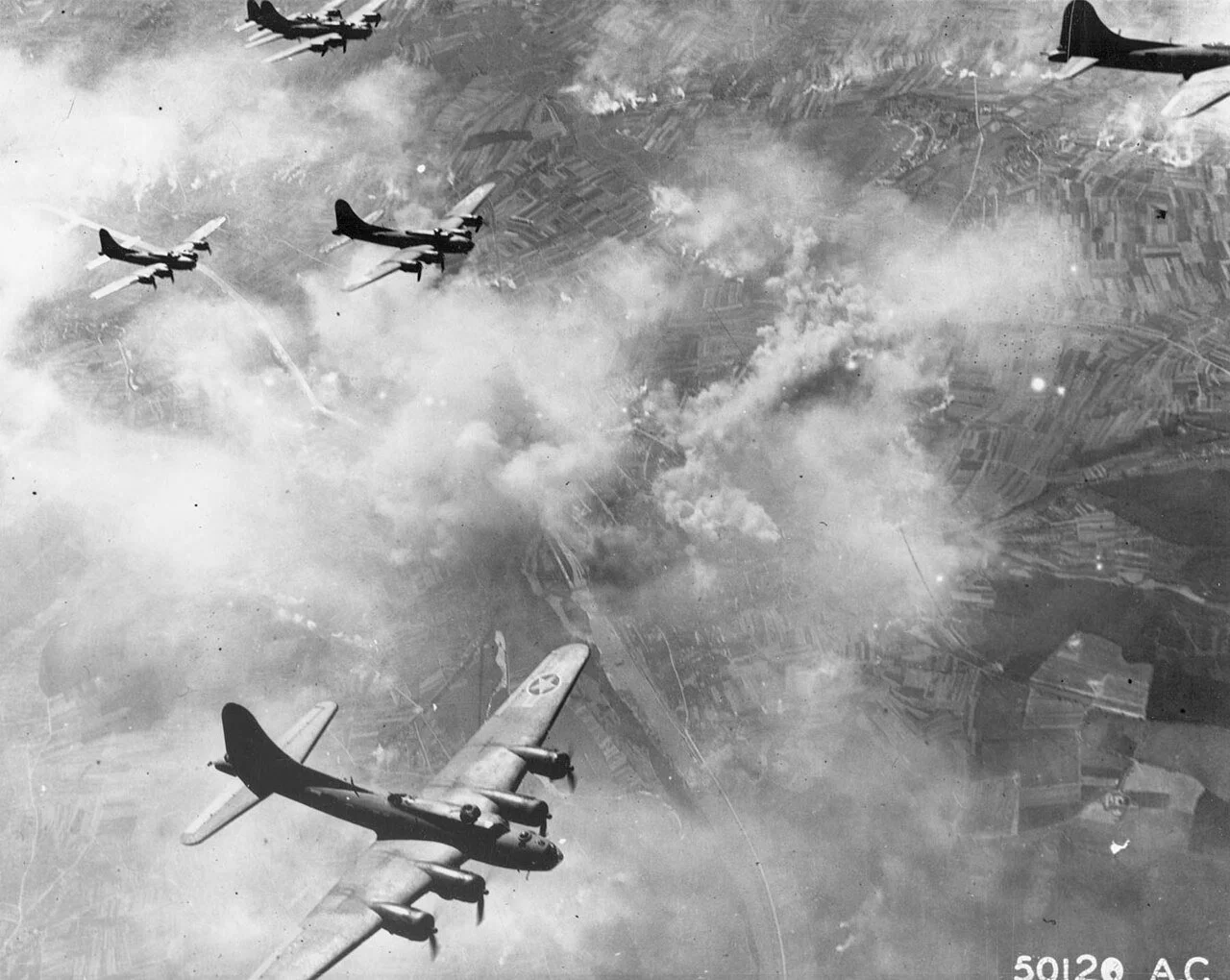
Boeing B-17 Flying Fortress formation. Schweinfurt, Germany - August, 17, 1943.

Boeing B-17 Flying Fortress formation. Schweinfurt, Germany - August 17, 1943.

The Challenge of Bringing Order to the Skies

From 1943 onward, the Eighth Air Force expanded its operations across East Anglia. Airfields were spread across Norfolk, Suffolk, and Cambridgeshire, and each one sent aircraft into the same busy morning sky. Every bomber had to find its place in a larger group, climb steadily, and keep to the timetable. Weather often interfered, and crews still adjusting to British conditions sometimes struggled to identify other aircraft in the haze.

The result was predictable. Aircraft sometimes climbed into the same airspace. Near misses were reported frequently. Several bombing missions suffered delays because the formations failed to gather quickly enough. Although ground control could guide departures, it could not solve the issue of identifying other aircraft in the air. Another solution was needed, one that crews could see without relying on radio contact or clear skies.


A Practical Innovation in a Growing Air War

The answer was the assembly ship. These were older bombers nearing the end of their combat life. Some had battle damage that made long missions impossible, while others had simply become worn. Instead of being scrapped immediately, many were converted into highly visible airborne rally points. Each bomb group had one, sometimes two, depending on operational needs.

The idea was straightforward. The assembly ship took off first and climbed into a holding pattern above its home base. Newer aircraft took off next and circled until they spotted the brightly painted machine overhead. Once enough aircraft had gathered, the assembly ship guided the formation into the correct climbing pattern and direction of travel. After completing the task, it returned to base. It did not cross the North Sea or accompany the mission toward its target.

This method saved time, reduced the risk of accidents, and helped maintain the tight formations required for mutual defense.


Color Schemes Designed to Be Impossible to Miss

The thing that makes assembly ships so memorable today is their appearance. Because they never flew into enemy territory, camouflage was unnecessary. Visibility became the priority. Groups across the Eighth Air Force began to develop their own designs, often with considerable imagination.

One aircraft might be painted bright yellow with red chevrons. Another might have wide black spots across a silver fuselage. Some had candy-striped tails. Others carried oversized geometric shapes or checkerboard patterns. A few used contrasting panels of green and white. The design language varied, but every scheme aimed at the same goal. Crews had to recognize the ship instantly, even in bad weather.

These color schemes created some of the most distinctive aircraft of the Second World War. They were not meant to impress the enemy or hide from it. They were meant for the airmen who needed to find their group quickly at dawn.


Conversions and Modifications

The aircraft chosen for this role were usually B-17s or B-24s. Each type required a fair amount of modification. Guns were removed, which reduced weight and made the aircraft easier to climb. Armor plate was often taken out for the same reason. Much of the interior was removed, along with equipment that was no longer needed. Lightening the aircraft made it easier for the assembly ship to get up early and remain overhead long enough for the rest of the group to form up.

Some groups gave their assembly ships names that embraced their unusual appearance. The 458th Bomb Group operated a B-24 known as “Spotted Cow”. Another group had “The Green Dragon”, painted in a vivid green finish with yellow markings. There were others, including “The Jolly Roger” and “Fightin’ Sam”. The names added a touch of character, but the paintwork did most of the talking.


Routine Work That Never Reached the Headlines

Assembly ships rarely appear in wartime newsreels or photographs. Their work was uneventful by design. They did not fly through flak or fighter attack. They were not part of the dramatic footage that accompanied raids on Berlin or the Ruhr. Yet their flights were essential. A large formation needed clarity and coordination. Without it, missions risked breakdown long before reaching the target.

Veterans often described the sense of relief that came with spotting the brightly colored aircraft circling above the base. In the low morning light, with engines warming and visibility uncertain, that visual cue gave crews a clear point of reference. They knew exactly where to go and how to start the long climb eastward.


Safety, Training, and an Air War Under Pressure

The arrival of assembly ships also made the morning departure routine noticeably safer. With so many aircraft circling the same patch of sky, the chance of a collision was never far from anyone’s mind. These brightly marked bombers gave crews an instant point of reference, which helped ease the congestion. They also became useful for newcomers. Pilots fresh from training in the United States often relied on them as they learned how to join and hold formation. It was an early step in understanding the discipline that large-scale operations demanded.

In addition, the system helped keep missions on schedule. The Eighth Air Force operated under strict timing. Multiple groups needed to cross the coast within narrow intervals. Delays could disrupt the larger plan. By ensuring orderly assembly at the start of each mission, these ships supported the wider strategic effort.


A Short Life and a Quiet End

When the war in Europe came to an end, most of these aircraft were taken apart or scrapped. Their bright paintwork, once an essential guide for dozens of aircrews, faded from the airfields almost overnight. Only a small number of photographs survived, tucked away in various archives and in a few private collections. They show a brief and unusual moment in the air war, when a practical need produced something unexpectedly creative.

Today, these aircraft give a modest but useful glimpse into a part of Allied operations that rarely comes up in broader accounts.


A Forgotten Chapter Worth Remembering

The story of the assembly ships shows how major military efforts depend on far more than the frontline aircraft that usually attract most of the attention in wartime histories. Yet the work done behind the scenes, whether through supporting aircraft, trial solutions, or improvised ideas, often proves just as important. The striking paint schemes on these older bombers might seem unusual today, but they grew out of the very real difficulties faced by crews trying to find one another in poor visibility. When an airman spotted one circling above the field, it was a clear sign that the day’s climb east was about to begin.

Their time in service was short, but the impression they left remains striking. Few wartime aircraft looked anything like them, and none were given the same specific job. In a campaign that relied on coordination and discipline, the assembly ships played a modest but essential part.


The site has been offering a wide variety of high-quality, free history content since 2012. If you’d like to say ‘thank you’ and help us with site running costs, please consider donating here.


References

Bowers, P. M. Boeing B 17 Flying Fortress. Smithsonian Institution Press, 1995.
 Freeman, R. A. The Mighty Eighth. Arms and Armour Press, 1970.
 Johnson, R. B 24 Liberator at War. Ian Allan Publishing, 1978.
 Roeder, G. H. The Censored War. Yale University Press, 1993.
 USAAF Eighth Air Force archival photographs and formation records, East Anglia, 1943–45.

Gertrude Bell had many accomplishments. A polyglot, she translated 43 Persian poems from the collection The Divan of Hafiz (also written as Hafez) into English. She published her translations in June of 1897 alongside a study of the poems in context of Islamic Persia’s history. Much of her life leading up to 1914 was spent on archaeological digs with a focus on Byzantine architecture in Turkey and the palace at Ukhaidir in what is now Iraq. The chronicles of her travels brought her recognition. These experiences were deemed useful during World War I when she worked as an interpreter for the British in Egypt and mapped wells and paths in Arabia. Her contemporary T. E. Lawrence later acknowledged that her information had aided the Arab Revolt against the Ottoman Empire during the war. After the war, she championed Faisal, a key figure during the Arab Revolt, as the first king of Iraq. For the remainder of her life, Faisal helped her establish the Iraq Museum to protect the country’s past. Perhaps less discussed, however, is her accomplished career as a mountaineer. Specifically, her 1902 crossing of the Lauteraarhorn-Schreckhorn traverse.

Michael Mirra explains.

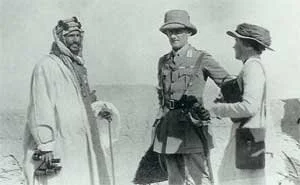
A 1916 meeting with Ibn Saud, Percy Cox, and Gertrude Bell.

Early Climbs in the French Alps

As a daughter of the sixth-richest family in Britain, Gertrude had the privilege of traveling extensively including two world tours; one with her brother Maurice and another with her half-brother Hugh (sometimes referred to as “Hugo”). Gertrude showed an interest in mountain climbing when her family visited the Dauphiné region of the French Alps in August of 1897. It was during that trip that she climbed minor peaks like Pic de la Grave and the Bec de l’Homme.

Gertrude returned to the region in August of 1899 to climb the larger La Meije and Barre des Écrins. Early in her visit, she encountered German mountaineer Helene Kuntze who had just completed a climb of La Meije’s summit peak before her. Gertrude’s expedition, however, would cross the complete traverse. This is considered Gertrude’s first climbing season.

For the 1900 climbing season, Gertrude went to the Chamonix commune in France. It was there that she enlisted Ulrich Fuhrer as one of her guides. Ulrich and his younger brother Heinrich would become her usual guides during the 1901, 1902, and 1904 (her last) seasons. In 1900, she climbed Mont Blanc, the Grépon, and the Grand Dru.


The 1901 Season in the Swiss Alps

In 1901, Gertrude came face-to-face with the Schreckhorn in Switzerland. After reaching the top via the southeast, which is the side she referred to as seen from the Grimsel Pass, she focused on the Engelhörner range where she achieved seven first ascents, three more ascents of old peaks or saddles, and the first traverse of the Urbachthaler Engelhorn. One of the seven virgin peaks was named after her, Gertrudspitze (or Gertrude’s Peak). Her attention then turned to the unclimbed northeast face of the Finsteraarhorn and the uncompleted traverse of the Lauteraarhorn and Schreckhorn. However, she was met with bad weather and returned to England unsuccessful.

At the end of the year, Gertrude wrote the article “Concerning Mountains: Die Engelhörner” for the National Review. Her description of Switzerland is worth quoting in detail:

You need not go farther afield than the much-trodden Bernese Oberland to find new peaks and new adventures; it is unnecessary to go farther in search of Alpine beauties, for in no region of mountains is there a greater variety of gorgeous scenery. Snowfield and rock would seem here to put on their finest aspects; a master hand hollowed out the thin shell-like ridge of the Schreckhorn and raised the pinnacle of the Finsteraarhorn, spread the white carpet of the Aletsch Glacier, and planted pine and willow gentian down the eastern slopes of the Great Scheidegg. No wonder (but great cause for thankfulness) that to the pioneers of Alpine adventure the Oberland was one vast magnet, drawing them irresistibly upwards.


Despite her successes, this article was the only time that she publicly wrote about her climbs. This tells us that she did not set out on these mountain expeditions for glory. Seeking adventure was simply how she lived her life.


The First Impossible

Gertrude returned to Switzerland in 1902. She got a glimpse of fame while on the Brünig railway line when a conductor asked her if she was the Miss Bell who had climbed the Engelhörner. At Rosenlaui, she once again encountered Helene Kuntze who had recently completed several Engelhörner first ascents with Ulrich as her guide. Ulrich had rejoined Gertrude the previous day to which she felt was Helene’s displeasure.

A couple of days later, Helene climbed the big gendarme on the Vorder Wellhorn. Gertrude woke up at midnight to attempt the same climb with a 1:00 a.m. start. She was halted by a storm half an hour later and took shelter in a deserted chalet, choosing one that did not have pigs in it. More rain at dawn led to her returning to her inn at 5:00 a.m., but she was still determined.

The next day, Gertrude started for the big gendarme at 9:50 a.m. She made it to the top by 1:00 p.m. Using a sling left by Helene’s guide, a German named Gustav Hasler, she let herself down the southeast corner.

It was not long before Gertrude took her ambitions a step further. The very next morning, she returned to the Vorder Wellhorn and, while making a five minute halt to undo her rope, viewed a chamois run up the arête above her, knocking down stones as it climbed. Gertrude described the Wellhorn arête as one of four “impossibles” of the Oberland. She ascended it that day. Her expedition ended by crossing the Rosenlaui Glacier under the seracs. Two days later, while crossing the couloir between King’s Peak and the Princes, she wore climbing shoes for the first time.


The Lauteraarhorn


A few days after conquering the Vorder Wellhorn, Gertrude left Rosnelaui for the Grimsel Pass to tackle her next “impossible.” She wrote to her father describing plans for a midnight climb of the arête between the Lauteraarhorn and the Schreckhorn on an unclimbed side. These were secret plans because there were assumptions that Helene was focused on the same expedition from the other side.

Thunderstorms pushed Gertrude’s climb to a 3:00 a.m. start. After walking up the glacier for three hours, the sun rose and Gertrude noticed the light shine on the Finsteraarhorn. She reached the bottom of the Lauteraarhorn arête around 9:00 a.m. Climbing through mist and then snowfall, she reached the top around 2:15 p.m. She, Ulrich, and Heinrich put their visiting cards in a bottle that they found there.

In another letter to her father, Gertrude wrote that it was all to be done again. However, she noted that all agreed not to climb the Lauteraarhorn from the Grimsel side again. She described the arête to the summit as “made by the devil” and “one of his happiest inspirations.” The gendarmes and snow cornices made it feel as though they were never getting any closer to the end. Instead, they would attempt it from the Grindelwald side.


The Lauteraarhorn-Schreckhorn Traverse

One week later, Gertrude set off for the Lauteraarhorn again. She woke up at 10:20 p.m. and set off at 11:10 p.m. Helene went to the Schrekhorn saddle. Gertrude followed the glacier toward the Strahlegg on the southwest ridge of the Lauteraarhorn. Once again she noticed the Finsteraarhorn, this time shining in the moonlight. She put out her lantern to take in its full brilliance. Just before 2:00 a.m., she made it to the Strahlegg and faced wind coming from the Schreckfirn bergschrund on the southwest ridge of the Schreckhorn. On the way up the arête toward the summit, she felt the bitter wind whenever she turned toward the Schrekfirn side. She made it to the top of the arête at 4:10 a.m. and watched the dawn come while she ate breakfast. The Matterhorn now received her admiration in the pink sky.

Now traversing across the mountain, Gertrude reached the saddle at 6:35 a.m. The wind was cruel. Ulrich half-suggested not going to the top of the Lauteraarhorn, but Gertrude insisted. Onto the gendarmes they went, reaching the summit at 8:50 a.m. After a second breakfast, she returned to the saddle. She then went up a tall gendarme and waited for Helene at the top, who joined her at 10:45 a.m. Together, they reached the top of a smooth arête at 11:35 a.m. From then on, there was a sharp arête, hard gendarme, and a gendarme with an overhang. Ulrich unrolled a thin rope for them to go up the overhang above a 25-30 foot drop. After Gertrude went up, she climbed to the top of a smooth face. Helene did not follow up the overhang. Instead, she went around the bottom and up the other side of the gendarme. She then followed the ordinary route back down the Lauteraarhorn and over the Strahlegg. Gertrude, however, made her descent to the saddle, reaching it at 2:00 p.m., and back across the glacier at 4:30 p.m. She reached a community used hut at 5:30 p.m. just before Helene. Both teams slept in the hut that night and Gertrude complained about Helene rolling onto her all night. The next morning, Gertrude returned to Grindelwald at 10:00 a.m. This was the first crossing of the Lauteraarhorn-Schreckhorn traverse and, according to the Alpine Journal, her most important climb.


The Finsteraarhorn

Gertrude’s attention returned to the unclimbed northeast face of the Finsteraarhorn. It is unclear in her letters if her second “impossible” was the Lauteraarhorn-Schreckhorn traverse or the Finsteraarhorn. However, the Finsteraarhorn would prove impossible for her. A storm, inability to light matches, shelterless glacier, facing unknown ground, and eventual frostbite would cause her to turn back 57 hours into the expedition. Gustav Hasler called this the “first real attempt” of the northeast face and a “most gallant and determined attack on it.” He praised her endurance and performance. Gustav and his friend Fritz Amatter successfully climbed what Gertrude could not in 1904, grabbing a rope ring left by Gertrude at her turning point as a souvenir.

In 1903, Gertrude spent some time climbing in Vancouver while on her world tour with Hugh. Her final climb was the Matterhorn the following year. The remaining two “impossibles” of the Oberland were the Jungfrau from the Jungfrauhjoch saddle (first traversed in descent by C. F. Meade, guided by Ulrich and Heinrich in 1903) and the northeast arête of the Eiger (first ascended by Yuko Maki, guided by Fritz Amatter in 1921).


Did you find that piece interesting? If so, join us for free by clicking here.


Works Cited

Bell, Gertrude. A Woman in Arabia: The Writings of the Queen of the Desert, edited by Georgina Howell, Penguin, 2006.

Bell, Gertrude. “Concerning Mountains: Die Engelhörner.” Alpine Journal, vol. 41, 1929, pp. 21-34.

Bell, Gertrude. “Diary entry by Gertrude Bell.” 7 August, 1897. Gertrude Bell Archive, New Castle University. https://gertrudebell.ncl.ac.uk/d/GB-2-5-2-1-9

Bell, Gertrude. “Diary entry by Gertrude Bell.” 6 July, 1902. Gertrude Bell Archive, New Castle University. https://gertrudebell.ncl.ac.uk/d/GB-2-7-4-6-2

Bell, Gertrude. “Diary entry by Gertrude Bell.” 7 July, 1902. Gertrude Bell Archive, New Castle University. https://gertrudebell.ncl.ac.uk/d/GB-2-7-4-6-3

Bell, Gertrude. “Diary entry by Gertrude Bell.” 9 July, 1902. Gertrude Bell Archive, New Castle University. https://gertrudebell.ncl.ac.uk/d/GB-2-7-4-6-5

Bell, Gertrude. “Diary entry by Gertrude Bell.” 10 July, 1902. Gertrude Bell Archive, New Castle University. https://gertrudebell.ncl.ac.uk/d/GB-2-7-4-6-6

Bell, Gertrude. “Diary entry by Gertrude Bell.” 11 July, 1902. Gertrude Bell Archive, New Castle University. https://gertrudebell.ncl.ac.uk/d/GB-2-7-4-6-7

Bell, Gertrude. “Diary entry by Gertrude Bell.” 12 July, 1902. Gertrude Bell Archive, New Castle University. https://gertrudebell.ncl.ac.uk/d/GB-2-7-4-6-8

Bell, Gertrude. “Diary entry by Gertrude Bell.” 14 July, 1902. Gertrude Bell Archive, New Castle University. https://gertrudebell.ncl.ac.uk/d/gb-2-7-4-6-10

Bell, Gertrude. “Diary entry by Gertrude Bell.” 15 July, 1902. Gertrude Bell Archive, New Castle University. https://gertrudebell.ncl.ac.uk/d/GB-2-7-4-6-11

Bell, Gertrude. “Diary entry by Gertrude Bell.” 16 July, 1902. Gertrude Bell Archive, New Castle University. https://gertrudebell.ncl.ac.uk/d/GB-2-7-4-6-12

Bell, Gertrude. “Diary entry by Gertrude Bell.” 17 July, 1902. Gertrude Bell Archive, New Castle University. https://gertrudebell.ncl.ac.uk/d/GB-2-7-4-6-13

Bell, Gertrude. “Diary entry by Gertrude Bell.” 24 July, 1902. Gertrude Bell Archive, New Castle University. https://gertrudebell.ncl.ac.uk/d/GB-2-7-4-6-20

Bell, Gertrude. “Diary entry by Gertrude Bell.” 25 July, 1902. Gertrude Bell Archive, New Castle University. https://gertrudebell.ncl.ac.uk/d/GB-2-7-4-6-21

Bell, Gertrude. Letter to Dame Florence Bell. 21 September, 1901. Gertrude Bell Archive, New Castle University. https://gertrudebell.ncl.ac.uk/l/gb-1-1-1-1-11-19

Bell, Gertrude. Letter to Dame Florence Bell. 7 July, 1902. Gertrude Bell Archive, New Castle University. https://gertrudebell.ncl.ac.uk/l/gb-1-1-1-1-12-16

Bell, Gertrude. Letter to Dame Florence Bell. 10 July, 1902. Gertrude Bell Archive, New Castle University. https://gertrudebell.ncl.ac.uk/l/gb-1-1-1-1-12-17

Bell, Gertrude. Letter to Dame Florence Bell. 13 July, 1902. Gertrude Bell Archive, New Castle University. https://gertrudebell.ncl.ac.uk/l/gb-1-1-1-1-12-18

Bell, Gertrude. Letter to Sir Hugh Bell. 8 September, 1901. Gertrude Bell Archive, New Castle University. https://gertrudebell.ncl.ac.uk/l/gb-1-1-2-1-6-8

Bell, Gertrude. Letter to Sir Hugh Bell. 10 September, 1901. Gertrude Bell Archive, New Castle University. https://gertrudebell.ncl.ac.uk/l/gb-1-1-2-1-6-9

Bell, Gertrude. Letter to Sir Hugh Bell. 15 September, 1901. Gertrude Bell Archive, New Castle University. https://gertrudebell.ncl.ac.uk/l/gb-1-1-2-1-6-10

Bell, Gertrude. Letter to Sir Hugh Bell. 16 July, 1902. Gertrude Bell Archive, New Castle University. https://gertrudebell.ncl.ac.uk/l/gb-1-1-2-1-7-3

Bell, Gertrude. Letter to Sir Hugh Bell. 18 July, 1902. Gertrude Bell Archive, New Castle University. https://gertrudebell.ncl.ac.uk/l/gb-1-1-2-1-7-4

Harding, J. G. R. “The Other Gertrude Bell.” Alpine Journal, vol. 124, 2020, pp. 168-178.

Hasler, Gustav. “The North-East Face of Finsteraarhorn.” Alpine Journal, vol 34, 1922, pp. 268-280.

Mayer Amschel Rothschild, the founder of the Rothschild banking dynasty famously said “Give me control of a nation’s money and I care not who makes its laws”, suggesting that whoever controls the economy of a country has more power than the lawmakers. The Swadeshi Movement, while fundamentally political, was India’s realization of this truth and understanding the importance of economic control. Over the years, many historians and scholars have given their definition of the term “Swadeshi”, all revolving around self-sufficiency and local self-reliance.

Shelton Rozario explains.

"Concentrate on Charkha and Swadeshi," a poster in the Swadeshi Movement. It shows Mahatma Gandhi using a Charkha.

According to Gandhi, the term Swadeshi is “that spirit within us which restricts us to the use and service of our immediate surroundings to the exclusion of the more remote.” He promoted the importance of indigenous skills, using them to live a simple and dignified life. For Sri Aurobindo, “It is an intellectual change, it is a spiritual change, it is a political change…Swadeshi is that which belongs to our own country. When applied to industry and commerce it means  the preference for our own articles produced by Indian labour and the exclusion of articles produced by the labour of foreign people.” Lisa N. Trivedi opines that the “social collective of Bharat (the dominant indigenous term for India) was the template on which popular swadeshi repertoires were forged.”

The Swadeshi Movement went beyond mere boycott and eventually became a way of living. This idea has been stressed upon in Gandhian philosophy and also in influential works like that of Rabindranath Tagore’s 1904 essay ‘Swadeshi Samaj’. It emerged as a mass political movement from 1905 onwards and developed into a crucial instrument for economic policy making post 1947, after Indian independence. This movement is about the making of a local economy and revival of the industries that were disbanded by the British. Despite harsh measures such as arrests and lathi charges to suppress it, the movement had already succeeded in forging a sense of national identity among Indians.


Drain of Wealth and Early Swadeshi Awakening

The economic awakening in colonial India occurred after the ‘Drain of Wealth’ debate put forward by Dadabhai Naoroji. In his work ‘Poverty and Un-British Rule in India’ originally published in 1901, he spoke about how Britain was practically bleeding India’s revenue. Dr. Dhananjaya in her study of this writes how “The Indian government was also forced to impose significant home charges as reparations on the people of England due to the political, administrative, and commercial ties between the two countries. The Home Charge covered annuities for irrigation and railroad projects, interest on public loans obtained from England, and payments to British workers in India in the form of salaries and pensions.”

Naoroji and the Indian National Congress had put forward their demands for industrial development, reduced taxes and promotion of Indian industries which were never given any importance. Between 1883 and 1892, Naoroji said that the total drain amounted to Rs. 24 crores which substantially increased to 51.5 crores by 1905. D.E. Wacha, the President of the Indian National Congress in 1901 also suggested that the drain was about thirty to forty crores. The figure varies as per the calculations of historians but drain of wealth from India was undeniably a major issue. In 1891, the Swadeshi agenda was adopted by the Indian National Congress. This became a national cause after the British Government amended the 1894 cotton duties in 1896 to benefit the textile manufacturers in Manchester by imposing a uniform 3.5% duty on manufactured Indian cloth.

Nitin Pai while tracing the early economic developments during the Swadeshi Movement highlights how “swadeshi…already became a social proxy against what many saw as political “mendicancy”. Bal Gangadhar Tilak in 1896 organized boycotts and publicly burned foreign cloth in Bombay. Mahadev Govind Ranade's work through the Industrial Conference of Western India aimed to promote industrial development in Bombay in the late 1880s. This phase marked the establishment of early Swadeshi stores, indigenous banks and the rise of an entrepreneurial Indian class. Nitin Pai sheds light on the global movements during this emergent political phase such as the abolition of slavery in America, the American Civil War, Industrial Revolution, all culminating in changing the “pattern of the deployment of Indian capital.”


Swadeshi and Local Enterprises in Full Swing

When Lord Curzon partitioned Bengal on October 16, 1905, his reasons revolved around Bengal being too large of a province. However, the main reason as supported by many historians was to curb Bengali nationalism, using the old tactic of “divide and rule” from the British playbook. In a 1903 memo, Curzon wrote: Bengal united is a power; Bengal divided will pull in different ways. East Bengal and Assam with approximately 31 million people became one unit while Bihar, Orissa and West Bengal formed the others. Little did Curzon expect that this move would act like a catalyst for the already brewing Swadeshi Movement.

Hundreds and thousands of people gathered on August 7, 1905 at Calcutta’ Town Hall chaired by moderate leader Surendranath Banerjee. Following this, students opted out of government schools, local banks and mills sprouted to promote the local economy. Some of the most prominent Swadeshi enterprises from Bengal include Acharya P.C. Ray's Bengal Chemicals, Bange Lakshmi Cotton Mills, Calcutta Potteries and the Swadeshi Steam Navigation Company (1906) by V.O. Chidambaram Pillai. In her article ‘Boycott of Lancashire Cloth: The real economic battle’, Diksha Tyagi observes how Import of foreign cloth declined by 1.5 crore rupees in 1907…Bombay’s textile mills, benefiting from increased demand for indigenous cloth, earned profits of over 2.7 crore rupees…” She further says that even Brahmins boycotted foreign goods and refused to perform pujas with those items.

When Gandhi arrived in 1915, he gave the movement a broader meaning by incorporating social, religious and cultural aspects. He promoted the khadi (cloth woven on handloom from fibers like cotton, silk, wool, etc.) as an alternative to the mill cloth and began spinning it in his Sabarmati Ashram. After World War I and brutal effects of the Great Depression in America, the British economy was slowly but surely crumbling. Khadi became a symbol of economic sufficiency and by 1925, the All India Spinners’ Association (AISA) was set up. They offered employment to women too who now became active economic contributors.


From Khadi to National Consciousness

Another major blow to the British economy was the Dandi March of 1930, a part of the larger Civil Disobedience Movement. Following the principles of satyagraha (truth) and ahimsa (non-violence), this was a salt march against a series of British laws that prohibited Indians from locally producing or selling salt. The Swadeshi movement post 1930s went beyond producing cloth and aimed at creating a decentralized economy. This was the opposite of what the British believed in : a centralized model of production. Nitin Pai writes “As India headed towards independence, swadeshi began to move from being an instrument of protest to a principle of economic policy of the new republic.”

The majority of the population of India during the 1940s had still not adapted to an urban lifestyle. In this sense, Gandhi’s vision of a self-sufficient village economy represents a microcosm of India itself. Trisha Rani Deka opines that Gandhi’s “entire effort of swadeshi was revolving around the village economy…village self-sufficiency, village self-government, cultivation of village and cottage industries were the main agenda in his concept of swadeshi.” Thus, this led to the revival of indigenous products, particularly handlooms and cottage industries. Gandhi himself said that his model was : “Not mass production, but production by the masses.” This community spirit further cultivated a collective identity and national consciousness which was rooted in atmashakti or self-reliance.

Interestingly for Gandhi, the total boycott of foreign goods or western items was never on the table. He would be willing to “buy surgical instruments from England, pins and pencils from Austria and watches from Switzerland” but “will not buy an inch of the finest cotton fabric from England or Japan or any other part of the world because it has injured and increasingly injures the millions of the inhabitants of India.”(Young India, 12-3-1925, p. 88). He was against mass industrialization as it would force villagers to leave their homes and craft, reducing them to factory workers. Even though the post 1947 models reflect a Nehruvian planning and state led heavy industrialization, Gandhi's Gram Swaraj ideals are reflected in the rural schemes and support for village industries.


Conclusion

India under a colony of the British was not only treated as a market and source of raw materials. For centuries under the rule of the British Raj, the Indian subcontinent was only a dumping ground for foreign grounds whose artisanal industries were dismantled. The Swadeshi Movement changed that and emerged as the first great reversal. What once was a dependent and culturally dependent colony saw an awakening and revival of its own local enterprises. As described by Gandhi : When every individual is an integral part of the community…when the economy is local… when homemade handicrafts are given preference, it is the real swadeshi.”

From the early efforts of the Indian National Congress to the growth of local enterprises and the entrepreneurial spirit, Swadeshi became a way of living. The pharmaceutical industries, banks, national schools and handloom industries laid the foundation of some big names that exist to this day. In many ways Swadeshi was India’s first “Atmanirbhar Bharat” that boosted the local economy via a model that revived its economy and embraced ethical consumption.


Over the past two years, Shelton has worked with various organizations as a content writer and contributes as a fact-checker for DigitEYE India, an IFCN signatory. He is passionate about history, politics and culture.


References

●      Joseph, S. K. (n.d.). Understanding Gandhi’s vision of Swadeshi. Retrieved on October 19, 2025 fromhttps://www.mkgandhi.org/articles/understanding-gandhis-vision-of-swadeshi.php

●      Aurobindo, Sri. “Swadeshi and Boycott.” Bande Mataram, 1907. Web. https://sri-aurobindo.co.in/workings/sa/37_06_07/0306_e.htm.

●      Trivedi, L. N. (2003). Visually Mapping the “Nation”: Swadeshi Politics in Nationalist India, 1920-1930. The Journal of Asian Studies, 62(1), 11–41. https://doi.org/10.2307/3096134

●      Dhananjaya. (2021). The Drain Theory of Wealth and Dadabhai Naoroji: An Overview. International Journal of Novel Research and Development, 6(7). https://www.ijnrd.org/papers/IJNRD2107007.pdf

●      Pai, N. (2021, July 2). A Brief Economic History of Swadeshi. Indian Public Policy Review, 2(4). https://doi.org/10.55763/ippr.2021.02.04.002

●      Tyagi, D. (2025, August 8). Boycott of Lancashire Cloth: The real economic battle. Organiser.https://www.organiser.org/2025/08/08/306782/bharat/boycott-of-lancashire-cloth-the-real-economic-battle/

●      Deka, T. R. (2020). Gandhi’s vision of Swadeshi and its relevance. International Journal of Management (IJM), 11(10), 2587-2593.https://iaeme.com/MasterAdmin/Journal_uploads/IJM/VOLUME_11_ISSUE_10/IJM_11_10_260.pdf

Posted
AuthorGeorge Levrier-Jones
Categories20th century

This the story of William Hitler, the nephew of Adolf Hitler. William enlisted and served in the U.S. Navy in 1944 after personally imploring the President, Roosevelt to admit him into the Allied armed forces. After some understandable hesitation, the U.S. authorities relented, and William proceeded to join the fight against the Axis regime in the Pacific. This is his story.

Steve Prout explains.

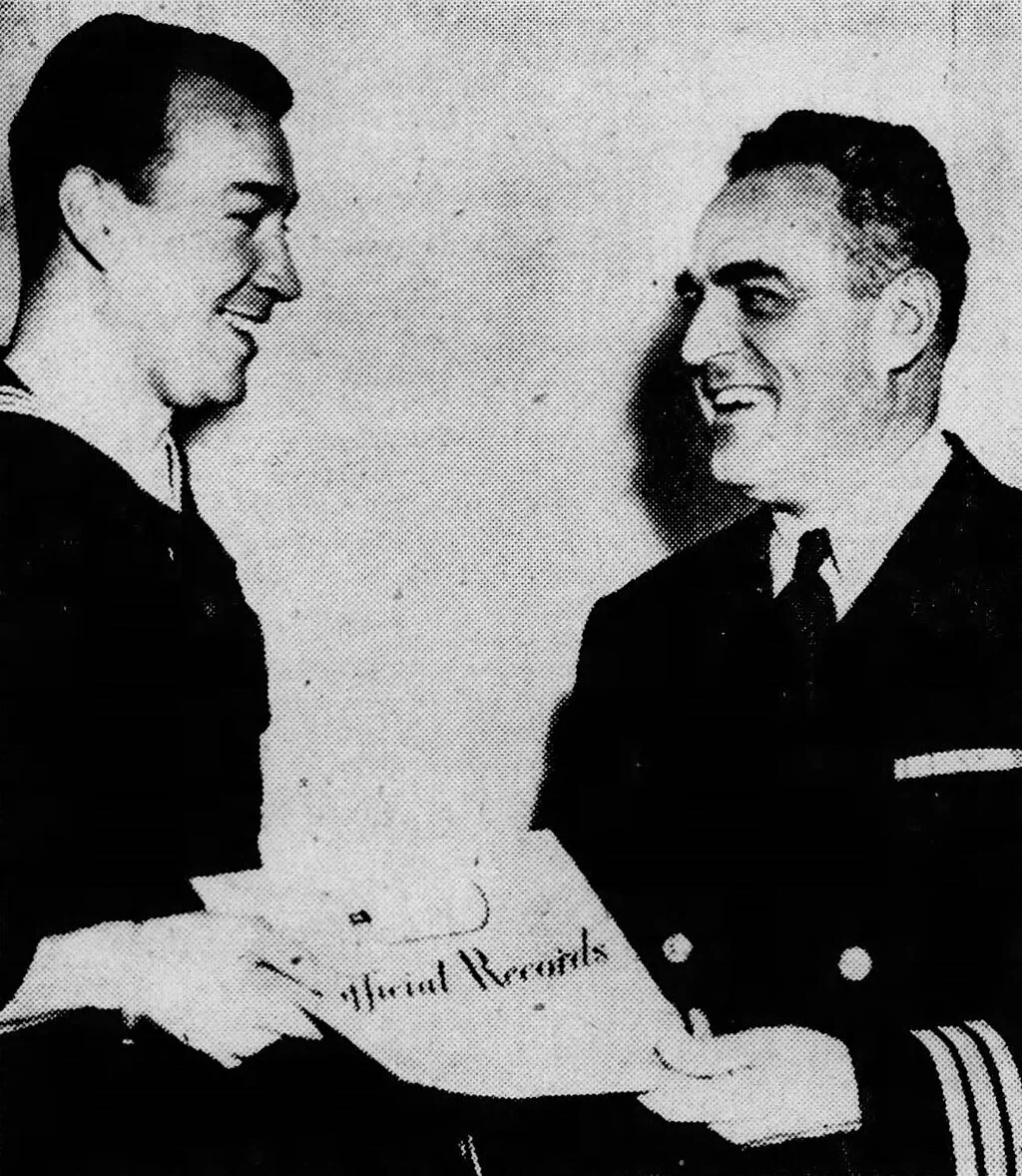
William Hitler receiving his honorable discharge from Navy Commander Louis A. Fey.

The early life of William Hitler

William was born in March 1911 in Liverpool, England to Alois Hitler and Bridget Dowling. Alois, William’s father was the half-brother of Adolf Hitler, therefore making Adolf William’s half uncle. William’s parents met in 1909 in Dublin when Alois was working as a waiter. Alois met Bridget Dowling there and they quickly eloped to London in 1910 and married. It was not an auspicious start to married life because Alois was accused of “kidnapping” Bridget by her father. The reality was that Alois did not obtain the customary yet old-fashioned blessing for the marriage from Bridget’s father. Eventually Bridget’s family become resigned to the fact that the marriage was now a fait accompli. The couple then moved and settled in Toxteth, Liverpool where William was born a year later.

The marriage did not last, and Alois returned to Germany in 1914 where he entered a bigamous marriage with Hedwig Mickley. They would both produce a son whom them named Heinz. Unlike William, Heinz became an ardent Nazi, who later perished in Soviet captivity in 1942. Alois became a restaurant owner which continued to run throughout the war’s duration. His wife, Bridget, was left to raise William alone in England now with the aid of her Irish family. Meanwhile, in Germany Adolf Hitler was about to make the family name a terrible part of history.

At the age of eighteen, while his half-uncle Adolf was making his presence known in German politics, William took on a more sober profession and trained to be an accountant in Highgate, London with Benham and Sons. When his connection to Adolf Hitler was discovered, his position was allegedly terminated, and many subsequent opportunities became closed to him.


Visting Germany and meeting Adolf Hitler

In 1929, after turning eighteen, William visited in Germany at the request of his estranged father. While in Germany he met his uncle Adolf Hitler for the first time, who was beginning to make an impact on German political life. After a brief stay William returned England. The first meeting with his uncle did not go well. Shortly after his return to England William was ordered to return to Berlin by Adolf, who subsequently admonished his nephew for his public revelations about him. William had on his return authored several articles that were published which irked the Nazi leader and he forced William to withdraw them. The incident appeared to have blown over, or it was more likely that Adolf Hitler’s wider ambitions in German politics consumed his full attention. William would try unsuccessfully to make a life in England and Adolf would seize control of Germany. It would be another four years before William would visit again and that also  did not go well for William.

In 1933 William returned to Germany, this time on the advice of his mother with the plan to use Adolf Hitler’s influence to improve William’s career opportunities. Britain at the time was still recovering from the Great Depression and had little to offer William. To make matters worse, being related to the Hitler family was very limiting for William; however, Germany’s economy was showing signs of prosperity and being related to Adolf Hitler carried some currency for William.

The plan seemed to work at first. Adolf’s influence first found William work in the Reich Credit Bank. This did not seem to favor William who then took on the role as a car salesperson in the Opel Car Factory. William did not last in any of  these jobs and his constant demands for alternative ones exasperated his uncle. He would soon label William, My loathsome nephew” and stated, “I didn’t become Chancellor for the benefit of my family…No one is going to climb on my back.” In 1939, after refusing to give up his British citizenship and fearing being trapped in In Germany while it was in a war, he fled back to England and then onto the USA. William had spent six years in Germany.

Willam also had little good to say about his uncle and of his time in Germany. On a tour of the USA in 1939 he officially announced that he “had no time for Hitler” and he (Adolf) was “of no benefit to the human race”.

He was projecting as an avid anti-Nazi doing “the right thing” but let us for a moment analyze that stance. Was the extent of his antipathy toward his uncle or the regime. Also was it more owing to failure to prosper in Germany than a dislike of Nazism?

William spent six years in Germany, and this was long enough to not fail to see the loathsome direction the Nazi Party and his uncle were taking the country and its people. However, we do not know how well acquainted he was with Adolf Hitler and how often he met his uncle. It is worth considering that in 1939 the true face and brutality of Nazism and Hitler were now becoming clearer to the world . Public events such as Kristallnacht, the antisemitism in the streets, the growing totalitarianism, the secret police, the rallies, and the growing militarism did not seem to deter William who still persisted in trying to carve out a career when all this was going on. He still could have easily slipped back to England. We will never know, and this is doing him a disservice.


William, the USA, and the war

After William left Germany, he visited the United States with his mother and began an anti-Nazi themed lecture tour that focused on his time with Adolf Hitler. This was encouraged by publisher William Randolph Hearst who, like William, saw this as very lucrative. William immediately went on a nationwide lecture tour of the USA. It was simply titled “My Uncle Adolf.”  The content was of course focused on his experiences with Hitler and the Nazis to the various audiences. This would be the only theatre where William would challenge his uncle’s regime. His combat experience would be confined to the Pacific theatre.

When World War II broke out William was still in the United States, but he still tried to join the British forces. For obvious reasons he was rejected and for a short while he sat as a bystander as the German army subjugated Europe. When the U.S. later entered the war William send a letter dated March 3, 1942, to President Roosevelt appealing for him to be allowed to join the U.S. forces and stating why he felt he was not allowed to serve in the British forces. The letter read:

“I am the nephew and only descendant of the ill-famed Chancellor and Leader of Germany who today so despotically seeks to enslave the free and Christian peoples of the globe. Under your masterful leadership men of all creeds and nationalities are waging desperate war to determine, in the last analysis, whether they shall finally serve and live an ethical society under God or become enslaved by a devilish and pagan regime.”


It continues:

"All my relatives and friends soon will be marching for freedom and decency under the Stars and Stripes … I am respectfully submitting this petition to you to enquire as to whether I may be allowed to join them in their struggle against tyranny and oppression. As a fugitive from the Gestapo, I warned France through the press that Hitler would invade her that year. The people of England I warned by the same means that the so-called ‘solution’ of Munich was a myth that would bring terrible consequences….The British are an insular people and while they are kind and courteous, it is my impression, rightly or wrongly, that they could not in the long term feel overly cordial or sympathetic towards an individual bearing the name I do.”


His application was passed to the FBI who eventually seemed satisfied with his background and his intentions. William was drafted into the US Navy in March 1944. He served as a pharmacist’s mate (aka hospitals corpsman), earning himself the purple heart medal after receiving a shrapnel wound to the heart. He remained in service until 1947. Whether his uncle knew about his enlistment or not we cannot be certain. It is more likely Adolf Hitler showed no interest in his nephew’s affairs after washing his hands of him before the war. Also, Adolf Hitler’s mental state deteriorated as the tide of the war was turning against Germany, therefore his “loathsome nephew”  would have been of little interest to him amid his more pressing concerns.


Post War Life

After the war, William changed his name to William Stuart-Houston and became an entrepreneur. He married Phyllis Jean Jaques in 1947 shortly after leaving the navy. Unlike his father before him he remained married and stayed with Phyliss until his death in 1987. It was a marriage that was certainly more successful than that of his parents. They had four sons born between 1949 and 1965, Alexander, Louis, Howard, and Brian (the latter being the youngest). None of William’s children sired any offspring. His wife, Phyllis, died in 2004.

It is of little surprise that William would spend his life in relative obscurity after the war. The true nature of his uncle’s legacy and the full extent of the Nazi atrocities were a permanent stain to his name. William had an extraordinary life, with winning the Purple Heart, being personally attended to by Roosevelt, vehemently opposing Adolf Hitler, and going on to run a successful business in America.

Although William served as a medic in the US Navy and not in actual physical combat, the challenges he faced were just as formidable. He had the reputation of his family name to overcome and as the horrors of the Nazi brutality were revealed post war, that challenge certainly would not have been made any easier. Despite his limited combat experience his actual contribution to the Allied cause was greater than he could have imagined. His public opposition to his uncle and his voluntary service spoke volumes as invaluable propaganda for the Allies.


The site has been offering a wide variety of high-quality, free history content since 2012. If you’d like to say ‘thank you’ and help us with site running costs, please consider donating here.
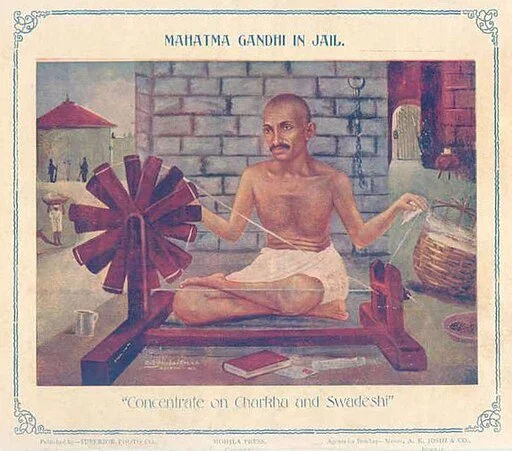
Ernest Shackleton remains one of the most remarkable figures of the Heroic Age of Antarctic Exploration, not for the discoveries he made, but for the indomitable spirit, endurance, and leadership he displayed in the face of seemingly impossible odds. Born on the 15th of February, 1874, in Kilkea, County Kildare, Ireland, Shackleton grew up in a large Anglo-Irish family. His father, a doctor, moved the family to London when Ernest was ten. Though bright, Shackleton found school confining and left at sixteen to join the merchant navy. The sea suited his restless temperament, and he quickly earned his officer's certificate, gaining valuable experience in navigation and leadership—skills that would later define his Antarctic career.

Terry Bailey explains.

Ernest Shackleton.

Shackleton's first encounter with the frozen continent came as a member of Captain Robert Falcon Scott's Discovery expedition (1901–1904). The journey awakened in him an enduring fascination with Antarctica and a drive to reach further than anyone before. However, illness forced Shackleton's early return home, an experience that left him determined to lead his own expedition. In 1907, he fulfilled that ambition with the Nimrod Expedition. Pushing further south than any man before him, Shackleton and his small team came within just 97 miles of the South Pole before turning back, a decision that demonstrated both his courage and his prudence. His choice to prioritize his men's lives over fame would become a hallmark of his leadership philosophy.

The most extraordinary test of Shackleton's resolve came with the Imperial Trans-Antarctic Expedition of 1914–1917, an ambitious plan to cross the Antarctic continent from sea to sea via the South Pole. His ship, Endurance, left England just as the First World War began, and by January 1915 it had become trapped in the Weddell Sea's thick pack ice. For months, the crew watched helplessly as the pressure of the shifting ice slowly crushed their ship, until Endurance finally sank in November 1915. Stranded on drifting ice floes hundreds of miles from land, Shackleton and his 27 men faced the ultimate test of survival. In conditions of unimaginable cold and constant hunger, they camped on the ice for months, enduring blizzards, dwindling supplies, and the continual threat of the ice breaking beneath them.

When the ice finally disintegrated, Shackleton ordered his men into three open lifeboats, which they navigated through frigid, storm-tossed seas to the desolate Elephant Island. For the first time in over a year, they stood on solid ground—but rescue was still nearly impossible. Realizing that help would not come to them, Shackleton made one of the most daring decisions in the history of exploration. With five companions, he set out across 800 miles of the most dangerous ocean on Earth in a 22-foot lifeboat, the James Caird, bound for South Georgia Island. After 16 harrowing days battling hurricane winds, freezing spray, and monstrous waves, they reached the island's uninhabited southern coast. Shackleton and two others then undertook an unprecedented 36-hour trek across glaciers and mountains to reach a whaling station on the northern shore. From there, Shackleton organized rescue missions, and after several failed attempts, he finally succeeded in bringing every one of his men home alive. Not a single life was lost—a testament to his exceptional leadership, courage, and unyielding will.

The Endurance expedition did not achieve its original geographic goal, yet it became one of the greatest survival stories ever told. Shackleton's calm authority, compassion for his men, and ability to maintain morale under the bleakest conditions made him a model of leadership studied to this day. His mantra, "By endurance we conquer," perfectly encapsulated both his expedition and his character.

In his later years, Shackleton struggled to find purpose in a world that had moved on from the age of exploration. He lectured, wrote, and tried to raise funds for new ventures, but his health began to fail. In 1921, he set out once again for the Antarctic, this time leading the Shackleton–Rowett Expedition aboard the ship Quest. However, before the journey could begin in earnest, Shackleton died of a heart attack on the 5th of January, 1922, at South Georgia—ironically the very island that had marked his greatest triumph. His body was buried there at Grytviken, at the edge of the world he loved so deeply.

Ernest Shackleton's legacy endures not in the discoveries he made, but in the spirit he embodied. His Endurance expedition remains a timeless tale of survival, teamwork, and leadership in adversity. Shackleton's story speaks to the unbreakable strength of human will when confronted with the raw power of nature, and his name continues to inspire adventurers, explorers, and leaders alike more than a century after his death.

In the final measure of history, Ernest Shackleton stands not merely as an explorer of frozen frontiers, but as a navigator of the human spirit. His expeditions, though often thwarted by the merciless forces of nature, revealed the deeper triumphs of character that outshine geographical success. Shackleton's courage, empathy, and unshakeable belief in the possibility of survival transformed desperate endurance into a shared act of hope. He led not through conquest, but through compassion, reminding the world that true greatness lies not in discovery alone, but in the preservation of life and the perseverance of purpose. His achievements demonstrated that leadership in its purest form is not about domination or fame, but about service, loyalty, and the ability to inspire others when all seems lost.

The ordeal of the Endurance was more than a tale of polar hardship, it was a study in human resilience and moral strength. Shackleton's steadfast optimism in the face of catastrophe kept despair at bay and gave his men something far more valuable than comfort: belief. His decisions, often made in the most perilous circumstances, consistently placed the welfare of his crew above personal ambition. This selflessness, rare among leaders of his era, turned what could have been a tragedy into one of the most celebrated rescues in the annals of exploration. In his insistence that every man would live, Shackleton embodied the ideal that leadership means responsibility for others, not authority over them.

Even after his death on the shores of South Georgia, Shackleton's influence did not fade. His story has become a moral compass for explorers, adventurers, and leaders in every field, those who face the metaphorical ice and darkness of their own challenges. The principles he lived by, courage under pressure, unwavering resolve, and care for one's companions remain timeless lessons in endurance, applicable not only to the extremes of Antarctica but to all human endeavor. Modern leadership studies, military academies, and business institutions still turn to Shackleton's example as a model for crisis management and team unity. His methods of fostering morale, maintaining purpose, and balancing discipline with empathy have proven as effective in boardrooms and classrooms as they once were on the drifting floes of the Weddell Sea.

In this way, Shackleton transcended his age and the icebound world that defined it. While many explorers sought glory through conquest or discovery, Shackleton's fame rests upon something more enduring: his humanity. He understood that exploration was not only about charting the unknown, but also about confronting one's own limitations and drawing from within the strength to persevere. His legacy, therefore, is not frozen in the past but alive in every act of determination, every instance where the human spirit refuses to yield to despair.

Ernest Shackleton's life is a reminder that greatness can emerge not from reaching a destination, but from the journey itself, the endurance, the compassion, and the unbroken will to carry others safely through the storm. As long as there are frontiers to face, whether of ice, space, or spirit, Shackleton's example will continue to guide and inspire. His name endures, not as a relic of the Heroic Age of Antarctic Exploration, but as a timeless symbol of leadership, humanity, and the unconquerable power of hope.


Did you find that piece interesting? If so, join us for free by clicking here.

It turns out that being the home to America’s oldest sports franchise still in continuous operation since 1883 means that its history is both well — good and bad. Throughout the existence of Philadelphia, the city has seen its fair share of hoaxes and heists alike — and it turns out — the sport’s scandal has made it into our history books as well. Recently it’s been one hundred and twenty-five years since the Phillies were caught red-handled in a buzzer-based baseball scandal at the Baker Bowl on Lehigh Avenue.

Michael Thomas Leibrandt explains.

Morgan Murphy.

Unfortunately for that same oldest, continuous sports franchise in American Sports History — the Phillies history has been intertwined with sign-stealing accusations multiple times over their long, storied history. Fifteen years ago in 2010 — during a stretch run of sustained success for the franchise catapulted by a 2008 World Series Championship right here at Citizens Bank Park — the team was accused of sign stealing when Philadelphia Bullpen Coach Mick Billmeyer utilized a pair of binoculars to observe catchers. In 2020 — players on the team even spoke out against the Houston Astros during their own sign-stealing controversy.

To be fair — Major League Baseball Teams knew that something was going on with the Phillies for quite some time. On September 17th, 1900 — the world would find out exactly what that was. And if you looked at the analytics — in 1899 (one year after Murphy instituted his sign-stealing scandal)—the Phillies scored nearly 100 more runs at home. It was even noted that at the games where Murphy was not in attendance — that the Phillies could hardly hit at all.

It turns out that all that the Philadelphia Phillies merely needed was some binoculars, a buzzer, and a certain player on the roster. During a double-header on September 17th against the Cincinnati Reds in Philadelphia in front of more than 4,800 fans — one of the earliest examples of sign-stealing in major league baseball would be exposed in the third inning.

Phillies backup catcher Morgan Murphy had previously been associated with a sign-stealing scheme in Philadelphia in 1898. Then carefully positioned behind an outfield wall whiskey advertisement — he would utilize his field glasses to relay signals to the batter. In 1900 — he would take the scheme to a new level.

Bringing in third base coach Pearce “Petie” Chiles — Murphy would sit in an observatory in the center-field clubhousewith binoculars in-hand. Then — Murphy relayed the signals from the visiting team’s catcher through the use of a telegraph device connected by hard-wire to a buzzer that had previously been buried under the third-base coaches box. Chiles has a noticeable leg-twitch — which some say combined with in detecting the vibrations of the buried buzzer — helped in allowing the scheme to be exposed.

Back in the third-inning during one of the games of the double-header — Reds player Tommy Corcoran had uncovered something in proximity to third base. Before the stadium groundskeeper and a policeman could reach the third base area — Corcoran had dug up the buzzer. He followed the buzzer wire all the way to the Phillies clubhouse— confronting Murphy. Umpire Tim Hurst finally proclaimed, “Back to the mines, men. Think on that eventful day in July when Dewey went into Manila Bay, never giving a tinker’s dam for all of the mines concealed therein. Come on, play ball.”

The Phillies were never punished by the MLB what was uncovered in Sept. 1900. With a final record of 75–63, they wouldn’t even make the playoffs. the Reds finished worse at 62–77. Just MLB history being made in September of 1900. And the outcome of the game itself? The Phillies won of course — by a score of 4–2.


Michael Thomas Leibrandt lives and works in Abington Township, PA.