
Gertrude Bell had many accomplishments. A polyglot, she translated 43 Persian poems from the collection The Divan of Hafiz (also written as Hafez) into English. She published her translations in June of 1897 alongside a study of the poems in context of Islamic Persia’s history. Much of her life leading up to 1914 was spent on archaeological digs with a focus on Byzantine architecture in Turkey and the palace at Ukhaidir in what is now Iraq. The chronicles of her travels brought her recognition. These experiences were deemed useful during World War I when she worked as an interpreter for the British in Egypt and mapped wells and paths in Arabia. Her contemporary T. E. Lawrence later acknowledged that her information had aided the Arab Revolt against the Ottoman Empire during the war. After the war, she championed Faisal, a key figure during the Arab Revolt, as the first king of Iraq. For the remainder of her life, Faisal helped her establish the Iraq Museum to protect the country’s past. Perhaps less discussed, however, is her accomplished career as a mountaineer. Specifically, her 1902 crossing of the Lauteraarhorn-Schreckhorn traverse.
Michael Mirra explains.
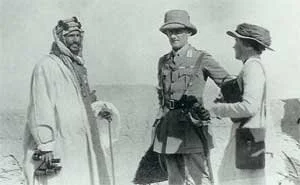
A 1916 meeting with Ibn Saud, Percy Cox, and Gertrude Bell.
Early Climbs in the French Alps
As a daughter of the sixth-richest family in Britain, Gertrude had the privilege of traveling extensively including two world tours; one with her brother Maurice and another with her half-brother Hugh (sometimes referred to as “Hugo”). Gertrude showed an interest in mountain climbing when her family visited the Dauphiné region of the French Alps in August of 1897. It was during that trip that she climbed minor peaks like Pic de la Grave and the Bec de l’Homme.
Gertrude returned to the region in August of 1899 to climb the larger La Meije and Barre des Écrins. Early in her visit, she encountered German mountaineer Helene Kuntze who had just completed a climb of La Meije’s summit peak before her. Gertrude’s expedition, however, would cross the complete traverse. This is considered Gertrude’s first climbing season.
For the 1900 climbing season, Gertrude went to the Chamonix commune in France. It was there that she enlisted Ulrich Fuhrer as one of her guides. Ulrich and his younger brother Heinrich would become her usual guides during the 1901, 1902, and 1904 (her last) seasons. In 1900, she climbed Mont Blanc, the Grépon, and the Grand Dru.
The 1901 Season in the Swiss Alps
In 1901, Gertrude came face-to-face with the Schreckhorn in Switzerland. After reaching the top via the southeast, which is the side she referred to as seen from the Grimsel Pass, she focused on the Engelhörner range where she achieved seven first ascents, three more ascents of old peaks or saddles, and the first traverse of the Urbachthaler Engelhorn. One of the seven virgin peaks was named after her, Gertrudspitze (or Gertrude’s Peak). Her attention then turned to the unclimbed northeast face of the Finsteraarhorn and the uncompleted traverse of the Lauteraarhorn and Schreckhorn. However, she was met with bad weather and returned to England unsuccessful.
At the end of the year, Gertrude wrote the article “Concerning Mountains: Die Engelhörner” for the National Review. Her description of Switzerland is worth quoting in detail:
You need not go farther afield than the much-trodden Bernese Oberland to find new peaks and new adventures; it is unnecessary to go farther in search of Alpine beauties, for in no region of mountains is there a greater variety of gorgeous scenery. Snowfield and rock would seem here to put on their finest aspects; a master hand hollowed out the thin shell-like ridge of the Schreckhorn and raised the pinnacle of the Finsteraarhorn, spread the white carpet of the Aletsch Glacier, and planted pine and willow gentian down the eastern slopes of the Great Scheidegg. No wonder (but great cause for thankfulness) that to the pioneers of Alpine adventure the Oberland was one vast magnet, drawing them irresistibly upwards.
Despite her successes, this article was the only time that she publicly wrote about her climbs. This tells us that she did not set out on these mountain expeditions for glory. Seeking adventure was simply how she lived her life.
The First Impossible
Gertrude returned to Switzerland in 1902. She got a glimpse of fame while on the Brünig railway line when a conductor asked her if she was the Miss Bell who had climbed the Engelhörner. At Rosenlaui, she once again encountered Helene Kuntze who had recently completed several Engelhörner first ascents with Ulrich as her guide. Ulrich had rejoined Gertrude the previous day to which she felt was Helene’s displeasure.
A couple of days later, Helene climbed the big gendarme on the Vorder Wellhorn. Gertrude woke up at midnight to attempt the same climb with a 1:00 a.m. start. She was halted by a storm half an hour later and took shelter in a deserted chalet, choosing one that did not have pigs in it. More rain at dawn led to her returning to her inn at 5:00 a.m., but she was still determined.
The next day, Gertrude started for the big gendarme at 9:50 a.m. She made it to the top by 1:00 p.m. Using a sling left by Helene’s guide, a German named Gustav Hasler, she let herself down the southeast corner.
It was not long before Gertrude took her ambitions a step further. The very next morning, she returned to the Vorder Wellhorn and, while making a five minute halt to undo her rope, viewed a chamois run up the arête above her, knocking down stones as it climbed. Gertrude described the Wellhorn arête as one of four “impossibles” of the Oberland. She ascended it that day. Her expedition ended by crossing the Rosenlaui Glacier under the seracs. Two days later, while crossing the couloir between King’s Peak and the Princes, she wore climbing shoes for the first time.
The Lauteraarhorn
A few days after conquering the Vorder Wellhorn, Gertrude left Rosnelaui for the Grimsel Pass to tackle her next “impossible.” She wrote to her father describing plans for a midnight climb of the arête between the Lauteraarhorn and the Schreckhorn on an unclimbed side. These were secret plans because there were assumptions that Helene was focused on the same expedition from the other side.
Thunderstorms pushed Gertrude’s climb to a 3:00 a.m. start. After walking up the glacier for three hours, the sun rose and Gertrude noticed the light shine on the Finsteraarhorn. She reached the bottom of the Lauteraarhorn arête around 9:00 a.m. Climbing through mist and then snowfall, she reached the top around 2:15 p.m. She, Ulrich, and Heinrich put their visiting cards in a bottle that they found there.
In another letter to her father, Gertrude wrote that it was all to be done again. However, she noted that all agreed not to climb the Lauteraarhorn from the Grimsel side again. She described the arête to the summit as “made by the devil” and “one of his happiest inspirations.” The gendarmes and snow cornices made it feel as though they were never getting any closer to the end. Instead, they would attempt it from the Grindelwald side.
The Lauteraarhorn-Schreckhorn Traverse
One week later, Gertrude set off for the Lauteraarhorn again. She woke up at 10:20 p.m. and set off at 11:10 p.m. Helene went to the Schrekhorn saddle. Gertrude followed the glacier toward the Strahlegg on the southwest ridge of the Lauteraarhorn. Once again she noticed the Finsteraarhorn, this time shining in the moonlight. She put out her lantern to take in its full brilliance. Just before 2:00 a.m., she made it to the Strahlegg and faced wind coming from the Schreckfirn bergschrund on the southwest ridge of the Schreckhorn. On the way up the arête toward the summit, she felt the bitter wind whenever she turned toward the Schrekfirn side. She made it to the top of the arête at 4:10 a.m. and watched the dawn come while she ate breakfast. The Matterhorn now received her admiration in the pink sky.
Now traversing across the mountain, Gertrude reached the saddle at 6:35 a.m. The wind was cruel. Ulrich half-suggested not going to the top of the Lauteraarhorn, but Gertrude insisted. Onto the gendarmes they went, reaching the summit at 8:50 a.m. After a second breakfast, she returned to the saddle. She then went up a tall gendarme and waited for Helene at the top, who joined her at 10:45 a.m. Together, they reached the top of a smooth arête at 11:35 a.m. From then on, there was a sharp arête, hard gendarme, and a gendarme with an overhang. Ulrich unrolled a thin rope for them to go up the overhang above a 25-30 foot drop. After Gertrude went up, she climbed to the top of a smooth face. Helene did not follow up the overhang. Instead, she went around the bottom and up the other side of the gendarme. She then followed the ordinary route back down the Lauteraarhorn and over the Strahlegg. Gertrude, however, made her descent to the saddle, reaching it at 2:00 p.m., and back across the glacier at 4:30 p.m. She reached a community used hut at 5:30 p.m. just before Helene. Both teams slept in the hut that night and Gertrude complained about Helene rolling onto her all night. The next morning, Gertrude returned to Grindelwald at 10:00 a.m. This was the first crossing of the Lauteraarhorn-Schreckhorn traverse and, according to the Alpine Journal, her most important climb.
The Finsteraarhorn
Gertrude’s attention returned to the unclimbed northeast face of the Finsteraarhorn. It is unclear in her letters if her second “impossible” was the Lauteraarhorn-Schreckhorn traverse or the Finsteraarhorn. However, the Finsteraarhorn would prove impossible for her. A storm, inability to light matches, shelterless glacier, facing unknown ground, and eventual frostbite would cause her to turn back 57 hours into the expedition. Gustav Hasler called this the “first real attempt” of the northeast face and a “most gallant and determined attack on it.” He praised her endurance and performance. Gustav and his friend Fritz Amatter successfully climbed what Gertrude could not in 1904, grabbing a rope ring left by Gertrude at her turning point as a souvenir.
In 1903, Gertrude spent some time climbing in Vancouver while on her world tour with Hugh. Her final climb was the Matterhorn the following year. The remaining two “impossibles” of the Oberland were the Jungfrau from the Jungfrauhjoch saddle (first traversed in descent by C. F. Meade, guided by Ulrich and Heinrich in 1903) and the northeast arête of the Eiger (first ascended by Yuko Maki, guided by Fritz Amatter in 1921).
Did you find that piece interesting? If so, join us for free by clicking here.
Works Cited
Bell, Gertrude. A Woman in Arabia: The Writings of the Queen of the Desert, edited by Georgina Howell, Penguin, 2006.
Bell, Gertrude. “Concerning Mountains: Die Engelhörner.” Alpine Journal, vol. 41, 1929, pp. 21-34.
Bell, Gertrude. “Diary entry by Gertrude Bell.” 7 August, 1897. Gertrude Bell Archive, New Castle University. https://gertrudebell.ncl.ac.uk/d/GB-2-5-2-1-9
Bell, Gertrude. “Diary entry by Gertrude Bell.” 6 July, 1902. Gertrude Bell Archive, New Castle University. https://gertrudebell.ncl.ac.uk/d/GB-2-7-4-6-2
Bell, Gertrude. “Diary entry by Gertrude Bell.” 7 July, 1902. Gertrude Bell Archive, New Castle University. https://gertrudebell.ncl.ac.uk/d/GB-2-7-4-6-3
Bell, Gertrude. “Diary entry by Gertrude Bell.” 9 July, 1902. Gertrude Bell Archive, New Castle University. https://gertrudebell.ncl.ac.uk/d/GB-2-7-4-6-5
Bell, Gertrude. “Diary entry by Gertrude Bell.” 10 July, 1902. Gertrude Bell Archive, New Castle University. https://gertrudebell.ncl.ac.uk/d/GB-2-7-4-6-6
Bell, Gertrude. “Diary entry by Gertrude Bell.” 11 July, 1902. Gertrude Bell Archive, New Castle University. https://gertrudebell.ncl.ac.uk/d/GB-2-7-4-6-7
Bell, Gertrude. “Diary entry by Gertrude Bell.” 12 July, 1902. Gertrude Bell Archive, New Castle University. https://gertrudebell.ncl.ac.uk/d/GB-2-7-4-6-8
Bell, Gertrude. “Diary entry by Gertrude Bell.” 14 July, 1902. Gertrude Bell Archive, New Castle University. https://gertrudebell.ncl.ac.uk/d/gb-2-7-4-6-10
Bell, Gertrude. “Diary entry by Gertrude Bell.” 15 July, 1902. Gertrude Bell Archive, New Castle University. https://gertrudebell.ncl.ac.uk/d/GB-2-7-4-6-11
Bell, Gertrude. “Diary entry by Gertrude Bell.” 16 July, 1902. Gertrude Bell Archive, New Castle University. https://gertrudebell.ncl.ac.uk/d/GB-2-7-4-6-12
Bell, Gertrude. “Diary entry by Gertrude Bell.” 17 July, 1902. Gertrude Bell Archive, New Castle University. https://gertrudebell.ncl.ac.uk/d/GB-2-7-4-6-13
Bell, Gertrude. “Diary entry by Gertrude Bell.” 24 July, 1902. Gertrude Bell Archive, New Castle University. https://gertrudebell.ncl.ac.uk/d/GB-2-7-4-6-20
Bell, Gertrude. “Diary entry by Gertrude Bell.” 25 July, 1902. Gertrude Bell Archive, New Castle University. https://gertrudebell.ncl.ac.uk/d/GB-2-7-4-6-21
Bell, Gertrude. Letter to Dame Florence Bell. 21 September, 1901. Gertrude Bell Archive, New Castle University. https://gertrudebell.ncl.ac.uk/l/gb-1-1-1-1-11-19
Bell, Gertrude. Letter to Dame Florence Bell. 7 July, 1902. Gertrude Bell Archive, New Castle University. https://gertrudebell.ncl.ac.uk/l/gb-1-1-1-1-12-16
Bell, Gertrude. Letter to Dame Florence Bell. 10 July, 1902. Gertrude Bell Archive, New Castle University. https://gertrudebell.ncl.ac.uk/l/gb-1-1-1-1-12-17
Bell, Gertrude. Letter to Dame Florence Bell. 13 July, 1902. Gertrude Bell Archive, New Castle University. https://gertrudebell.ncl.ac.uk/l/gb-1-1-1-1-12-18
Bell, Gertrude. Letter to Sir Hugh Bell. 8 September, 1901. Gertrude Bell Archive, New Castle University. https://gertrudebell.ncl.ac.uk/l/gb-1-1-2-1-6-8
Bell, Gertrude. Letter to Sir Hugh Bell. 10 September, 1901. Gertrude Bell Archive, New Castle University. https://gertrudebell.ncl.ac.uk/l/gb-1-1-2-1-6-9
Bell, Gertrude. Letter to Sir Hugh Bell. 15 September, 1901. Gertrude Bell Archive, New Castle University. https://gertrudebell.ncl.ac.uk/l/gb-1-1-2-1-6-10
Bell, Gertrude. Letter to Sir Hugh Bell. 16 July, 1902. Gertrude Bell Archive, New Castle University. https://gertrudebell.ncl.ac.uk/l/gb-1-1-2-1-7-3
Bell, Gertrude. Letter to Sir Hugh Bell. 18 July, 1902. Gertrude Bell Archive, New Castle University. https://gertrudebell.ncl.ac.uk/l/gb-1-1-2-1-7-4
Harding, J. G. R. “The Other Gertrude Bell.” Alpine Journal, vol. 124, 2020, pp. 168-178.
Hasler, Gustav. “The North-East Face of Finsteraarhorn.” Alpine Journal, vol 34, 1922, pp. 268-280.