The Lincoln-Douglas Debates were a series of 1858 debates between Abraham Lincoln of the Republican Party and Stephen Douglas of the Democratic Party. Laureen Vernon explains.
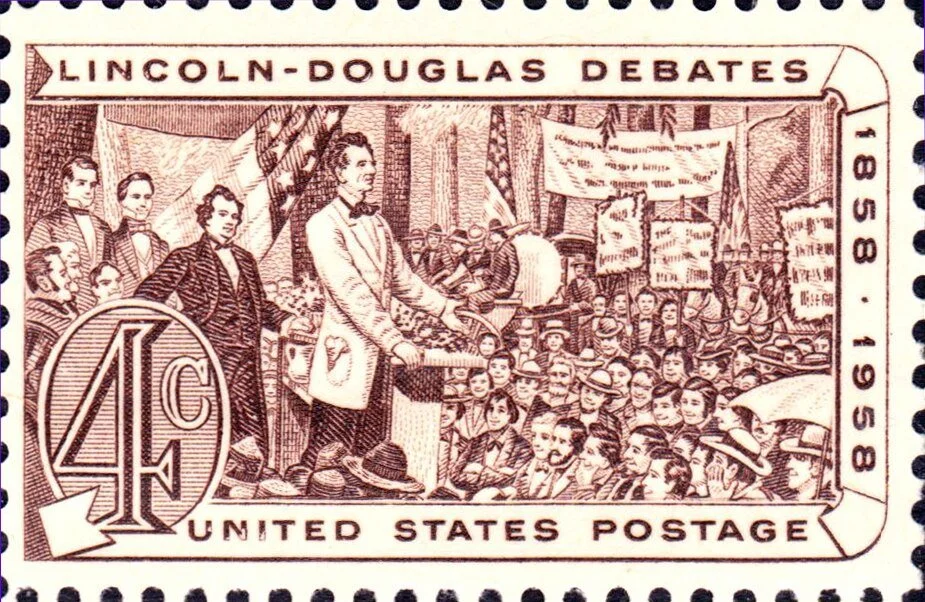
An 1958 postage stamp commemorating the debates.
Now, as in then there can be but one supreme issue, that between right and wrong. In our country there are no ruling classes. The right to direct public affairs, according to his might and influence and conscious belongs to the humblest as well as the greatest… But it is times of danger, crucial moments, which bring into action the high moral quality of the citizenship of America. The people are always true. They are always right, and I have the abiding faith that they will remain so Robert Todd, Lincoln, speaking at the Galesburg, celebration 1896. (A, 314)
The weather was so extremely dusty due to the preceding drought that the streets resemble the vast smoke houses because of the dust picked up by the thousands of spectators, economic recession, deflated land values brought railroad construction to a halt as Illinois Central and Michigan Central Railroad; and reduced the money supply of the banknotes from $215 million to $115 million. Money grew suddenly so scarce with us that a man possessing $10 in coins or in notes of a solvent bank might call himself a capitalist, Carl Scharz, a German, immigrant (a,XI) When considering the series of 1858 debates between Abraham Lincoln of the Republican Party and Stephen Douglas of the Democratic Party I think of civility and decorum. In reality the discussions were quite the opposite. They both used a lot of sarcasm did a lot of name calling to the degree that it most likely would be unable to be aired on network television. Until 1913, senators were elected not by popular vote, but by the General Assembly made up of their Representatives. Lincoln and Douglas were trying to win the votes of the State Legislator of the two chambers of the Illinois General Assembly. This was the first time debates were held between Senate candidates (B).
Debates
Originally, Lincoln proposed a series of 50 debates. Douglas agreed to 7 “joint discussions” because there were nine congressional districts in Illinois (B). He was frustrated that in the two districts he already spoke in, Lincoln would arrive two days after he left and defend his views. This left Douglas unable to rebuke. With crowds ranging from 1,000 to 20,000 spectators, it was a huge media story. Two rival newspapers in the Chicago area hired shorthand stenographers to capture every word of the candidate’s debates. From the articles published, Lincoln prepared scrapbooks that he had published by an Ohio printer to assist in his later bid for the Presidency of the United States.
While their primary focus was on slavery, they also debated popular sovereignty, the implication of the Dred Scott decision, the morality of enslavement, and the potential of a fractured union. Douglas chose to speak first in four of the seven debates. He was allowed sixty minutes to present his point with the challenger being (Lincoln) given a ninety-minute response followed by thirty-minute rejoinder by the first candidate. Douglas argued his belief that residents should decide if the state is free or not (Popular Sovereignty), and that the Supreme Court ruled in the Dred Scott case the slaves aren't people and could be brought into a free state and remain slaves. He was worried about the possibility of a fractured union. However, he believed that Popular Sovereignty would solve that.
Slavery
Lincoln argued against slavery on moral grounds. He avoided stating that the races are equal, he just argued that slavery shouldn't be expanded into new territories. If the territory already had slaves, they would be able to keep them. He felt that the Dred Scott decision had critical implications on the expansion of slavery, and he too was concerned about the division of the union, but felt only keeping slavery where it existed while not expanding into new territories would solve it. He spoke of the “eternal struggle’ between right and wrong when speaking of slavery, he mentioned “two principles that stood face to face since the beginning of time. The one of the common rights of humanity and the other the divine right of kings.” Lincoln used the house divided metaphor as early as 1843. He shared the biblical phrase “a house divided cannot stand” as a warning to unify the members of his political party. The names of parties are the same, but their principals and positions have flipped in the last one hundred fifty years.
As the debates drew to a close, an observer noted that Douglas had lost his voice when Lincoln's voice and spirit were intact. Lincoln won the popular vote, but lost the vote in in the General Assembly, Lincoln was confident even though he had lost because he had won the popular vote. Lincoln had gained notoriety and used the debates to help propel him into the White House. Lincoln and Douglas had disagreed for many years. However, Douglas supported Lincoln during the war.
Did you find that piece interesting? If so, join us for free by clicking here.
References
A. Lincoln and Douglas, the debates, define America, Allen C. Guelza, Simon and Schuster, New York, New York, 2008
B. The Lincoln Douglas debate of 1858, nps.gov, February 16, 2017, https://www.nps.gov/liho/learn/historyculture/debates.htm
C. Lincoln Douglas Debates, britannica.com, October 27, 2025, https://www.britannica.com/event/Lincoln-Douglas-debates