The War of the Breton Succession, or Breton War of Succession (1341–1365), was a war over the succession to the dukes of Brittany, in north-western France, that lasted for over twenty years. The war was a major conflict in the long Hundred Years’ War, which drove both France and England into a fight for survival and a contest for supremacy in Western Europe. Talia Bega explains — and looks at what happened as the English kept winning – until they didn’t.

Part 1 on the origins of the war is here, and part 2 on the rise of the English is here, and part 3 on the rise of the English here, and part 4 on French Struggles Against the English at Crécy here.
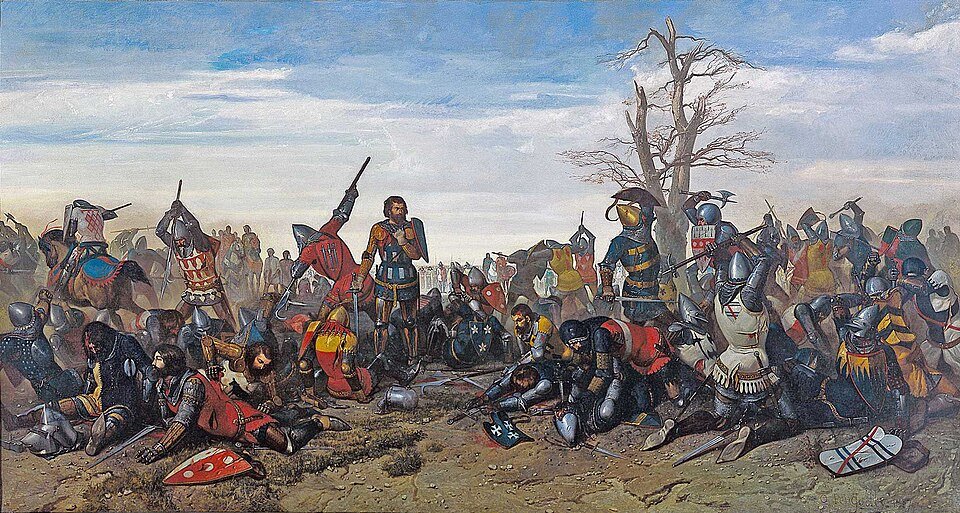
The Battle of the Thirty (1350). By Octave Penguilly L'Haridon. Source: Public domain, available here. 

The Failures at Crécy

In 1346, Edward successfully invaded France in a large-scale campaign known today as the Crécy Campaign. Edward saw it as a chance to press deeper into a France already reeling, striking further into its territories.  At first the campaign was risky for Edward: supplies ran short and morale was low. At the time, Charles of Blois was facing challenges as Edward was still sending in reinforcements to help strengthen the Montfort claim to the Duchy of Brittany.

Charles knew what Edward was about to do and had no choice but to face the fight.  Instead of a war for succession, it was now a fight for the survival of France. Philip VI, the first Valois king of France, saw much of the country fall apart. In 1337, he watched Edward lay claim to the French crown, and knew a reckoning between them was only a matter of time. A few years later, John III, Duke of Brittany, died, causing the War of the Breton Succession. Philip had a chance to win at first, but as the years dragged on, French morale collapsed.  He kept sending in as many men as he could, but the defeats kept coming.

Philip asked Charles for support to defeat Edward, but the risk was considerable. After the French defeat at Crécy, Charles lost hope, and a year later he was captured at La Roche-Derrien.


Charles vs the Hands of the English

In 1347, Charles had one more chance to lay siege to La Roche-Derrien and recapture it — but he was captured in the attempt. The battle showcased the power of the English longbowmen, whose arrows had an effective range of roughly 200m. Longbowmen would prove just as decisive nearly 70 years later at Agincourt. As at Crécy, the French besieging force heavily outnumbered the English relief force, yet still suffered the heavier losses.  The French were also backed by Genoese mercenaries, who remained a key part of their forces throughout the Hundred Years’ War. Despite their numbers, the French seemed unable to learn from their repeated defeats. The battle also saw surprise attacks on Charles’ forces by townsfolk armed with axes and swords, who harried his men and the longbowmen alike.

Charles thought he had won after his initial charge succeeded, but the English rallied and turned the battle against him. Charles was taken prisoner — another decisive victory for the English. With Charles gone, Philip’s support in Brittany had collapsed, and the English were closer than ever to securing their claim.

Charles was then held in the Tower of London for years, and little is known for certain about the conditions of his imprisonment. At the time, the Tower served as a central political prison, a royal residence, and a site for coronation ceremonies. The French pope, Innocent VI, was alarmed by the conflict and pressed for a peace treaty.  It allowed both factions to hold part of the territory and maintain an uneasy peace.


At Last Victory

At this time came one of the most famous episodes of medieval chivalry: in 1351, the Combat of the Thirty.  It came to represent the very peak of knighthood and honor. Both sides had thirty knights each, and the French were led by Marshal of Brittany, Jean de Beaumanoir, and for the English, Robert Bemborough. It was part duel, part military exercise — not simply a show for entertainment. The arrangements were straightforward: Jean challenged Robert to a fight, and both men accepted.

The fight itself lasted only a few hours, with four French knights and two English dead by the time of a short break. Bemborough was killed soon after, followed by several more of his knights. The English were surrounded and defeated, securing a French victory that underscored the era’s ideals of chivalry. The casualties were nine dead for the English vs six for the French. Unlike a typical battle of the period, it was remembered above all as a display of chivalric ideals. Chroniclers such as Jean Froissart cited the encounter as an example of chivalry itself.

Though the Combat of the Thirty had little effect on the war itself, Edward signed the Treaty of Westminster in 1353, formally recognizing Charles as the rightful Duke of Brittany — though this recognition proved short-lived. If Charles could pay a large ransom and forge an alliance with England, the arrangement would hold. Edward also wanted the young John of Montfort to marry his daughter Mary, though this required approval from both the Papacy and France. Amid the struggles, the treaty was never enacted, and Charles was freed and returned as the rightful duke.

This moment in history raises many questions, but it also offers lessons. Edward was now in his early forties and physically weakening, but his mind remained fixed on the prize. The English enjoyed strong support on both sides of the Channel, which helps explain Edward’s deep investment in the treaty. Charles became a political pawn after his capture — and so, in a sense, did France, which faced its own struggle for power.

How could France decide its own fate now? With Charles restored to his rightful duchy, peace settled over Brittany — but not for long. Ten years later, a new claim to the duchy would rise, asking the same question all over again.


A reminder that Part 1 on the origins of the war is here.


Bibliography

GRAHAM-GOERING, E. (2021). Princely power in late medieval France: Jeanne de Penthievre and the war for Brittany. CAMBRIDGE UNIV PRESS.

Sumption, J. (1991). The Hundred Years' War. University of Pennsylvania Press.
The War of the Breton Succession, or Breton War of Succession (1341–1365), was a war over the succession to the dukes of Brittany, in north-western France, that lasted for over twenty years. The war was a major conflict in the long Hundred Years’ War, which drove both France and England into a fight for survival and a contest for supremacy in Western Europe. Talia Bega explains — and asks whether the French could compete with the English.

Part 1 on the origins of the war is here, and part 2 on the rise of the English is here.

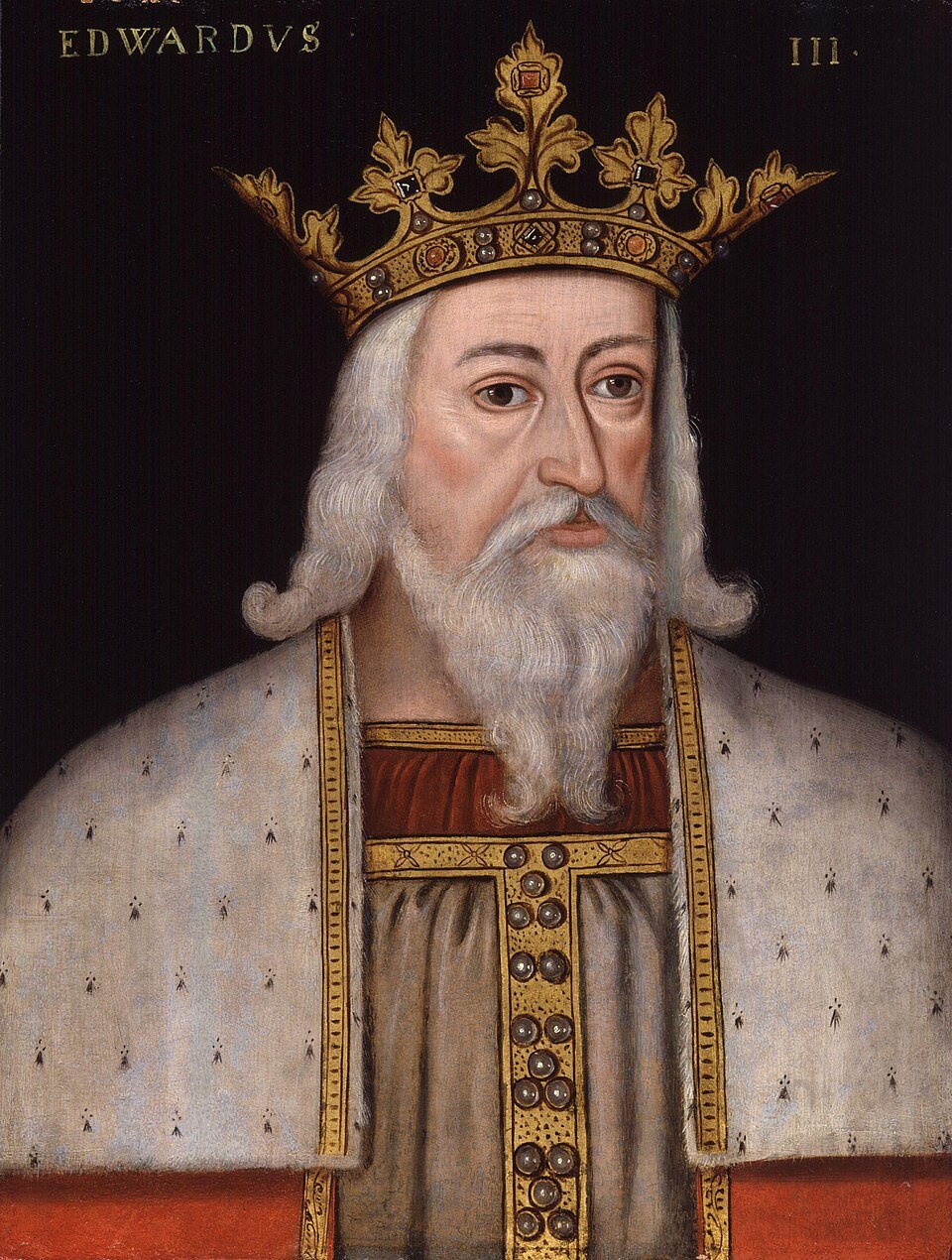
King Edward III, 16th century depiction. Source: Public domain, available here.

Edward III’s Breton Campaign

For the past two years, France and England had been locked in a brutal succession war over who would become the next Duke of Brittany after the death of John III in 1341. The conflict unfolded within the long Hundred Years’ War (1337–1453), a wider trial of which realm was the more powerful. John of Montfort backed the English cause, while Charles of Blois backed the French. Both men were eager to win the duchy, but Edward III of England had plans of his own.

After the Truce of Espléchin in 1340, which paused the fighting for a year, Edward put forward a plan to support John once the old duke died — in return for John’s backing of his own claim to the French throne. The treaty allowed both sides to stop fighting and committed the English not to invade French lands. Charles believed himself the rightful heir to the duchy, not least because of the popular support he enjoyed, while John sought to reconquer territories such as Nantes and Rennes. He was captured by French forces, however, and imprisoned in 1341. Edward resolved to plan an invasion after John’s wife, Joanna of Montfort, begged him to intervene and free her husband. With Edward now involved — a military mastermind backed by a strong realm — Charles was suddenly at risk.


A Large Invasion and the Rise to Victory

The year 1342 at last saw Edward act on his plan to free John from prison and press the Montfort claim to the duchy of Brittany. Helping the duke also allowed Edward to gain territory and strengthen his own bid for the French crown. It is worth noting that many popes of this era were French — a period known as the Avignon Papacy. Many of them were pro-French, which posed a problem for Edward, who needed support for his claim to the French throne. Clement VI in particular was strongly pro-French and had long served at the French court under Philip. Edward, for his part, was determined to turn the duchy to his own advantage.

Clement did his best to resolve the conflict, but Edward refused to cooperate and pressed on with his own plans. He sent a large body of reinforcements after Joanna pleaded for help in the summer of 1342. Charles used the same period to regain lost territory and laid siege to Hennebont in Brittany. By this point John had already been captured, and some of his commanders had passed under his wife’s control. Edward put his reinforcements to work in the struggle for control, winning several victories along the way.

Joanna also proved shrewd, particularly in winning over French supporters such as the famous Amaury de Clisson. Clisson might be seen as a traitor for aiding the Montfort cause and helping to break the siege Charles had laid. The Montfort recovery owed much to Charles himself: his financial terms were ones not everyone would accept, and some of his Italian mercenaries deserted him. His fortunes dipped again a few weeks later, when another of his sieges, this time at Brest, failed. Joanna once more found herself besieged by Charles as he pressed to seize the duchy’s main power base. Since his victory at Sluys in 1340, Edward had built a much stronger navy — one whose value would later show in his greater triumphs of the Hundred Years’ War.


English attack

The English warships were modeled on the cogs of the German territories, in contrast to the French galleys. These large merchant vessels were prized for their carrying capacity, and their roomy holds could just as easily transport soldiers. The crossing to Brest took about three days, carrying a relief force of some 1,350 men. The town of Bayonne, loyal to Edward, proved a great help: it gave him a base from which to launch the ships, and with it the advantage. The English fell on the Genoese galleys without warning and destroyed them one by one. Shaken by the strength of this force, Charles abandoned the field, leaving Brest in English hands for decades to come. His defeats were not yet over — he was beaten again at Morlaix, to the embarrassment of the French. Meanwhile John remained a prisoner, while his wife’s strategy took shape, aided above all by the king of England.

A few weeks later Edward landed and won a victory at Vannes, helped by Robert of Artois, who was wounded there and later died. Robert had watched Charles storm and ravage the town, but with over 10,000 men he helped lift the siege. Vannes endured several sieges in all, and before long both sides had gathered large armies for a far wider war. That war never came: with the help of Pope Clement VI, the Treaty of Malestroit was sealed on 19 January 1343, pausing the conflict for the next three years. The siege was over, and under the treaty the papal legates decided who should govern the territory.

This was a turning point in England’s favor: the treaty suited the English and fulfilled Edward’s wishes. It secured the release of John of Montfort, along with several other prisoners on both sides. The main conference followed a year later, in 1344, though the two delegations never met face to face. It produced a great deal of back-and-forth, since neither side took it seriously and each pursued its own ends. Two years after that, Edward launched his Crécy campaign, ravaging France still further. He was far better prepared than Philip VI, knowing exactly what he wanted and when. His strategy stripped Charles of power and pressed England’s claim in France, even though Charles had until then held the upper hand. The next thirty years would prove perilous for France — and in 1346, everything changed at once.


A reminder that Part 1 on the origins of the war is here.


References

Graham-Goering, E. (2021). Princely power in late medieval France: Jeanne de Penthièvre and the war for Brittany. Cambridge University Press.

Sumption, J. (1991). The Hundred Years’ War. University of Pennsylvania Press.
Posted
AuthorHistory Is Now Magazine
CategoriesBlog Post

The War of the Breton Succession or the Breton War of Succession (1341–1365) was a war over the succession of the Dukes of Brittany, north-western France, that lasted for over twenty years. The war was a major conflict in the long Hundred Years’ War, which drove both France and England into a fight for survival and a contest for supremacy in Western Europe. Talia Bega explains - and here looks at the rise of the English.

Part 1 on the origins of the war is here.

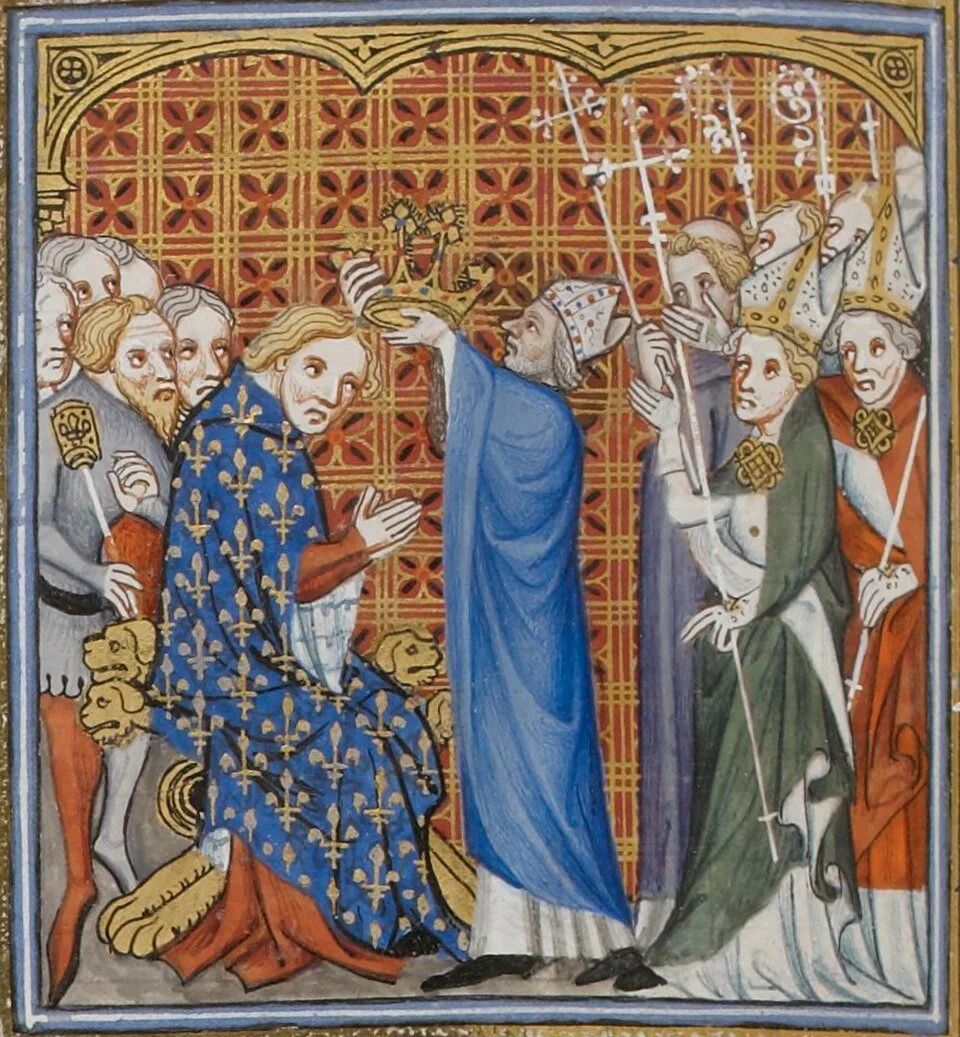
A depiction of the coronation of Philip VI of France.

1341, the Year that Changed Everything

The Hundred Years’ War (1337–1453) was waged by Edward III of England, who pressed his claim to the throne of France after the death of his uncle Charles IV in 1328, the last direct Capetian. The English fought to recover and expand the territories their Angevin predecessors had held in France in the twelfth century. The war brought bloody campaigns on multiple fronts and devastated large parts of the French countryside. However, it was not just about the French throne; it also intersected with internal conflicts in France. In 1341, John III, Duke of Brittany (1286–1341), died, leaving a crisis over who would succeed him. This was not just a problem of succession but a source of wider chaos, especially for France and England during the Hundred Years’ War.

The dukes of Brittany were important in French politics, serving as a basis for stability in the French realm. After John's death, there was widespread anxiety over who should become the next duke. Two candidates emerged, each backed by one of the rival kingdoms. On the French side stood Charles of Blois, who had married the late duke’s niece, Joan of Penthièvre. Joan was the daughter of the late duke’s younger full brother, Guy, Count of Penthièvre, making him one of the most plausible heirs. But this was not the only option. Whenever a dispute opened up in France, the English were rarely far away. The English backed John of Montfort, the late duke’s younger half-brother, born of their father Arthur II’s second marriage to Yolande de Dreux. Both sides knew where their candidate stood; what remained was to see whose claim could prevail.


A Truce that Turns the Tide

France and England were at peace with the Truce of Espléchin, which had been signed in 1340 and ran until the summer of 1341. The truce followed the failed English siege of Tournai, after which Pope Benedict XII asked Edward’s mother-in-law, Jeanne of Valois (who was also Philip VI’s sister), to mediate. The English would not attack France for nine months over the period. It was soon overtaken by events in the Breton War of Succession.  

The treaty allowed both sides to gather numerous troops and to rethink a new plan, especially as France faced a challenge from its own people to an increase in debt after constant battles with the English.  After the death of the Duke of Brittany, the violation of the treaty occurred as the English came to support John of Montfort. However, at the time, many of the nobility supported Charles, causing a wide division. Even though John had arguably the stronger legal claim, the French king, Philip VI, preferred Charles, who was well known and well-connected among the French aristocracy. John saw that the matter would not resolve itself in his favor, and he made other plans. Encouraged by his wife, he moved on the capital of the duchy, Nantes, after the funeral of the late duke, and took control of the treasury.

John’s aim was to seize as much of the duchy as possible and force the king of France to confirm him as duke. He pressed on to Rennes and took it without serious opposition. Still, his position had weaknesses: much of his support came from the lower classes and the towns, while most of the nobility continued to favor Charles. By the end of 1341, much of eastern Brittany was in John’s hands, bringing him closer to the ducal title. He also had the backing of Edward III, who pursued his own claim to the French throne. With Edward behind John and Philip behind Charles, any prospect of a negotiated settlement was vanishingly small.


A Spark of a New War

In September 1341, the French Court of Peers at Conflans, summoned by Philip VI, ruled in favor of Charles, with John of Montfort called as a witness. On September 7, Charles was formally recognized as the new duke. As Charles took up his duchy, he faced military pressure from several directions, and the situation in Brittany remained volatile. Philip also wanted to absorb the duchy into the French royal domain as a province, although the terms of the recent truce restricted what he could do openly. Edward, for his part, was furious that events were running against him and decided to resume the war. He saw Brittany as a useful foothold for English forces, and a Montfort duke would strengthen the English position in France.

Aware of the growing English threat, Charles secured the king’s help and a force of more than 7,000 troops was dispatched to defend the duchy against any invasion or siege. It was led by the future king of France, John, Duke of Normandy. Montfort saw the large army approach and rallied whatever fighters he could muster. Heavily outnumbered, his forces were defeated, and the French took Champtoceaux. John had no choice but to retreat to Nantes, where he soon surrendered to the duke of Normandy after a long blockade during which the French broke into the town. Philip had John escorted back to Paris and once again pressed him to drop his claim. What Philip did not know was that John’s wife was already working to bring English forces across the Channel and widen the war.

The west of Brittany still held out for the Montfort cause, but with John captive, time was running short. This was not only a struggle for power, but also a contest of wills between two powerful realms. John’s wife, Joanna of Flanders, fought hard to keep her husband’s claim alive. So too did Charles’ wife, Joan of Penthièvre — a rivalry that gave the conflict its other name, the War of the Two Joans. These events have rarely received the attention they deserve, yet they reveal how local successions could feed into the larger Anglo-French struggle, with the outcome only settled more than twenty years later.


A reminder that Part 1 on the origins of the war is here.


References

GRAHAM-GOERING, E. (2021). Princely power in late medieval France: Jeanne de Penthievre and the war for Brittany. CAMBRIDGE UNIV PRESS.

Sumption, J. (1991). The Hundred Years War. University of Pennsylvania Press.

The War of the Breton Succession or the Breton War of Succession (1341–1365) was a war over the succession of the Dukes of Brittany, north-western France, that lasted for over twenty years. The war was a major conflict in the long Hundred Years’ War, which drove both France and England into a fight for survival and a contest for supremacy in Western Europe. Talia Bega explains - and looks at the origins of the conflict here.

Marriage of Charles IV and Marie of Luxembourg, by Jean Fouquet.

Downfall

Before the turmoil of the Hundred Years’ War, France had experienced a period of prosperity. However, the last Capetian king of France, Charles IV, passed away in 1328, ending a dynasty that had ruled since the 10th century and passing the crown to the House of Valois. His death raised a pressing question: what would happen next? Before Charles’ death, his father, Philip IV—known for various campaigns, including wars with England, the Flemish, and the papacy—had held the upper hand. Philip transformed France and challenged the powerful English, but the years following his death did not go well for the French. His three sons—Louis X, Philip V, and Charles IV—left no male heirs to the throne and faced constant threats on all sides from the Flemish and the English. Even before Philip took the throne, Louis IX of France had expanded royal power from the early 13th century, seizing English-held lands in France from the weakened King John and his son Henry III.

 Phillip saw it as his chance to keep the power, but quickly drove France into more debt and begged the church for more money. With his death on the line, some of the feudal powers that France controlled started to rebel. One main issue when Phillips' sons took power was the constant threat from the Flemish, and the areas of Modern-day Belgium, which saw their chance to rebel, and France had to stop them. Face forward after the death of Charles in 1328, France was a powerful kingdom, slowly dying internally.  The morale of the people fell as France's leadership in military power and threats on all ends, including the start of a major war in 1337, where Edward III claimed himself king of France.  Philip saw this as his chance to retain power, but he quickly drove France into deeper debt and was forced to beg the church for more money. As his death approached, some of the feudal powers that France controlled began to rebel. One main issue when Philip’s sons took power was the constant threat from the Flemish in the areas of modern-day Belgium, who saw their chance to rebel and whom France had to suppress. By the time of Charles’s death in 1328, France was a powerful kingdom that was slowly dying from within. The morale of the people fell as France’s military leadership weakened and threats mounted on every side, culminating in the start of a major war in 1337, when Edward III claimed himself king of France.

The start of the war proved a challenge for France as the battles were like a tennis match for both sides.  However, in 1341, the death of John III of Brittany impacted French soil. Brittany was in the northern part of France and was a key figure in French politics, with a goal of trying to remain balanced for the French throne.  His death didn't just drive France further down, but also brought the whole war together over one land.  The start of the war proved a challenge for France, as the battles went back and forth like a tennis match between the two sides. However, in 1341, John III of Brittany died in France. Brittany was in the northern part of France and was a key region in French politics, striving to remain balanced in its loyalty to the French throne. His death did not only drive France further down; it also drew the entire war to bear on France.

A Change in the Tide

John III, Duke of Brittany ( 1289-1341) was the son of Arthur, Duke of Brittany, and Marie, Viscountess of Limoges. Not much is known about his childhood, but he married Isabella of Valois, which gave him a connection to the future house of Valois through Isabella’s father, Charles of Valois.  John married three times throughout his life, which had an impact on power and trade from all over the Duchy. John, just like the French kings, did not have an heir and was possibly thinking of giving the duchy to France if he died, for a new way of gaining power. However, his half-brother, John, Duke of Montfort, who plays a much bigger role later, wanted the duchy after his death. This, in fact, did not work out as Montfort, soon after his death, claimed power for the Duchy itself. John III, Duke of Brittany (1289–1341), was the son of Arthur, Duke of Brittany, and Marie, Viscountess of Limoges. Not much is known about his childhood, but he married Isabella of Valois, a union that gave him a connection to the future House of Valois through Isabella’s father, Charles of Valois. John married three times throughout his life, with consequences for power and trade across the region. Like the French kings, John had no heir and may have considered ceding the duchy to France upon his death as a means of gaining power. However, his half-brother, John, Duke of Montfort—who would play a much bigger role later—wanted the duchy after John III’s death. This did not come to pass, as Montfort, soon after John III’s death, claimed the duchy for himself.

Montfort indeed came and took his place for power and control, with the English side facing the high ground. Arthur indeed had another heir when John died, who was in fact Guy, Count of Penthièvere, who passed away in 1331, but his daughter Joan of Penthièvere married Charles of Blois, in which both he and Montfort fought over the duchy.  Now, with the issue of the heirs coming into play, why does France need to get involved? At the start of the Hundred Years War, Gascony played a key role in the region of the war, as the forces of Edward III came crashing down into France. Montfort moved quickly to claim power and control, with the English at his back. Arthur had in fact had another heir, Guy, Count of Penthièvre, who had passed away in 1331; Guy’s daughter, Joan of Penthièvre, married Charles of Blois, and both Charles and Montfort fought over the duchy. Now, with the question of the heirs in play, why did France need to get involved? At the start of the Hundred Years’ War, Gascony played a key role in the conflict, as the forces of Edward III came crashing into France.

 The Hundred Years War saw a chance for England to claim France after the succession crisis in 1328. France did not allow women to rule due to the Salic Law, and was panicking as to who could be the new heir for the French throne, which was the house of Valois.  Edward can trace his claims as the cousin to the late king, as her mother, Isabella of France, also known as the “She Wolf”. This can be traced as much to the start of the war as Gascony was key, but also a succession crisis that brought panic to French soil. France needed all the help it could get, as Brittany was a territory that built stability within the region for France. Without a perfect ally, how would France survive, especially in the need of defeating a larger force and soon a force of France's enemies that comes together to face France? If John had heirs, the war wouldn’t be an issue, especially for a conflict that became a large problem of the French debt.

On April 30, 1341, John III, Duke of Brittany, passed away, initially starting a succession that lasted until 1365, deciding who would be the next Duke of Brittany. Both Charles of Blois and John, the Duke of Montfort, joined forces to claim Brittany. It didn't just stop as both France and England fought on both sides, widening the war. The Breton War of Succession is one war forgotten to many, but a conflict for who wants France and how.The Hundred Years’ War gave England a chance to claim France after the succession crisis of 1328. France did not allow women to rule under the Salic Law, and the kingdom was panicking over who could be the new heir to the French throne—a question ultimately answered by the House of Valois. Edward could trace his claim through his mother, Isabella of France, also known as the “She-Wolf,” who was sister to the late king. This claim, alongside Gascony, was a key factor at the start of the war, and the succession crisis brought panic to French soil. France needed all the help it could get, as Brittany was a territory that brought stability to the region. Without a strong ally, how could France survive—especially when it needed to defeat a larger force soon to be joined by other enemies? Had John left heirs, the war might have been avoided, sparing France a conflict that contributed greatly to its debt. On April 30, 1341, John III, Duke of Brittany, passed away, beginning a succession dispute that would last until 1365 and decide the next Duke of Brittany. Both Charles of Blois and John, Duke of Montfort, vied to claim Brittany. The conflict did not stop there, as both France and England backed opposing sides, widening the war.

The War of the Breton Succession is forgotten by many, yet it remained a critical struggle over who would control France- and how.

Part 2 in the series on the conflict is here.

Did you find that piece interesting? If so, join us for free by clicking here.

Bibliography:

GRAHAM-GOERING, E. (2021). Princely power in late medieval France: Jeanne de Penthievre and the war for Brittany. CAMBRIDGE UNIV PRESS.

Sumption, J. (1991). The Hundred Years War. University of Pennsylvania Press.