
In the long and often turbulent history of the Medal of Honor, one name stands entirely alone: Mary Edwards Walker. She remains the only woman ever to have received the United States' highest military decoration, and her life was as unconventional as the distinction itself. A surgeon, reformer, prisoner of war, and tireless advocate for women's rights, Walker's story is inseparable from the upheaval of the American Civil War, a conflict that reshaped the nation and, in her case, opened a narrow but historic path into military service.

Terry Bailey explains.
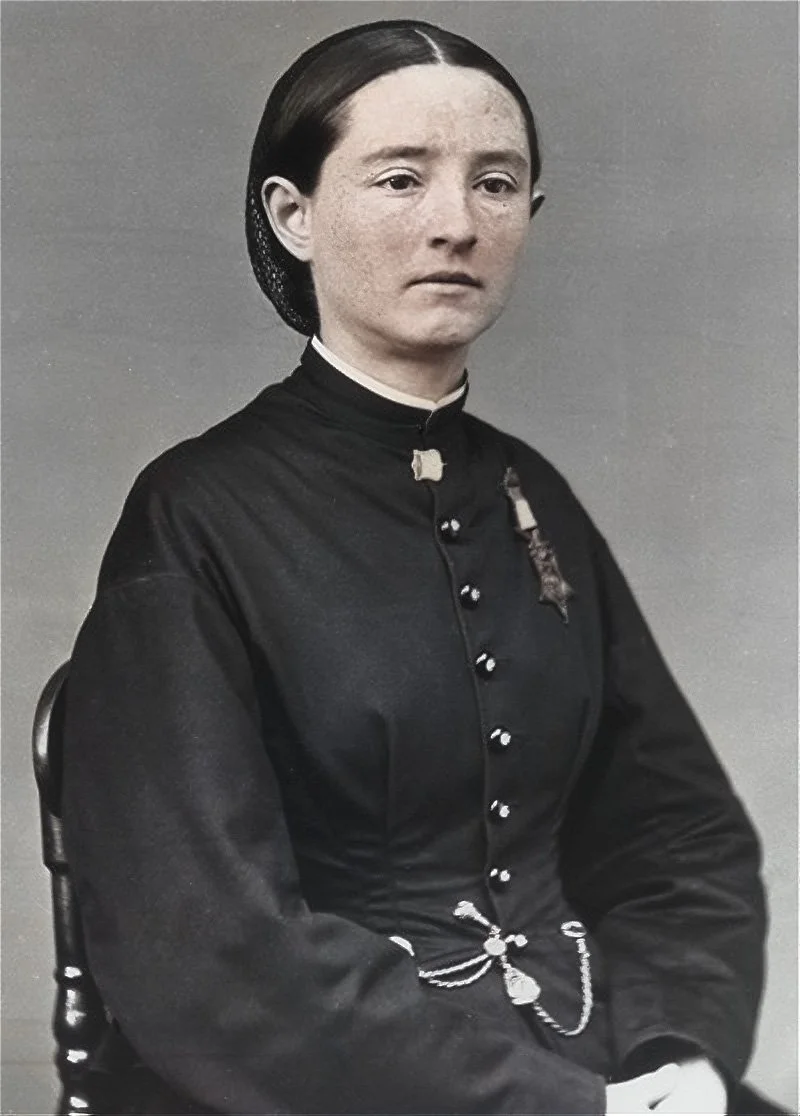
Mary Edwards Walker.

Mary Edwards Walker was born in 1832 in Oswego County, New York, into a household that quietly defied many of the era's expectations. Her parents were progressive thinkers who believed firmly in education, self-reliance, and physical health. Her father, a farmer with reformist views, insisted that his daughters receive the same rigorous schooling as his sons—an unusual stance in mid-nineteenth-century America. From an early age, Mary absorbed the idea that intellectual capacity was not determined by gender. She also rejected restrictive clothing, later arguing that heavy skirts and corsets were both unhealthy and symbolic of women's social confinement.

Her determination led her to pursue a medical career at a time when female physicians were rare and frequently dismissed. She enrolled at Syracuse Medical College, one of the few institutions willing to admit women, and graduated in 1855 with a Doctor of Medicine degree. Even with credentials in hand, she struggled to establish a practice. Patients were hesitant to trust a woman doctor, and professional networks largely excluded her. Yet she persevered, convinced that her skills would eventually find their proper arena.

That arena emerged with the outbreak of civil war in 1861. As the Union and Confederate states mobilized for what would become a four-year struggle of unprecedented scale, medical services were rapidly overwhelmed. Disease—typhoid, dysentery, pneumonia—claimed more lives than bullets, and battlefield surgery was often conducted in makeshift tents or barns with limited anesthesia and rudimentary sterilization. Determined to serve, Walker travelled to Washington, D.C., and petitioned the War Department for a commission as an army surgeon. She was refused solely because she was a woman.

Undeterred, she offered her services as a volunteer and began working in Union hospitals. Over time, her persistence and demonstrated competence earned her a contract appointment as an acting assistant surgeon with the Army of the Cumberland. This placed her in the Western Theatre of the war, where campaigns through Tennessee and Georgia were marked by relentless maneuvering and ferocious engagements. The struggle for control of strategic rail hubs such as Chattanooga and the drive toward Atlanta produced waves of wounded soldiers, and medical personnel worked under constant strain.

Walker frequently placed herself near the front lines, tending not only to Union troops but, when possible, to civilians caught in the crossfire. Her medical practice was guided by both professional duty and humanitarian conviction. In April 1864, during operations connected to the Atlanta Campaign, she crossed into territory controlled by Confederate forces to treat wounded men and suffering civilians. It was a bold and dangerous act. Confederate soldiers arrested her, suspecting that a woman in modified military attire moving between lines must be a spy. She was transported to Richmond, Virginia, and held as a prisoner of war. Confinement was harsh, food scarce, and uncertainty constant. Yet Walker endured several months of captivity before being exchanged in August 1864 as part of a formal prisoner swap. Her experience gave her a rare distinction: she was one of the few women formally held as a prisoner of war during the conflict.

In 1865, after the war had drawn to a close, President Andrew Johnson signed the order awarding Mary Edwards Walker the Medal of Honor. The citation recognized her meritorious service, devotion to the wounded, and steadfastness during captivity. Although the criteria for the award were broader in the nineteenth century than they would later become, her work near the front lines and her imprisonment under enemy authority were extraordinary by any standard.

Decades later, in 1917, a review board reassessed earlier awards and rescinded hundreds of Medals of Honor deemed inconsistent with newly tightened combat requirements. Walker's medal was among those revoked. She refused to surrender it, asserting that her service had been honorable and that no bureaucratic revision could erase lived reality. She continued to wear the medal daily, a small but potent act of defiance. In 1977, long after her death, the U.S. government restored her award, reaffirming her singular place in American military history.

Walker's postwar years were as combative in their own way as her time in uniform. She became a prominent advocate for women's suffrage, lecturing across the country and arguing that the Constitution already guaranteed women the right to vote. Her reformist zeal extended to dress reform; she adopted tailored jackets and trousers, insisting that practicality and health should outweigh social convention. For this she was ridiculed and occasionally arrested for "impersonating a man," yet she remained resolute. While she sometimes clashed with more cautious leaders within the suffrage movement, her independence and courage commanded respect.

Mary Edwards Walker died in 1919, just one year before the ratification of the Nineteenth Amendment secured women's suffrage nationwide. She did not live to cast a ballot in a federal election, but her life had already redefined the boundaries of possibility. In war, she proved that medical skill and personal bravery transcended gender. In peace, she continued to challenge the assumptions that had once barred her from a commission. Her Medal of Honor—awarded, revoked, and restored—serves as more than a military decoration. It stands as a testament to endurance in the face of prejudice, to professional commitment under fire, and to a lifetime spent pressing against the limits imposed by society. In Mary Edwards Walker's story, the upheaval of civil war intersected with the broader struggle for equality, and from that intersection emerged a legacy unlike any other in American history.


The site has been offering a wide variety of high-quality, free history content since 2012. If you’d like to say ‘thank you’ and help us with site running costs, please consider donating here.

Posted
AuthorGeorge Levrier-Jones

Sybil Ludington, a sixteen-year-old female, was called into action one rainy night in April 1777 to relay a vital message for the American rebel army in the US Revolutionary War. Here, Tom Daly explains the story of the US Revolutionary War heroine.

Sybil Ludington’s grave (with spelling differences). Source: Anthony22, available here.

Sybil Ludington’s grave (with spelling differences). Source: Anthony22, available here.

A storm was gathering on the evening of April 26, 1777, as a man desperately spurred his horse to the home of Henry Ludington, a colonel in the American rebel army, near the Connecticut-New York border. Dismounting from his horse and struggling for breath, he barely managed to get his words out, but when he did they sparked an extraordinary sequence of events. The man reported to Ludington that British troops had attacked Danbury, a town 15 miles to the south-east that had reserves of food and weapons for the Continental army. He had come to beg for re-enforcements and Ludington quickly agreed, but there was one problem: because it was planting season, he had already sent his men home to their respective farms. Ludington urgently needed to gather his men, but the messenger was unfamiliar with the area and his horse was exhausted. Ludington himself couldn’t go, as he would be needed at his farm to organise the troops when they started arriving. It seemed as if no one would be able to collect the American rebels to defend Danbury anytime soon,  but there was another person present who would rise to the occasion: Henry’s 16-year-old daughter, Sybil Ludington

You may have heard of Paul Revere, the man who rode through the night in 1775 to warn American rebels about approaching British troops. But you are less likely to know about Sybil Ludington. She did exactly what Revere did, and then some: she rode twice the distance he did and, unlike him, managed to avoid capture, and her efforts were recognised by George Washington himself. But a combination of gender bias and lack of publicity meant that she faded from the national consciousness, and her heroics were not made the stuff of legend in the way Revere’s actions were.


Upbringing

Sybil Ludington was born in Kent, New York, on April 5, 1761, the eldest of 12 children born to Henry and Abigail Ludington. Henry was a farmer by trade but like many men of the time he also had a military background, serving in the British army in the Seven Years’ War (1756-1763). 

Sybil was brought up in a loving household and had a peaceful childhood, growing into a pretty young woman with dark hair and blue eyes, but events in the world around her would disrupt her tranquil existence. Tensions were rising in colonial America as people began to resent the fact that they were controlled by a far away government in London, with no right to representation in that government. In 1773 Henry Ludington disavowed his loyalty to Britain, telling his family that when the inevitable war broke out he would pledge his allegiance to the rebels. The war started two years later, and Henry was true to his word, rising to the rank of Colonel in the Continental army and organising rebel troops in his part of New York state.


Sybil’s ride through the night

When the messenger arrived at the Ludington family farm that spring evening in 1777, Sybil was infuriated at his account of British troops looting the homes of civilians. It is not clear who decided that she would alert the militia men – some accounts claim she decided herself, while others suggest it was her father who asked her to. In any case, she was more than willing to help her father’s cause. By now it was dark and rain had started lashing down, but Sybil mounted her horse, which she had affectionately named Star, and rode at full speed into the night. 

It was no easy task to reach the nearly 400 men who were under Henry Ludington’s command, but Sybil and Star rode all night long, covering over 30 miles of wood and farmland. Aside from the poor conditions, Sybil faced the added danger of outlaws and British loyalists who were known to roam the area, and she had only a stick for protection. Still, she courageously pressed on, returning to the family farm as dawn broke the following morning to find hundreds of men gathering under the command of her father. Henry Ludington was relieved and immensely proud of his daughter, embracing her before setting off towards Danbury at the head of his men. 

Unfortunately, Sybil’s heroic mission had come too late to save Danbury, and the British troops had already moved to nearby Ridgefield by the time Ludington’s militia found them. Caught by surprise, the British were forced into a retreat back to Long Island, in what was considered a small but important tactical victory for the rebels. It was a victory that would not have been possible without Sybil Ludington.


Did Sybil get the recognition she deserved?

For a short while Sybil Ludington was hailed as a hero by fellow rebels in New York and Connecticut, and she even earned the praise of George Washington, who sent his congratulations and expressed his deep appreciation. However, the war progressed for several more years and Sybil’s actions were overshadowed by other momentous events.

The war officially ended in 1783, and Sybil celebrated the fact that the American colonies had become the United States of America, independent from Britain. The following year she married a young lawyer, Edward Ogden, and the couple settled in New York where Sybil gave birth to their son, Henry. Edward died in 1799, and Sybil used the money he had left for her to buy a tavern, which she ran successfully. She eventually used the profits from this to buy a house for her son and his family. Her son died in 1838, and she followed him a year later, dying on February 26, 1839 at the age of 77. She was buried next to her beloved father. 

Sybil was mostly forgotten about for the next century. Paul Revere, though certainly a noteworthy man in his own right, had his place in history secured by a publicist, Henry Wadsworth Longfellow, who wrote a poem about his exploits and turned them into legend. Sybil had no such publicity, and seemed doomed to eternal anonymity. However, in 1961 the Daughters of the American Revolution organisation commissioned a statue in her honour, which now stands proudly on the banks of Lake Glenida in New York, just miles from her old family farm. This surge in publicity led to books being written about her, and in 1975, as part of the US’ celebrations of 200 years as an independent nation, a postage stamp was produced in her honour. It may have been late, but finally Sybil Ludington had some degree of recognition for her valiant efforts on a stormy night in 1777. 


Now, you can also read Tom’s articles on the Princess Alice Disaster on London’s River Thames here, 14th century French female pirate Jeanne de Clisson here, and why Tom loves history here.

Finally, read more from Tom at the Ministry of History here.

Posted
AuthorGeorge Levrier-Jones
CategoriesBlog Post