Aviatrix Mary Jayne Gold came from a prominent Chicago family. Under the Gestapo’s nose in Marseilles, she helped save thousands from Hitler’s concentration camps, all while carrying out a brazen l’affaire de guerre with a cutthroat French-American commando. In part 3, we look at how she waged war against Hitler’s Reich. Timothy M. Gay explains.
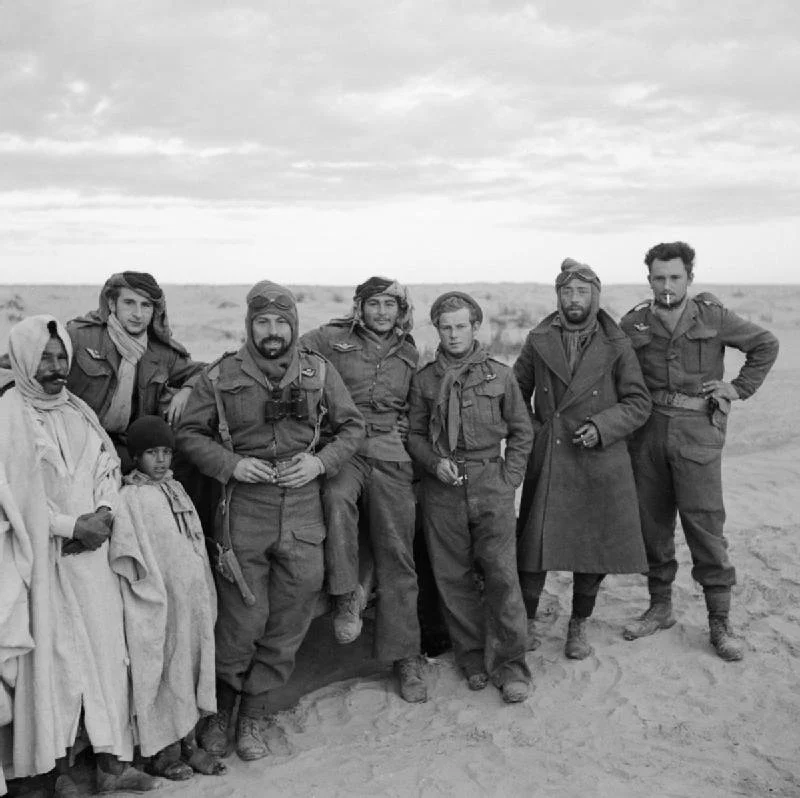
The SAS French Second Squadron in Tunisia, 1943.
Once war broke out in 1939, Mary Jayne Gold donated her plane to the French air force and never saw it again. In the spring of 1940, with Hitler’s blitzkrieg closing in on Paris, Gold was forced to abandon her posh lodgement on the Avenue Foch to join the exodus of panicked refugees heading south by rail, foot, and automobile. En route to Marseilles, she and her dachshund Dagobert were entrusted with the care of the toddler son of close friends.
While fleeing south, Mary Jayne bumped into Miriam Davenport, an American sculptor and painter soon to be hired by Fry to work on emergency relief activities. Davenport recognized that Gold and her deep pockets could be of immense value to the Fry operation. Soon after her arrival in Marseilles, Gold joined Davenport in helping Fry hector Vichy officials and collude with Resistance heads.
Davenport and Gold that August were also conspiring to help three handsome ex-French Foreign Legionnaires whom Miriam had befriended while waiting in line at the U.S. consulate.
Two of the soldiers were onetime American journalists who had enlisted in the Legion to experience a grand adventure and help beat back Hitler and Mussolini. That adventure had included being pummeled by the Nazis in Norway and watching the nightmare repeat itself a few weeks later in France.
The third ex-Legionnaire was the leathery-faced Raymond Couraud, who had lied about his age (he was only 16 when he signed up) to avoid being rubbed out by his rivals in the French mob. Four years later, Couraud had earned a reputation as a kick-ass infantryman, winning plaudits in both Norway and France. Vichy wanted Couraud fighting for the pro-Nazi side; Couraud wanted nothing to do with them.
*
Under Marseilles’ azure sky, the four young Americans and their French-American friend became inseparable, finding plenty of ways to make mischief despite the war. They pretended to ignore the gendarmes tailing them as they bounced from bistro to café and back again.
“It’s a shame there’s a war on, otherwise we’d be having a hell of a time,” they would snigger while quaffing wine and beer at the Pelikan Bar, which had a breathtaking view of the Mediterranean. With Gold paying the freight, there was no shortage of Burgundy, or Rouge Rhône, or frothy brew served in a foot-high flute affectionately known as a “Formidable.”
After midnight, the gang would repair to Gold’s suite at the Continental, where the radio – if the knobs were finetuned just so – could reel in the forbidden BBC and its nightly wrap-up of war news. Britain in those perilous days was hanging by a thread. Each time the wireless crackled, they feared it meant Hitler had launched the cross-Channel assault that would finish off the Brits. Every day that passed without a German invasion brought a sliver of hope that Britain might survive.
The fivesome caused quite a stir as they bustled through the alleyways of Le Vieux-Port, two American femmes, one tiny, one tall, escorted by the three exiles from the FFL. They would babble in French one minute, English the next.
Couraud may have suffered from paranoia (among other mental illnesses), but that didn’t mean that Marseilles’ cops weren’t spying on him and his pals. As Vichy suspected, the ex-Legionnaires and their American enablers were indeed plotting ways to escape the South of France so they could rejoin the Allied fight.
The women were helping them run the traps on buying (or stealing) a boat and sailing it to British-held Gibraltar, or hopping a freighter anchored in Marseilles harbor, or hiking southwest under the cover of darkness and sneaking through a gap in the Pyrenees Mountains into neutral Spain.
Feigning nonchalance, the five of them combed Marseilles’ bookstores and novelty shops for nautical and topographical charts. They hid the maps in Gold’s suite. Sipping Scotch, they would pore over potential escape routes while huddled in front of the radio in those post-midnight BBC sessions.
Without Gold’s cash and bravado – not to mention Couraud’s dodgy connections to the Marseilles underworld – Fry’s Centre Américain de Secours (American Relief Center) would not have been nearly as effective. Gold’s rental of Villa Air-Bel, a decrepit château on a farm outside Marseilles, provided food and shelter to scores of transients and gave Fry a home base to foil Vichy henchmen – at least for a time. In many ways, Couraud and Gold became the “real Rick and Ilsa,” star-crossed lovers caught in a maelstrom but remaining devoted to the Allied cause.
Couraud never stopped being a thug and a gigolo, but he served with distinction in Britain’s two leading cloak-and-dagger outfits: the ultra-secret Special Operations Executive (SOE) and the highly irregular (and misnamed) Special Air Service (SAS). In both capacities, he was repeatedly sent behind Axis lines as a spy, a Resistance partner, and a liberator of Allied prisoners-of-war.
Despite earning commendations at every turn, he was expelled from both units for insubordination. Worse, at war’s end he was court-martialed for dereliction of duty and an abhorrent breach of conduct. The charge was eventually lessened but the episode remains a stain on his record.
*
Raymond William Jacques Couraud, a.k.a. “Captain Jack William Raymond Lee,” was a Zelig-like hero in the underground war against the Nazis. Couraud-Lee and his thick-rimmed specs popped up all over the European and Mediterranean Theaters – usually with a Sten gun and a string of grenades strapped across his shoulders.
Wounded three times, he survived scores of bloody skirmishes on two continents with Wehrmacht and Regio Esercitoregulars, not to mention Gestapo henchmen, Vichy mercenaries, hostile guerillas, and black-market thugs.
Twice captured and imprisoned, he endured beatings at the hands of Fascist policemen in both the South of France and Spain. Five years and two dozen harrowing missions later, he was among the first Allied soldiers to enter Paris in the throes of liberation. After the war, he was not only awarded a number of the United Kingdom’s highest military honors, but King George VI personally conferred on him the British Defence Medal.
Yet Couraud was so lippy and irascible that he was tailed by military gumshoes almost everywhere he went while stationed in England. To this day, Couraud stirs ambivalence among the scholars who study Allied special operations. None question his élan, but some view him as a poseur, others as a grandstander – and a crook and playboy to boot. Couraud’s military personnel file at the British National Archives is full of innuendo about reckless behavior.
His story reads like something concocted in Hollywood, a surreal combination of Sergeant York, Audie Murphy, and Casablanca, plus a healthy dose of Scarface. The son of a wayward Broadway showgirl and a ne’er-do-well French dairyman turned arms merchant, Couraud was deserted by his parents and left to be raised by his paternal grandparents (and eventually, his father’s brother) in a small village in France’s Aquitaine province.
In his early teens, Couraud moved to New York City to live with his mother, Broadway showgirl Flora Lea Bowen. But the boy apparently quarreled with her and her theater-producer husband and was sent packing back to Surgeres. His mother’s rejection left the youngster with emotional scars that lasted a lifetime.
While still in early adolescence he ran away to the Riviera. He soon joined a gang of organized crime ruffians and began smuggling hookers and contraband across the Mediterranean to North Africa. Couraud incensed the Corsican mafia by starting a rival prostitution ring in Cairo; before long, there was a price on the teenager’s head.
To elude his mobster enemies, he lied about his age and joined the French Foreign Legion. Couraud spent two-plus years digging latrines and patrolling restless French colonies in North Africa and the Near East.
In May of ‘40, after Hitler unleashed his stormtroopers against France and the Low Countries, Couraud and other Legionnaires were rushed back from Norway and thrown against the blitzkrieg north of Marseilles. The overwhelmed French army quickly collapsed; Couraud, hellbent on not being conscripted by Vichy, deserted the FFL and went into hiding in Marseilles.
With Gold’s help, he escaped to Spain, where he was arrested and confined. After gaining his release, he made his way to Gibraltar and eventually to England, where he joined Britain’s Special Operations Executive. He went on a number of early SOE missions to buoy French Resistance cells but got into hot water thanks to his intemperate attitude.
Lord Louis Mountebatten, a senior officer in the Royal Navy, invited Couraud to participate in the March ’42 raid on the Nazis’ naval repair base at Saint-Nazaire on the French Atlantic coast. Couraud, the only Frenchman on the mission, was wounded in both legs and dragged onto a retreating British ship. He spent months recovering in a Falmouth hospital.
*
By January of ’43, SOE had tired of Couraud, transferring him to the newly formed 62nd Commando unit, which was soon folded into the Second Regiment of Colonel David Stirling’s Special Air Service (SAS) Regiment.
SAS’s mission was to make life miserable, by any means necessary, for enemy combatants, which at that point in the war meant the Mediterranean Theater. Its Second Regiment was a small-scale raiding force that spent the next 14 months bushwhacking Axis soldiers from Sardinia to Tunisia.
Sometimes, Couraud and his SAS men parachuted behind Axis lines; at other times they flummoxed the enemy by using jeeps or attacking from the sea via rafts launched from submarines. SAS’s target was often an enemy airstrip or naval port; other missions blew up rail tracks or big fuel depots.
SAS was so successful that it soon tripled in size. A new French SAS Second Squadron was formed, with Captain Lee/Couraud in command and other former Legionnaires assigned to key capacities. On at least 17 occasions, Couraud and his men were dispatched behind enemy lines.
In May of 1943, Couraud took advantage of the Churchill Act and became a U.K. citizen, albeit situated 1,300 miles from Piccadilly. Four months later, his Second Squadron provided crucial reconnaissance in Operation SLAPSTICK, the British Eighth Army’s assault on Taranto. Attacking in jeeps that had been deposited on a nearby beach, Couraud and his men blew up roads, bridges, and airdromes, liberating hundreds of Allied prisoners and stealing tons of supplies.
During a night-time amphibious raid on Italy’s Adriatic coast in mid-September, enemy artillery destroyed Couraud’s landing craft, killing several commandos. Couraud was wounded in both shoulders and hospitalized, but only for a few days. Two weeks later, he helped lead a stunning assault on Camp 59, a POW compound outside Termoli. Scores of Allied officers were freed, sparing them from the Axis machine gun squads stalking the Italian countryside.
In early October, Couraud’s commandos ambushed a German convoy near Chieti, then shielded the leading edge of General Bernard Montgomery’s host as it approached the River Sangro. Amid these audacious missions, Couraud hatched a plan to steal gold bullion from the Bank of Italy branch in Chieti. Fortunately for the Allies, Couraud’s crooked scheme was rebuffed by an SAS superior.
In late winter 1944, most of the Second Squadron was ordered back to the U.K. to prepare for special ops missions related to the cross-Channel invasion. When Churchill, Montgomery, and the Allied high command approved the formation of an elite squad to be deployed against Field Marshall Erwin Rommel, the head of German forces in Normandy, the SAS put Couraud in charge.
Couraud headed a seven-man unit that spent weeks training in Scotland and England for what became Operation GAFF, a hush-hush maneuver to kidnap or kill Rommel in the aftermath of the invasion.
Like many of the war’s covert operations, GAFF got its title from Churchill; the Prime Minister loved to give his favorite special ops colorful codenames. A “gaff” is an outsized hook; in Churchill’s youth, it was also the term for the backstage vaudeville device used to abruptly remove an unpopular entertainer.
For most of the next half-century, GAFF remained a closely guarded secret. It wasn’t fully divulged until decades after the war when long-suppressed SAS intelligence files were released by the British National Archives.
It’s clear from the files that GAFF’s hoped-for object was to capture Rommel alive and bring him back to Britain. Not only would kidnapping Rommel provide the Allies with a propaganda coup, but his presence would have served a larger purpose. Allied intelligence may well have hoped that Rommel could be positioned as the leader of a “new” Germany in the event of Hitler’s demise. Rommel was a beloved figure in the Fatherland; he was perhaps the one German general who could have persuaded his countrymen to lay down their arms.
British and American intelligence had known for months that Wehrmacht officers (among them Rommel’s chief of staff, General Hans von Spiedel), together with civilian members of the German Resistance, were plotting to kill Hitler. Couraud’s team was scheduled to drop not far from Chateau La Roche Guyon along the Seine, the site of Rommel’s headquarters, on July 18, 1944, two days before the attempt on Hitler’s life was carried out at Wolf’s Lair in East Prussia.
Bad weather, however, appears to have delayed GAFF’s jump-off for a week, although chronological accounts of the mission differ. By one reckoning, some 72 hours after parachuting into a wooded area north of Orleans, Couraud and his men learned from Resistance sources that Rommel had been severely wounded on July 17 by a British fighter plane that had strafed his staff car. By late July, Rommel was back in Germany, recovering in a hospital and awaiting Der Fuhrer’sinevitable revenge, which came that fall in a visit from the Gestapo. The field marshal who once exercised “hypnotic” control over Hitler was forced to swallow a cyanide capsule for his complicity in the assassination plot.
Once Allied intelligence confirmed that Rommel had been removed from France, GAFF was scrubbed, which is puzzling. If GAFF’s goal was to remove the enemy commander in Normandy, why not pursue Rommel’s successor, Field Marshal Gunther von Kluge? Von Kluge was from a distinguished Prussian family and had, like Rommel, been awarded an Iron Cross in the Great War. His 1940 exploits in Poland and France were almost as admired as Rommel’s legerdemain in North Africa. Surely, kidnapping or killing von Kluge would have represented a significant feat for the Allies. The high command’s decision not to go after von Kluge suggests that a different agenda had been in the offing.
Couraud and his men put their time behind enemy lines to destructive use. They ambushed two trains and seven trucks and harassed German units scrambling to contain General Omar Bradley’s Operation COBRA, the Allied breakout from hedgerow country. Captain Lee also led a wild nighttime assault on a German intelligence and police command post at Mantes-la-Jolie that inflicted a dozen fatalities, paved the way for Canadian troops to capture the village, and yielded a cache of important papers on German troop deployments in northern France.
Wearing a pilfered uniform, Couraud disguised himself as a gendarme and maneuvered on foot through enemy lines to Pontchartrain, reaching General George S. Patton’s U.S. Third Army on August 12. After sharing information seized at Mantes-la-Jolie, Couraud stayed with the Third Army for several days, plotting with local Resistance leaders and providing Patton’s staff with intelligence on German strongholds.
He then pulled the stunt that eventually got him court-martialed. Without obtaining permission, he helped Alfred Kraus, the son-in-law of a prominent British socialite and a double agent with ominously close ties to the Gestapo, escape from France to England. The day after Couraud and Kraus’ plane arrived in the U.K. amid much teeth-gnashing from British intelligence, Couraud was ordered back to France to help spearhead SAS’ Operations WALLACE and HARDY, a series of ballsy hit-and-run raids – plus one pitched battle at Chȃtillon – that hobbled the retreating Wehrmacht.
Under the overall command of famed SAS Colonel Roy Farran, the men and their machine gun-mounted jeeps crash-landed into northern France. Farran split the group in two. Couraud’s contingent wreaked havoc around Orleans; Farran’s team spread chaos 120 miles west near Rennes. Between them, they wrecked two dozen enemy staff cars and three dozen trucks, half-tracks, and troop carriers, destroyed tens of thousands of barrels of petrol, derailed a passel of trains, and inflicted more than 500 casualties.
Farran’s group eventually met up with Couraud’s near the village of Langres, 200 miles southeast of Paris, from which they launched one lethal raid after another. Couraud was held in such high esteem by his fellow Frenchmen that in late August he was given an exalted position in the liberation of Paris, near the tip of the French armored advance. He wrote to Mary Jayne that he found her old apartment on the Avenue Foch, went inside, and spent time reminiscing about their romance as La Libération raged outside. Following his court-martial that fall, he was dismissed from the British Army, whereupon he joined the French Army General Staff.
After the war, Couraud continued his martial (and often malicious) ways, running guns in some of the world’s hotter spots, advising the French army as it struggled to quell uprisings in Algeria and other colonies, and serving as military consigliere to a rajah on the Indian subcontinent.
At some point, he separated from Katherine Davies, his well-connected British wife, to marry a Frenchwoman named Hélène Louise Nancy Debono. She was the surgeon who had patched him up after he was wounded in the Termoli raid. Alas, it does not appear that Couraud obtained a divorce before his second nuptials, so “bigamist” can be added to the disquieting credentials in his bio.
After fathering two sons with Debono, he apparently left her late in life to return to Davies. He spent his twilight years with Davies, shuttling between Surgeres, his family’s ancestral village in the southwest of France, and Cornwall in the southwest of England. One of his sons, also named Raymond Couraud, is a World War II historian of note who’s written extensively about D-Day. Couraud junior now describes his father as a man of mystery, a schemer who deliberately built layers of intrigue and deceit around almost everything he did in life.
Couraud died in 1977, 35 years after being dragged off the Nazis’ Saint-Nazaire naval base with wounds to both legs. He is buried in a small cemetery in Vouhé, not far from his hometown. His gravestone lauds his bravery as a soldier and his loving heart.
The only book written about Couraud was done by an Italian historian named Silvio Tasselli. His Captain Lee, which focuses on the Mediterranean exploits of the SAS French Second Squadron, was privately published and has sold only a handful of copies in the U.S. and Britain. A French historian has written an account of the SAS’s Second Squadron that’s also difficult to find. Moreover, most SAS histories, including Ben McIntyre’s popular Rogue Heroes, do not give Couraud-Lee his due.
Although Killer’s role in the Marseilles Resistance was highlighted in memoirs written by Gold, Davenport, and Fry, and acknowledged in more recent accounts of the Fry cell’s heroics, Couraud remains an enigmatic and divisive figure.
After the war, Couraud and Gold had reunions in the South of France and Quebec, but it’s not known if the romance was rekindled – or if Couraud owned up to the fact that he was married, perhaps twice over. A French filmmaker has tried to turn Gold’s memoir, Crossroads Marseilles 1940, into a film, but to date the project has not gotten off the ground. Gold’s book, edited at Doubleday by Jacqueline Kennedy Onassis, proved far more popular in France than the U.S. A 2023 Netflix series called Transatlantic was loosely based on Mary Jayne’s story, but it eliminated the Davenport character and distorted the Couraud character.
After the war, Davenport ended up accompanying her college professor husband to Iowa, where she taught French and art. Couraud, for his part, could never get out of his own shadow. He was jailed at least twice after the war, for stealing jewels and art. In the postwar years, Mary Jayne bought a chalet in the South of France with a garden that looked like a Cezanne watercolor. She spent most her time there with occasional trips to New York and Chicago.
Gold told interviewers late in life that the nefarious “Killer” was the only man she ever truly loved. Their coupling was anaffaire de guerre, a yen for danger and passion that animated her entire life. Her father would have approved.
Did you find that piece interesting? If so, join us for free by clicking here.
About the Author
Timothy M. Gay is the author of two critically acclaimed books on World War II: Assignment to Hell: The War Against Nazi Germany with Correspondents Walter Cronkite, Andy Rooney, A.J. Liebling, Homer Bigart, and Hal Boyle(NAL/Penguin, 2012) and Savage Will: The Daring Escape of Americans Trapped Behind Nazi Lines (NAL/Penguin, 2013). Tom Brokaw called Assignment to Hell, which was nominated for a Pulitzer, a Bancroft, and an American Book Award, “a book every modern journalist – and citizen – should read.” Historian Marcus Brotherton wrote that Savage Will was “powerful, intriguing, well-researched, and fierce.”
Gay’s lengthy article on the citizen response to the Nazi U-boat threat in U.S. waters early in WWII was featured in a pandemic-inspired special issue of American Heritage called “America in Crisis.”
He has been featured on PBS’ “History Detectives” and contributed on-camera and off- to two documentaries – one on Walter Cronkite’s coverage of the Kennedy assassination, the other on Lyndon Johnson’s legacy on civil rights – which have appeared in Britain and the U.S.
His latest book is RORY LAND, a biography of golf superstar Rory McIlroy. It looks at McIlroy’s life through the prism of Ireland’s sectarian Troubles that devastated both sides of his family.
Endnotes
“Some bastard weaseled on him!” and the other references to the circumstances surrounding Couraud’s arrest comes from Gold’s memoir, Crossroads Marseilles 1940, pp. 124-140.
Information on Varian Fry’s Scarlet Pimpernel operation comes from Crossroads, other books on the Marseilles-based rescue efforts, including A Hero of Our Own, Villa Air-Bel, and A Quiet American: The Secret War of Varian Fry, and Miriam Davenport’s unpublished memoir, An Unsentimental Education, housed online at the Chambon Foundation.
The account of Gold’s visit to the Marseilles jail where Couraud was being held comes from Crossroads, pp. 132-140.
The information on Mary Jayne Gold’s background comes from a variety of sources, including the early chapters of Crossroads, Oh, You Must Not Peek Under My Sunbonnet, Gold’s unpublished memoir housed (in part) online at the Chambon Foundation, and the obituaries that appeared in the New York Times and other news outlets upon Ms. Gold’s passing in October 1997.
Information on Gold’s Percival Vega Gull monoplane comes from the “This Day in Aviation” website, September 4, 2020.
Information on the ancestral background of the Gold family comes from Who’s Who in Chicago, provided online by Chicago History.
The Chicago Daily Tribune articles on the Egbert Gold-“Mother” Lyons scandal in May of 1901 and again in January 1914, were provided online by Chicago History.
Edgar Lee Masters’ free-verse poem Spoon River Anthology and Carl Sandburg’s poem Chicago can be found online via the Poetry Foundation.
The information on Ms. Gold’s aviation exploits can be found in the early chapters of Crossroads and her obituaries. The contemporaneous Chicago Daily Tribune regularly reported on her races.
Information on the French Foreign Legion experiences of Couraud and his American mates comes from Crossroads, Silvio Tasselli’s Captain Lee (“Captain Lee” was Couraud’s British Army pseudonym), and various online Special Operations Executive and Special Air Service resources, plus declassified files at the British National Archives at Kew Gardens, London.
The stories about the Gold-Davenport-Couraud experiences in Marseilles come from Crossroads and the ladies’ unpublished memoirs housed at the Chambon Foundation.
Information on Villa Air-Bel comes from Villa Air-Bel, Crossroads, and the other books about the Fry operation.
Information on Couraud’s war heroics comes from Crossroads, Captain Lee, various online SOE and SAS sources, and declassified files at Kew Gardens.
Information on Gold and Couraud’s postwar friendship comes from Crossroads and Villa Air-Bel.