The dynastic struggle that would later erupt into the Wars of the Roses did not emerge suddenly in the mid–fifteenth century. Its roots lay decades earlier in the complicated aftermath of the reign of Edward III, one of England's most powerful medieval kings. When Edward died in 1377 after a reign of fifty years, he left behind a formidable legacy of military victories and royal prestige. Yet beneath the apparent strength of the monarchy lay a dangerous problem: a tangled web of royal descendants whose competing claims to the throne would gradually destabilize the kingdom. The seeds of civil war had already been planted within the royal family itself, and over the following generations, those seeds would steadily grow into one of the most destructive internal conflicts in English history.

Terry Bailey explains.
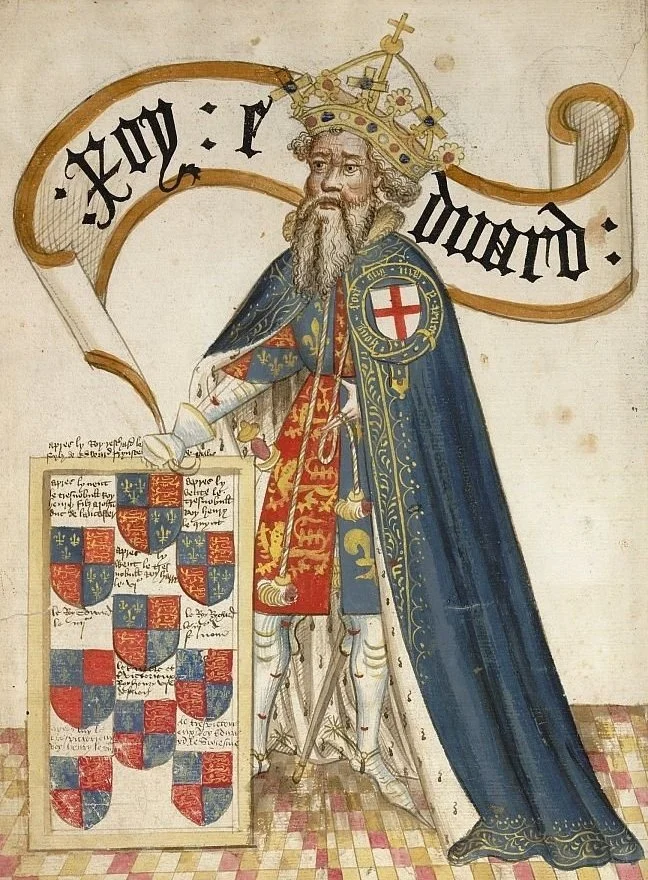
An 15th century depiction of Edward III of England. From the Bruges Garter Book made by William Bruges (1375–1450), first Garter King of Arms, British Library, Stowe 594 ff. 7v.

Edward III had fathered several sons who survived into adulthood, each of whom founded powerful branches of the royal lineage. In the medieval system of dynastic succession, such an abundance of heirs could appear to strengthen a monarchy, yet it could just as easily generate rival claims. The king's eldest son, Edward the Black Prince, was widely admired as one of the greatest military commanders of his age. During the early campaigns of the Hundred Years' War against France, the Black Prince gained fame for his leadership and battlefield skill, particularly in victories such as the Battle of Poitiers. He appeared destined to succeed his father and continue England's military dominance on the continent. Fate, however, intervened. The Black Prince died in 1376 after a long illness, a year before Edward III himself passed away.

The death of the heir apparent created an immediate problem of succession. The Black Prince left behind only one legitimate son, the young Richard II. When Edward III died the following year, the crown therefore passed not to an experienced adult prince but to a ten-year-old boy. Although medieval monarchies were accustomed to child rulers, such circumstances almost always created opportunities for political rivalries to flourish. A king who was too young to rule independently depended upon advisers and regents, and those who surrounded him inevitably competed for influence.

The early years of Richard II's reign were therefore dominated by powerful relatives and leading nobles who sought to guide royal policy. Among the most influential figures was John of Gaunt, Duke of Lancaster, Edward III's third surviving son. Gaunt possessed enormous wealth, extensive estates, and vast political influence throughout the kingdom. The lands and titles associated with the Duchy of Lancaster gave him resources that rivalled those of the crown itself. As a result, the Lancastrian branch of the royal family emerged as one of the most powerful political forces in England.

Another of Edward III's surviving sons was Edmund of Langley, Duke of York. Though less politically dominant than his brother John of Gaunt, Edmund's descendants would later form the basis of the Yorkist claim to the throne. At the time, however, these various branches of the royal family coexisted uneasily within the aristocratic structure of England. The stability of the realm depended heavily on the king's ability to balance the interests of these powerful houses. A strong monarch could maintain harmony; a weak one risked allowing rivalry to flourish.

Richard II struggled to command the authority necessary to maintain such a balance. Although he displayed intelligence and a sense of royal dignity, he often proved politically inflexible and suspicious of the great magnates whose support he required. His reign became increasingly characterized by factionalism and mistrust. Early in his rule England experienced a major social upheaval in the form of the Peasants' Revolt of 1381. This uprising, one of the most dramatic popular revolts in medieval Europe, was fueled by widespread resentment over taxation and economic hardship in the aftermath of the Black Death.

The revolt brought thousands of rebels marching toward London, demanding relief from oppressive taxes and the abolition of certain feudal obligations. Though still a boy, Richard II confronted the rebels personally in an attempt to defuse the crisis. The revolt was eventually suppressed, but the event left a lasting impression on the young king and revealed how fragile social and political stability could be during times of economic strain. England's ruling elite became increasingly aware that the kingdom faced internal pressures that could erupt unexpectedly.

As Richard matured, his style of governance became more assertive and increasingly controversial. Determined to strengthen royal authority, he relied heavily on a small circle of trusted favorites while punishing opponents with severity. This approach alienated many influential nobles who believed their traditional rights and privileges were being ignored. Over time, the king's court became associated with factional intrigue and personal rivalries rather than broad political consensus.

One of the most significant figures drawn into this growing conflict was Henry Bolingbroke, the son of John of Gaunt. Bolingbroke was a capable and respected nobleman who had cultivated strong support among England's aristocracy. In 1398 he became embroiled in a dispute with another prominent lord, leading Richard II to intervene by exiling both men from the kingdom. The situation worsened dramatically the following year when John of Gaunt died. Instead of allowing Bolingbroke to inherit the vast Lancastrian estates, Richard confiscated them for the crown.

This decision proved to be a fatal miscalculation. By denying Bolingbroke his inheritance, Richard effectively transformed a political rival into a determined enemy.

In 1399 Bolingbroke returned to England while Richard was campaigning in Ireland. Initially, he claimed that his goal was simply to recover his rightful lands, yet discontent with the king's rule had become widespread among the nobility. As Bolingbroke advanced through the country, support for his cause rapidly grew.

The political situation quickly escalated into a full-scale revolution. Richard II found himself abandoned by many of his supporters and was eventually captured. Forced to abdicate the throne, he was imprisoned and later died under mysterious circumstances. Bolingbroke then claimed the crown and was crowned as Henry IV, inaugurating the Lancastrian dynasty.

The deposition of Richard II marked a profound turning point in English constitutional history. For centuries the legitimacy of kingship had been based on hereditary succession. By removing the reigning monarch and replacing him with another claimant, the nobility had demonstrated that the crown could be transferred through political force. Although Henry IV justified his claim by emphasizing his descent from Edward III, his hereditary right was not the strongest available within the royal family.

Indeed, another line of descent from Edward III provided the foundation for a potentially stronger claim. Through the descendants of the king's second surviving son, Lionel of Antwerp, later Yorkist supporters could argue that their lineage represented the senior branch of the royal family. Although this issue did not immediately provoke conflict, it created an unresolved question of legitimacy that would later resurface with dramatic consequences.

Henry IV's reign was therefore far from secure. Throughout his rule, he faced rebellions, conspiracies, and political instability. Noble families who had supported his rise to power expected rewards and influence, while others remained loyal to the memory of Richard II. Maintaining authority required constant vigilance and careful political management. Though the Lancastrian dynasty survived these early challenges, it did so in an atmosphere of uncertainty.

The broader political climate of the early fifteenth century further complicated the situation. England remained deeply involved in the long and costly Hundred Years' War against France. Maintaining armies overseas and defending English territories required vast financial resources. Heavy taxation placed increasing strain on the population, while military setbacks undermined confidence in royal leadership.

For a brief moment, however, the Lancastrian monarchy appeared to regain its prestige. Henry IV's son, Henry V, proved to be a charismatic and formidable warrior king. His dramatic victory at the Battle of Agincourt in 1415 revived English fortunes and restored a sense of national pride. Henry's campaigns in France brought new territorial gains and renewed confidence in the Lancastrian regime.

Yet this revival proved short-lived. Henry V died unexpectedly in 1422 at the height of his success, leaving the throne to his infant son, Henry VI. Once again England faced the political complications of a child king. A prolonged minority government placed power in the hands of competing factions among the nobility, each seeking influence over the young monarch.

As Henry VI grew to adulthood, it became increasingly clear that he lacked the political strength and military ability of his father and grandfather. Gentle and deeply religious by nature, he struggled to command authority over the powerful nobles who dominated English politics. At the same time, England's position in France began to collapse. During the final phases of the Hundred Years' War, French forces gradually recaptured most of the territories England had once controlled.

The loss of these lands dealt a severe blow to the prestige of the monarchy. Military failure abroad undermined confidence in royal leadership at home. Many noble families who had once profited from warfare in France found their opportunities disappearing, while the financial burden of past campaigns continued to weigh heavily on the kingdom. Discontent within the aristocracy steadily increased.

Within this unstable environment, alternative claims to the throne began to attract greater attention. Among the most prominent figures was Richard, Duke of York. Through his descent from multiple lines of Edward III's family, York possessed a powerful hereditary claim that rivalled—and in some interpretations exceeded—that of the Lancastrian kings. Combined with his considerable wealth and influence, this lineage placed him at the center of a growing political opposition.

By the mid-fifteenth century, England had become a kingdom strained by weak kingship, economic hardship, and unresolved questions of dynastic legitimacy. The precedent set by the overthrow of Richard II had demonstrated that a king could be removed if powerful nobles united against him. Meanwhile, the decline of English fortunes in France eroded the authority of the Lancastrian dynasty.

Thus the conditions for civil war were already firmly in place. What began as a complicated issue of royal inheritance gradually evolved into a bitter political rivalry between two powerful branches of the royal family. The Houses of Lancaster and York, later symbolized by their rival red and white roses, would soon plunge England into a prolonged struggle for control of the throne. In the decades ahead, battles, betrayals, and shifting alliances would reshape the English monarchy and leave an enduring mark on the nation's history.

Therefore, the Wars of the Roses were not the product of sudden ambition or isolated acts of rebellion, but the culmination of long-developing structural weaknesses within the English monarchy. The reign of Edward III, for all its outward strength and prestige, had unintentionally created a dynastic landscape crowded with competing lines of succession. This abundance of royal heirs, which might have ensured continuity under a strong ruler, instead became a source of instability when authority faltered. The premature deaths of key figures and the repeated accession of child kings—most notably Richard II and later Henry VI—further weakened the crown's ability to manage powerful nobles whose ambitions increasingly outpaced their loyalty.

The deposition of Richard II by Henry IV proved to be a decisive constitutional rupture. In overturning the principle of unquestioned hereditary succession, it introduced a dangerous precedent: that kingship could be claimed and justified through force as much as by lineage. From that moment onward, legitimacy became contested ground, open to interpretation and, crucially, to challenge. The rival claims descending from Lionel of Antwerp and John of Gaunt lingered unresolved, quietly hardening into ideological fault lines within the nobility.

Compounding these dynastic tensions were the broader pressures bearing down on the kingdom. The economic aftershocks of the Black Death, the social volatility exposed by the Peasants' Revolt, and the immense financial strain of the Hundred Years' War all contributed to a climate of uncertainty and discontent. Military decline in France, particularly during the reign of Henry VI, eroded confidence in Lancastrian rule, while simultaneously depriving the nobility of the wealth and purpose that foreign campaigns had once provided.

By the mid-fifteenth century, England stood on a knife-edge. The monarchy, no longer an unassailable institution, depended heavily on the fragile balance of noble support. Into this volatile environment stepped Richard, Duke of York, whose formidable lineage and political influence offered a credible alternative to Lancastrian authority. What had begun as a question of inheritance had evolved into a struggle for power, legitimacy, and survival between two rival houses.

Thus, the outbreak of the Wars of the Roses was less an abrupt descent into chaos than the inevitable consequence of decades of accumulating tension. Dynastic ambiguity, political miscalculation, and social strain converged to produce a conflict that would engulf the English nobility and redefine the monarchy itself. In this sense, the wars were not merely fought over the crown—they were born from the very foundations upon which that crown had come to rest.


The site has been offering a wide variety of high-quality, free history content since 2012. If you’d like to say ‘thank you’ and help us with site running costs, please consider donating here.

Good Queen Anne or Anne of Bohemia (1366-1394) was Queen of England from 1382-1394 as the wife of King Richard II of England (1367-1400; king from 1377-1399). Here, we tell you about Anne’s life, the many good deeds she did, the positive influence she had on Richard, and how both she and Richard II died.

Anne of Bohemia as seen on the Liber Regalis.

Anne of Bohemia as seen on the Liber Regalis.

The background to Anne’s arrival

Anne was born May 11, 1366 in Prague, Bohemia (now the Czech Republic) as the eldest daughter to Charles IV, Holy Roman Emperor and King of Bohemia, and Elizabeth of Pomerania. Charles IV was the most powerful monarch in Europe at the time and ruled over half of Europe’s population and territory. The majority of her childhood was spent at the Hradschin Palace, today known as Prague Castle, in the recently renovated and flourishing city of Prague. Anne was given an extraordinary education and could speak several languages. Her love of reading was greatly noted as she possessed the Scriptures in three languages, her favorites being the four Gospels, which she constantly studied.

In 1377, King Edward III of England died in the fiftieth year of his reign. Since his eldest son, Edward, Prince of Wales (the Black Prince) had died the previous year, the elderly king was succeeded by his grandson King Richard II who was ten years old at the time. Conflicts were already brewing in the early years of his reign which included England beginning to lose the Hundred Years’ War with France, border clashes with Scotland, and economic strains brought on by the Black Death thirty years prior. Following the Peasants’ Revolt in 1381, pressures were made to find the now 15-year old Richard a suitable bride.

Three years earlier, a split was formed within the Roman Catholic Church when two men claimed the papal throne, the elected Urban VI and his rival Clement VII. Anne of Bohemia seemed the most strategic choice for the sitting pope, Urban VI, as Bohemia and the Holy Roman Empire could be potential allies against France which backed Clement VII as the true pope. King Wesceslaus of Bohemia, Anne’s brother, enthusiastically embraced the marriage proposal between his sister and the King of England. The marriage was not popular among the English nobility and members of parliament as Anne brought no dowry and few diplomatic benefits while King Richard gave Wenceslaus 20,000 florins (4,000,000 pounds in today’s value). Sir Simon Burley, King Richard’s tutor, traveled with the Earl of Suffolk to negotiate the marriage with King Wenceslas in place of her late father and by 1381, the negotiations were settled.


Anne to England

Anne voyaged to England, bringing a mass of ladies-in-waiting and gentlemen. She was stumped at Brussels on the way as the French had schemed to kidnap Anne and her uncle, the Duke of Brabant, who managed to confer with the French king. Charles VI, King of France, recalled his armed vessels, citing his love for his cousin, Anne, and not for the English king. She then sailed to Calais, then Dover, where she was received by the English king’s uncle, John of Gaunt. Upon her arrival, Anne was harshly critiqued by contemporary chroniclers, possibly as a result of the financial arrangements of the marriage. The Westminster Chronicler remarked that she was “a tiny scrap of humanity.” A Benedictine monk, Thomas Walsingham, pointed out a disastrous omen upon her arrival when her ships were smashed to pieces by a violent storm as soon as she disembarked. Anne spent the Christmas season at Leeds Castle before journeying to Westminster where she was greeted with magnificent displays and her future husband at last.

However, as Anne and Richard proceeded through the streets, the crowds ripped the royal arms apart which had been crossed with the imperial arms and mounted on a fountain in her honor. The Bohemian princess was not welcome among the people of England on her arrival.

Nevertheless, Anne and Richard II were married in Westminster Abbey on January 20, 1382, the fifth royal wedding in Westminster Abbey and the last for the next 537 years. She was sixteen years old, Richard a year younger. The exact date of their wedding is still debated. Anne was crowned Queen of England two days later. Despite their tender age, the relationship between these “two wispy teenagers” developed into more than just a political alliance. The king seemed delighted with his bride and paid her every attention. After a week of festivities and tournaments at Westminster in celebration of their marriage, the young couple travelled by river to Windsor Castle accompanied by King Richard’s mother, Joan, Princess of Wales.

King Richard II of England.

King Richard II of England.

Growing popularity

Initially resented, Anne earned the love and popularity of England over the years. She was gentle and kind in nature, wielding considerable influence over her husband by interceding on behalf of others who displeased him. Examples include acquiring pardons for the Peasant’s Revolt culprits on the occasion of her coronation and begging on her knees for three hours before her husband and his political opponents for the life of Sir Simon Burley, the king’s own tutor, to be spared. He didn’t grant her wish this time but Burley was spared the gruesome traitor’s death.

In 1392, Richard requested a loan from the City of London which the city refused as they were already suffering from food shortages and plague. Angered, the king had the mayor and sheriffs arrested, revoked some of the city’s privileges, and named his own wardens. To add to the stacking penalties, he fined London one hundred thousand pounds. The Londoners submitted. Once again, Anne intervened and begged on her knees for Richard to forgive them at Windsor and Nottingham. The royal couple entered the city to Westminster Hall where Anne begged on her knees for the city’s behalf in a public ceremony. Richard raised her from her knees and seated her next to him before assuring the city officials of their renewed favor, pardoning them in September.

An often overlooked action of Anne’s reign was her protection for the religious reformer John Wycliffe against prosecution and potential death. With her encouragement, Bohemian students traveled to Oxford to study under Wycliffe. As a result, many writings and teachings of Wycliffe were carried back to Prague, Bohemia and throughout central Europe.

The Queen contributed to her new home country in the fashion sense too. She introduced the Polish long-pointed shoes called Cracows. Anne is also credited with introducing a head-dress for ladies known as the horned cap which were two feet high, two feet wide, arranged on a frame of wire and pasteboard, and covered with gold-speckled muslin or gauze. Before her groundbreaking introduction of pins which were produced in Germany for some time, gowns were fastened by tiny skewers consisting of ivory or wood. The queen also accompanied her husband on horseback all over the country. In this age, women rode seated sideways on a cushion behind the male rider’s saddle until Anne was said to have brought in sidesaddles, seats made of wood strapped to the horse’s back with a pommel for gripping, and a wooden plank that was wide enough to accommodate both feet and hung along the left side of the animal.


True love

Richard and Anne grew to love each other deeply. Richard was devoted to his wife and rarely left her side. In a letter to his mother-in-law, Elizabeth of Pomerania, he refers to her as “mater nostra carissima” which loosely translates to ‘mother of my beloved.’ They travelled together everywhere including to a 1383 pilgrimage to the shrine of Walsingham which may have been an attempt at seeking divine intervention for their childlessness. Despite no children being produced during their twelve year marriage, Anne did not become a discarded wife and the lack of illegitimate children shows he did not take any mistresses. At least one biographer theorized that their marriage was childless because it was chaste, due to Richard’s admiration for Edward the Confessor, though Richard strongly expressed a sense of lineage. Ultimately, both were still young so the king must have believed there was still hope for a future heir.

King Richard was infamous for his fierce temper and lack of forethought. The queen rarely wielded political influence but encouraged him to curb his temper and think before reacting rashly, even helping him through his severe depression. After the 1386 death of his mother, his wife became his sole and trustworthy confidant though he continued to favor some nobles.


Death

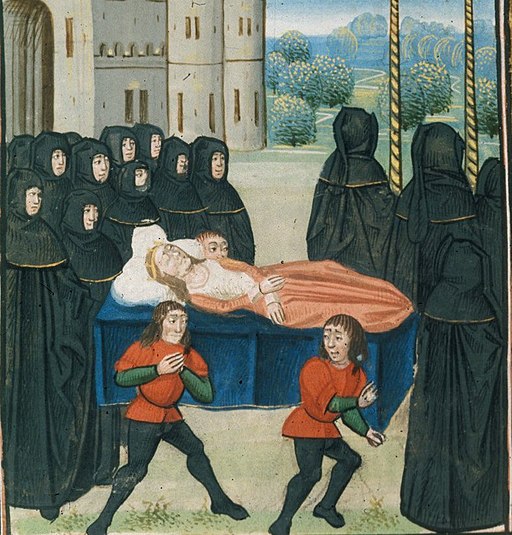
In 1394, the plague struck and Queen Anne fell seriously ill. She died on June 7, 1394 at Sheen Palace. She was just 28 years old. The king was preparing an expedition to quell a rebellion in Ireland when she fell ill. He rushed to her side and was with her when she died. He was described as “wild with grief” and inconsolable, ordering Sheen Palace to be demolished. Richard summoned all the barons and nobles of England to her expensive and lavish funeral that would take two months to prepare. Extra wax torches were ordered from Flanders. The nobles and their wives were expected to arrive the day before and escort the body from Sheen to Westminster Abbey. On August 3, her body was carried from Sheen to Old St. Paul’s Cathedral to Westminster Abbey. Archbishop Arundel conducted her funeral service and praised her commitment to pious reading.

An embarrassing incident occurred during the funeral when Richard Fitzalan, Earl of Arundel, was not present for the procession and then, arriving late at the abbey, tactlessly asked the King’s permission to leave early on urgent business. Enraged, King Richard drew his sword and struck the Earl’s head so violently that he fell dizzily to the ground before ordering him to the Tower. He was released a week later.

Anne’s funeral.

Anne’s funeral.

Richard after Anne

Richard’s biographer, Nigel Saul, states that even the year after Anne’s death, the widowed king refused to go into any room she had been in. In 1395, Richard commissioned lifelike tombs for himself and Anne with their right hands joined and both holding scepters in their left hands. For matters of state, Richard married Isabella of Valois, daughter of Charles VI of France, two years after Anne’s death. She was only six years old at the time and it would be several years before their marriage was to be consummated, thus giving the King more time to overcome his grief for Anne. Despite her age, Richard was fond of her, showering her with gifts and visiting her often. Accounts report that she mourned deeply for him after his death.

The last two years of Richard’s reign were chronicled as a period of tyranny with levied forced loans, arbitrary arrests, and murdering of the king’s rivals. Historians debate whether Richard was suffering from mental illness during this time. Richard’s friends quickly deserted him. If Anne lived, would her pious and gentle influence over her husband have made a difference? The answer is simply no; Richard had very definitive ideals of kingship and his own reign that made him increasingly unpopular.

In 1399, Richard’s first cousin and childhood playmate, Henry Bolingbroke gained enough power and support to declare himself Henry IV of England and deposed Richard, citing his incompetence and tyranny as being unworthy to rule. Richard is thought to have starved to death in captivity at the Tower of London around February 14, 1400. Henry did not honor Richard’s wishes to be buried by his beloved late wife.

Henry IV’s son, Henry V, in an effort to atone for Richard’s dishonorable death and to silence persistent rumors of Richard’s survival, as well as possibly recognizing the tender love between Richard and Anne, moved Richard’s body to Westminster Abbey beside her where they remain today.

While their tomb has been subsequently damaged over time, its effigy initially showed the couple clasping hands, inseparable in death as they were in life.


What do you think of Good Queen Anne? Let us know below.


Sources

Abernethy, Susan. “Anne of Bohemia, Queen of England.” The Freelance History Writer, 7 June 2017, thefreelancehistorywriter.com/2014/10/03/anne-of-bohemia-queen-of-england/.

“Anne of Bohemia - Good Queen Anne.” History of Royal Women, 4 Feb. 2018, www.historyofroyalwomen.com/anne-of-bohemia/anne-bohemia-good-queen-anne/.

“Anne of Bohemia.” Henry VI, www.englishmonarchs.co.uk/plantagenet_61.html.

Brown, Rebecca Starr. “The Wedding of Richard II & Anne of Bohemia.” RebeccaStarrBrown.com, 27 Sept. 2017, rebeccastarrbrown.com/2017/01/14/january-14-the-wedding-of-richard-ii-anne-of-bohemia/.

Davison, Anita. “A Royal Love Story-Richard II and Anne of Bohemia.” Political Meaning in 18th Century Nursery Rhymes (Part Two), 5 Aug. 2012, englishhistoryauthors.blogspot.com/2012/08/a-royal-love-story-richard-ii-and-anne.html.

Eckford, Teresa. “Richard II and Anne of Bohemia.” To Be Noble in Italy: Outward Displays of Grandeur as a Means of Class Identification, www.triviumpublishing.com/articles/richard_ii_anne_bohemia.html.

Posted
AuthorGeorge Levrier-Jones
CategoriesBlog Post

What comes to mind when the ‘Dark Ages’ is mentioned? Religious conflict? Anti-science sentiment among the illiterate and uneducated? Noble knights conquering on horseback amid plagues and unsanitary cities? In contrast, the Middle Ages were marked by the preservation of knowledge following the collapse of the Roman Empire and the pursuit of further innovation that birthed the Renaissance. Below we explain four infamous myths about the Medieval Era. 

King Richard II of England (1367-1400) holding an orb and scepter for his coronation nearly a century before Christopher Columbus made his famous sail across the ocean blue. 

King Richard II of England (1367-1400) holding an orb and scepter for his coronation nearly a century before Christopher Columbus made his famous sail across the ocean blue. 

Myth 1#: Medieval Woman had no rights

As opposed to the image of an oppressed, powerless peasant woman in the Middle Ages, women wielded considerable power outside of domestic duties. In the church, women could hold high positions as abbesses of convents or the female head of a community of nuns. This position possessed great responsibility and superior authority over the monks. Women also exercised political power, most prominently as queens and substitutes for the male monarchs during their periods of absence, illness, or due to their youth. Some queens were remarked in history as powerful and influential. In one historical example, Isabella of France or the “She-Wolf of France,” joined forces with her lover, exiled Marcher Lord, Roger Mortimer, to end the reign of her husband, Edward II, and took the English throne for herself. While an overwhelming majority of women did not hold such positions of power, taking up the role of wives and nuns instead, those that were widowed had legal independence. It is worth noting that both young aristocratic men and women had little say in their choice of spouse. By all historical accounts, women in the Medieval Era were resilient, skillful, and practical people.


Myth #2: Medieval people had terrible hygiene and a low life expectancy

The disastrous effects of the Black Death (1346-1353) prompted people during the Dark Ages to explore the link between health, hygiene, and disease. It was during this time the crusaders brought soap from the Far East to Europe along the Silk Road. People generally bathed in cold water with the exception of the wealthy who bathed in hot water. Before entering the Great Hall in Medieval Castles, guests and nobility alike were expected to wash their hands. Teeth were brushed with the use of a cloth or mixtures of herbs and even ashes of burnt rosemary. Bad teeth could be pulled out – the only remedy – without the use of anesthetic or painkillers.

In 1388, the English Parliament issued the following statement in an effort to improve hygiene in Medieval London: “Item, that so much dung and filth of the garbage and entrails be case and put into ditches, rivers, and other waters… so that the air there is grown greatly corrupt and infected, and many maladies and other intolerable diseases do daily happen… it is accorded and assented, that the proclamation be made as well in the city of London, as in other cities, boroughs, and towns through the realm of England, where it shall be needful that all they who do cast and lay all such annoyances, dung, garbages, entrails, and other ordure, in dithes, rivers, waters, and other places aforesaid, shall cause them utterly to be removed, avoided, and carried away, every one upon pain to lose and forfeit to our Lord the King the sum of 20 pounds…”


Myth #3: People believed the earth was flat

The full common myth follows: Christopher Columbus’ voyage to the new world disproved the Church’s teachings of a flat earth. This was a belief defended vigorously by people living in the Medieval Era on punishment of imprisonment or worse – similar to Galileo’s case while championing heliocentrism (that the earth and other planets revolve around the sun) in the 1610s, over a century after the end of the Dark Ages. In reality, that popular myth was coined in 1828 by author Washington Irving who wrote a biography of Columbus, depicting him as a “radical thinker” who turned his back on a backwards Old World in favor of the rationalism promised to the New World without historical and factual backing, in favor of popularity and publicity. During some kings’ coronations, a golden sphere was held in the king’s left hand to symbolize the earth (see the above image of King Richard II of England). In a collection of German sermons dated to the thirteenth century, its  peasant audience was told that the earth was “round like an apple.”


Myth #4: The “Dark Ages” had no technological and scientific breakthroughs which is why progress was stalled for centuries

With the Western Roman Empire’s collapse in 476AD, funding for engineering and large-scale infrastructure depleted. Many of the skills necessary to create monumental buildings and complex technology withered away to history. Then over time, the decline of long-distance trade between Europe and Asia resulted in self-sufficient production to solely meet local needs. This method was used in communities so efficiently that it led to its continental spread across Europe and the invention of the horse-collar, mouldboard plough, water mills, and power mills. The blast furnace and development of cast iron were two innovations that advanced metal technology in Medieval times that even exceeded that of the Romans!

Moreover, innovations in wind and water-power during the Second half of the Middle Ages (1000 – 1500 AD) revolutionized agrarian Europe, turning the continent into a rich, populous, and expanding Christian power. In the thirteenth century, the first mechanical clocks were installed across Europe. This clock was the most complex form of mechanism at the time, taking eight years to complete its full cycle of calculations. Universities were on the rise in Medieval Europe, providing a large market for books, while experiments with block printing led to the best known Medieval invention: the printing press.


A closer look into Medieval Europe debunks our perceived image of the infamous “Dark Ages”. In between two revolutionary eras of breakthroughs, innovation, and artistic expression lies a thousand-year period of struggles, self-sufficiency, and a bridge into future human progress.


What do you think of progress during the Dark Ages? Let us know below…

References

Frater, Jamie. "Top 10 Myths About The Middle Ages." Listverse.com. N.p., 7 Jan. 2009. Web. 6 June 2017.

Gabriele, Matthew. "Five Myths about the Middle Ages." The Washington Post. N.p., 23 Sept. 2016. Web. 6 June 2017.

O'Neill, Tim. "How the Middle Ages Really Were." The Huffington Post. TheHuffingtonPost.com, 08 Sept. 2014. Web. 06 June 2017.