The War of the Breton Succession or the Breton War of Succession (1341–1365) was a war over the succession of the Dukes of Brittany, north-western France, that lasted for over twenty years. The war was a major conflict in the long Hundred Years’ War, which drove both France and England into a fight for survival and a contest for supremacy in Western Europe. Talia Bega explains - and looks at the origins of the conflict here.

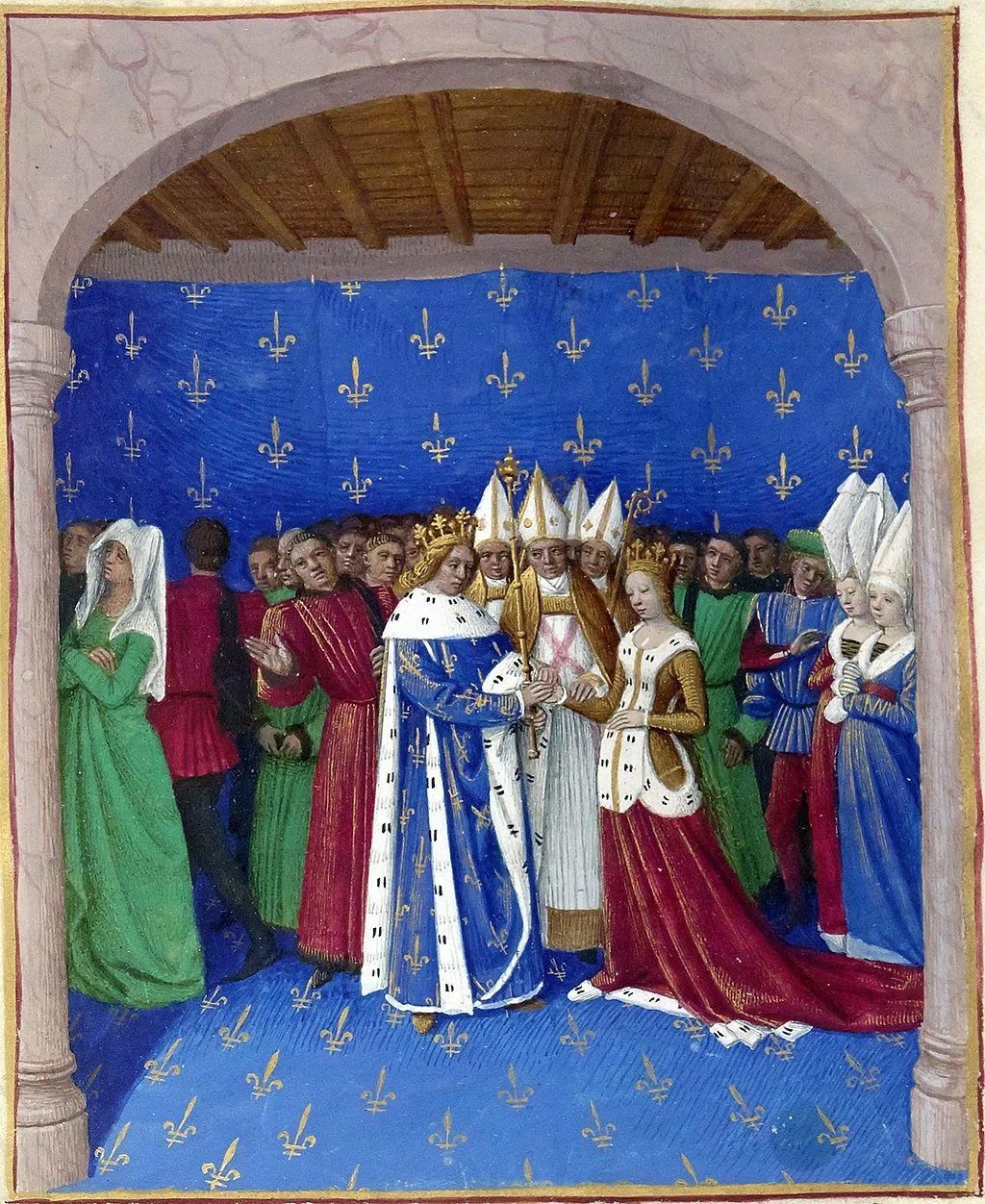
Marriage of Charles IV and Marie of Luxembourg, by Jean Fouquet.
Downfall
Before the turmoil of the Hundred Years’ War, France had experienced a period of prosperity. However, the last Capetian king of France, Charles IV, passed away in 1328, ending a dynasty that had ruled since the 10th century and passing the crown to the House of Valois. His death raised a pressing question: what would happen next? Before Charles’ death, his father, Philip IV—known for various campaigns, including wars with England, the Flemish, and the papacy—had held the upper hand. Philip transformed France and challenged the powerful English, but the years following his death did not go well for the French. His three sons—Louis X, Philip V, and Charles IV—left no male heirs to the throne and faced constant threats on all sides from the Flemish and the English. Even before Philip took the throne, Louis IX of France had expanded royal power from the early 13th century, seizing English-held lands in France from the weakened King John and his son Henry III.
Phillip saw it as his chance to keep the power, but quickly drove France into more debt and begged the church for more money. With his death on the line, some of the feudal powers that France controlled started to rebel. One main issue when Phillips' sons took power was the constant threat from the Flemish, and the areas of Modern-day Belgium, which saw their chance to rebel, and France had to stop them. Face forward after the death of Charles in 1328, France was a powerful kingdom, slowly dying internally. The morale of the people fell as France's leadership in military power and threats on all ends, including the start of a major war in 1337, where Edward III claimed himself king of France. Philip saw this as his chance to retain power, but he quickly drove France into deeper debt and was forced to beg the church for more money. As his death approached, some of the feudal powers that France controlled began to rebel. One main issue when Philip’s sons took power was the constant threat from the Flemish in the areas of modern-day Belgium, who saw their chance to rebel and whom France had to suppress. By the time of Charles’s death in 1328, France was a powerful kingdom that was slowly dying from within. The morale of the people fell as France’s military leadership weakened and threats mounted on every side, culminating in the start of a major war in 1337, when Edward III claimed himself king of France.
The start of the war proved a challenge for France as the battles were like a tennis match for both sides. However, in 1341, the death of John III of Brittany impacted French soil. Brittany was in the northern part of France and was a key figure in French politics, with a goal of trying to remain balanced for the French throne. His death didn't just drive France further down, but also brought the whole war together over one land. The start of the war proved a challenge for France, as the battles went back and forth like a tennis match between the two sides. However, in 1341, John III of Brittany died in France. Brittany was in the northern part of France and was a key region in French politics, striving to remain balanced in its loyalty to the French throne. His death did not only drive France further down; it also drew the entire war to bear on France.
A Change in the Tide
John III, Duke of Brittany ( 1289-1341) was the son of Arthur, Duke of Brittany, and Marie, Viscountess of Limoges. Not much is known about his childhood, but he married Isabella of Valois, which gave him a connection to the future house of Valois through Isabella’s father, Charles of Valois. John married three times throughout his life, which had an impact on power and trade from all over the Duchy. John, just like the French kings, did not have an heir and was possibly thinking of giving the duchy to France if he died, for a new way of gaining power. However, his half-brother, John, Duke of Montfort, who plays a much bigger role later, wanted the duchy after his death. This, in fact, did not work out as Montfort, soon after his death, claimed power for the Duchy itself. John III, Duke of Brittany (1289–1341), was the son of Arthur, Duke of Brittany, and Marie, Viscountess of Limoges. Not much is known about his childhood, but he married Isabella of Valois, a union that gave him a connection to the future House of Valois through Isabella’s father, Charles of Valois. John married three times throughout his life, with consequences for power and trade across the region. Like the French kings, John had no heir and may have considered ceding the duchy to France upon his death as a means of gaining power. However, his half-brother, John, Duke of Montfort—who would play a much bigger role later—wanted the duchy after John III’s death. This did not come to pass, as Montfort, soon after John III’s death, claimed the duchy for himself.
Montfort indeed came and took his place for power and control, with the English side facing the high ground. Arthur indeed had another heir when John died, who was in fact Guy, Count of Penthièvere, who passed away in 1331, but his daughter Joan of Penthièvere married Charles of Blois, in which both he and Montfort fought over the duchy. Now, with the issue of the heirs coming into play, why does France need to get involved? At the start of the Hundred Years War, Gascony played a key role in the region of the war, as the forces of Edward III came crashing down into France. Montfort moved quickly to claim power and control, with the English at his back. Arthur had in fact had another heir, Guy, Count of Penthièvre, who had passed away in 1331; Guy’s daughter, Joan of Penthièvre, married Charles of Blois, and both Charles and Montfort fought over the duchy. Now, with the question of the heirs in play, why did France need to get involved? At the start of the Hundred Years’ War, Gascony played a key role in the conflict, as the forces of Edward III came crashing into France.
The Hundred Years War saw a chance for England to claim France after the succession crisis in 1328. France did not allow women to rule due to the Salic Law, and was panicking as to who could be the new heir for the French throne, which was the house of Valois. Edward can trace his claims as the cousin to the late king, as her mother, Isabella of France, also known as the “She Wolf”. This can be traced as much to the start of the war as Gascony was key, but also a succession crisis that brought panic to French soil. France needed all the help it could get, as Brittany was a territory that built stability within the region for France. Without a perfect ally, how would France survive, especially in the need of defeating a larger force and soon a force of France's enemies that comes together to face France? If John had heirs, the war wouldn’t be an issue, especially for a conflict that became a large problem of the French debt.
On April 30, 1341, John III, Duke of Brittany, passed away, initially starting a succession that lasted until 1365, deciding who would be the next Duke of Brittany. Both Charles of Blois and John, the Duke of Montfort, joined forces to claim Brittany. It didn't just stop as both France and England fought on both sides, widening the war. The Breton War of Succession is one war forgotten to many, but a conflict for who wants France and how.The Hundred Years’ War gave England a chance to claim France after the succession crisis of 1328. France did not allow women to rule under the Salic Law, and the kingdom was panicking over who could be the new heir to the French throne—a question ultimately answered by the House of Valois. Edward could trace his claim through his mother, Isabella of France, also known as the “She-Wolf,” who was sister to the late king. This claim, alongside Gascony, was a key factor at the start of the war, and the succession crisis brought panic to French soil. France needed all the help it could get, as Brittany was a territory that brought stability to the region. Without a strong ally, how could France survive—especially when it needed to defeat a larger force soon to be joined by other enemies? Had John left heirs, the war might have been avoided, sparing France a conflict that contributed greatly to its debt. On April 30, 1341, John III, Duke of Brittany, passed away, beginning a succession dispute that would last until 1365 and decide the next Duke of Brittany. Both Charles of Blois and John, Duke of Montfort, vied to claim Brittany. The conflict did not stop there, as both France and England backed opposing sides, widening the war.
The War of the Breton Succession is forgotten by many, yet it remained a critical struggle over who would control France- and how.
Part 2 in the series on the conflict is here.
Did you find that piece interesting? If so, join us for free by clicking here.
Bibliography:
GRAHAM-GOERING, E. (2021). Princely power in late medieval France: Jeanne de Penthievre and the war for Brittany. CAMBRIDGE UNIV PRESS.
Sumption, J. (1991). The Hundred Years War. University of Pennsylvania Press.