
The War of the Breton Succession, or Breton War of Succession (1341–1365), was a war over the succession to the dukes of Brittany, in north-western France, that lasted for over twenty years. The war was a major conflict in the long Hundred Years’ War, which drove both France and England into a fight for survival and a contest for supremacy in Western Europe. Talia Bega explains — and looks at what happened as the English kept winning – until they didn’t.
Part 1 on the origins of the war is here, and part 2 on the rise of the English is here, and part 3 on the rise of the English here, and part 4 on French Struggles Against the English at Crécy here.
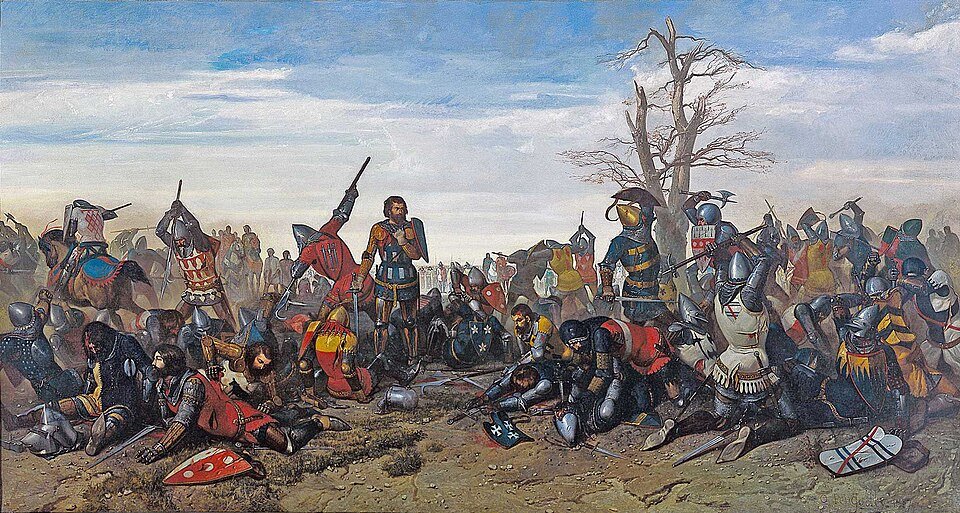
The Battle of the Thirty (1350). By Octave Penguilly L'Haridon. Source: Public domain, available here.
The Failures at Crécy
In 1346, Edward successfully invaded France in a large-scale campaign known today as the Crécy Campaign. Edward saw it as a chance to press deeper into a France already reeling, striking further into its territories. At first the campaign was risky for Edward: supplies ran short and morale was low. At the time, Charles of Blois was facing challenges as Edward was still sending in reinforcements to help strengthen the Montfort claim to the Duchy of Brittany.
Charles knew what Edward was about to do and had no choice but to face the fight. Instead of a war for succession, it was now a fight for the survival of France. Philip VI, the first Valois king of France, saw much of the country fall apart. In 1337, he watched Edward lay claim to the French crown, and knew a reckoning between them was only a matter of time. A few years later, John III, Duke of Brittany, died, causing the War of the Breton Succession. Philip had a chance to win at first, but as the years dragged on, French morale collapsed. He kept sending in as many men as he could, but the defeats kept coming.
Philip asked Charles for support to defeat Edward, but the risk was considerable. After the French defeat at Crécy, Charles lost hope, and a year later he was captured at La Roche-Derrien.
Charles vs the Hands of the English
In 1347, Charles had one more chance to lay siege to La Roche-Derrien and recapture it — but he was captured in the attempt. The battle showcased the power of the English longbowmen, whose arrows had an effective range of roughly 200m. Longbowmen would prove just as decisive nearly 70 years later at Agincourt. As at Crécy, the French besieging force heavily outnumbered the English relief force, yet still suffered the heavier losses. The French were also backed by Genoese mercenaries, who remained a key part of their forces throughout the Hundred Years’ War. Despite their numbers, the French seemed unable to learn from their repeated defeats. The battle also saw surprise attacks on Charles’ forces by townsfolk armed with axes and swords, who harried his men and the longbowmen alike.
Charles thought he had won after his initial charge succeeded, but the English rallied and turned the battle against him. Charles was taken prisoner — another decisive victory for the English. With Charles gone, Philip’s support in Brittany had collapsed, and the English were closer than ever to securing their claim.
Charles was then held in the Tower of London for years, and little is known for certain about the conditions of his imprisonment. At the time, the Tower served as a central political prison, a royal residence, and a site for coronation ceremonies. The French pope, Innocent VI, was alarmed by the conflict and pressed for a peace treaty. It allowed both factions to hold part of the territory and maintain an uneasy peace.
At Last Victory
At this time came one of the most famous episodes of medieval chivalry: in 1351, the Combat of the Thirty. It came to represent the very peak of knighthood and honor. Both sides had thirty knights each, and the French were led by Marshal of Brittany, Jean de Beaumanoir, and for the English, Robert Bemborough. It was part duel, part military exercise — not simply a show for entertainment. The arrangements were straightforward: Jean challenged Robert to a fight, and both men accepted.
The fight itself lasted only a few hours, with four French knights and two English dead by the time of a short break. Bemborough was killed soon after, followed by several more of his knights. The English were surrounded and defeated, securing a French victory that underscored the era’s ideals of chivalry. The casualties were nine dead for the English vs six for the French. Unlike a typical battle of the period, it was remembered above all as a display of chivalric ideals. Chroniclers such as Jean Froissart cited the encounter as an example of chivalry itself.
Though the Combat of the Thirty had little effect on the war itself, Edward signed the Treaty of Westminster in 1353, formally recognizing Charles as the rightful Duke of Brittany — though this recognition proved short-lived. If Charles could pay a large ransom and forge an alliance with England, the arrangement would hold. Edward also wanted the young John of Montfort to marry his daughter Mary, though this required approval from both the Papacy and France. Amid the struggles, the treaty was never enacted, and Charles was freed and returned as the rightful duke.
This moment in history raises many questions, but it also offers lessons. Edward was now in his early forties and physically weakening, but his mind remained fixed on the prize. The English enjoyed strong support on both sides of the Channel, which helps explain Edward’s deep investment in the treaty. Charles became a political pawn after his capture — and so, in a sense, did France, which faced its own struggle for power.
How could France decide its own fate now? With Charles restored to his rightful duchy, peace settled over Brittany — but not for long. Ten years later, a new claim to the duchy would rise, asking the same question all over again.
A reminder that Part 1 on the origins of the war is here.
Bibliography
GRAHAM-GOERING, E. (2021). Princely power in late medieval France: Jeanne de Penthievre and the war for Brittany. CAMBRIDGE UNIV PRESS.
Sumption, J. (1991). The Hundred Years' War. University of Pennsylvania Press.


.jpg)
