The story of King Henry VIII is often told through the dramatic rise and fall of his six wives, yet to understand those stories fully one must begin with the king himself—a ruler whose personal ambitions, insecurities, and convictions reshaped England politically, socially, and religiously. He was not born to be king, nor initially raised for the role, but circumstance and dynastic fragility propelled him onto the throne and into history as one of the most consequential monarchs in European history.
Terry Bailey explains.
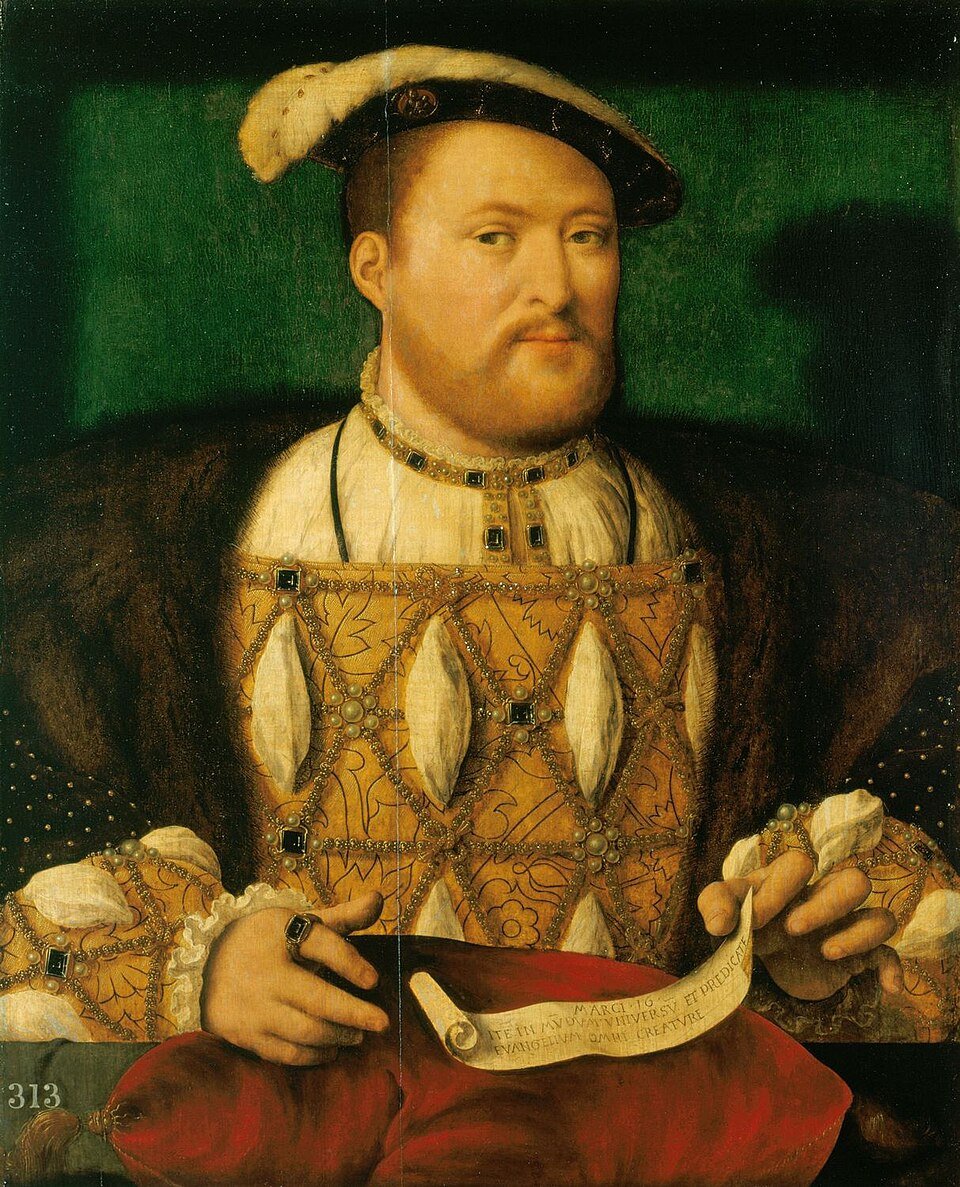
King Henry VIII by Joos van Cleve .
Henry was born in 1491, the second son of Henry VII, the founder of the Tudor Dynasty. His father's reign had brought an end to the Wars of the Roses, a prolonged period of dynastic conflict that had devastated the English nobility and left the monarchy precariously balanced. As a younger son, Henry was not initially burdened with the expectations of kingship. Instead, he received the education of a Renaissance prince, immersed in theology, classical languages, music, and philosophy. He became an accomplished musician and a skilled linguist, embodying the ideals of a cultivated ruler. His upbringing instilled not only intellectual confidence but also a deep awareness of the fragility of dynastic power, a lesson that would later shape his reign in profound ways.
The sudden death of his elder brother, Arthur Tudor, altered Henry's destiny overnight. No longer a spare heir, he became the focal point of Tudor continuity. When he ascended the throne in 1509, he did so as a young man of eighteen, admired for his physical prowess and charm. Contemporary observers described him as the embodiment of kingship—tall, athletic, and charismatic, with a commanding presence that inspired loyalty and admiration. He excelled in jousting tournaments, hunting expeditions, and courtly entertainments, projecting an image of vitality and strength that reinforced his authority.
Yet beneath this image lay a more complex personality. Henry possessed a strong sense of his own importance and an expectation of obedience that would deepen over time. In the early years of his reign, he governed in collaboration with capable advisers, most notably Thomas Wolsey, whose administrative skill and diplomatic acumen helped shape England's foreign and domestic policies. Under Wolsey's guidance, Henry pursued military campaigns in France and sought to position England as a significant player in European politics. The Tudor court flourished as a center of culture and influence, attracting scholars, artists, and diplomats who contributed to its reputation as one of the most sophisticated courts in Europe.
However, Henry's desire for glory and recognition often placed a strain on the kingdom's resources. His ambitions extended beyond mere stability; he sought to rival the great monarchs of Europe, engaging in costly wars and elaborate displays of power. Court life, while dazzling, was also intensely political. Favour could be won through loyalty and service but lost just as quickly through miscalculation or perceived betrayal. This environment fostered a culture in which personal relationships were inseparable from political advancement, setting the stage for the central role that marriage would play in Henry's reign.
The defining transformation of Henry's kingship emerged from what began as a deeply personal crisis. His marriage to his first wife failed to produce a surviving male heir, a situation that threatened the stability of the Tudor line. Haunted by the memory of civil war and driven by the belief that a secure succession was essential to national stability, Henry became increasingly determined to resolve what he saw as both a personal and dynastic failure. When his request for an annulment was denied by Pope Clement VII, Henry's response set in motion one of the most significant religious upheavals in English history.
The English Reformation marked a decisive break with the authority of the Roman Catholic Church. By asserting his supremacy over the Church in England, Henry redefined the relationship between religion and the state. This was not initially a move driven by theological conviction but by political necessity and personal determination. Nevertheless, the consequences were far-reaching. The dissolution of monasteries redistributed vast amounts of wealth and land, altering the social and economic landscape of the kingdom. Religious practices and identities shifted, often causing tension and resistance among the population. Henry's actions demonstrated how deeply intertwined religion and politics had become, each shaping and reinforcing the other.
At the center of these developments was Henry's relentless pursuit of a male heir. His obsession with succession was not simply a matter of personal preference but a reflection of the precarious nature of Tudor legitimacy. Without a clear line of succession, the kingdom risked descending once again into conflict. This urgency drove Henry to make decisions that would have profound consequences for himself and those around him. His marriages became instruments of policy, alliances, and ambition, each one reflecting the intersection of personal desire and political necessity.
The evolution of Henry's character over the course of his reign is one of the most striking aspects of his story. The vibrant and charismatic young king gradually gave way to a more authoritarian and, at times, ruthless ruler. Physical injuries, including those sustained in jousting accidents, contributed to a decline in his health and temperament. As he aged, he became increasingly suspicious and less tolerant of dissent. Trusted advisers could fall from favor with alarming speed, and those who failed to meet his expectations often faced severe consequences. This transformation not only affected his governance but also had a direct impact on his wives, whose fortunes were closely tied to his changing moods and priorities.
The experiences of Henry's queens highlight the complex dynamics of power and gender in Tudor England. While queens could exert influence and play significant roles in court politics, their primary function was to secure the succession. Their value was often measured by their ability to produce a male heir, and their positions were inherently precarious. In this context, marriage was both a personal relationship and a political contract, one that could elevate a woman to the highest position in the land or lead to her downfall. The fates of Henry's wives—ranging from coronation to execution—underscore the risks inherent in a system where personal and political interests were so closely intertwined.
Henry's reign also had a lasting impact on the structure and identity of the English monarchy. By establishing the monarch as the head of the Church of England, he expanded the scope of royal authority in unprecedented ways. This shift not only strengthened the power of the crown but also set the stage for future monarchies and political developments. The legacy of his decisions would be felt in the reigns of his children, particularly Elizabeth I, whose rule would solidify many of the changes initiated during her father's time.
As the opening scene in this series, Henry's story provides the foundation for understanding the lives and experiences of his six wives. Each marriage was shaped by the king's evolving character, his political ambitions, and the broader forces at play in Tudor England. Together, these stories reveal a world in which power, religion, and personal relationships were deeply interconnected, and where the actions of a single individual could alter the course of a nation's history.
In examining Henry VIII, one encounters a figure of profound contradictions: a patron of learning and culture who could also be merciless, a defender of faith who ultimately broke from the Church, a king driven by both genuine concern for his realm and an unyielding desire for control. His reign stands as a testament to the complexity of leadership and the enduring impact of personal decisions on the broader sweep of history.
In conclusion, the reign of Henry VIII cannot be reduced to the familiar sequence of six marriages, however dramatic their outcomes. Rather, those marriages were the outward expression of deeper forces rooted in the king's character and the fragile political landscape he inherited. His life illustrates how the private anxieties of a monarch, fear of dynastic collapse, desire for legacy, and need for authority can reverberate outward, reshaping institutions, beliefs, and the lives of an entire nation. The Tudor court, for all its splendor and intellectual vitality, was ultimately an extension of Henry himself: ambitious, brilliant, unpredictable, and at times dangerously volatile.
The transformation of England during his reign was neither accidental nor inevitable, but the result of deliberate choices made under pressure. The break with Rome, the redefinition of royal supremacy, and the sweeping redistribution of wealth through the dissolution of the monasteries were all tied to Henry's determination to secure what he believed was England's future. Yet these actions came at significant cost, social upheaval, religious division, and a climate of uncertainty that would persist long after his death. In this sense, Henry's legacy is not one of simple progress or decline, but of profound and often turbulent change, driven by the intersection of personal will and political necessity.
Equally significant is the way in which his reign exposes the precarious position of those closest to power. The stories of his queens are not merely personal tragedies or triumphs; they are reflections of a system in which influence was conditional and security fleeting. Each marriage reveals a different facet of Henry's evolving priorities and temperament, as well as the broader expectations placed upon queenship in Tudor England. Through them, we see how power operated not only through institutions, but through relationships, fragile, strategic, and often perilous.
Ultimately, the enduring significance of Henry VIII lies in the scale of his impact. He did not simply rule England; he redefined what it meant to be its king. By concentrating both political and religious authority in the crown, he altered the trajectory of the English monarchy and laid the groundwork for the transformations that would follow under his children, particularly Elizabeth I. His reign stands as a pivotal moment in the transition from medieval to early modern England, where questions of authority, faith, and governance were contested and reshaped.
As this series unfolds, the lives of his six wives will bring these themes into sharper focus, each narrative illuminating the human consequences of Henry's rule. Their experiences, set against the backdrop of a changing kingdom, offer insight not only into the man himself but into the nature of power in an age of transformation. To understand them is to understand Henry and to understand Henry is to grasp how a single ruler's ambitions and fears could alter the course of history in ways that still resonate today.
Now read part 2 on Catherine of Aragon here.
The site has been offering a wide variety of high-quality, free history content since 2012. If you’d like to say ‘thank you’ and help us with site running costs, please consider donating here.