
There can be a point when circumstances in life get so desperate that we will go to extraordinary lengths to just simply “get by.” Mary Ann Bevan, an extraordinary woman found herself in that situation after suffering a series of tragedies in the early part of the twentieth century. This is the extraordinary yet tragic story of Mary Bevan who found fame and fortune as “the ugliest woman in the world.”
Steve Prout explains.
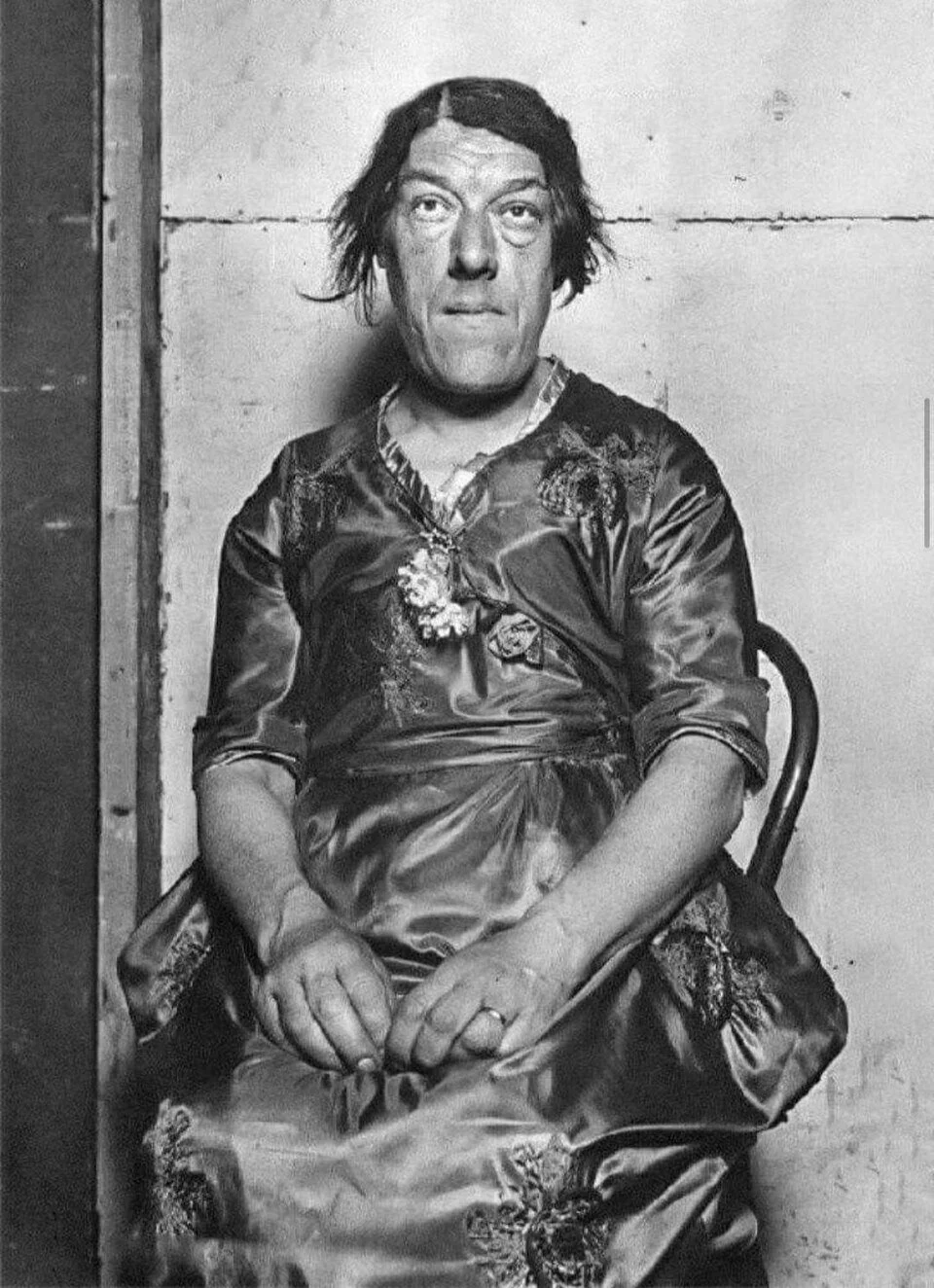
Mary Ann Bevan.
The early life of Mary Bevan
Mary Ann Bevan (nee Webster) was born in December 1874 in Plaistow, London. She became a nurse at 22 years of age and proceeded to lead a normal and unremarkable life. Mary herself was one of eight siblings. In 1902 she married a Thomas Bevan and had four children, two boys and two girls. In 1914 her husband Thomas sadly died, leaving her to fend for herself and her children. If that was not enough, at the age of 32, Mary was the struck with a rare medical condition called acromegaly which made life even more difficult - and left the grieving family in a desperate financial situation.
Acromegaly is a rare medical condition that creates abnormal growth around the face resulting in distortion. The condition also has other side effects such as eyesight deterioration and crippling headaches which Mary also suffered. Due to this she was unable to continue working as a nurse and now was only able to earn money by performing odd jobs at infrequent intervals. This was not enough to support her family of four children and the financial pressures mounted. However, in a bizarre twist of fate an opportunity presented itself which would accord her unexpected fame and fortune.
“The Worlds Ugliest Woman” and the Coney Island project
In 1919 Mary entered and won a competition to find “The World’s Ugliest Woman,” that presented her with other opportunities for her to earn a living that would change her life and fortunes forever. By 1920 Mary commercialized her appearance with the help of a Samuel Gumpertz. Grumpertz, along with J T Ringling, were the main leaders in this field of entertainment. Grumpertz was also the talent agent for Harry Houdini and Ringling’s own organization would later become the world famous Barnum and Bailey traveling circus.
May soon found herself profiting from various public appearances and performances. Grumpertz then hired Mary to appear in the Dreamland Sideshow at Coney Island, USA. Mary would also work in the Ringing Brothers Circus.
Mary Bevan was not the only attraction in the Coney Island show, which was also known as the "Congress of Curious People and Living Curiosities.” During its heyday the crowds would be entertained by such acts as Baron Paucci (aka Peppinio Magro) who was presented as the "world’s smallest perfect man". Paucci was an Italian who was only two feet tall. William Johnson, also known as Zip the pinhead or “zip what is it”, possessed a tapered head and his act was pretending to be “the missing link” in human evolution. There was also a Dog-Faced Boy called Lionel, real name Stephen Bibrowski (1890-1932). Other acts included a band of Philippine Bantoc tribe members, the Wild Man of Borneo, and Ubangi "Platter-Lipped" women. His greatest attraction was the half-scale Lilliputian Village that he also situated at Dreamland where hundreds of small people lived in a self-contained community for spectators to view.
Conclusion
Even in Mary’s times there were critics and disapprovers of these shows. Gompertz’s sideshows were seen by some as being exploitative, which is a is a fair statement for one side of the debate; however, from another point of view, these performers were reported to make “a good living” which otherwise would have been impossible for many given their individual circumstances. In a time where society was less inclusive, entry to the normal profession or vocations would have been difficult if not impossible. Apart from the financial gain, the sideshow offered the individuals a comradeship and community support that they may not have found in wider early twentieth century society.
Among those critics was Mary’s doctor. In May 1927 he wrote to Time magazine out of concern for people like Mary, criticising the industry for its exploitative nature. However, from that industry he condemned, his patient had become a celebrity and afforded her means to support her children and their education. It is estimated that from her numerous appearances, picture postcard sales, and sales of miscellaneous merchandise she earned over fifty thousand dollars (the equivalent of some one million dollars today). It was a considerable sum that she never would have achieved from her former nursing career. Some of Mary’s peers also prospered. William Johnson (aka “Zip”) apparently “made a better living than most sideshow performers” not just from his performances but from several successful and shrewd investments, which included a chicken farm in Nutley, New Jersey.
Mary died on Boxing Day in December 1933. She was laid to rest at The Brockley and Ladywell Cemeteries in London. The story of Mary Bevan can be read by the audience as one of triumph over tragedy. Alternatively, it can be read as the story of a woman forced with little choice into the fringe of society and exploited for her unfortunate looks by a wealthy and established entertainer - but that is up to the reader to decide. Not all personalities that make it into the history books are great states-people, warriors, rulers, inventors, or dictators. Some can be just ordinary people trying to lead ordinary lives.