This December will mark for the people of Russia one of the most defining moments in their history; the 35th anniversary of the dissolution of the Soviet Union. A major world power that had existed for nearly 70 years, its collapse reflected other significant developments in Eastern Europe at that time, where long-established communist regimes fell one by one and national boundaries changed dramatically, with Yugoslavia similarly dissolving, Czechoslovakia splitting into the two separate nations of Slovakia and the Czech Republic, and East Germany and West Germany becoming a united country once again. The latter geopolitical development stands in direct contrast to the ongoing situation in Korea and Cyprus, with both lands split for decades into two independent states; one of which, the Turkish Republic of Northern Cyprus, is recognised only by Turkey (a similar situation to the breakaway state of Somaliland, with Israel the only country to recognise it as an independent nation).

Vittorio Trevitt explains.
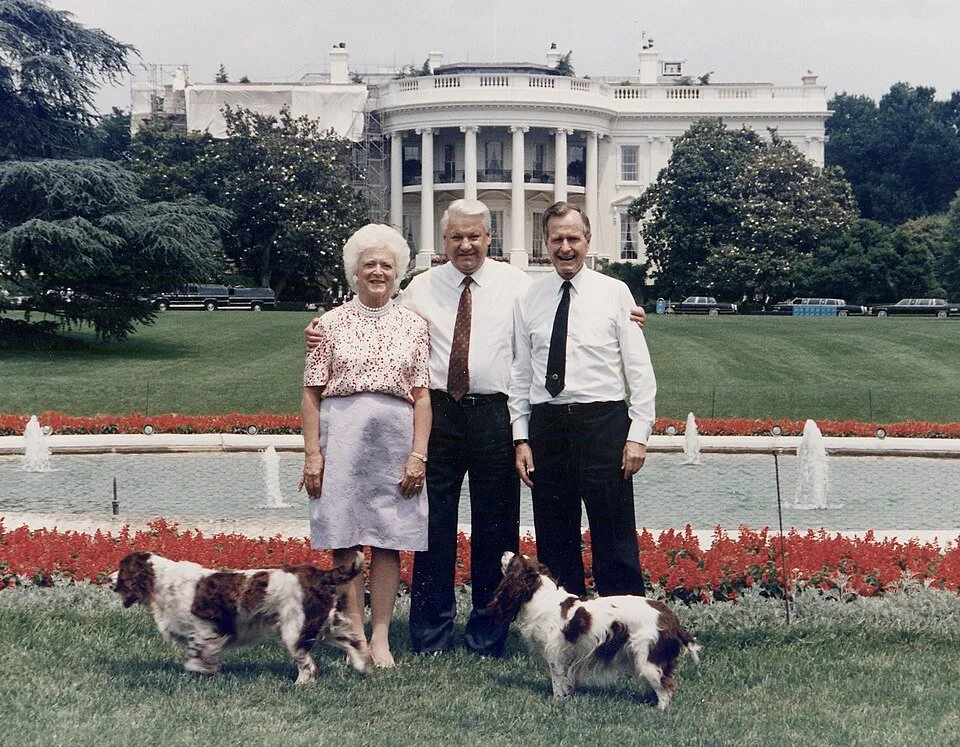
Boris Yeltsin (center), with US President George H.W. Bush and Barbara Bush in 1992. Source: Public domain, National Archives and Records Administration, available here.

The Soviet Union’s demise has to this day elicited mixed reactions from Russians, but at the time it heralded the chance for the Russian people to put their autocratic past behind them and build a prosperous, democratic society. It is worth assessing, since that time, how much things have changed in Russia and the impact that the decisions of Russia’s post-Soviet leaders have had both within and beyond the nation’s borders.

Boris Yeltsin, the first president of the newly formed Russian Federation, was a political veteran who had previously held a series of posts (including that of the head of Moscow) and received admiration for his stance against a coup attempt by hardliners seeking to turn back the tide of reform opened up by Yeltsin’s predecessor Mikhael Gorbachev; dramatically symbolised by Yeltsin standing on top of a tank and then speaking out against the plot, which ultimately failed. Yeltsin’s presidency, however, would be a far from memorable one. Although prior to its collapse Gorbachev had envisaged a democratic socialist path for the Soviet Union, the course taken by the Yeltsin administration for the new Russian state was diametrically opposed to Gorbachev’s vision. Believing that the quick adoption of a free-market system was the way forward, Yeltsin presided over the rollout of a major economic reform programme which throughout the course of the Nineties resulted in mass joblessness, rapidly rising inflation, and delays in wage receipts and pension payouts.

Two years into his presidency, there was much opposition to the administration’s financial policies both amongst the general public and within the legislature, the latter of which Yeltsin would directly confront in late 1993. Yeltsin proposed changes to the constitution that partly involved giving stronger powers to the presidency; something that encountered strong parliamentary opposition due to concerns that this would emasculate the country’s fledgling democratic system. A standoff between the president and the legislature (with the vice president himself joining the opposition camp) led to tanks being sent against the latter, the arrest of several political figures, and the subsequent adoption of a new constitution; albeit following a public vote. This did not, however, give Yeltsin a consistent pro-government majority in parliament. In elections held in December that year, parties that supported the administration’s economic strategy only won a minority of seats, with the party winning the most seats being an ultranationalist outfit; the inappropriately named Liberal Democratic Party (LDPR). During the election campaign, its leader Vladimir Zhirinovsky, a racist demagogue who expressed admiration for the idea of Nazism, made bombastic statements directed against all kinds of groups such as the Baltic states (contributing to the case put forward by the latter to join NATO) and the Caucasus; calling for Russia’s borders to be closed off to the “criminal element” of that region. Zhirinovsky also advocated an expansion of Russian territory to where it stood eighty years earlier together with mass arrests and executions to combat crime.

It is worrying that a party led by such a figure could have done as well as it did. Nevertheless, despite its breakthrough, most parties in the Duma did not share the LDPR’s ideology, and further elections in 1995 witnessed the Communist Party of the Russian Federation (KPRF), a descendant of the ruling party of the Soviet Union, obtain the largest parliamentary representation. Along with other left-wing groups, the KPRF now formed part of a reformist legislative majority. Their triumph demonstrated the extent to which ordinary people yearned for a more progressive course on social and economic policy after years of hardship. Indeed, the KPRF made the ambitious promise of restoring the various social guarantees that existed during the Soviet era. Although they were unable to deliver on this, the communists were nevertheless able to successfully make use of their newfound influence to effect improvements in welfare allowances and the minimum wage.

In presidential elections the following year, Yeltsin’s main rival was KPRF leader Gennady Zyuganov, who forced Yeltsin into a runoff after coming just a few percentage points behind the incumbent. Zyuganov’s platform was appealing to an austerity-weary public, which included promises like improvements in retirement benefits and earnings, controls on prices, and assured employment. In the end, Yeltsin plucked victory from the possible jaws of defeat; winning over 50%of the popular vote. The fear factor played a major part in Yeltsin’s triumph, with television channels broadcasting negative depictions of Zyuganov together with anti-communist propaganda which implied that a Zyuganov presidency would mark a return to the horrors of Stalinist rule. Yeltsin also helped his cause by making similar pledges to Zyuganov in regards to pay and allowances, while delivering splurges in public spending in the run-up to the elections. Although the KPRF would remain the largest party in the 1999 legislative elections (the last that Yeltsin would preside over as president), it lost much of its representation, and failed to establish itself as a possible alternative party of government.

During his first term, Yeltsin presided over a separatist movement in Chechnya which, as has often been the case throughout history with examples such as Kosovo, Transnistria, South Ossetia, Abkhazia and Western Sahara, culminated in armed conflict. After the sending of Russian forces into Chechnya in the latter part of 1994, a war was waged that led to widespread death and destruction. Shortly before the 1996 presidential elections, Yeltsin signed a decree at a military base in Chechnya bringing an end to conscription while describing Russian soldiers as heroes; moves that probably helped save his presidency. Yeltsin’s honeymoon period proved, however, to be short-lived. Two years into his second term (which went off to a good start with the signing of peace accords in Chechnya) Russia’s economy went into turmoil as a result of misfortunes such as the fallout from the 1998 Asian financial crisis and a mounting deficit; with a currency devaluation, a default on short-term debt, and a subsequent fall in living standards the consequence of these.

At the dawn of the new millennium, Yeltsin stood down from the presidency; leaving behind an economically scarred and socially fractured nation. The appointment of then prime minister Vladimir Putin as the one to succeed Yeltsin would prove to be a major turning point. A strong figure, Putin has remained the president of Russia ever since; barring a period from 2008 to 2012 when the post was held by a close associate, Dimitry Medvedev. Under Putin’s leadership, Russia has little independent media and there is the imprisonment and death of journalists and opposition politicians. Although the holding of elections provides the image of democratic choice, in practice Russia is an authoritarian state. Over the years, the administration has facilitated the creation of new parliamentary parties that are partial towards the regime while during Putin’s first term the remaining independent national television networks came under government control (national T.V. being the source where the majority of Russians draw their information on current affairs from), therefore ensuring that the mainstream media broadcasts a pro-government message. Unsurprisingly, the United Russia party (Putin’s political vehicle) has consistently won every national election since its formation in 2001. A more recent example was the legislative elections held in September 2026, with United Russia winning well over two-thirds of all seats while one notable opposition party, the liberal Yabloko (distinct from the other registered political parties in standing against Russia’s war in Ukraine), was prevented from taking part.

Russia is not atypical of the former Soviet Union. Although the Baltic states have been liberal democracies since gaining independence from the Soviet Union, and Armenia has made strides towards democracy in recent years, Belarus has been led uninterruptedly since 1994 by Alexander Lukashenko; an autocratic ally of Putin’s. The Central Asian states of Uzbekistan, Turkmenistan, Kazakhstan and Tajikistan have been under the control of dictatorial regimes since the end of Soviet rule. Further west, Azerbaijan has for the most part been led by dictatorships while Kyrgyzstan, Georgia and Moldova have undergone shifts from political liberalisation to authoritarian turns. Ukraine has been different, which since the Orange Revolution of 2004 (a series of protests precipitated by rigging in favour of a pro-Russia candidate, who ultimately lost) has often witnessed the election of reformers favouring closer ties to the West. The most recent of these is former television star Volodymyr Zelenskyy who, in his third year in office, would become a war leader. In 2022, eight years following a decision by Russia to annex the Ukrainian region of Crimea, the Russian military launched an invasion of Ukraine (described in Russia as a “special military operation”) that has to date claimed hundreds of thousands of lives on both sides and forced millions of people to flee their homes. The invasion of Ukraine has effectively turned Russia in the eyes of many in the West into a pariah state while having negative repercussions for living standards the world over.

More than three decades since the fall of the Soviet Union, the idea of Russia becoming a Western-style free and affluent society remain elusive. Although economic conditions have greatly improved since the Yeltsin years, as characterised by a larger middle class, the economic costs of the war in Ukraine have precipitated a squeeze on household incomes more recently. Attacks on freedom of speech continue to be waged, as demonstrated by social media restrictions and literary bans. Despite Putin’s autocratic rule, however, public protests that have taken place over the years against the regime concerning matters such as a proposed rise in the retirement age show that support for the regime is far from universal. As long as there are Russians who challenge it, the dream of Russia becoming a wealthier, more liberal society is one that can still become a reality.


Did you enjoy the piece? Join us on X here to receive regular updates: @HistoryIsNowMag

War is often remembered for its battles, its victories, and its great leaders, but for the ordinary soldier, the reality is far grimmer. Nowhere was this more apparent than in the trenches of the Crimean War, where men endured not just the enemy's gunfire but an even more relentless onslaught: hunger, disease, and the unforgiving elements.

Terry Bailey explains.

Read part 1 in the series here, part 2 here, and part 3 here.

The Mission of Mercy: Florence Nightingale receiving the Wounded at Scutari. By Jerry Barrett.

The winter of 1854–1855 turned the besieged city of Sevastopol into a frozen wasteland, where soldiers huddled in ill-equipped trenches, wrapped in tattered uniforms that offered little protection against the biting cold. Food was scarce, medical care was rudimentary at best, and the looming specter of death came as often from sickness as from enemy fire.

Rats, lice, and the stench of decay were constant companions. Letters Home painted a picture not of glory but of sheer survival in a war where the greatest challenge was simply staying alive.

Yet, amidst this suffering, change was brewing. The horrors of the Crimean War would spark reforms in battlefield medicine, bring women like Florence Nightingale and Mary Seacole into the public eye, and transform war reporting forever. This conflict was not just fought in the trenches, it was fought in the hospitals, the newspapers, and in the minds of those who would demand a better future for the soldiers of tomorrow.


Life in the trenches: Mud, hunger and the shadow of death

For soldiers on the frontlines, the Crimean War was defined not just by battle, but by relentless suffering. The harsh winter of 1854–1855 turned the trenches outside Sevastopol into frozen pits of misery. Soldiers faced extreme cold with inadequate clothing, often wearing threadbare uniforms unsuited to the brutal climate. Supplies were inconsistent, and food shortages left men weak and malnourished. Hard biscuits and salted meat made up the bulk of their diet, with fresh rations arriving sporadically, if at all.

Disease was as deadly as enemy fire. Dysentery, typhus, and cholera swept through the ranks, claiming more lives than the battles themselves. Lice and rats were omnipresent, spreading filth and infection. Letters from soldiers described the unimaginable stench of decaying bodies, the cries of the wounded, and the relentless fear of the next attack.


Medicine and Florence Nightingale's legacy

The appalling conditions of battlefield hospitals were brought to the world's attention by Florence Nightingale, a determined British nurse who arrived in Scutari in 1854. Hospitals were overwhelmed, with wounded men lying in their filth, untreated for days. Infection was rampant, and medical supplies were scarce.

Nightingale, along with a team of nurses, introduced basic hygiene practices, insisting on cleanliness, fresh air, and proper nutrition. Though germ theory was not yet understood, her efforts significantly reduced death rates. Dubbed "The Lady with the Lamp," Nightingale's nightly rounds brought comfort to the suffering, and her work laid the foundation for modern nursing.


Women in the war: More than just nurses

While Nightingale became the face of female contributions to the war effort, many other women played crucial roles. Mary Seacole, a Jamaican-born nurse and entrepreneur, independently travelled to the war zone and set up the "British Hotel" near Balaclava, offering soldiers warm meals, medical care, and even morale-boosting comforts like fresh linens and tea. Despite being overlooked by British authorities, Seacole's efforts were widely recognized by the soldiers she treated.

Women also played vital roles as camp followers, laundresses, and caregivers. Some disguised themselves as men to fight, while others served as spies or helped transport supplies. The Crimean War broadened the perception of women's capabilities in conflict, laying the groundwork for future involvement in military and medical service.


The first war of the press: War correspondents and public opinion

The Crimean War was the first major conflict to be extensively reported in newspapers, changing how wars were perceived at home. William Howard Russell of The Times was the first modern war correspondent, sending back vivid and often damning accounts of the British army's struggles. His reports exposed government mismanagement, the suffering of the soldiers, and the incompetence of some commanders, leading to public outrage and political reforms.

Illustrations and early war photography also emerged, with Roger Fenton capturing haunting images of the battlefield. Though staged to avoid showing corpses, his photographs gave civilians a stark glimpse of war's desolation. The press coverage of the Crimean War shaped public perception, fueling both patriotic fervor and calls for change.

Needless to say, the Crimean War was more than just a military campaign; it was a turning point in how war was fought, perceived, and remembered. For the soldiers trapped in the trenches, it was a grim struggle against not only the enemy but also disease, hunger, and the merciless elements. The horrors they endured underscored the urgent need for improved logistics, medical care, and military planning, lessons that would influence future conflicts.

Florence Nightingale and Mary Seacole's efforts revolutionized battlefield medicine, proving that compassionate and systematic care could save lives even in the direst conditions. Their contributions marked the beginning of modern nursing and demonstrated that women had an indispensable role to play in war beyond traditional domestic spheres. The presence of women in military operations would only grow in significance in the decades to come.

At the same time, the Crimean War ushered in a new era of war reporting. The firsthand accounts of war correspondents like William Howard Russell shattered the romanticized image of battle, exposing the incompetence of leadership and the suffering of common soldiers. Photography, though still in its infancy, provided the public with a tangible, visual connection to the realities of war. Never before had the home front been so intimately tied to events on the battlefield, paving the way for future conflicts to be scrutinized through the lens of journalism and public opinion.

In many ways, the Crimean War set the stage for the modern era of warfare. The lessons learned in its muddy, disease-ridden trenches shaped military reforms, the evolution of medical care, and the role of the press in holding governments accountable. Though often overshadowed by later conflicts, its impact was profound, leaving behind a legacy that still resonates in military, medical, and journalistic practices today.


The site has been offering a wide variety of high-quality, free history content for over 12 years. If you’d like to say ‘thank you’ and help us with site running costs, please consider donating here.

Peter I of Russia, more famously known as Peter the Great (1672–1725), stands as one of history's most influential monarchs. A towering figure, both literally and figuratively, Peter reshaped Russia into a modern empire, expanding its territorial reach, and left an indelible legacy that transcends borders and centuries. His reign, marked by relentless reform, military conquest, and cultural transformation, defined Russia's path as a European power. However, his rule also reflected contradictions—strengths that propelled Russia forward and weaknesses that revealed the cost of progress.

Terry Bailey explains.

A 1717 portrait of Peter I of Russia by Jean-Marc Nattier.

Strengths of Peter the Great

Peter the Great was a ruler of exceptional vision and ambition, whose leadership transformed Russia into a major European power. His determination to modernize the nation and bring it closer to Western European standards drove nearly every policy he implemented. His Grand Embassy tour of Europe (1697–1698) played a pivotal role in shaping his goals. During this journey, Peter observed Western innovations in military organization, shipbuilding, and governance, which fueled his efforts to reform Russia's military, economy, and culture.

One of Peter's most remarkable achievements was his transformation of the Russian military. Recognizing the importance of naval power, he founded the Russian Navy, a groundbreaking step for a nation that planned to expand. Peter also modernized the army by adopting European tactics, introducing advanced training programs, and ensuring access to modern weaponry. His military reforms culminated in a decisive victory over Sweden in the Great Northern War (1700–1721), securing Russia's access to the Baltic Sea and marking its emergence as a significant force in European politics.

Peter's relentless drive for reform extended beyond the battlefield. He overhauled Russia's government structure, replacing outdated systems with the meritocratic Table of Ranks, which rewarded service and talent over noble birth. His economic policies promoted the growth of industries and trade, while his cultural reforms encouraged Western dress, customs, and education, sparking a cultural renaissance in Russia.

Perhaps Peter's most enduring legacy is the city of St. Petersburg, founded in 1703. Conceived as a "window to the West," the city exemplified Peter's vision of a modern, European Russia. It's elegant architecture and strategic location on the Baltic Sea symbolized the nation's transformation under his rule. Today, St. Petersburg remains a vibrant testament to Peter's foresight and determination.


Weaknesses of Peter the Great

Peter the Great is celebrated as a transformative figure in Russian history, yet his autocratic rule had significant flaws that left parts of Russian society alienated and strained. His sweeping reforms centralized power in his hands, enabling rapid modernization but stifling dissent. Opposition was ruthlessly crushed, culminating in the execution of his son, Alexei, for alleged treason. This brutal approach to governance not only silenced his critics but also alienated the old nobility, who resented the erosion of their traditional influence.

The human cost of Peter's reforms was staggering. His ambitious projects, such as the conscription of peasants and forced labour to construct the new capital, St. Petersburg, were carried out with little regard for human suffering. Thousands perished in grueling conditions, with entire communities uprooted to fulfill his vision of a modern Russia. For many, his reign was one of relentless toil and sacrifice rather than progress and enlightenment.

Peter's vision of Westernization, while transformative, often came at the expense of Russia's traditional culture. His reforms clashed with Orthodox Christian values and long-standing Russian customs, creating a deep cultural rift. Critics argued that his embrace of European ideals eroded Russia's unique identity, leaving a legacy of tension between modernization and tradition.

Despite his successes, Peter's relentless drive for expansion and reform pushed Russia to its limits. His military campaigns and monumental projects depleted the treasury, while the burden of heavy taxation fell on the population. These policies, though effective in securing Russia's status as a major European power, left the country economically and socially strained.


Political achievements

Peter's reign marked a seismic shift in Russian governance. His restructuring of the government centralized authority, replacing old feudal systems with a more bureaucratic state. The creation of the Senate and the establishment of the Table of Ranks as indicated ensured that merit, rather than birth, determined advancement in service. Peter also established the Holy Synod, bringing the Orthodox Church under state control, which weakened ecclesiastical power and strengthened the monarchy.


Military achievements

Peter's military reforms were groundbreaking. He transformed a feudal army into a disciplined, professional force. His navy, built from scratch, played a pivotal role in securing Russian victories. The Battle of Poltava (1709), a turning point in the Great Northern War, showcased his strategic brilliance. By the Treaty of Nystad (1721), Russia emerged as a dominant Baltic power, establishing itself as a European player.


Cultural influence

Peter's Westernization policies profoundly altered Russian society. He encouraged education, established the first Russian newspaper, and founded institutions such as the Academy of Sciences. His introduction of Western dress, language, and customs brought Russia into closer alignment with Europe. However, as could be expected these changes often alienated the traditionalist segments of Russian society, creating a cultural divide that persisted long after his death.


The Global and long-term influence of Peter the Great

Peter the Great's reign as the ruler of Russia left a mark not only on his nation but on the global stage. His sweeping reforms and visionary leadership provided a blueprint for modernization that resonated far beyond Russia's borders. By prioritizing education, infrastructure, and military advancement, Peter established a legacy that later reformist leaders across the world sought to emulate.

One of Peter's most profound achievements was elevating Russia to the status of a European powerhouse. His transformative policies reshaped the country's economic, political, and military structures, positioning Russia to play a pivotal role in global affairs. His strategic efforts to secure warm-water ports expanded Russia's trade capabilities and influence, laying the groundwork for the empire's dominance in the 18th and 19th centuries.

St. Petersburg, the city Peter founded, stands as a lasting testament to his vision. Built to embody Russia's new identity as a modern and European-oriented nation, the city became a symbol of urban innovation and architectural grandeur. To this day, St. Petersburg reflects Peter's ambitious legacy and continues to inspire admiration for its cultural and historical significance.

Peter's influence also extended to his successors. Leaders like Catherine the Great and Alexander II drew inspiration from his commitment to reform, adopting his ideals to pursue their modernization agendas. Through their efforts, Peter's legacy of innovation and progress was carried forward, cementing his role as one of history's most influential leaders.

In conclusion, the reign of Peter the Great represents a pivotal chapter in Russian history, one defined by transformation, ambition, and complexity. His visionary leadership propelled Russia into the ranks of European powers, reshaping its military, economy, and culture. Through monumental reforms and achievements, he bridged the gap between tradition and modernity, leaving a legacy that resonates far beyond his era.

However, Peter's legacy is not without its shadows. The human cost of his ambitions and the cultural divides his reforms deepened to reflect the complexities of his rule. While his drive for Westernization modernized Russia, it also alienated traditionalists and imposed immense hardship on many of his subjects. These contradictions serve as a reminder of the dual-edged nature of his reforms: unparalleled progress achieved at significant cost.

Ultimately, Peter the Great remains a towering figure in global history, his life a testament to the power of vision and determination to shape a nation. His contributions continue to inspire debates about leadership, modernization, and the intricate balance between progress and preservation. In his legacy lies the story of a leader whose ambitions forever altered the trajectory of Russia and its place in the world.


The site has been offering a wide variety of high-quality, free history content for over 12 years. If you’d like to say ‘thank you’ and help us with site running costs, please consider donating here.

Posted
AuthorHistory Is Now Magazine
CategoriesBlog Post
2 CommentsPost a comment

The Roman Dynasty ruled Russia from 1613 to 1917. Here, author Ellen Alpsten tells us of her fascination with Russian history and how she started to write her series on the Tsarinas.

Catherine I, one of the Russian Tsarinas. She was empress from 1725-27.

Catherine I, one of the Russian Tsarinas. She was empress from 1725-27.

If ever there was a walk on the wild side, the early Romanovs in the 17th and 18th century took it. The wild and unbridled world of the Russian Baroque gives me the perfect backdrop for my novels of the ‘Tsarina’ series: epics cloaked in ice and snow, personal passions ruthlessly push on in the quest for power, resulting in the birth of the nation we know today.

My family’s stance on Russia is ambivalent – my father grew up in the German Democratic Republic (GDR), or East Germany. Forced to learn Russian he felt free to hate the Soviets. My cousin, however, runs a small, highbrow publishing house, which works with latter-day Russian intellectuals. I myself discovered this geographical behemoth and historical riddle when reading a book called ‘German and Russians’ by author Leo Sievers. It introduced me to the larger-than-life characters of Ivan the Terrible, the ‘Times of Troubles’ and finally the rulers of the young Romanov dynasty, who had been voted into office. I fell in love, head over heels, with these lives, fascinated by their uncompromising fullness.

But how to find out more about the shadowy figures that captured me the most: the women who dared to rise against the oppressing patriarchy in the world’s largest and wealthiest realm? The first century of Romanov rule was largely female-dominated. If the fact had not been ignored, research centered on Russian’s final Tsarina, Catherine the Great, who was not even a Romanov by blood, but a German Princess. Instead, I hoped to surprise and tell something new. Yet where to start? 


Growing fascination

Nikita Romanov said it in 1666: ‘We are as cursed – our men are as meek as maidens, and our women as wild as wolverines.’ Dwelling deeper on such a quote did not allow for half-measures. I read voraciously, and such divers oeuvres ranging from Tolstoy, Pushkin, Gogol, and Dostoyevsky to modern sociological studies such as the deeply disturbing ‘The unwomanly face of war’ by Svetlana Alexeyevich, Biographies like ‘Young Stalin’ by Simon Sebag Montefiore and also the lost, genteel worlds of the few that came at the expense of millions in Vladimir Nabokov’s ‘Speak, Memory’. How else should a foreigner grasp a culture as complex as the Russian? My interest morphed into a passion: I watched Russian films such as ‘Battleship Potemkin’ and the experimental ‘Russian Ark’ movie. And, lucky me, there were fascinating original sources galore, such as the diary of the German merchant Adam Olearius, who visited Tsar Mikhail Romanov’s court, stunned by a people ‘hardly better than animals.’ Invaluable, too, were letters of foreigners at the Russian Court such as the British Mrs Rondeau, and reports by the Dutch ambassadors and his colleagues sent by Princes of German nationality. Rounding off things with Robert Massie’s and Henri Troyat’s biographies about Peter the Great was unavoidable. Last but not least, Professor Lindsey Hughes of the ‘London School of Slavonic Studies’ tome 'Russia in the time of Peter the Great' turned out to be my bible as I dwelled deeper and deeper into the strange, shocking, sensuous world of both Russian history and its soul. It combines seemingly insurmountable contrasts casually, a lack of compromise that is fascinating. Finally, I even read Russian myths and fairy tales, which disclose so much about the imagination of a people.  

It took me a year to dare write the first word of my then debut, ‘Tsarina.’ The series is like threading a loom to weave a story as rich as any tapestry covering the walls of the Winter Palace. The novels attempt an answer to what my heroines’ lives were really like, flying in the face of a brutal patriarchy, and taking Russia from backward nation to beginnings of the modern superpower. Fleshing out those bare bones forced me to consider a myriad of aspects. 


Writing

The Russians are a communal people – the word for happiness -‘shast’ye’- means being part of something bigger. Neither ‘Tsarina’ nor ‘The Tsarina’s Daughter’ ever surrendered to fate’s blows but made the best of a given situation. Their minds were not academically trained, they acted with courage, care and cunning, counting on people and rewarding family, friendship, and loyalty. Whatever obstacle there was to overcome, they dusted themselves off and saw another day, ready to be surprised by its gifts. This makes ‘The Tsarina’s Daughter’ a very modern book. 

The strict framework of dates, events and details of the Russian Baroque and the Petrine era set of the beauty of my hitherto hidden historical heroines the better. If I was free to construct ‘my’ characters, every aspect had to be correct, from the clothes they wore, to the food they ate, the beliefs they held and how houses, roads, villages, carts etc. looked. As for the dramatic curve, I followed advice that the best-selling French author Benoîte Groult had once given me when I worked as her assistant: ‘To wish our hero well, the reader needs to see her/him sink low.’ Elizabeth, ‘The Tsarina’s Daughter’, falls from riches to rags and rises from rags to Romanov! 

After all this research I hope that nobody, who has read ‘Tsarina’ or ‘The Tsarina’s Daughter’, will ever forget my heroines again; and I hope for my writing to be as raw and unafraid as their lives were. Any writer dreams of finding such unspoiled, unexploited characters as the ‘Tsarina’ series. 

If an artist has a central theme to his creation, they are mine.


The Tsarina’s Daughter by Ellen Alpsten (Amazon), published by Bloomsbury, is out in hardback on July 8, and Tsarina, Ellen’s first book, is out in paperback now (Amazon US | Amazon UK).

Posted
AuthorHistory Is Now Magazine
CategoriesBlog Post
2 CommentsPost a comment