The Confederate victory at Second Manassas, August 28-30, 1862, followed victories in the Valley Campaign and the Peninsula. The casualties incurred by the Army of the Potomac included 14,000 killed or wounded of 62,000 engaged, compared to about half of that for the Army of Northern Virginia. Then, on September 1, Stonewall Jackson defeated a Union cohort retreating from the battlefield at Chantilly. General Pope was relieved of command and sent to Minnesota to deal with the Sioux, and was never again involved in the Civil War. Pope would blame Fitz-John Porter for the loss, even though that wasn’t the case; Porter would be heard from again at Antietam but would go through a devastating court martial soon after. One of Pope’s generals said of him, “Suffice to say ... that more insolence, superciliousness, ignorance, and pretentiousness were never combined in one man.”

In this multi-part series, here Lloyd W Klein looks at what happened during the Battle of Antietam itself.

Read part 1 on the background here, part 2 on General McClellan’s Response to Finding the Lost Order here, and part 3 on the battle itself here.
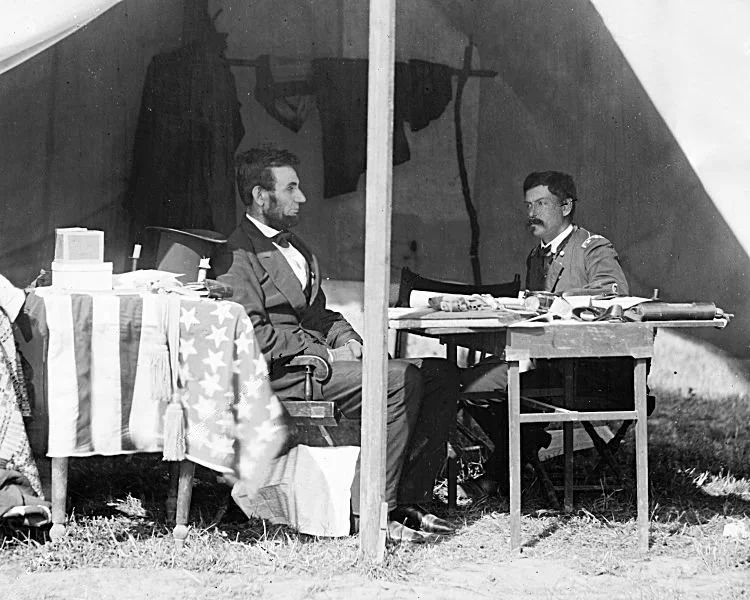
Abraham Lincoln and George B. McClellan at Antietam, Maryland, October 3, 1862. Source: Public domain, United States Library of Congress's Prints and Photographs division under the digital ID cwpb.04351., available here.

Aftermath

The battle was over by 5:30 pm. When the smoke cleared and the guns fell silent, Antietam had inflicted an unprecedented toll: estimated total casualties reached 22,717 men—killed, wounded, missing, or captured—making it the bloodiest single‐day engagement in American history. More Americans died in battle on September 17, 1862, than on any other day in the nation's history. The bloodiest battle in American history was Gettysburg, but its more than 46,000 casualties occurred over three days. Antietam ranks fifth in terms of total casualties in Civil War battles.

The devastation to both armies was profound. Officers, enlisted men & horses were destroyed in huge numbers. The dead and wounded littered the field, and it would take months for the dead to be buried. For years after, and even to this day, the remains of soldiers are still being found, evidence of the battle resurfacing in the form of bullets, cannonballs, horseshoes, and other detritus.

The battle is traditionally considered a tactical draw but a strategic Union victory. Modern scholarship suggests Antietam was both a Federal tactical and strategic victory. The battle inflicted terrible casualties on the Army of Northern Virginia, which was already in the process of disintegrating from straggling. Federal troops broke Confederate lines five times during the fighting, and at no point did Southern forces regain the line they occupied before the battle started. Lee remained in place for another day out of the refusal to abandon his campaign, but that amounted to nothing more than posturing.

Lee stayed on the battlefield overnight He prepared to defend against a renewed assault, which never came. Strategically, the battle was a disaster for Lee. The casualties were catastrophic for an army of his size. The ANV retreated to Virginia, McClellan did not pursue despite myriad orders to do so, and was relieved for the second time as commander.

The figures are staggering. Union losses totaled 12,401 (including 2,108 killed, 9,540 wounded, and 753 missing or captured), while Confederate losses amounted to 10,316 (with 1,546 killed, 7,752 wounded, and 1,018 missing or captured). Britannica additionally notes that officer casualties were especially severe: six generals (three Union, three Confederate) fell in the battle, and about a dozen more were wounded.

Looking at the troops actually committed, roughly 56,000 Federal soldiers engaged on key fronts suffered 12,400 casualties (~22%), while about 37,400 Confederates incurred 10,300 casualties (~27.5%)—meaning nearly one in four combatants on the field was killed, wounded, or went missing. When set against the full armies present (approximately 132,000 Union and 87,000 Confederate), these figures translate to overall casualty rates of about 9% and 12%, respectively—figures that belie the ferocity experienced by frontline units.

In terms of casualty composition, of the 22,717 total:

3,654 men were killed (≈16.1%)

17,292 were wounded (≈76.1%)

1,771 were missing or captured (≈7.8%)  

This breakdown roughly mirrors the broader Civil War norm—where about 20% of battle casualties were deaths and 80% were wounds—but Antietam’s sheer scale set a grim benchmark, producing the highest single‐day body count in U.S. military history.


Every historian includes or excludes various units, which may or may not be considered to be part of the battle. Sears, for example, gives lower figures. The desertion rate of the Confederate forces is another major area of contention. According to the Washington Post, these traditional figures are skewed. In his after-action report, McClellan claimed that his men buried 2,700 Confederates on the Antietam battlefield and captured 6,000 more. He could only guess at the number of wounded, but he estimated it was 18,742 men, using the ratio of killed to wounded for his own troops.

This stands in stark contrast to Confederate reports, which claimed losses of 1,674 dead, 2,292 missing and 9,451 wounded — a total of 13,417. Even discounting the wounded, the discrepancy between the two reports is almost 5,000 casualties.


Which is right? The burial grounds would indicate that McClellan’s number is closer to the truth. More than 3,300 dead rebels specifically associated with the Antietam campaign can be found buried in the Confederate cemeteries in Hagerstown, Frederick, Shepherdstown and Winchester. This number is larger than McClellan’s because it includes bodies buried by the Confederates themselves as well as those who died shortly after the battle.

Perhaps the most important misconception is the number of troops Lee brought with him during his invasion. Most historians cite McClellan as having had 87,000 men and Lee around 40,000. These numbers are often used for the entire three-week campaign, with the Confederates sometimes credited with as many as 55,000 men, 15,000 of whom straggled off before the battle. But there are no complete returns for Lee’s army until Oct. 10, 1862. Every historian’s count is merely a best-guess estimate.

Lee filed his first return five days after the battle, noting the count is “very imperfect” and does not include cavalry or artillery. It states that on Sept. 22, he had at least 36,418 infantry. Adding a conservative number of 5,000 for the missing cavalry and artillery units would bring his total to about 41,000 troops at the end of the campaign.

Eighteen days later, on Oct. 10, Lee filed his first complete report, which showed 64,273 present for duty. This number is significant because Lee had not received a single new regiment to replace his losses; nor did he receive many, if any, recruits because the February draft law had already pulled every eligible man into the army by early summer. If we add Lee’s reported campaign losses of 13,417 (which, as already noted, are too low), it would show that Lee started the campaign with at least 75,000 men. My final answer is that a lot of people died or were wounded, but we really will never know exactly.

IF this is true, McClellan’s supposed outsized numerical advantage is overstated, and his potential to have annihilated Lee is exaggerated. The army he drove back was not much smaller than his own. He did it without proper cavalry support, with his superiors hoping to oust him and with a significant portion of his army untrained. And as it turns out, he inflicted more damage on Lee’s army than anyone suspected.


Lee’s Retreat

Lee was just lucky to have gotten out of Antietam intact. It was a horrible day for him. He had divided his army numerous times and had not planned to be attacked while Jackson was at Harpers Ferry and Longstreet was at Suffolk.  Losing armies in retreat are by definition at their most vulnerable, but for that very reason, at their most dangerous.

On September 18, the armies remained in their positions without fighting. By this point, Lee was highly vulnerable. His army had its back to the Potomac River, just a few miles away, and a quarter of his force had been lost in the previous day’s battle. And after more than two weeks of marching, his men were tired. McClellan, on the other hand, welcomed thousands of additional troops on September 18. But, although he outnumbered Lee’s troops by almost three times, McClellan did not pursue Lee. In fact, despite constant urging from President Abraham Lincoln and Chief of Staff Henry Halleck, McClellan did not move toward Virginia for over a month. McClellan overestimated the size of Lee’s force, assuming that Lee had nearly 100,000 troops in his command, and insisted that the fall of Harpers Ferry, Virginia, on September 15 allowed an additional 40,000 Confederate troops, in his inflated estimation, to fight at Antietam.

Once again, though, modern scholarship has shifted this traditional view. The newest thought points out that McClellan did not pursue Lee because his own army was in no position to give battle. They note that this Union force was in reality four separate commands and that with the battlefield losses, it lacked a unified command structure to organize a movement. The Battle of Shepherdstown, in which just a small part tried to pursue at Shepherdstown (or Botelers) Ford the next 3 days, resulted in a small-scale disaster. Undoubtedly, the units engaged were in bad shape: on September 17th, the 1st Corps suffered 27 % casualties, the Second 31%, the 9th 20 %, and, lastly, the 12th Corps lost 22%. Antietam NPS ranger Keith Snyder has stated that during the battle, there were, in both armies, at least 300 corps, division, brigade, and regimental command changes. In the Federal army alone, there were close to 600 officers, below the rank of colonel, who were either killed or wounded. Not only were the rank and file slaughtered, the command structure was decimated as well.

The post-Antietam messages and reports in the Antietam Official Records contain numerous requests for supplies ranging from ammunition, blankets, shoes, rations, and food. Horses were a major problem. Union horses had also suffered severe casualties. Although Lincoln famously pooh-poohed this concern ("What have your horses done that they are fatigued?”), the Union Army couldn’t move anywhere without the replenishment of the major transportation modality.

Lee retreated across the Potomac River at Shepherdstown Ford, also called Boteler’s Ford: After several days of maneuvering and skirmishing with Union forces, Lee's army crossed the Potomac River at Shepherdstown Ford on September 19-20, 1862. This crossing allowed them to retreat back into Virginia after the Battle of Antietam.

The Battle of Shepherdstown on September 20th. There were 624 casualties—363 Union and 261 Confederate. The Battle of Shepherdstown is one of the largest engagements fought in the modern state of West Virginia (it was still Virginia at the time of the battle in 1862). It was largely inconsequential in the course of the Antietam Campaign because it essentially harassed, but did not stop, Lee’s retreat.
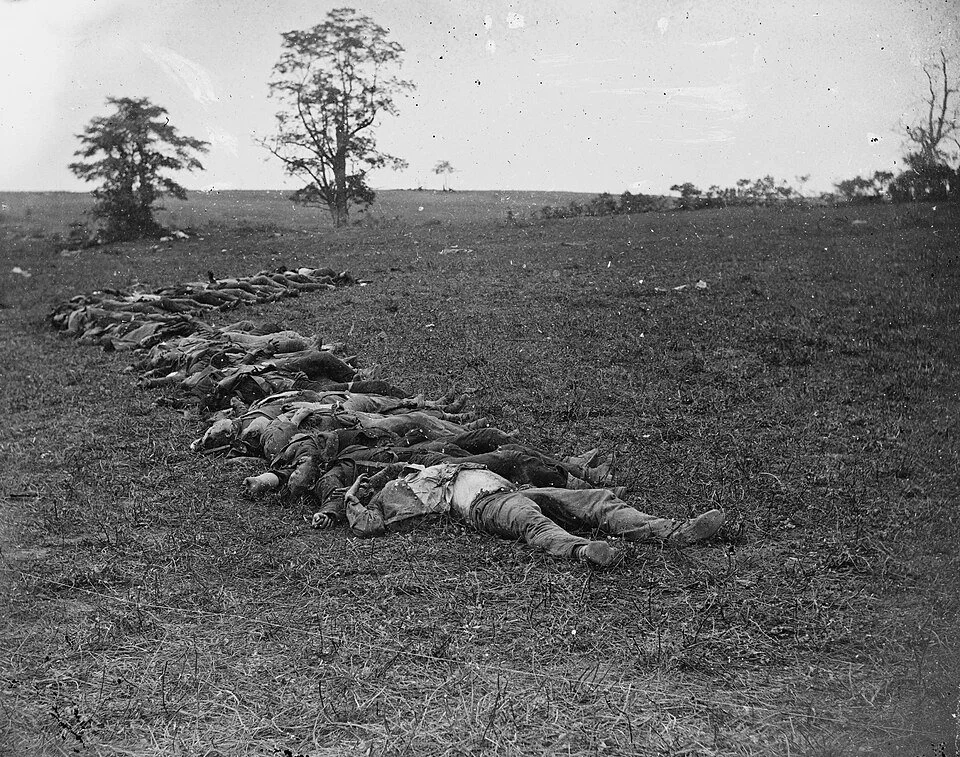
Bodies of Confederate dead gathered for burial after the Battle of Antietam. Source: Public domain, United States Library of Congress's Prints and Photographs division under the digital ID cwpb.01094, available here.

Lincoln Pays a Visit

Meanwhile, President Lincoln was severely disappointed in McClellan's performance both during and after the battle. He believed that McClellan's overly cautious and poorly coordinated actions in the field had caused the battle to be a tactical draw rather than the overwhelming Confederate defeat it really should have been. The president was even more astonished that from September 17 to October 26, despite repeated entreaties from the War Department and the president himself, McClellan declined to pursue Lee across the Potomac, citing shortages of equipment and the fear of overextending his forces.

Famously, President Lincoln came to visit General McClellan on October 3rd. As you can clearly see from the photo, the temperature of the meeting was frosty. As these stiff poses suggest, the personal relationship between the general and the president remained awkward. Abraham Lincoln spent four days travelling over the field, just two weeks after the guns fell silent. He met with McClellan, trying to prod his young Napoleon into action, met with other generals, and with thousands of wounded soldiers, including both Union and Confederate. His trip was well-documented, and the photos of his visit are among the most famous of the entire war.

The biggest winner of all was President Lincoln, absolutely. He had won a victory in time for the November election, to show that progress in the war was being made. The Republicans kept the Senate, gaining an additional seat, and also the House, although they lost 27 seats. Despite inflation, new taxes, a longer and deadlier war than expected, and a midterm election, Lincoln had pulled out a victory of his own.

Lincoln, the master politician, turned Antietam into a political windfall. He used the victory as a cover to issue the Emancipation Proclamation, redefining the purpose of the war and turning it into a moral struggle, not a cultural one. With one victory, he showed Congress and the voters that he had control over how the war would progress and what it was about. Moreover, the English Parliament dropped any discussion of bringing the combatants together for negotiations.


What had seemed just a few weeks before like the biggest crisis in the existence of the country up to that time was resolved by a president who chose the best man available for the predicament at hand, not necessarily the one he got along with or liked best or could manipulate: a far cry from what passes for executive decision making these days. Lincoln showed by his decision how to keep one’s eyes on the prize. This is a lesson numerous hospital administrators I know could learn. Lincoln was the greatest President, and his management of this crisis must forever be regarded as brilliant and exemplary of his genius.

Other winners include all subsequent generations of Americans, because Lincoln used McClellan’s victory to issue the Emancipation Proclamation, the critical first step for redefining what liberty and freedom could mean. The 4 million enslaved Americans were also victors. Although a pure wartime measure, it meant that slavery was on the road to extinction; Allen Nevins has pointed out that within weeks, slaves were leaving their masters’ plantations. The common Federal soldiers were victors. The battle showed that they WERE capable of defeating Massa Robert.

This photograph waw taken by Alexander Gardner., working for Mathew Brady. Lincoln wrote his wife that he was about to sit for the famous photographer with Little Mac: “If we can sit still long enough, which should be no problem for the general.” Lincoln was a sharp, quick-witted man, all right. He was highly critical of McClellan for allowing Lee to get away.


The Dead of Antietam

Mathew Brady exhibited a series of 97 photographs taken immediately after the Battle of Antietam. These images were the first to show the dead bodies of soldiers still on the battlefield.  The impact of this exhibit changed how non-combatants viewed war, and indeed, war news reporting, ever since.

"Mr. Brady has done something to bring home to us the terrible reality and earnestness of war. If he has not brought bodies and laid them in our dooryards and along the streets, he has done something very like it." So wrote a correspondent for The New York Times after visiting Mathew Brady's Manhattan gallery in October 1862 to view the famed photographer's latest exhibit, "The Dead of Antietam."

The accompanying photographs are the two best-known Antietam photographs and are immediately recognizable to every Civil War enthusiast. The top image shows Confederate dead at the Dunker Church. The photographer was standing in what is today the Visitors Center Parking Lot. The second, entitled “View in the Field, on the west side of Hagerstown road, after the Battle of Antietam,” shows the dead by a fence in a road that still exists. The ease of modern accessibility to these locations and their banality add to our sense of horror.  The 95 others are graphic and disturbing even by modern standards, several of which I used in the past week.

The Times review continued:

"You will see hushed, reverent groups standing around these weird copies of carnage," the review noted, "bending down to look in the pale faces of the dead, chained by the strange spell that dwells in the dead men's eyes."


Harper’s Weekly, the leading news weekly, devoted the center spread of its October 18, 1862, issue to images of the Antietam dead. Although the technology did not yet exist to reproduce actual photographs in newspapers and news weeklies, the periodical published woodcut engravings of eight photos, including six showing the dead.

Challenge: Two photographers Brady hired to document the war produced these images at Antietam. Who were these men who took these incredible photographs that changed war reporting forever?

Matthew Brady decided to move on from studio portraits and cartes-de-visite to document the war, and, with permission from President Lincoln, he organized and self-financed a team of photographers who took thousands of photographs documenting camp life and battlefield scenes. One of these photographers on Brady’s team, Alexander Gardner, took all the photographs featured, and James Gibson assisted.

In 1862, Brady’s exhibit The Dead of Antietam showed the public the first ever photographs of a battlefield before the dead had been removed. The exhibition took place at Brady’s studio on Broadway in New York City. In modern society, we often see live battlefield scenes on television news and movie images of graphic content, and have become somewhat desensitized to the violence of warfare. It is hard for us today to fully comprehend the shocking impression this exhibit made.

Gardner arrived on the battlefield on September 19, 1862, two days after the battle had ended. He photographed the dead and the living who handled their remains, demonstrating without protecting the viewer from the sight, those who had grisly wounds, those who fell over rocks in their final moments, and the bodies bloating under the hot sun.

Gardner and Brady knew they were capturing history with their cameras, but their primary reason for taking battlefield images was that they knew they would sell. Civil War photos and stereo views sold well during and after the war. Their popularity is evidenced by the dozens of original views available today at online auction sites or from antique photograph dealers. Brady’s stereographs and Album Gallery Cards cost 50 cents each during the war. That’s $10.67 in 2020 dollars, putting them in the same general price range as a video or movie today.

These images received extensive media attention. They shocked and fascinated, and saddened those who saw them. And to this day, they remain some of the most graphic images of American war casualties ever published. Unlike the battle images of Vietnam, these images did not create an anti-war backlash. Instead, they convinced the public that the soldiers fighting for their country were indeed brave, and that war was not the glorious spectacle of fairy tales.

The New York Times review conveys the impact of these photos, perhaps as well as the photos themselves:

“The living that throng Broadway care little perhaps for the Dead at Antietam, but we fancy they would jostle less carelessly down the great thoroughfare, saunter less at their ease, were a few dripping bodies, fresh from the field, laid along the pavement. There would be a gathering up of skirts and a careful picking of way; conversation would be less lively, and the general air of pedestrians more subdued. As it is, the dead of the battlefield come up to us very rarely, even in dreams. We see the list in the morning paper at breakfast, but dismiss its recollection with the coffee.”


Enjoyed the piece?

Join thousands of history readers getting occasional updates on new blog posts, books, and video releases — plus a free history book to get you started.

Join History Is Now here


References

·       Sears Stephen. Landscape Turned Red: The Battle of Antietam, Houghton Mifflin, 1983.

·       Rossino, Alexander & Thorp, Gene. The Tale Untwisted: George McClellan and the Discovery of Lee's Lost Orders, September 13, 1862. El Dorado Hills, CA: Savas Beatie.

·       Rossino, Alexander. Their Maryland: the Army of Northern Virginia from the Potomac Crossing to Sharpsburg in September 1862. Savas Beatie. 2021.

·       Rossino, Alex. Calamity at Frederick: Robert E. Lee, Special Orders No. 191, and Confederate Misfortune on the Road to Antietam. Savas Beattie, 2023.

·       Hartwig, D Scott. I Dread the Thought of the Place: The Battle of Antietam and the End of the Maryland Campaign. Johns Hopkins University Press, 2023.

·       https://emergingcivilwar.com/2022/02/24/who-lost-the-lost-order/

·       https://www.rebellionresearch.com/special-order-191-ruse-of-war-part-1

·       https://www.theodysseyonline.com/the-insignificance-of-special-order-191

·       https://alexanderrossinocom.wordpress.com/wp-content/uploads/2023/09/ns-lees-beaver-creek-plan-june-2022.pdf

·       Rossino, Alexander B. Reset in Maryland. America’s Civil War Winter 2024 pp 22-31.

·       Rossino, Alexander. Lecture: Before September: The Origin of the 1862 Maryland Campaign. Antietam Institute, July 7, 2025.

·       https://antietaminstitute.org/2025/01/10/before-september-the-origin-of-the-1862-maryland-campaign-dr-alex-rossino/

·       https://www.washingtonpost.com/lifestyle/style/in-defense-of-mcclellan-at-antietam-a-contrarian-view/2012/09/06/79a0e5cc-f131-11e1-892d-bc92fee603a7_story.html

·       https://www.washingtonpost.com/wp-srv/special/artsandliving/civilwar/mcclellan-graphic/

·       Marcel D'Aoust. https://www.historynet.com/little-mac-not-dawdle/

·       https://www.washingtonpost.com/lifestyle/style/in-defense-of-mcclellan-at-antietam-a-contrarian-view/2012/09/06/79a0e5cc-f131-11e1-892d-bc92fee603a7_story.html

·       https://www.battlefields.org/learn/civil-war/battles/shepherdstown

·       https://civildiscourse-historyblog.com/blog/2021/3/15/retreat-from-antietam-the-battle-of-shepherdstown-september-19-20-1862

·       https://www.nytimes.com/1862/10/20/archives/bradys-photographs-pictures-of-the-dead-at-antietam.html
Posted
AuthorHistory Is Now Magazine

Abraham Lincoln’s assassination on April 14, 1865 had significant consequences, particularly coming as it did shortly before the end of the U.S. Civil War. Here, Lloyd W Klein looks at the assassination and Lincoln’s killer, John Wilkes Booth.

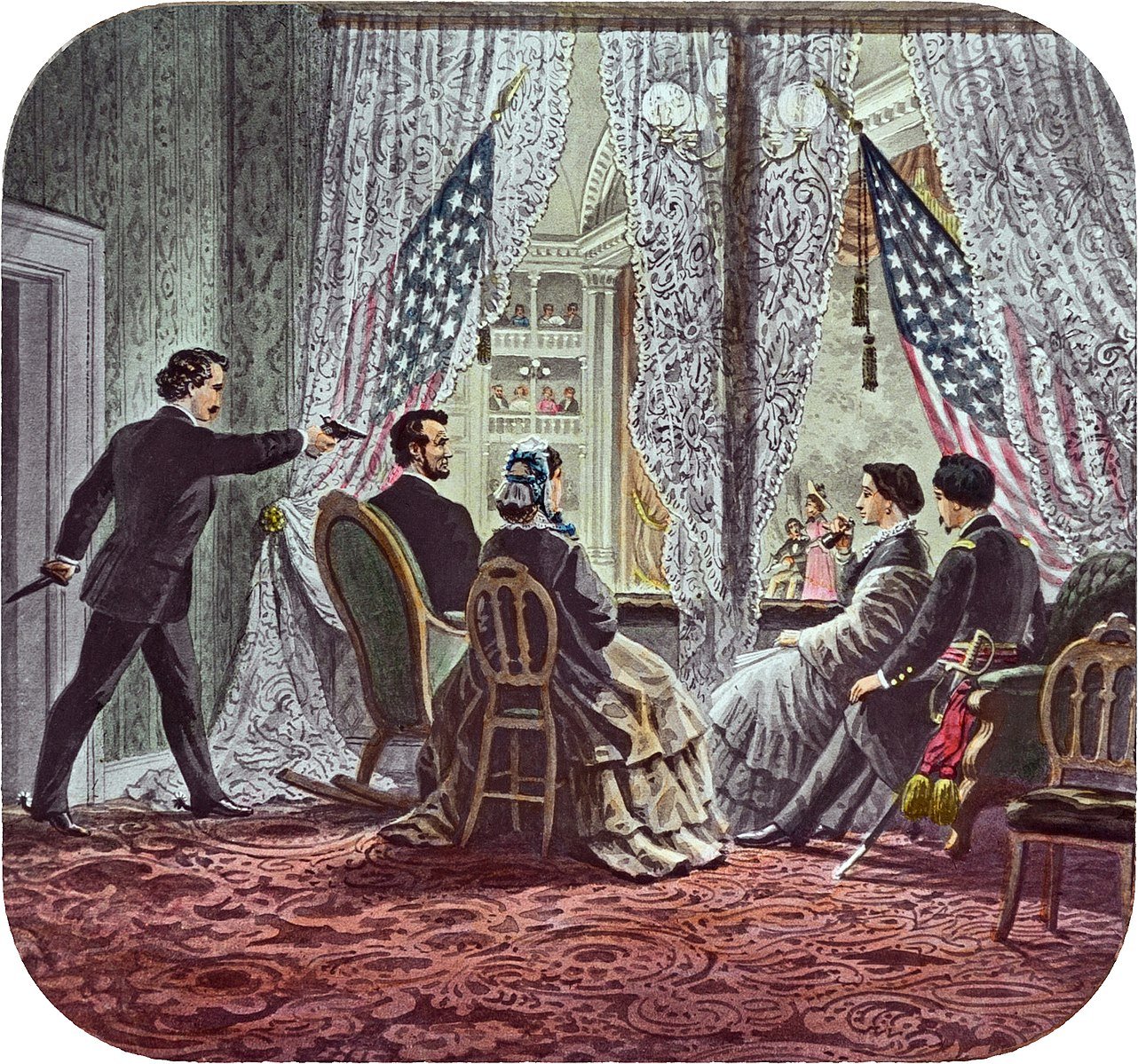
A depiction of John Wilkes Booth when he was about to shoot President Abraham Lincoln.

The Assassination

The assassin silently opened the first door to the President’s theater box, fully aware that the bodyguard was not around. He barricaded the door behind him, using a stick that he wedged in between the door and the wall. He then looked through a small peephole he’d previously carved in the second door. The time was shortly after 10 PM. He waited for the particular line in the play he knew was received by the audience with loud laughing and noise, to be spoken by actor Harry Hawk (playing Asa Trenchard). When he heard the line, “Don’t know the manners of good society, eh? Well, I guess I know enough to turn you inside out, old gal; you sockdologizing old man-trap!” and heard the expected audience response, he opened the second door.  He silently moved forward and took one shot at the back of the President’s head, who was laughing. He dropped his derringer, then pulled a knife to fight off the officer accompanying Lincoln that night, who had grabbed his coat to restrain him.

Well aware of the layout of Ford’s Theater, having acted there numerous times, his escape route was to jump from the balcony where the box was located to the stage. When he jumped to the stage, Booth broke the fibula, the small bone in the bottom of his left leg. In his diary, Booth wrote that he said, “Sic semper” although eyewitnesses thought he said “Sic semper tyrannis” and others “The South is avenged”. Only the screams of the ladies from the box suggested this wasn’t a part of the play; the audience began to realize what had happened when the officer yelled, “Stop that man”.

Booth ran out to the alley from backstage, pursued by audience members, where his groom Joseph “Peanuts”  Burroughs was waiting outside, holding Booth’s horse. Booth struck Peanuts in the head with his knife, jumped onto his horse, and rode off.


Booth had gained entrance to the President’s box at the theater without any problem because the assigned bodyguard, John Parker, a Metropolitan Washington DC officer, was not where he was supposed to be: seated just outside in a passageway by the door. From where he sat, the bodyguard couldn’t see the stage, so after Lincoln and his guests settled in, he moved to the first gallery to enjoy the play. Later, he committed an even greater folly: at intermission, he joined the footman and coachman of Lincoln’s carriage for drinks in the Star Saloon next door to Ford’s Theatre. Booth was seated in the Star Saloon, drinking quite heavily. When Booth crept up to the door to Lincoln’s box, he knew there was no one on duty because he saw Parker drinking in the saloon.

Major Henry Rathbone attended the play at Ford’s Theater with the Lincolns and his fiancée, Clara Harris. He was invited only because General and Mrs. Grant turned down the invitation at a late hour. The general’s wife, however, had recently been the victim of Mary Todd Lincoln’s acid tongue and wanted no part of a night on the town with the First Lady. Grant had backed out citing the couple’s desire to travel to New Jersey to see their children. He attempted to stop the assassin but was seriously wounded by Booth, who slashed Rathbone’s left arm from his elbow to his shoulder.

All four of the people in that box would become tragic victims of that night. Major Rathbone married Clara—who also happened to be his stepsister—in 1867, but then he grew increasingly erratic and perhaps suffered from post-traumatic stress. Although they had 3 children, he was mentally anguished forever after by thoughts that he had not done enough to prevent the murder. Although appointed by President Arthur to be the Consul to Hanover, his mental health continued to decline. He threatened divorce frequently. He ultimately fatally shot and stabbed his wife and then stabbed himself five times. He was charged with murder but instead was declared insane and committed to a mental asylum for the remainder of his life. Mary Todd Lincoln, the fourth person present, was herself institutionalized in 1875.

The president had been mortally wounded; He was carried to a lodging house across the street from the theater. At about 7:22 the next morning, he died—the first U.S. president to be assassinated.


Seward

Another segment of the plot was to assassinate William Seward, the Secretary of State. Lewis Powell, a co-conspirator with John Wilkes Booth, forced his way into Seward’s house. Seward had been in a carriage accident 9 days previously, breaking his jaw. He was recuperating from a painful wound that prevented him from eating normally. The accident and Seward’s injuries were widely reported. Powell came to the door dressed well and claimed to be bringing pain medication that Seward’s doctor had prescribed. The servant answering the door was happy to take the medication but would not give the “messenger” entrance to the house. Powell pushed open the door and raced up the stairs to the bedroom, where he stabbed Seward several times before fleeing the scene. Seward was wearing a brace for his jaw injury that deflected the knife slashes. He also rolled over away from the killer and was only minimally injured in the chest and neck.  Besides Seward, 8 people were stabbed and one hit in the head; these included four of Seward's children, a bodyguard, and a messenger. His son Frederick was hit in the head by a pistol when the gun malfunctioned; he spent 2 months in a coma. That night and the next morning, Seward deduced that Lincoln had been murdered. Seward heard church bells tolling; although the people around him tried to deny it, fearing the effect of inflicting emotional pain, Seward said, “Lincoln is dead because if he were alive he would have been the first to come to see me.”


Who was Booth? What was he planning?

John Wilkes Booth was a famous actor, from a very prominent theatrical family. Many considered Booth’s father, Junius Brutus Booth, to be the finest Shakespearean actor of his generation, and Booth’s older brother, Edwin is commonly named among the greatest American actors of all time,  Booth grew up in Baltimore. He was called “the handsomest man in America” by at least one critic.

His interest in politics, and particularly his partiality to slavery, developed at a young age. The rest of his family could not abide his politics, as they were all Union men. Booth became involved with the Knights of the Golden Circle in Baltimore. During the war, he chose to remain in the North despite his political persuasions as there were more options for actors in northern cities.

His anti-Union sentiments were fully displayed on an October 1864 trip to Montreal, a city noted for its southern sympathy and a notorious outpost of Confederate agents. On October 18th he checked into St. Lawrence Hall, an old Hotel known as the Confederacy’s Canadian center. Witnesses would later claim to have seen Booth talking with known agents and openly expressing contempt for Lincoln.

There, money from some source changed hands; a bankbook with $ 455 and three certificates of exchange from The Ontario Bank dated October 27th was found in his possession when he was killed. It is believed that he had already developed a general plan for the kidnapping of Abraham Lincoln at that point. Booth was known to have been in Montreal that day. The origin of these funds remains uncertain, especially regarding whether someone high up in the Confederate government had financed the assassination (Klein).

A witness at the 1865 trial of Booth’s accomplices testified that Patrick C. Martin accompanied Booth to the Montreal branch of the Ontario Bank, where Booth made a deposit and took bills of exchange. Martin was a Baltimore liquor dealer who had established a Confederate Secret Service base in Montreal in the summer of 1862. He had arranged blockade running and financial services benefitting Confederate interests. It is known that Booth tried to arrange the transfer of his theatrical costumes to Jamaica by Martin

Martin gave Booth letters of introduction to two southern Maryland physicians, Dr. William Queen and Dr. Samuel Mudd. These operatives were to assist him in escaping. In November, 1864. Booth deposited $1,500 in the Cooke Bank in Washington. He spent these funds between January 7 and March 16, 1865, to assemble his team.


The Plot

Booth had visited Bryantown MD  in November and December 1864, allegedly to search for real estate investments. Bryantown is located 25 miles from Washington and about 5 miles from Dr. Mudd's farm. Of course, the real estate alibi was a cover; Booth's true purpose was to plan an escape route as part of the plan to kidnap Lincoln. Booth’s original idea was that the federal government would ransom Lincoln by releasing a large number of Confederate prisoners of war.


There, he met with Dr Mudd, an active participant in a confederate spy network. Booth met Mudd at St. Mary's Catholic Church in Bryantown during one of those visits, probably in November. Booth visited Mudd at his farm the next day and stayed there overnight. The following day, Booth purchased a horse from Mudd's neighbor and returned to Washington.

On December 23, 1864, Mudd traveled to Washington. There he met Booth again, where the two men, as well as John Surratt, Jr., and Louis J. Weichmann, had a conversation and drinks. They met first at Booth's hotel and later at Mudd's. According to a statement made by George Atzerodt taken while he was in federal custody on May 1, 1865, Mudd knew in advance about Booth's plans; Atzerodt was sure the doctor knew  because Booth had "sent (as he told me) liquors & provisions... about two weeks before the murder to Dr. Mudd's."


It has been suggested that Booth heard Lincoln speak at his second inaugural address. Some photos appear to show him in the crowd wearing a top hat but perhaps also without. No one knows for certain if this individual is Booth, or even if Booth was present that day.


On March 17, Booth and a group composed of  George Atzerodt, David Herold, and Lewis Powell, met in a Washington bar to plot the abduction of the president three days later. However, the president changed his plans, and the scheme was scuttled. General Robert E. Lee surrendered to the Union on April 9th at Appomattox Court House and the war was essentially over.


On the evening of April 11, the president stood on the White House balcony and delivered a speech outlining some of his ideas about reconstruction and bringing the defeated Confederate states back into the Union. Lincoln indicated a desire to give voting rights to some African Americans, such as those who had fought in the Union ranks during the war. He expressed a desire that the southern states would extend the vote to literate blacks, as well. Booth was in the small audience on the White House lawn listening. , “That means n____ citizenship,” he told Lewis Powell. “Now, by God, I’ll put him through. That is the last speech he will ever make.” Booth’s plot changed to murder at that moment. The conspirators altered their plan; the new plot was to kill Lincoln, Vice President Andrew Johnson, and Secretary of State William Seward on the same evening.


While visiting Ford's Theatre around noon to pick up his mail on April 14th, Booth learned that Lincoln and Grant were to visit the theater that evening for a performance of Our American Cousin. Booth had performed there several times, so he knew the theater's layout and was familiar to its staff. Recognizing this was a golden opportunity, Booth went to Mary Surratt's boarding house and asked her to deliver a package to her tavern in Surrattsville, Maryland. He also asked her to tell her tenant Louis J. Weichmann to ready the guns and ammunition that Booth had previously stored at the tavern.


The conspirators met for the final time at 8:45 pm. Booth assigned Powell to kill Secretary of State William H. Seward at his home, Atzerodt to kill Vice President Andrew Johnson at the Kirkwood Hotel, and Herold to guide Powell (who was unfamiliar with Washington) to the Seward house and then to a rendezvous with Booth in Maryland. Atzerodt backed out of his part to kill Johnson.


The Fibula Fracture

Many people believed that Booth broke his leg as a result of jumping from the presidential box onto the theatre stage from the impact of the jump to the stage, where he landed somewhat off balance. Some historians speculate that Booth may have broken his leg when the horse that he was riding, galloping away from the murder scene at a high rate of speed, tripped and fell on its left side. Perhaps his left leg was entangled in the flag that was draped in front.

Fibular fractures can be due to falls when landing incorrectly, but can also occur from a severely twisted ankle.The distance from the theatre box balcony to the stage floor today is approximately 12 feet. Some eyewitness accounts suggested that the original height was closer to 9 feet, and a sketch done soon after the assassination suggests the distance was 10 feet, 7 inches. The distance Booth jumped may never be accurately known since the theatre was renovated in 1866. The original box was completely demolished.

Fibular fractures are painful and often accompanied by ligament or tendon injuries. Swelling, tenderness, inability to bear weight, and numbness are common. This injury would be a serious impediment to one’s ability to walk without a limp or run normally.


Escape Route & Capture

After the assassination, Booth rode to Maryland with David Herold. The first place was Popes Creek on the Potomac River in southern Maryland, and then to the Surratt Tavern to pick up the weapons he had asked to be delivered there earlier. Finally, he went to the home of Dr. Mudd, who placed splints on Booth’s leg. It would have been impossible, as Mudd claimed, that he did not know this man, whom he had met on several occasions. Moreover, while Mudd may not have known about the assassination that night, he certainly did the next morning when he went into town; yet he told no one about his guests. Booth then left and they stayed at the home of Samuel Cox, and then in some woods on the north bank of the Potomac. There, Booth had access to newspapers and food. On April 22nd, they rowed across the river to Virginia, on the south side. They hid in a barn on Richard Garrett’s farm, as thousands of Union troops combed the area looking for them.

The assassination of Abraham Lincoln initiated a massive search to find the killers Secretary of War Stanton sent a telegram to his man, Lafayette Curry Baker, head of the federal intelligence service, called the US Secret Service. Curry was in New York City when Stanton ordered him to come to DC immediately and help find the murderer. The identity of the assassin was well established, but he remained at large. Despite being In a city with thousands of troops at the war’s end, and hundreds of police, Stanton sent out the signal for this particular man to help find him. “Come here immediately and see if you can find the murderer of the President,” Stanton telegraphed him. He took the train the next day.

Within two days he had arrested Mary Surratt, Lewis Paine, George Atzerodt, and Edman Spangler. He also had the names of the fellow conspirators, John Wilkes Booth and David Herold. His investigation method wasn’t to search for anyone. Instead, he planted moles in the ranks of the investigators. From them, he learned that the prime suspects were traveling south through the eastern Maryland counties of Prince George and Charles. Thousands of troops and uncounted civilians were involved in the manhunt. Stanton had put out a reward of $100,000 (about $1.8 million in today’s dollars). Every motivated civilian, detective, policeman, and Union officer hoped to strike it rich.

He happened to be in the offices of the War Department when he learned that two men identified as the fugitives had been seen making the Potomac crossing into Virginia near Mathias Point on April 22nd. He knew a great deal about the routes used by Confederate couriers and spies that operated in the Northern Neck and made an educated guess as to where Booth and Herold might be. He summoned two assistants in his office spread out a map on a small table and pointed to Mathias Point on the Virginia side of the Potomac. “He’s right in there,” pointing to a circle he drew on the map. “I want you to go to this place, search the country thoroughly, and get Booth.”

He sent Lieutenant Edward P. Doherty and twenty-five men from the Sixteenth New York Cavalry to capture Booth in Virginia, accompanied by Lieutenant Colonel Everton Conger, an intelligence officer.  Several of his men knocked on doors, and asked about two men, one with a broken leg, for 12 hours. Finally, an ex-Confederate soldier named William S Jett was interrogated roughly. The man guided them and a cavalry squad to Richard H Garrett’s farm, where the cavalrymen discovered the fugitives in a tobacco barn on the morning of Wednesday, April 26, 1865.

Around 2:00 am the soldiers surrounded the barn, which was located about 60 miles south of Ford's Theatre near Port Royal, Virginia. Lieutenant Luther Baker yelled, "Surrender, or we'll fire the barn and smoke you out like rats! We'll give you five minutes more to make up your minds." Booth asked for time to decide. Finally, after some more give and take with the soldiers, Booth yelled, "Well, my brave boys, you can prepare a stretcher for me! I will never surrender!" After a short time, Booth said, "Oh, Captain, there's a man in here who wants to surrender awful bad." The barn door rattled, and David Herold's voice was heard saying he wanted to give up. Herold slowly came out and was slammed to the ground by the soldiers. He was hauled to a nearby tree and tied up with rope.

Still, Booth would not come out. Using straw and brush, Conger set the barn on fire. Booth was visible to the soldiers because the barn was full of cracks and knotholes. They could see him moving about the burning barn holding his carbine and crutch. At this moment, Corporal Boston Corbett shot Booth through the neck. Booth was paralyzed and barely alive. With difficulty, Booth was able to speak. He said, "Tell Mother I died for my country." A local doctor, Dr. Charles Urquhart, Jr., who had been a physician in nearby Port Royal since 1821, arrived on the scene and indicated the wound that had punctured Booth's spinal cord was fatal. Sometime around 7:00 A.M. Booth looked at his hands and moaned, "Useless! Useless!" Those were probably the last words Booth spoke before dying.

Booth was pronounced dead at 7:15 A.M. A search of his body turned up a pair of revolvers, a belt and holster, two knives, some cartridges, a file, a war map of the Southern States, a spur, a pipe, the Canadian bills of exchange, a compass with a leather case, a signal whistle, an almost burned up candle, pictures of five women - four actresses (Alice Grey, Helen Western, Effie Germon, and Fanny Brown) and his fiancée, Lucy Hale (the daughter of ex-Senator John P. Hale from New Hampshire), and an 1864 date book kept as a diary. These items found on his person still exist. They are owned by the National Park Service and held at the Ford’s Theater Museum. They have a long history in themselves.

Lt Col Conger brought Booth’s possessions back to Curry, who turned them over to Secretary of War Edwin M. Stanton, who used them as trial evidence for the assassins' accomplices. Except for one thing: Booth’s diary. When it reappeared in 1867, it was missing 18 pages. No one knows who cut those out of the book, or why. Stanton claimed it was given to him like that. It might be that the missing pages in Booth’s diary told who Booth was working for, and the whole story of the plot; and may have incriminated very prominent people, such as Andrew Johnson, as part of the kidnapping scheme. Some have speculated that Stanton destroyed the pages because his own name appeared in it. Yet another theory is that the missing pages included the names of people who had financed the conspiracy; it later emerged that  Booth had received a large amount of money from a New York-based firm to which Stanton had connections.

The other conspirators were captured the day after the assassination outside Surratt’s boarding house, except for John Surratt, who fled to Canada. Powell was caught purely by accident, as he approached the boarding house not knowing Union troops were inside; he was missing his hat (found in the Seward home) and had blood stains on his clothes. On July 7, after a military court trial. George Atzerodt, Lewis Powell, David Herold, and John Surratt’s mother, Mary, were hanged in Washington. The execution of Mary Surratt is believed by some to have been a miscarriage of justice. Although there was proof of her involvement in the original abduction conspiracy, it is clear that her deeds were minor compared to those of the others who were executed. John was eventually tracked down in Egypt and brought back to trial, but with the help of clever lawyers, he won an acquittal in a civilian court.

On June 29, 1865, Mudd was found guilty with the others. The testimony of Louis J. Weichmann was crucial in obtaining the convictions. Mudd escaped the death penalty by one vote and was sentenced to life imprisonment. He was later pardoned by President Andrew Johnson in 1869.

Some contemporary historians make a case that Dr Mudd should be exonerated. There is no definitive evidence to support that he knew that Lincoln was assassinated nor that Booth had committed a crime. There is evidence that he was involved in the kidnapping plot though. The key issue is that he lied about knowing Booth, and how much he knew about the plot, and delayed reporting Booth's presence. That made him guilty of conspiracy and being an accomplice, but saved him from the death penalty. Interestingly, others also knew about the kidnapping plot who weren't convicted of the murder. Legally his lack of planned involvement in the assassination mitigates any participation after the fact. Then there is his Hippocratic oath, which obligated him to treat Booth's leg, although not to maintain his anonymity. Moreover, although Weichmann tied the acquaintance of Booth to Mudd, he did not claim to know what they discussed.

Baker was promoted to Brigadier General and received all the publicity and the reward for the capture. But several years later he died under mysterious circumstances, further suggesting a conspiracy of profound intrigue.


Was the Booth capture a hoax?

Booth's remains were sewn up in a horse blanket and placed on a wide plank. An old market wagon was obtained nearby, and the body was placed in the wagon. The body was taken to Belle Plain. There it was hoisted up the side and swung upon the deck of a steamer named the John S. Ide and transported up the Potomac River to Alexandria where it was transferred to a government tugboat. The tugboat carried the remains to the Washington Navy Yard, and the corpse was placed aboard the monitor Montauk at 1:45 A.M. on Thursday, April 27. Once aboard the Montauk, Booth's remains were laid out on a rough carpenter's bench. The horse blanket was removed, and a tarpaulin was placed over the body.

Several witnesses were called to identify the body. A sketch that appeared in Harper's Weekly on May 13, 1865, shows the process. Several people who knew Booth personally are known to have identified the body. One of these people was Dr. John Frederick May. Sometime before the assassination, Dr. May had removed a large fibroid tumor from Booth's neck. Dr. May found a scar from his operation on the corpse's neck exactly where it should have been. Charles Dawson, the clerk at the National Hotel where Booth was staying, identified the initials "J.W.B" pricked in India ink on the corpse's hand. As a boy, Booth had his initials indelibly tattooed on the back of his left hand between his thumb and forefinger. Alexander Gardner, the well-known Washington photographer, was also among those who positively identified the remains, as were his assistant Timothy O’Sullivan, and Seaton Munroe, a prominent Washington attorney.

There were five witnesses to the post-mortem: Charles M. Collins, Charles Dawson, Seaton Munroe, John Frederick May, and William Wallach Crowninshield, Surgeon General Joseph K. Barnes, Dr. Joseph Janvier Woodward, and Dr. George Brainard Todd performed the autopsy aboard the Montauk. Booth’s third, fourth, and fifth cervical vertebrae, which were removed during his autopsy, are housed (not on public display) at the National Museum of Health and Medicine at the Walter Reed Army Medical Center. An additional fragment from Booth's autopsy (tissue possibly cleaned off the cervical vertebrae) is in a bottle in the Mütter Medical Museum of the College of Physicians of Philadelphia.


******************************************************************************

Dr. Barnes wrote the following account of the autopsy to Secretary of War Edwin Stanton:

“Sir,

I have the honor to report that in compliance with your orders, assisted by Dr. Woodward, USA, I made at 2 PM this day, a postmortem examination of the body of J. Wilkes Booth, lying on board the Monitor Montauk off the Navy Yard.


The left leg and foot were encased in an appliance of splints and bandages, upon the removal of which, a fracture of the fibula (small bone of the leg) 3 inches above the ankle joint, accompanied by considerable ecchymosis, was discovered.”


The cause of death was a gunshot wound in the neck - the ball entering just behind the sterno-cleido muscle - 2 1/2 inches above the clavicle - passing through the bony bridge of fourth and fifth cervical vertebrae - severing the spinal chord (sic) and passing out through the body of the sterno-cleido of right side, 3 inches above the clavicle.


Paralysis of the entire body was immediate, and all the horrors of consciousness of suffering and death must have been present to the assassin during the two hours he lingered.”


****************************************************************************

Some have suggested that Booth actually was never captured and escaped to Texas, where many years later his “corpse” was a great sideshow hit. This photograph is searchable online, but it is complete nonsense: the Booth autopsy was well attended and documented.

The corpse was again positively identified in February of 1869 when Booth's remains were exhumed and released by the government to the Booth family. At that time an inquest was held at Harvey and Marr's Parlor in Washington. Booth's corpse was taken to Baltimore for burial and was positively identified by many people including John T. Ford, He ry Clay Ford, and Joseph Booth, John's brother.


Did you find that piece interesting? If so, join us for free by clicking here.


References

https://www.thevintagenews.com/2016/01/18/46415/

https://www.smithsonianmag.com/history/lincolns-missing-bodyguard-12932069/

https://www.history.com/this-day-in-history/john-wilkes-booth-shoots-abraham-lincoln

https://www.historynet.com/dr-samuel-a-mudd/

https://globalnews.ca/news/1611968/lincoln-assassin-john-wilkes-booths-canadian-connection/

https://lincolnconspirators.com/picture-galleries/found-on-booth/

https://lincolnconspirators.com/2012/05/31/booth-at-lincolns-second-inauguration/

https://www.onthisday.com/photos/john-wilkes-booth-at-lincolns-inauguration,

https://www.nps.gov/foth/learn/historyculture/faq-the-assassin.htm#:~:text=Many%20people%20believed%20that%20John%20Wilkes%20broke%20his,on%20something%20and%20fell%20on%20its%20left%20side.

https://www.fords.org/visit/historic-site/museum/

https://www.militaryimagesmagazine-digital.com/2022/06/05/scoundrel-the-rise-and-fall-of-union-spy-chief-lafayette-curry-baker/

American Brutus by Michael Kauffman On page 348 (first edition hardcover)

https://www.history.com/this-day-in-history/john-wilkes-booth-shoots-abraham-lincoln

https://columbialawreview.org/.../the-law-of-the-lincoln.../

https://www.rogerjnorton.com/Lincoln83.html


Further Reading

·      https://rogerjnorton.com/Lincoln40.html

·      Michael W Kauffman, American Brutus: John Wilkes Booth and the Lincoln Conspiracies. Random House, 2004

A few weeks before he was elected President, Lincoln received a letter from Grace Bedell, an 11-year-old girl from Westfield, New York. Richard Bluttal explains.

Grace Bedell in the 1870s.

The Letter

N Y Westfield Chatauque Co Oct 15. 1860

Hon A B Lincoln Dear Sir

My father has just home from the fair and brought home your picture and Mr. Hamlin's. I am a little girl only eleven years old, but want you should be President of the United States very much so I hope you wont think me very bold to write to such a great man as you are. Have you any little girls about as large as I am if so give them my love and tell her to write to me if you cannot answer this letter. I have got 4 brother's and part of them will vote for you any way and if you will let your whiskers grow I will try and get the rest of them to vote for you   you would look a great deal better for your face is so thin. All the ladies like whiskers and they would tease their husband's to vote for you and then you would be President. My father is a going to vote for you and if I was a man I would vote for you to but I will try and get every one to vote for you that I can   I think that rail fence around your picture makes it look very pretty   I have got a little baby sister she is nine weeks old and is just as cunning as can be. When you direct your letter dir[e]ct to Grace Bedell Westfield Chatauque County New York

I must not write any more   answer this letter right off Good bye Grace Bedell.


 As soon as Mr. Lincoln received the letter he wrote back the following:


October 19, 1860

Springfield, Illinois Miss Grace Bedell

My dear little Miss,

Your very agreeable letter of the 15th is received. I regret the necessity of saying I have no daughters. I have three sons—one seventeen , one nine, and one seven years of age. They with their mother, constitute my whole family. As to the whiskers, having never worn any, do you not think people would call it a piece of silly affection if I were to begin it now? Your very sincere well-wisher.

-A. Lincoln


By the time Lincoln left his Illinois home to start his inaugural journey to Washington, D.C., he wore a full beard. The trip took him by rail through New York state, where he stopped briefly in Westfield on February 16. Once at the train station, he called into the crowd for Grace. The following contemporary newspaper accounts recorded the incident.


From the Philadelphia Inquirer of February 20, 1861

At Westfield, Mr. Lincoln greeted a large crowd of ladies, and several thousand of the sterner sex. Addressing the ladies, he said, "I am glad to see you; I suppose you are to see me; but I certainly think I have the best of the bargain. (Applause.) Some three months ago, I received a letter from a young lady here; it was a very pretty letter, and she advised me to let my whiskers grow, as it would improve my personal appearance; acting partly upon her suggestion, I have done so; and now, if she is here, I would like to see her; I think her name was Miss Barlly." A small boy, mounted on a post, with his mouth and eyes both wide open, cried out, "there she is, Mr. Lincoln," pointing to a beautiful girl, with black eyes, who was blushing all over her fair face. The President left the car, and the crowd making way for him, he reached her, and gave her several hearty kisses, and amid the yells of delight from the excited crowd, he bade her good-bye, and on we rushed.


Did you enjoy the piece? If so, join us for free by clicking here.