By September 1066, England had become the prize in one of the most extraordinary succession crises of the medieval world. King Edward the Confessor was dead, Harold Godwinson occupied the English throne, and two powerful foreign rulers had already claimed that the crown belonged to them. Duke William of Normandy was preparing an invasion across the Channel, but before William could strike, another claimant had arrived in England. From Scandinavia came Harald Hardrada, King of Norway, one of the most formidable warriors of his age. His invasion would force Harold Godwinson into a desperate gamble: to march north, defeat the Viking army, and then somehow return south before William could land.

Terry Bailey explains.

Read part 1 on the pre-invasion world of 1066 here, and part 2 on the road to invasion here.
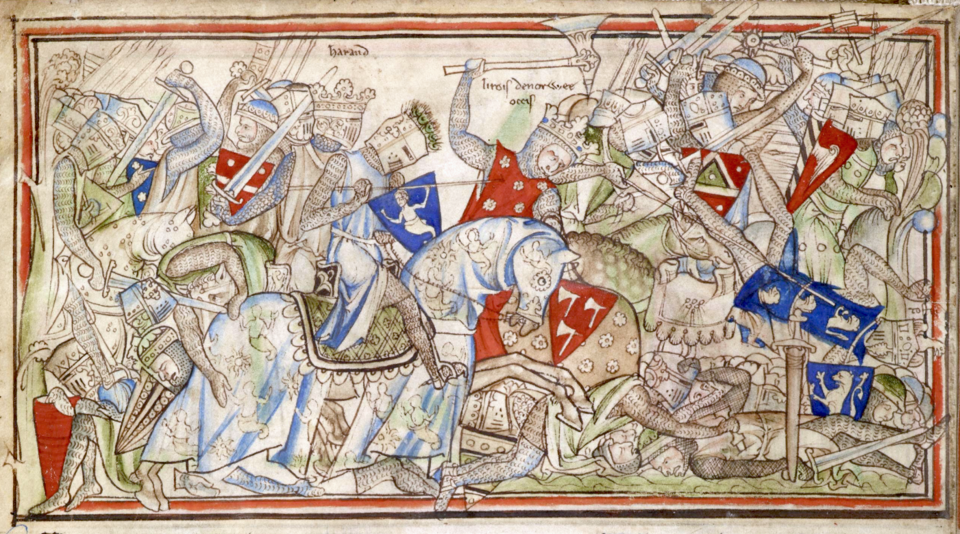
The Battle of Stamford Bridge. Source: public domain, he Life of King Edward the Confessor by Matthew Paris. 13th century, available here.

The Norwegian invasion was not a minor raid. Hardrada was an experienced military commander who had spent much of his life fighting across Europe and beyond. His claim to the English throne rested partly upon an agreement allegedly made between the Norwegian king Magnus the Good and the English king Harthacnut, under which each was said to have inherited the other's kingdom if one died without an heir. Although the legal basis of Hardrada's claim was disputed, the Norwegian king possessed something more immediately important than legal arguments: a powerful army and a fleet capable of carrying an invasion force into England.

Hardrada did not act alone. He was joined by Tostig Godwinson, Harold's estranged brother. Once one of the most powerful men in England, Tostig had been Earl of Northumbria until rebellion against his rule forced him into exile in 1065. His alliance with Hardrada transformed the Norwegian expedition from a foreign invasion into something even more dangerous. Tostig knew England, understood its politics, and possessed his own claim to influence. For Harold, the invasion was therefore both a military and a deeply personal crisis.

In September, Hardrada's forces sailed into northern England. The Norwegians first seized York, one of the most important centres in the north, after defeating an English army at the Battle of Fulford on the 20th of September. The English forces were commanded by the northern earls Edwin of Mercia and Morcar of Northumbria, and their defeat demonstrated how serious the invasion had become. York was effectively at the mercy of the invaders, and Hardrada appeared to have established a powerful base from which he could extend his control.

For Harold Godwinson, the news could hardly have been worse. His army had spent much of the summer waiting in southern England for William's expected invasion. Maintaining a large army in the field was enormously difficult because many of Harold's troops were drawn from the fyrd, the system through which free men were called upon to serve. They could not remain indefinitely away from their homes and farms. As supplies diminished and the campaigning season advanced, Harold had been forced to release many of his men.

Then came the news from the north; Harold reacted with remarkable speed. Gathering the forces available to him, he began one of the most extraordinary marches in English military history. His army travelled north towards York, covering hundreds of miles in a remarkably short period. Medieval armies normally moved at a relatively slow pace, constrained by roads, terrain, supplies, horses and the physical limitations of thousands of men. Harold nevertheless succeeded in concentrating a substantial force in the north before Hardrada and Tostig fully appreciated the danger approaching them.

The speed of Harold's advance was itself a weapon. Hardrada had every reason to believe that the English king would need considerable time to respond. Instead, Harold appeared with an army close to York. The Norwegian forces were caught in a vulnerable position at Stamford Bridge, several miles east of the city. According to the traditional accounts, the Norwegians were not expecting an immediate attack and some were without their armour. Whether every detail of the later accounts is accurate is uncertain, but the essential fact is clear: Harold had achieved surprise.

The two armies met on the 25th of September 1066 and the battle that followed became one of the great encounters of the Viking Age. Hardrada's army initially formed a defensive position, with the English attacking across the River Derwent. The traditional accounts describe a fierce struggle in which the Norwegian position proved extremely difficult to break. One of the most famous episodes tells of a lone Norwegian warrior holding the bridge against the English long enough to delay their advance before eventually being killed. Whether the story is entirely historical cannot be established with certainty, but it reflects the ferocity of the fighting.

As the battle developed, the advantage gradually shifted towards Harold. The Norwegian army had been divided by the speed of the English advance, and Hardrada was forced to fight without the full protection of his preparations. Yet the Norwegians fought with extraordinary determination. Hardrada himself was at the centre of the fighting, as was characteristic of the warrior kings of the period; however, Harald Hardrada was eventually killed.

The Norwegian king was struck in the throat by an arrow, according to the Anglo-Saxon Chronicle and later accounts, although the precise circumstances surrounding his death remain uncertain. With Hardrada dead, the invasion lost its principal commander. Tostig continued the fight, but Harold reportedly offered him the opportunity to abandon the battle. Tostig refused, and the struggle continued until he too was killed.

With the deaths of Hardrada and Tostig, Norwegian resistance collapsed. The Viking invasion of England had been decisively defeated. The scale of the victory was extraordinary. Hardrada had arrived as one of the most formidable military leaders of his generation, accompanied by a substantial invasion force. Within a single day, his ambitions had been destroyed and the last great Scandinavian attempt to conquer England had effectively come to an end.

For Harold Godwinson, Stamford Bridge was an extraordinary personal and political triumph. He had defended his kingdom against a major invasion, defeated a renowned warrior king, and eliminated one of the two principal foreign threats to his crown. Had the story of 1066 ended there, Stamford Bridge might have been remembered simply as one of the greatest victories in English history.

However, the story was only halfway finished; the victory came at a terrible price. The fighting had been exceptionally violent, and the English army suffered substantial casualties. Even more importantly, Harold's force was now exhausted. Many of the men who had marched north had already endured a rapid journey across England followed by a major battle. The army that emerged victorious from Stamford Bridge was therefore very different from the force that Harold had originally assembled to defend the south.

Harold had also lost valuable time. While he had been marching north and fighting Hardrada, Duke William of Normandyhad been waiting for favourable conditions to cross the Channel. The winds that had kept William's fleet in Normandy eventually changed. By the end of September, William was finally able to set sail; the timing was disastrous for Harold.

Only days after Stamford Bridge, the English king received news that William had landed in southern England. The Norman invasion he had anticipated for months had finally begun. Harold now faced an extraordinary military problem. He had just defeated a powerful Scandinavian army in the north, but his kingdom was being invaded from the opposite direction.

There was no easy choice. Harold could remain in the north and allow William to establish himself in southern England, gathering reinforcements and strengthening his position. Alternatively, he could march south once again and confront the Normans before their army became too powerful. Harold chose the second course.

His decision reveals both the strength and the weakness of the English position. Harold's ability to move rapidly across England was impressive, but the same speed that had helped him defeat Hardrada now demanded an extraordinary physical and logistical effort from his army. His men had marched north, fought a major battle and then had to turn around and march south again. Some had been killed or wounded. Others were exhausted. Reinforcements had to be gathered along the way, but there was no time for the leisurely preparation of a campaign.

The two battles of 1066 were therefore becoming connected by more than chronology. Stamford Bridge had removed one enemy, but it had also shaped the conditions under which Harold would face the other. His army had been bloodied, depleted and exhausted. William's army, meanwhile, had arrived fresh in southern England after crossing the Channel and had begun establishing itself on English soil.

There was another crucial difference. Harold had been forced to react to events throughout the year. William, by contrast, had spent months preparing his invasion. He had assembled ships, gathered troops from Normandy and elsewhere, secured the support of powerful nobles and waited for the opportunity to cross. When that opportunity finally came, he landed in England with his army intact.

The road from Stamford Bridge to Hastings would therefore become one of the most consequential marches in English history. Harold's army moved south once again, knowing that another enemy was waiting. The king had achieved what appeared to be the impossible: he had defeated Hardrada, destroyed the Norwegian invasion and demonstrated the military strength of the English kingdom. Yet the victory had not secured his crown. It had merely removed one claimant.

On the 28th of September, William landed at Pevensey on the Sussex coast. The Norman invasion had begun. The irony of Stamford Bridge is therefore at the heart of the story of 1066. Harold's victory was spectacular, but it came at precisely the moment when he could least afford the losses and exhaustion that accompanied it. The battle demonstrated the remarkable speed and military effectiveness of the English king, but it also left him facing the second invasion with an army that had already endured an extraordinary campaign.

Stamford Bridge was not simply the destruction of the last great Viking invasion of England. It was the turning point that connected the Scandinavian struggle for England with the Norman conquest that followed. Within days, the battlefield in Yorkshire would be replaced by another battlefield hundreds of miles to the south. The English army that had celebrated victory over Hardrada would soon be marching towards Hastings.

Harold had defeated one invasion but another had already begun. The succession crisis that had started with the death of Edward the Confessor had now entered its most dangerous stage. England had survived the Viking challenge, but the fate of the English crown would soon be decided not in the north, but on a hill overlooking the Sussex coast.


Enjoyed the piece?

Join thousands of history readers getting occasional updates on new blog posts, books, and video releases — plus a free history book to get you started.

Join History Is Now here


Now, you can read Terry’s series on cruel King John here.
Posted
AuthorHistory Is Now Magazine
CategoriesBlog Post

When Edward the Confessor died on the 5th January 1066, England did not simply lose a king. It lost the political center around which a fragile succession had been organized. Within hours, the kingdom had a new ruler, but that ruler was immediately confronted by men who believed that the English crown belonged to them. Harold Godwinson had been crowned King of England, yet across the Channel Duke William of Normandy was preparing an invasion, while in Scandinavia Harald Hardrada, King of Norway, was also preparing to claim the throne by force. The succession crisis described had become something much more dangerous: a struggle in which competing interpretations of legitimacy were about to be settled by armies.

Terry Bailey explains.

Read part 1 on the pre-invasion world of 1066 here.

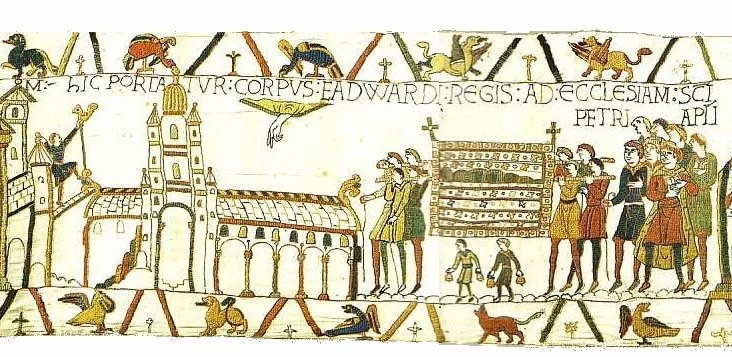
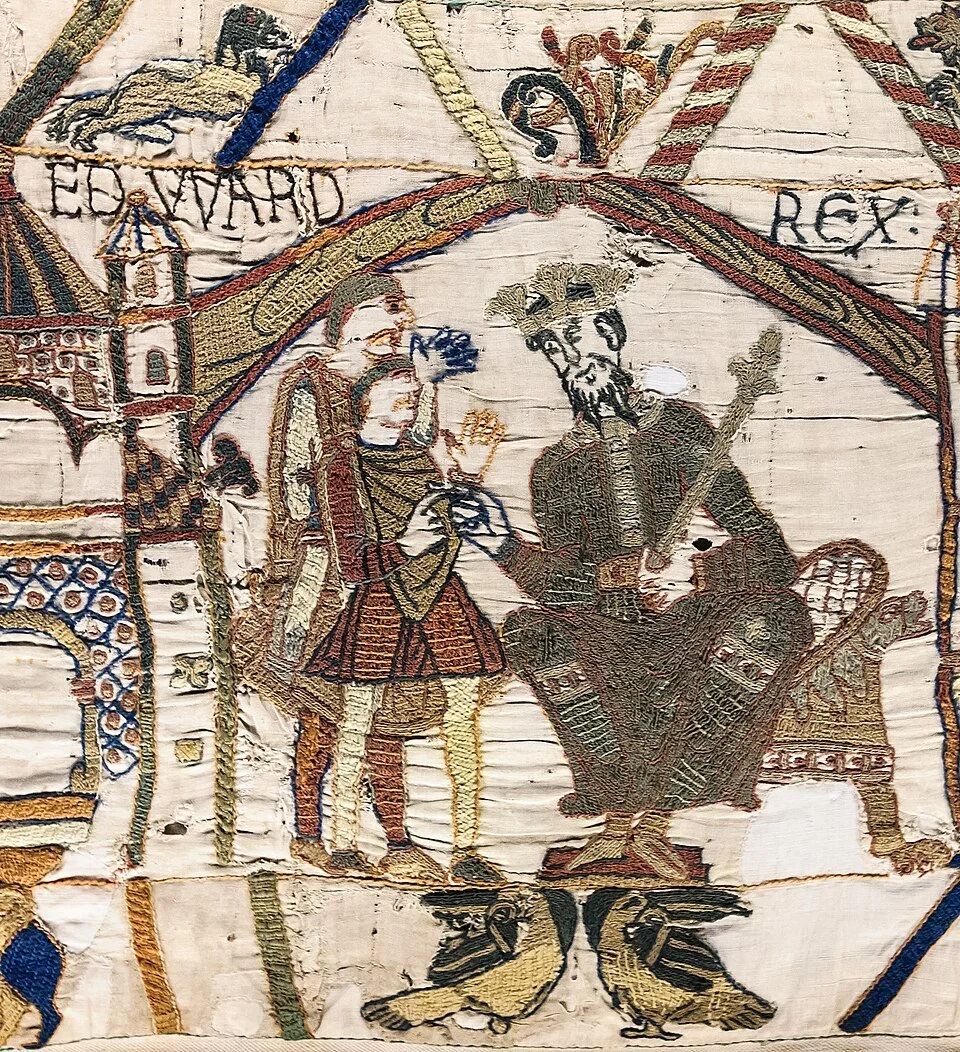
The funeral of Edward the Confessor being crowned from the Bayeux Tapestry. Source: Public domain, Bayeux Tapestry Museum, available here.

The situation was particularly complicated because medieval kingship did not operate according to a single, universally accepted rule of inheritance. Blood relationship mattered, but so did previous promises, oaths, political support and, ultimately, the ability to command the loyalty of powerful men. Harold possessed enormous political authority within England and had the support of leading members of the English ruling elite. William argued that Edward had previously promised him the throne and that Harold himself had sworn an oath supporting William's claim. Harald Hardrada approached the succession from an entirely different direction, invoking the Scandinavian connections that had bound England to the Viking world for generations. Each claimant therefore possessed a different version of legitimacy, and each believed that the circumstances of 1066 justified decisive action.

Harold Godwinson's position was nevertheless the most immediate and practical. He was the most powerful nobleman in England, Earl of Wessex, an experienced military commander and the brother of Queen Edith, Edward's wife. When Edward died, the leading English nobles supported Harold's accession, and he was crowned at Westminster on the 6th of January, the day after Edward's burial. His coronation represented the established political machinery of the English kingdom functioning according to its own traditions. Yet from the moment the crown was placed upon Harold's head, England was effectively on a war footing. William regarded Harold's accession as an act that had violated his own rights, while Hardrada saw an opportunity to revive an older Scandinavian claim.

William, Duke of Normandy, was not a random foreign adventurer seeking an opportunity to seize a wealthy kingdom. He was a powerful ruler with a longstanding connection to the English royal family. Edward the Confessor had spent much of his early life in Normandy, and William was related to him through the Norman ducal family. According to Norman accounts, Edward had promised William the English succession. The precise circumstances of this alleged promise remain difficult to establish, and English sources do not provide the same version of events. Nevertheless, William regarded the promise as genuine and regarded Harold's accession as a betrayal of an existing commitment.


The issue became even more complicated because of Harold's journey to Normandy in the years before the Conquest. Norman accounts claimed that Harold had sworn an oath to William, promising to support the duke's claim to the English throne. The Bayeux Tapestry famously depicts Harold placing his hands upon sacred relics during an oath-taking ceremony. To William, therefore, Harold was not merely a rival claimant who had been chosen by the English. He was, according to the Norman interpretation, a man who had broken a solemn and religiously significant oath. English sources are much less explicit about the episode, and historians continue to debate its precise nature and circumstances.

For William, however, the distinction between political dispute and moral obligation was extremely useful. His invasion could be presented not simply as an attempt to conquer England but as an effort to recover what he believed had been promised to him. His case was strengthened when Pope Alexander II gave his support to the Norman enterprise and sent William a papal banner. The papal approval gave William's campaign an important religious and political dimension, although it should not be mistaken for proof that the papacy had established William's legal right to the English throne. It nevertheless provided the Norman duke with a powerful symbol around which his supporters could rally.

William now had to turn a claim into an invasion. That required considerably more than assembling a group of knights and sailing across the Channel. An invasion force needed ships, horses, weapons, armor, food, water and equipment, as well as thousands of men capable of fighting together. William therefore spent much of the summer of 1066 preparing an expedition on a substantial scale. Norman nobles and knights had to be persuaded to participate, and the promise of land, wealth and advancement in England provided powerful incentives. The undertaking was sufficiently ambitious that its success depended not only upon military strength but upon careful organization and favorable circumstances.

The resulting invasion fleet became one of the largest military transport operations attempted in western Europe during the eleventh century. The exact number of vessels remains uncertain, and medieval sources do not provide figures that can be accepted without qualification. What is clear is that William needed enough ships to transport an army and its horses across the Channel. The operation therefore represented a remarkable logistical challenge. The Normans were not merely preparing for a raid; they were preparing to land an army capable of fighting a major battle and then maintaining itself in hostile territory.

Yet the Channel itself became an unexpected obstacle. William's army gathered in Normandy and waited for the right moment, but an invasion fleet could not simply depart whenever its commander wished. Wind, tides and weather were fundamental considerations. The fleet remained in readiness while William waited for conditions that would allow the crossing. This delay proved extraordinarily important because, while William was unable to move, Harold was forced to maintain his own defensive preparations in England.

Harold understood that the Norman invasion was coming. He could not know precisely when William would cross, or where the main landing would take place, but the threat was sufficiently serious for him to mobilize an army and fleet along the southern coast. According to the Anglo-Saxon Chronicle, the force assembled was exceptionally large by English standards. Harold positioned his troops in anticipation of William's arrival and personally operated in the south, while his fleet also watched the approaches to England.

The English military system gave Harold significant defensive resources, but those resources had limitations. The fyrd was not a permanent professional army in the modern sense. It was a system through which men could be called upon for military service, drawing upon the population and obligations of local communities and landholders. Alongside these forces were the king's household troops, the elite warriors known as the housecarls. Together they could produce a formidable army, particularly when fighting on home territory. But maintaining a large force in the field for an extended period was expensive and placed considerable demands upon the kingdom.

This created one of Harold's first major strategic problems. An army waiting for an invasion cannot remain mobilized indefinitely. Soldiers needed food and supplies, and many had land, families and responsibilities to return to. Harold's forces remained ready through the summer, but eventually supplies became exhausted. In early September, the army was stood down and Harold returned to London. The Norman fleet, meanwhile, had still not crossed the Channel.

For a brief moment, the great invasion appeared to have stalled. But England's danger had not disappeared. It had merely changed direction.

Far to the north, another claimant was preparing to enter the struggle. Harald Hardrada, King of Norway, was one of the most formidable warriors of his generation. His career had taken him across Europe and beyond, and by 1066 he ruled Norway with considerable authority. His claim to England was rooted in the Scandinavian history of the English crown. The reign of Cnut in the eleventh century had created a political world in which England and Scandinavia were deeply connected, and the memory of Danish and Norwegian kings ruling England remained very real.

Hardrada's particular claim was complicated and considerably less straightforward than the Norman case sometimes suggests. It drew upon the succession arrangements and agreements associated with the Scandinavian kingdoms and the descendants and successors of Cnut. Hardrada believed that he possessed a legitimate claim to the English crown, but the precise legal basis was contested and depended upon political agreements made years earlier. Like William, however, Hardrada possessed something more immediately important than an argument about succession: an army capable of enforcing his interpretation of events.

Hardrada's cause was strengthened by an Englishman who had his own reasons for opposing Harold: Tostig Godwinson. Harold's brother had once been Earl of Northumbria, but his rule had become increasingly unpopular. A rebellion in Northumbria in 1065 resulted in Tostig's removal from power and exile. The humiliation was profound. Tostig was not merely a disgraced nobleman; he was Harold's brother, a member of the same family that dominated English politics. His subsequent decision to seek foreign assistance transformed a family feud into an international threat.

Tostig initially sought support elsewhere, but eventually found a willing ally in Harald Hardrada. Their interests were very different but temporarily compatible. Hardrada wanted the English crown, while Tostig wanted to recover the position and influence he had lost. Together they could exploit a weakness in Harold's kingdom that William's invasion threatened to expose: England could not easily defend its southern and northern approaches at the same time.

In September, Hardrada's fleet sailed for England. Medieval accounts give widely varying estimates for its size, but it was clearly a substantial force. Hardrada was not attempting a minor raid. This was a serious invasion conducted by a king who intended to replace Harold as ruler of England. Tostig joined him with his own supporters, turning the expedition into something more complicated than a purely Norwegian invasion.

The northern invasion immediately changed Harold's strategic situation. The king had spent months preparing for William's arrival in the south, only to discover that the first major attack would come from Scandinavia. Hardrada's forces moved into northern England, and the threat to York was especially serious. York was one of the most important cities in the kingdom and the center of a wealthy and strategically significant region. If Hardrada could establish control over the north, he would possess an important base from which to challenge Harold's authority.

Harold reacted with extraordinary speed. The English king had to move from defending the southern coast against William to confronting Hardrada in the north. The army that had been prepared to stop a Norman invasion now had to march hundreds of miles towards Yorkshire. The sudden movement demonstrates the fundamental problem confronting Harold: England's greatest strength, its ability to mobilize a large army, could also become a weakness if that army had to be repeatedly moved across the length of the kingdom.

The geographical problem was immense. England was not a small battlefield around London. It was a substantial kingdom stretching from the southern Channel coast to the Scottish border and beyond. An invading army landing in one region could force the king to abandon another. Harold therefore faced a strategic dilemma that no amount of personal courage could completely solve. If he remained in the south, Hardrada might establish himself in the north. If he marched north, William could cross the Channel into an undefended southern England.

And that was precisely the situation developing as September progressed. William remained in Normandy, still waiting for the opportunity to cross. Hardrada, meanwhile, had already brought his army into England. Harold was forced to respond to the invasion that had actually arrived rather than the one he had spent months expecting.

The timing was devastatingly significant. Harold marched north with remarkable speed, gathering the forces available to him as he went. The English king's response demonstrated both the mobility of the Anglo-Saxon military system and the seriousness of the threat. Hardrada was not expecting such a rapid concentration of English forces. On the 25th of September 1066, the two armies met at Stamford Bridge near York. The battle that followed would become one of the most famous victories in English military history, but its consequences would extend far beyond the battlefield.

Before Stamford Bridge was fought, however, England stood in an extraordinary state of uncertainty. Harold had spent the summer watching the southern horizon for William's ships. William had spent the same summer waiting for the winds that would carry his fleet across the Channel. Hardrada had then appeared from the north, accompanied by Harold's own exiled brother. The English king had been forced to abandon one front in order to confront another.

The irony was profound. Harold's greatest immediate victory would eventually become part of the chain of events that weakened his ability to resist William. When Hardrada invaded, Harold had no choice but to meet him. When Hardrada was defeated, Harold could not simply return to London and wait. Another invasion was still possible, and the Norman threat had never disappeared. The two invasions were therefore not separate episodes but parts of one extraordinary strategic crisis.

By late September, the succession dispute had become a struggle of kings, armies and geography. Harold Godwinson possessed the English crown and the support of the English political establishment. William of Normandy possessed a claim based upon alleged promises and oaths, reinforced by military preparation and papal approval. Harald Hardrada possessed a Scandinavian claim and the formidable military reputation necessary to attempt its enforcement. Tostig Godwinson added a deeply personal dimension, transforming the conflict from a contest between foreign rulers and an English king into a struggle that also divided Harold's own family.

The fate of England now depended upon a remarkable sequence of movements. William was still waiting in Normandy. Hardrada had invaded from the north. Harold had marched north to meet him. The English king was about to fight one of the most decisive battles of the Viking Age, believing that defeating Hardrada would remove the immediate threat to his kingdom.

But while Harold was looking north, the winds across the Channel were changing. The Norman fleet was still waiting and somewhere across the sea, William was preparing to sail. The succession crisis that had begun with the death of Edward the Confessor had now reached the point where claims could no longer be settled through ceremony, negotiation or oaths. England had entered the age of invasion. Yet the most extraordinary part of the story was still to come. Harold was about to defeat one invading army at Stamford Bridge, only to discover that another army had finally reached the English coast.


Enjoyed the piece?

Join thousands of history readers getting occasional updates on new blog posts, books, and video releases — plus a free history book to get you started.

Join History Is Now here


Now, you can read Terry’s series on cruel King John here.
In the year 1066, England stood at the edge of one of the most consequential transformations in its history. It was not an impoverished or primitive kingdom waiting to be rescued by a more advanced civilization. On the contrary, England was wealthy, organized and politically sophisticated, with an established legal system, an effective administration, a powerful Church and a highly developed network of towns and markets. Yet within a single year, the kingdom would be invaded from abroad, its king killed, its ruling aristocracy devastated and its political order overturned. By Christmas 1066, England had a Norman king. The Anglo-Saxon kingdom that had developed over centuries had entered a new and turbulent age.

Terry Bailey explains.

Edward the Confessor being crowned,, opening scene of the Bayeux Tapestry. Source: Public domain, Bayeux Tapestry Museum, available here.

The story of the Norman Conquest, however, did not begin on the battlefield at Hastings. Its origins lay in the complicated political circumstances of the decades before 1066, and particularly in the problem of who should succeed King Edward the Confessor. Edward's death did not simply leave an empty throne. It exposed competing interpretations of inheritance, promises allegedly made years earlier, political alliances, family connections and ambitions extending far beyond England's shores. Three men in particular would eventually claim the crown, while a fourth represented a potentially significant English alternative.

To understand why England became vulnerable to conquest, it is first necessary to understand the kingdom that Edward ruled. By the eleventh century, England was one of the most unified political entities in western Europe. Although its origins lay in the numerous Anglo-Saxon kingdoms that had emerged following the end of Roman Britain, centuries of warfare and political consolidation had gradually produced a single English kingdom. Kings such as Alfred the Great and his successors had strengthened royal authority, while the expansion of Wessex had brought increasing portions of England under one dynasty.

The result was a kingdom that possessed something particularly valuable in medieval Europe: political unity. England was not a loose collection of independent territories. The king stood at the center of government, law and taxation, while powerful regional aristocrats exercised authority beneath him. The system was far from modern, but it was capable of mobilizing considerable resources. Royal officials administered justice, collected revenues and supervised local government, while the kingdom's network of shires provided an effective framework through which royal authority could reach deep into the countryside.

At the heart of this system were the shires and their subdivisions, the hundreds. The shire-reeve, or sheriff, acted as an important representative of royal authority, overseeing administration, taxation and aspects of law enforcement. Local courts dealt with disputes and offences, while written records and royal charters provided a degree of administrative sophistication unusual for the period. England also possessed a remarkably developed monetary economy, with coinage produced at numerous mints and taxes collected across the kingdom.

This organization mattered enormously in 1066. England was wealthy enough to support a substantial military establishment and an elaborate system of government, but that wealth also made it an attractive prize. A successful conqueror would not merely acquire land. He would inherit a kingdom capable of generating considerable revenue through taxation, trade, agricultural production and landholding. Whoever controlled England could command one of the richest kingdoms in northern Europe.

English society was dominated by a hierarchy of land and loyalty. At the summit stood the king, followed by the great earls who controlled vast territories and commanded considerable political and military influence. Beneath them were the thegns, an important class of landholding aristocrats and royal servants. Thegns could possess substantial estates, hold positions of authority and provide military service to the king or their regional lord. Below this elite was the much larger population of farmers, laborers, craftsmen and other inhabitants whose work sustained the kingdom's economy.

Military service was closely connected to this social structure. England possessed the fyrd, a system through which free men could be called upon for military service. The fyrd was not a permanent professional army in the modern sense. Instead, the king could summon men from the various districts of the kingdom when military necessity demanded it. Alongside the fyrd were the king's more experienced household warriors, particularly the elite huscarls who served powerful lords and were equipped for sustained campaigning.

The English military system was formidable when properly mobilized. The shield wall, in which heavily armed infantry stood closely together with overlapping shields, could present an extraordinarily difficult obstacle to an attacking army. Yet the system also had limitations. The fyrd depended upon men leaving their farms and communities, meaning that prolonged campaigns could be economically disruptive. Furthermore, England's military strength depended heavily upon the ability of the king to mobilize forces quickly enough to meet an invasion.

The Church was equally important to the organization of Anglo-Saxon England. Christianity had become deeply embedded within English society, and bishops and abbots were not merely religious figures. The Church was a major landowner, an important center of learning and an essential component of government. Monasteries and ecclesiastical institutions preserved manuscripts, educated clerics and maintained traditions of literacy. Royal charters were produced by literate officials, while churchmen could serve as advisers and diplomats.

King Edward the Confessor occupied the center of this world. He had become king in 1042 following the death of his half-brother Harthacnut, restoring the old West Saxon royal dynasty after the Danish rule associated with Cnut and his successors. Edward was deeply religious and would later become celebrated as a saint, but his reign was also dominated by the political realities of aristocratic power.

Edward had spent much of his youth in Normandy, and his long association with the Norman court would later become one of the most controversial aspects of the succession crisis. He married Edith, daughter of the powerful Earl Godwin of Wessex, but their marriage produced no surviving children. Consequently, the question of who would succeed Edward became increasingly important as the king grew older.

The absence of a direct heir created a dangerous political vacuum. Medieval succession was not governed by a simple, universally accepted rule that automatically transferred the crown to the nearest male relative. Blood relationship mattered enormously, but so did political support, previous promises, oaths, royal designation and the ability to command the allegiance of the kingdom's leading men. In 1066, these factors would collide with devastating consequences.

The most powerful English family during Edward's later reign was undoubtedly the Godwin family. Earl Godwin had risen from relatively modest origins to become one of the most influential men in England. His influence expanded through political alliances and marriage, and his children became deeply embedded within the ruling elite. His sons included Harold, Tostig, Gyrth, Leofwine and Wulfnoth, while his daughter Edith became Edward's queen.

Harold Godwinson emerged as the most powerful of Godwin's sons. He inherited the earldom of Wessex after his father's death and gradually became one of the king's principal political and military commanders. Harold was not merely a wealthy aristocrat. He possessed military experience, extensive connections throughout England and relationships with many of the kingdom's most important nobles. By the beginning of 1066, he was arguably the most powerful man in England after the king himself.

This produced an obvious tension. Edward was king, but Harold's influence was immense. If Edward died without a son, Harold possessed many of the qualities required to become king: English political support, military experience, wealth, aristocratic connections and proximity to the center of government. Yet there were other men who believed the crown belonged to them.

Across the English Channel, William, Duke of Normandy, claimed that Edward had promised him the English crown. William was a distant relative of Edward through the king's mother, Emma of Normandy, and his claim rested heavily upon the assertion that Edward had designated him as his successor. William also maintained that Harold had personally sworn an oath supporting William's claim.

The alleged oath became central to William's case. According to Norman accounts, Harold had travelled to Normandy before Edward's death and had sworn to support William's succession. The precise circumstances remain disputed, and the surviving sources were written after the Norman victory, meaning they cannot simply be accepted without question. Nevertheless, William regarded the matter as settled. From his perspective, Harold had not merely become king unlawfully; he had broken a solemn oath.

There was another formidable claimant in the north. Harald Hardrada, King of Norway, was a legendary warrior and one of the most formidable military commanders of his generation. His claim to England was connected to the complicated succession arrangements following the reign of Cnut. Harald believed that an agreement between the Norwegian king Magnus and the Danish-English king Harthacnut had created a basis for Norwegian claims to the English throne.

Harald Hardrada's claim was less straightforward than William's, but medieval politics rarely depended upon straightforward arguments. Claims could be constructed from inheritance, treaties, promises and precedent, and their strength ultimately depended upon whether a claimant could turn political theory into military reality. Harald possessed something particularly persuasive in medieval politics: an experienced army and the ambition to use it.

There was also Edgar Ætheling, the surviving male member of the old royal family with perhaps the strongest hereditary connection to the English throne. Edgar was the grandson of Edmund Ironside and therefore belonged directly to the ancient royal dynasty. Yet he was young, probably only in his mid-teens in 1066, and lacked the political power necessary to impose his claim.

Edgar's presence demonstrates why the succession was so complicated. If hereditary descent alone had determined the matter, Edgar might have appeared an obvious candidate. Yet medieval kingship was never simply a matter of genealogical mathematics. A king required recognition and support. The great earls, churchmen and other leading figures of the kingdom had to accept the new monarch, and they had powerful interests of their own.

Edward's final days therefore became surrounded by questions that historians have debated for centuries. Who did Edward actually intend to succeed him? Had he promised the crown to William? Did he later indicate that Harold should succeed him? Were promises made under circumstances that affected their validity? How much weight should be given to oaths made under political pressure? And, most importantly, what did the English political community believe should happen when the king died?

The evidence is frustratingly incomplete. Norman and English sources do not always agree, and later accounts were inevitably influenced by the events that followed. William's supporters had an obvious reason to emphasize Edward's alleged promise and Harold's oath, while English accounts naturally viewed Harold's accession differently. The historian must therefore navigate between competing narratives rather than assuming that one surviving account provides the complete truth.

What is certain is that Edward died on the 5th of January 1066. His death transformed a complicated political question into an immediate crisis. The next day, Harold Godwinson was chosen and crowned king. The speed of the succession is significant. England's leading men did not wait for a foreign claimant to arrive. They needed a king immediately, and Harold was the man with the political authority and practical ability to assume the role.

Harold's coronation represented the continuation of English government rather than an abrupt revolution. The kingdom still possessed its established institutions, its earldoms, its Church, its laws and its military organization. But beneath this apparent continuity lay an extraordinary danger. Harold's accession could be interpreted in very different ways depending upon which political perspective one adopted.

To his English supporters, Harold was a powerful and experienced nobleman who could defend the kingdom at a moment of crisis. To William, he was an oath-breaker who had seized a crown that had been promised to the Duke of Normandy. To Harald Hardrada, England represented a kingdom to which Norway possessed a legitimate claim. And behind all three stood the young Edgar Ætheling, whose royal blood gave him a claim that could not simply be ignored.

The situation was therefore extraordinarily unstable. England had a strong government, a wealthy economy and a formidable military tradition, but the very strength of its political system had produced a succession in which legitimacy depended upon competing interpretations of law, custom, bloodline, promises and consent. The kingdom was not weak because it lacked institutions. It was vulnerable because those institutions could not prevent rival powers from challenging the legitimacy of its new king.

Harold understood the danger. He could not know exactly when or where his enemies would strike, but he had every reason to expect invasion. His immediate task would be to defend England against a foreign claimant whose fleet and army could arrive from across the Channel. Yet William was not the only threat. In the north, Harald Hardrada was preparing his own challenge, supported by Harold Godwinson's estranged brother Tostig.

The stage was now set for an extraordinary sequence of events. England had begun 1066 as an established Anglo-Saxon kingdom ruled by Edward the Confessor. It had entered the year with a functioning government, powerful aristocracy and extensive wealth. It now possessed a new king whose legitimacy was already being challenged by two determined foreign rulers.

What followed would turn the succession dispute into one of the most dramatic military campaigns in medieval history. Harold Godwinson would soon discover that defending England required more than simply possessing the crown. Before he could confront William of Normandy, he would have to face Harald Hardrada in the north. The first great battle of 1066 would therefore take place not at Hastings, but at Stamford Bridge.

England had a new king. It also had two powerful foreign rulers who believed, for very different reasons, that the crown belonged to them. The succession crisis had become an international struggle, and the future of England would soon be decided not by argument, diplomacy or ancient promises, but by armies on English soil.

Needless to say, by the beginning of 1066, England was therefore a kingdom caught between political continuity and unprecedented uncertainty. The institutions of Anglo-Saxon government remained intact, the monarchy possessed considerable authority, the Church was deeply established, and the kingdom's economy generated the wealth necessary to support both administration and warfare. England was neither disorganized nor incapable of defending itself. Indeed, the events that followed would demonstrate just how formidable its military and political resources could be. Yet beneath this apparent strength lay the unresolved question of succession, and that question would prove capable of drawing the kingdom into a conflict of extraordinary scale.

Edward the Confessor's failure to leave a surviving son meant that the English crown became the focus of competing claims founded upon different understandings of legitimacy. Harold Godwinson possessed political influence, military experience and the support of powerful elements within England. William of Normandy believed that a promise made by Edward, reinforced by Harold's alleged oath, gave him a rightful claim. Harald Hardrada invoked an entirely different succession tradition and was prepared to enforce his claim with the military power of Norway. Edgar Ætheling represented the hereditary connection to England's ancient royal dynasty, but lacked the political strength necessary to make that connection decisive.

The fundamental problem was that medieval kingship could not be reduced to a single principle. Hereditary descent mattered, but so did royal designation, aristocratic approval, oaths, political alliances, military capability and the customs of the kingdom. In 1066, these principles pointed in different directions. Harold's accession could therefore appear legitimate within the political traditions of England while simultaneously being regarded as illegitimate by William and his supporters. The resulting dispute was not merely a disagreement over who should wear a crown. It was a confrontation between competing concepts of rightful kingship.

This distinction is essential to understanding the Norman Conquest. England did not simply collapse because it was weak, nor was William's victory inevitable from the moment he began preparing his invasion. The English kingdom possessed substantial resources and a military system capable of inflicting devastating defeats upon its enemies. What placed England in an exceptionally difficult position was the geographical reality of having to defend a kingdom against threats arriving from different directions. Harold could not concentrate indefinitely upon a single enemy. His forces would have to move rapidly across a kingdom stretching from the southern Channel coast to the northern frontier.

That danger became reality when Harald Hardrada and Tostig invaded northern England. Harold was suddenly confronted with the necessity of marching north to meet them, setting in motion the events that would culminate at Stamford Bridge. The battle would demonstrate the extraordinary capabilities of the English army, but its consequences would extend far beyond the battlefield. The victory would eliminate one of the major threats to Harold's crown while simultaneously leaving the English king and his army exhausted at precisely the moment when another invasion was approaching from Normandy.

Thus, as the summer of 1066 gave way to autumn, the question that had begun as a dispute over succession was becoming something far more consequential. The future of England would no longer be determined solely by its institutions, traditions or political negotiations. It would be contested through military force. The kingdom that had entered the year with one king and several competing claims would soon find itself fighting for its political survival.

The next stage of the story would take Harold Godwinson and his army south once again, this time towards an enemy who had crossed the Channel with an invasion force assembled from Normandy and beyond. William's expedition would bring together soldiers, ships, horses and aristocratic warriors with a single objective: to secure the English crown. Harold, having defeated one invasion in the north, would now face another in the south.

The road from Edward's death to the battlefield at Hastings was therefore shaped by a remarkable combination of political ambition, disputed legitimacy, military necessity and sheer circumstance. The England of Edward the Confessor had not been destined to disappear, but the unresolved succession had produced an opening through which rival claimants could attempt to reshape the kingdom. By the autumn of 1066, the fate of Anglo-Saxon England would rest upon the outcome of a confrontation that neither Harold nor William could afford to lose.

The first chapter of the Norman Conquest had consequently ended not with England's defeat, but with the kingdom poised for the greatest test it had faced in generations. Harold Godwinson had secured the crown, survived one invasion and defeated Harald Hardrada. Yet William of Normandy remained, his army was now established in England, and the decisive encounter was approaching. The next battle would take place at Hastings, where the competing claims to England's throne would collide and the political landscape of England would be transformed forever.


Enjoyed the piece?

Join thousands of history readers getting occasional updates on new blog posts, books, and video releases — plus a free history book to get you started.

Join History Is Now here

Now, you can read part 1 on Terry’s series on cruel King John here.

Posted
AuthorHistory Is Now Magazine
CategoriesBlog Post

The Hundred Years War took place between France and England in the 14th and 15th centuries, but the causes of the war are many and complex. Here, Jonathan Riley looks at the Norman conquest of England and the expansion of Plantagenet power in the 11th and 12th Centuries as factors for the later outbreak of war.

If you missed it, you can read Jonathan’s first piece on the rise of Capetian power here.

William the Conqueror, or William II of Normandy, as shown in the Bayeux Tapestry.

William II of Normandy, was nominated heir to the throne of England in 1066 CE. This created unfortunate political conflicts between the thrones of England and France because, under feudal politics, God’s anointed cannot bow to other kings or emperors (Bates, 2018). This meant that in practical terms, the relationship between the Dukes of Normandy, who were also kings of England from 1066 to 1204, was that there was an un-codified feudal, political and social relationship between the Dukes of Normandy and the Kings of the Franks.

Feudal Relationships 

There is such contention in the feudal relationship between the kings of England after the Norman conquest and the Kings of the Franks because of the vast territories the kings of England held within the kingdom of modern day France by 1154. The Norman dynasty’s crown, after the extinction of the male line of William the Conqueror in 1135 with the death of King Henry I of England, passed to Stephen of Balos, who became King Stephen I of England. He fought for control of the crown from Empress Matilda who was the only legitimate surviving child of Henry I of England, thus leading to over 20 years of anarchy from 1135 to 1154. When the Plantagenets managed to finally secure the crown with a peace deal with King Stephen, the Plantagenets were not only the Counts of greater Anjou but also the Dukes of Normandy and Dukes of Aquitaine. This massive territorial expansion placed the Plantagenet dynasties and Capetian Kings of France on a collision course of conflict and war (Jones, 2014).

To reiterate, the kings of the Franks did not truly have centralized government to control their lords. This meant a constant power struggle between the territorial princes over power and prestige with the crown, at least symbolically the head of the kingdom. With the rapid expansion of Norman power with the conquest of England, England and Normandy during the 11th and 12th centuries were probably the most centralized kingdoms in Europe in terms of resources. This meant that the kings of England, also as Dukes of Normandy, could outcompete the kings of France, Dukes of Brittany, Counts of Anjou, and other lords within the kingdom of the Franks. The massive gains of King Henry II of England with his marriage to the heiress of the Aquitaine, Eleanor of Aquitaine, further catapulted the kings of England as the most powerful rulers in Western Europe for a time. However, even with these gains, the accurate picture is not that simple. King Henry II of England did not rule his continental domains as a fiefdom of the kingdom of England; this can be hard to grasp with the modern concepts of nationhood and country. It is essential to highlight that from 1066 CE until 1399 CE, the language of the English nobility was not English, but French. The coronation oath was not spoken predominantly in English until the rule of King Henry IV of England (1399 CE to 1413 CE). In practical terms, until the beginning of the Hundred Years War and the long divorce between the English and French nobility, England and its aristocracy would be predominantly French and involved in affairs on the continent. Henry II of England styled himself as the King of the English, Lord of the Normans, Lord of the Angevin, and the Lord of Aquitania (Gold, 2019). What this meant in practical terms was that the Plantagenets were not ruling monarchs in their continental lands; they were still subservient to the throne of the Franks, for these holdings created a constitutional, legal and diplomatic problem regarding the legal relationship between the kings of England and the kings of France which contributed to the causes of the Hundred Years War (Strayer, 1956).

Anglo-Norman Realm and Hundred Years War 

The establishment of the Anglo-Norman realm between 1066 CE and 1204 CE placed the dynasties of England and France on a collision course towards war and conflict, and it is more accurate to say that there have been three different Hundred Years’ War between the kingdoms. The first was from 1052 CE to 1214 CE, the second was from 1294 CE to 1453 CE, and the final conflict was from 1689 CE to 1814 CE. Though these dates are all more than 100 years, and historians have debated the start of these conflicts, the main point is that over nearly 800 years, England and France have been trying to conquer one another (Zeihan, 2020).

The cause of the Hundred Years War was the feudal relationship between the English kings as Dukes of Normandy, Dukes of Aquitaine and other territories on the continent as vassals to the King of France. This position was untenable and was one of the driving factors in conflicts between the dynasties (Sumption, 1999). Even after Philip II, Augustus of France (1180 CE to 1223 CE) won back the bulk of the Plantagenet and Norman territories from King John of England in the early 13th century. Then, after the Battle of Bouvines in 1214, which was a pivotal battle in French history which is the cultural equivalent of the Battle of Hastings in 1066 or the Battle of Bosworth Field which ended the Plantagenets rule in England in 1485. The battle of Bouvines was significant in the emergence of French national identity, with proto-nationalism in France and England starting to emerge in the 13th and 14th centuries (van Gorp, 2011). Philip II and his son Louis VIII of France, who between them ruled from 1180 CE to 1226 CE, established Capetian authority in northern, central and southern France, reaching its apex under Philip IV of France in the late 13th and early 14th centuries. This is relevant to the causes of the Hundred Years War. Until their destruction in 1485, the Plantagenet dynasty would continue to try to reclaim its lost territories. However, this answer is not entirely clear cut because King Henry III of England, who reigned from 1216 CE to 1272 CE, made a peace treaty with St Louis or Louis IX of France, who reigned from 1226 CE to 1270 CE. This peace treaty was the Treaty of Paris signed in 1259 CE (Rothwell, 1927). The treaty would be important because it maintained peace between the kingdoms from 1259 CE to 1294 CE. After all, no framework split the duties of the kings of England and their duties as the Dukes of Aquitaine/Gascony. It was this legal framework that, by a technicality, gave Philip IV of France’s claims to dominion or at least legal dominion over the kings of England. This legal framework was a massive contributor towards the beginning of the Hundred Years War (Morris, 2016).

What do you think of the rise of the expansion of Plantagenet power Let us know below.

Bibliography

Brown, E. A. R. (2012). Moral Imperatives and Conundrums of Conscience: Reflections on Philip the Fair of France. Speculum, 87(1), 1–36. https://www.jstor.o rg/stable/41409273?searchText=Philip%20iV%20of%20France&searchUri=%2Faction%2FdoBasicSearch%3FQuery%3DPhilip%2BiV%2Bof%2BFrance&ab_segments=0%2Fbasic_search_gsv2%2Fcontrol&refreqid=fastly-default%3A53cb91140781cd8dbcae9f5db0030351

Bates, D. (2018). William the Conqueror (The English Monarchs Series) (Reprint). Yale University Press.  

Gold, C. (2019). King of the North Wind: The Life of Henry II in Five Acts (Reprint). William Collins. 

Hallam, E. M., & West, C. (2020). Capetian France, 987-1328. Routledge.

Higham, J. K. (2022). Summary of Powers and Thrones: A New History of the Middle Ages By Dan Jones. Independently published. 

Jones, D. (2014). The Plantagenets: the warrior kings and queens who made England. Viking Penguin Books.  

Jones, D. (2015). The Hollow Crown (Main). Faber & Faber.

King, A. (2016). Edward I (Penguin Monarchs). Penguin UK.

Morris, M. (2016). A great and terrible king: Edward I and the forging of Britain. Pegasus Books.  

Morris, M. (2016). King John: Treachery, Tyranny and the Road to Magna Carta. RANDOM HOUSE.

Rothwell, H. (1927). Edward I’s Case against Philip the Fair over Gascony in 1298. The English Historical Review, 42(168), 572–582. https://www.jstor.org/stable/552416?searchText=French%20and%20English%20war%201294%20to%201298&searchUri=%2Faction%2FdoBasicSearch%3FQuery%3DFrench%2Band%2BEnglish%2Bwar%2B1294%2Bto%2B1298&ab_segments=0%2Fbasic_search_gsv2%2Fcontrol&refreqid=fastly-default%3A39802e10c624f58a2f9bb666a21bdb4a

Strayer, J. R. (1956). Philip the Fair--A “Constitutional” King. The American Historical Review, 62(1), 18. https://doi.org/10.2307/1848510

Sumption, J. (1999). The Hundred Years War: Trial by Battle (The Middle Ages Series, Volume 1). University of Pennsylvania Press. 

Wood, C. T. (1979). The English Crisis of 1297 in the Light of French Experience. Journal of British Studies, 18(2), 1–13. https://doi.org/10.1086/385734

van Gorp, D. (2011). Historical introduction: The War of Bouvines. Medieval Warfare, 1(1), 6–9. In- https://www.jstor.org/stable/48579318?searchText=Philip%20II%20of%20France&searchUri=%2Faction%2FdoBasicSearch%3FQuery%3DPhilip%2BII%2Bof%2BFrance%26efqs%3DeyJjdHkiOlsiYW05MWNtNWhiQT09Il19&ab_segments=0%2Fbasic_search_gsv2%2Fcontrol&refreqid=fastly-default%3A3364281838a88ad84064941ed698cf13

Zeihan, P. (2020). Disunited Nations: The Scramble for Power in an Ungoverned World (Illustrated). Harper Business.

Zeihan, P. (2022). The End of the World Is Just the Beginning: Mapping the Collapse of Globalization. Harper Business.  

Posted
AuthorHistory Is Now Magazine
CategoriesBlog Post