By the autumn of 1066, England had become the prize at the center of one of the most extraordinary succession crises in medieval European history. What had begun as a dispute over the English crown had already drawn armies from Scandinavia and Normandy onto English soil, forcing King Harold Godwinson to fight two invasions in the same year.

Yet the events that unfolded at Stamford Bridge had not ended the crisis. Instead, Harold's spectacular victory over Harald Hardrada had left him facing an even greater danger. While the English king had been marching north, fighting and defeating the Norwegian invasion, William, Duke of Normandy, had been preparing his own army across the Channel.

Terry Bailey explains.

Read part 1 on the pre-invasion world of 1066 here, part 2 on the road to invasion here, and part 3 on the Battle of Stamford Bridge here.
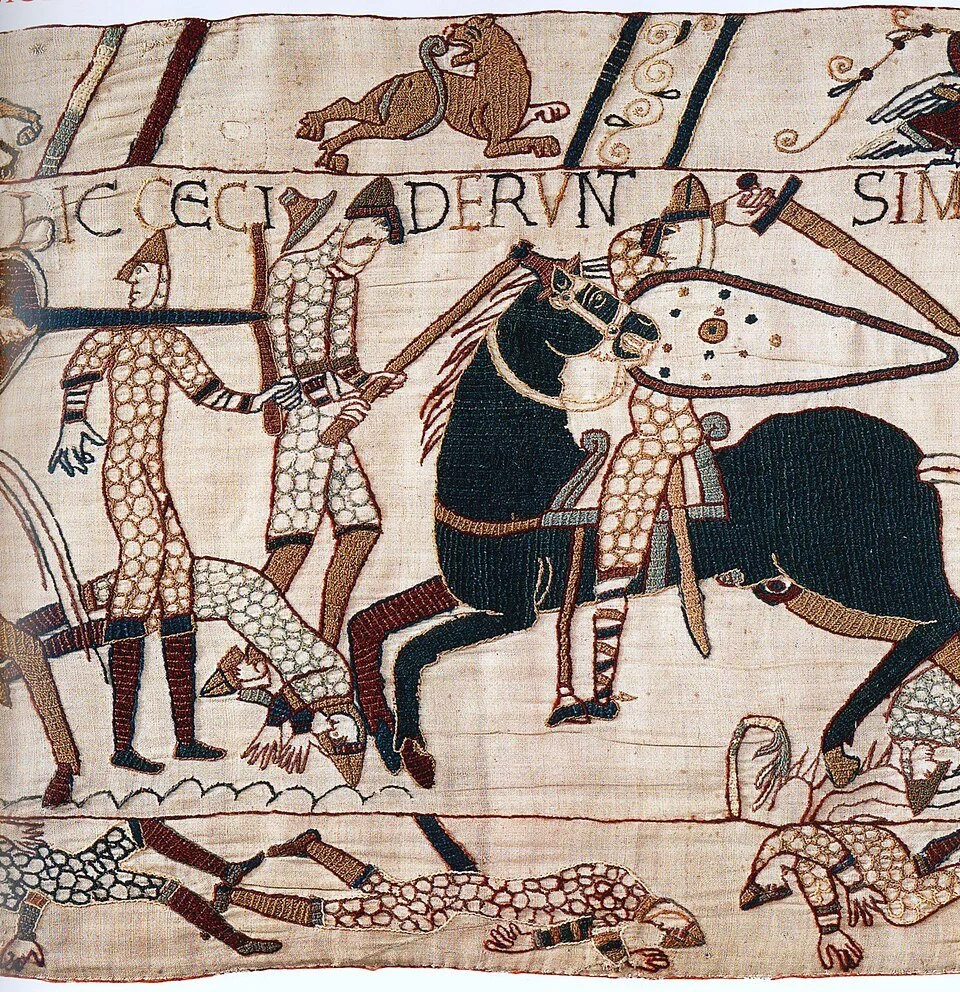
Scene 53 of the Bayeux Tapestry. Mounted Normans attacking infantry Anglo-Saxons. Source: Public domain, Bayeux Tapestry Museum, available here.

On the 28th of September 1066, William's invasion fleet crossed the Channel and landed on the Sussex coast near Pevensey. The Norman army came ashore without encountering the kind of resistance that might have been expected from a kingdom supposedly prepared for invasion. Harold was still in the north, and William immediately understood the importance of establishing a secure base. Pevensey offered a valuable harbor and the remains of an old Roman fortification that could be strengthened and used as a defensive position. From there, William moved eastward towards Hastings, where the Normans established another fortified position and began devastating the surrounding countryside.

William's strategy was calculated to force Harold to respond. The Norman army could not simply remain indefinitely on English soil waiting for the king to arrive. Its soldiers needed food, supplies and secure territory, while the destruction of the surrounding countryside served a second purpose: it demonstrated the consequences of resisting William and placed pressure upon Harold to act. The Norman duke had come to England claiming that the English crown had been promised to him. He now intended to make that claim impossible to ignore.

For Harold, the situation was extraordinarily difficult. He had only recently returned from the north after his victory at Stamford Bridge, where his army had defeated and destroyed much of Harald Hardrada's invading force. The English king and his soldiers had marched an extraordinary distance in a remarkably short period of time. They had fought one of the most important battles of the year, celebrated victory and then learned that another invasion had already begun hundreds of miles away. Harold now had to make another decision that would determine the fate of England.

Rather than waiting for William to advance deeper into the kingdom, Harold gathered his forces and marched south. The speed of his movement had become one of the defining features of the campaign of 1066. His army had already demonstrated its ability to move rapidly, but the march from the north to Sussex placed enormous physical demands upon men who had just fought a major battle. Some soldiers had been killed or wounded at Stamford Bridge, while others may have remained behind or dispersed. Harold nevertheless believed that confronting William quickly offered the best opportunity to prevent the Normans from consolidating their position.

The English army eventually reached the area around Hastings in October. Harold established his position on a ridge now known as Senlac Hill, overlooking the surrounding landscape. William, meanwhile, prepared his army for battle. The two forces represented different military traditions, although the distinction between them should not be exaggerated. The English army was not simply a mass of infantry facing an entirely different Norman force. Both armies contained experienced warriors, and both relied upon combinations of weapons and tactics that had developed throughout western Europe.

The English strength lay particularly in its infantry and the defensive formation known as the shield wall. Closely packed warriors stood shoulder to shoulder, locking shields together and presenting a formidable barrier to an attacking force. Behind the front ranks were additional soldiers who could reinforce weakened sections of the line. The English army also included experienced housecarls, heavily armed professional warriors whose equipment and discipline made them particularly formidable opponents.

William's army possessed a different combination of strengths. Norman infantry could attack the English line directly, while archers could harass the defenders from a distance. Most importantly, William possessed a substantial cavalry force. The Normans could therefore combine missile fire, infantry attacks and mounted assaults in a coordinated effort to break the English formation. The battle would become a contest between Harold's ability to maintain the integrity of his defensive position and William's ability to find a way through it.

On the morning of the 14th of October, the Norman army advanced towards the English position. William's forces were arranged with archers, infantry and cavalry forming the principal components of his army. The English remained on the ridge, protected by their shield wall. The initial Norman attacks met fierce resistance. Arrows were fired towards the English position, infantry advanced up the slope and cavalry attempted to find weaknesses in the English line. Yet the English formation proved extremely difficult to penetrate.

The terrain itself favored Harold. The English were positioned on higher ground, forcing Norman soldiers to advance uphill against a disciplined defensive formation. Every step towards the summit increased the difficulty of the attack. For hours, the English shield wall absorbed repeated assaults. The Normans could attack, retreat and regroup, but the English line continued to hold.

At this point, the battle began to develop into something far more complicated than a simple frontal assault. The Normans suffered setbacks on portions of the battlefield, and at one stage some of William's soldiers fled downhill. The sight of retreating Normans apparently encouraged English warriors to leave the protection of the shield wall and pursue them. This became one of the most famous episodes associated with Hastings.

Later accounts describe these movements as deliberate Norman feigned retreats, in which troops pretended to flee in order to lure English soldiers away from the defensive formation before turning upon them. Whether every such movement was deliberately planned remains uncertain, and the surviving sources were written after the battle. Nevertheless, there is strong evidence that Norman forces were able to exploit moments when English soldiers abandoned the protection of the ridge. Once separated from the main formation, pursuing English troops could become vulnerable to Norman cavalry.

The fighting continued for much of the day. The English shield wall repeatedly resisted the Norman attacks, while the Normans adapted their tactics and continued searching for weaknesses. The battle was becoming a contest of endurance. William could draw upon forces that had crossed the Channel specifically for the campaign, while Harold's army had already endured the extraordinary events of the preceding weeks. Yet despite exhaustion and mounting casualties, the English continued to resist.

The traditional image of Hastings often portrays the battle as a straightforward Norman victory achieved through cavalry and archery. The reality was considerably more complicated. The Norman army did not simply overwhelm the English from the beginning. The English held their position for hours and inflicted serious losses upon their opponents. The battle was a prolonged struggle in which tactical decisions, terrain, leadership, fatigue and chance all mattered.

As the day progressed, however, the English position gradually deteriorated. Harold's army had suffered heavy casualties, and maintaining a coherent shield wall became increasingly difficult. The death of senior warriors weakened the command structure, while gaps could appear in the defensive formation. William also remained personally active in directing the battle, helping to maintain Norman morale at moments when the fighting threatened to turn against him.

Then came the event that transformed the battle. Harold Godwinson was killed.

The exact circumstances of Harold's death remain uncertain. The famous story that he was struck in the eye by an arrow appears in the Bayeux Tapestry, although the identification of the figure has been debated. Other traditions claim that Harold was subsequently cut down by Norman warriors. It is possible that several later accounts combined different traditions surrounding his death. What is certain is that Harold died on the battlefield, and his death removed the central figure around whom English resistance had been organized.

The consequences were devastating. The English army did not immediately vanish, but the death of the king shattered the political and military structure upon which continued resistance depended. Some English soldiers continued fighting, particularly among the remaining housecarls, but large-scale organized resistance began to collapse. Norman forces were finally able to break through the English position, and by the end of the day William had achieved the victory for which he had crossed the Channel.

The Battle of Hastings was therefore much more than a clash between two armies. It was the decisive military encounter in a succession crisis that had already transformed England. Harold had defeated one invasion at Stamford Bridge, only to find himself confronted by another army from across the Channel. His decision to march south and fight William so quickly has been debated ever since, but the consequences of the battle are undeniable. Harold was dead, his army was defeated, and the most powerful military obstacle between William and the English crown had been removed.

Yet Hastings did not make William king of England in an instant. Winning the battle was one thing; securing the kingdom was another. Large parts of England remained outside William's direct control, and the political elite had not simply disappeared with Harold. English resistance continued, and alternative candidates for the throne emerged. William therefore faced a new phase of the campaign in which military victory had to be converted into political authority.

The significance of Hastings ultimately lies in the fact that it changed the direction of English history. Had Harold defeated William, the Norman claim to the English throne might have collapsed, and the political and cultural development of England could have followed a dramatically different path. Instead, William's victory opened the way for the Norman Conquest, bringing a new ruling dynasty, new aristocratic families and profound changes to England's institutions, military organization, landholding patterns and culture.

The battle also reveals why 1066 cannot be understood as a single isolated event. Stamford Bridge and Hastings were intimately connected. Harold's extraordinary victory against Harald Hardrada demonstrated the strength of the English army, but it also left Harold with little time to recover before confronting William. The two battles therefore became the dramatic turning points of the same campaign: first Harold destroyed one invasion in the north, and then, only weeks later, his own kingdom was transformed by defeat in the south.

By sunset on the 14th of October 1066, William had won the battle, but England had not yet submitted. Harold Godwinson was dead, the English army had been defeated and the Norman duke stood closer than ever to the crown he claimed. Yet the conquest was only beginning. William had won Hastings; now he had to win England.


Enjoyed the piece?

Join thousands of history readers getting occasional updates on new blog posts, books, and video releases — plus a free history book to get you started.

Join History Is Now here


Now, you can read Terry’s series on cruel King John here.
Posted
AuthorHistory Is Now Magazine
CategoriesBlog Post

By September 1066, England had become the prize in one of the most extraordinary succession crises of the medieval world. King Edward the Confessor was dead, Harold Godwinson occupied the English throne, and two powerful foreign rulers had already claimed that the crown belonged to them. Duke William of Normandy was preparing an invasion across the Channel, but before William could strike, another claimant had arrived in England. From Scandinavia came Harald Hardrada, King of Norway, one of the most formidable warriors of his age. His invasion would force Harold Godwinson into a desperate gamble: to march north, defeat the Viking army, and then somehow return south before William could land.

Terry Bailey explains.

Read part 1 on the pre-invasion world of 1066 here, and part 2 on the road to invasion here.

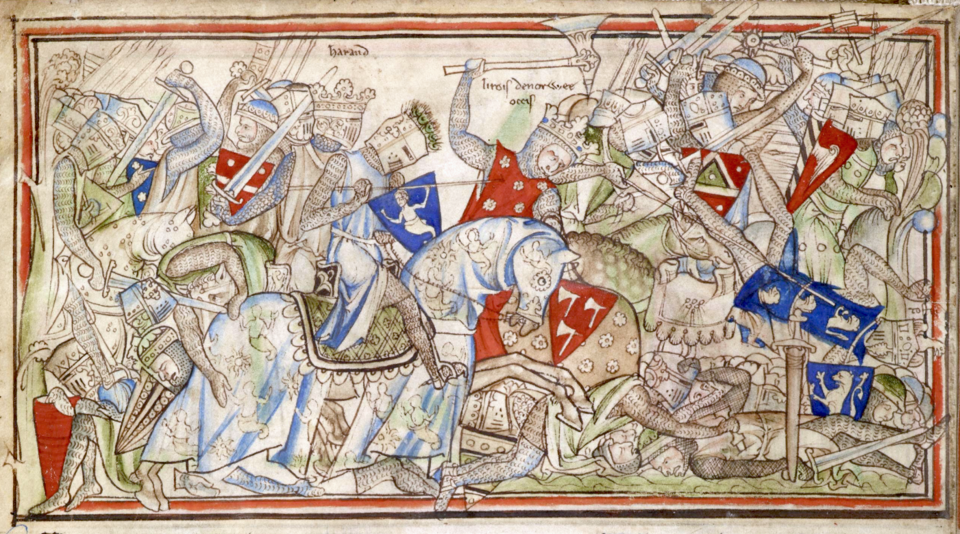
The Battle of Stamford Bridge. Source: public domain, he Life of King Edward the Confessor by Matthew Paris. 13th century, available here.

The Norwegian invasion was not a minor raid. Hardrada was an experienced military commander who had spent much of his life fighting across Europe and beyond. His claim to the English throne rested partly upon an agreement allegedly made between the Norwegian king Magnus the Good and the English king Harthacnut, under which each was said to have inherited the other's kingdom if one died without an heir. Although the legal basis of Hardrada's claim was disputed, the Norwegian king possessed something more immediately important than legal arguments: a powerful army and a fleet capable of carrying an invasion force into England.

Hardrada did not act alone. He was joined by Tostig Godwinson, Harold's estranged brother. Once one of the most powerful men in England, Tostig had been Earl of Northumbria until rebellion against his rule forced him into exile in 1065. His alliance with Hardrada transformed the Norwegian expedition from a foreign invasion into something even more dangerous. Tostig knew England, understood its politics, and possessed his own claim to influence. For Harold, the invasion was therefore both a military and a deeply personal crisis.

In September, Hardrada's forces sailed into northern England. The Norwegians first seized York, one of the most important centres in the north, after defeating an English army at the Battle of Fulford on the 20th of September. The English forces were commanded by the northern earls Edwin of Mercia and Morcar of Northumbria, and their defeat demonstrated how serious the invasion had become. York was effectively at the mercy of the invaders, and Hardrada appeared to have established a powerful base from which he could extend his control.

For Harold Godwinson, the news could hardly have been worse. His army had spent much of the summer waiting in southern England for William's expected invasion. Maintaining a large army in the field was enormously difficult because many of Harold's troops were drawn from the fyrd, the system through which free men were called upon to serve. They could not remain indefinitely away from their homes and farms. As supplies diminished and the campaigning season advanced, Harold had been forced to release many of his men.

Then came the news from the north; Harold reacted with remarkable speed. Gathering the forces available to him, he began one of the most extraordinary marches in English military history. His army travelled north towards York, covering hundreds of miles in a remarkably short period. Medieval armies normally moved at a relatively slow pace, constrained by roads, terrain, supplies, horses and the physical limitations of thousands of men. Harold nevertheless succeeded in concentrating a substantial force in the north before Hardrada and Tostig fully appreciated the danger approaching them.

The speed of Harold's advance was itself a weapon. Hardrada had every reason to believe that the English king would need considerable time to respond. Instead, Harold appeared with an army close to York. The Norwegian forces were caught in a vulnerable position at Stamford Bridge, several miles east of the city. According to the traditional accounts, the Norwegians were not expecting an immediate attack and some were without their armour. Whether every detail of the later accounts is accurate is uncertain, but the essential fact is clear: Harold had achieved surprise.

The two armies met on the 25th of September 1066 and the battle that followed became one of the great encounters of the Viking Age. Hardrada's army initially formed a defensive position, with the English attacking across the River Derwent. The traditional accounts describe a fierce struggle in which the Norwegian position proved extremely difficult to break. One of the most famous episodes tells of a lone Norwegian warrior holding the bridge against the English long enough to delay their advance before eventually being killed. Whether the story is entirely historical cannot be established with certainty, but it reflects the ferocity of the fighting.

As the battle developed, the advantage gradually shifted towards Harold. The Norwegian army had been divided by the speed of the English advance, and Hardrada was forced to fight without the full protection of his preparations. Yet the Norwegians fought with extraordinary determination. Hardrada himself was at the centre of the fighting, as was characteristic of the warrior kings of the period; however, Harald Hardrada was eventually killed.

The Norwegian king was struck in the throat by an arrow, according to the Anglo-Saxon Chronicle and later accounts, although the precise circumstances surrounding his death remain uncertain. With Hardrada dead, the invasion lost its principal commander. Tostig continued the fight, but Harold reportedly offered him the opportunity to abandon the battle. Tostig refused, and the struggle continued until he too was killed.

With the deaths of Hardrada and Tostig, Norwegian resistance collapsed. The Viking invasion of England had been decisively defeated. The scale of the victory was extraordinary. Hardrada had arrived as one of the most formidable military leaders of his generation, accompanied by a substantial invasion force. Within a single day, his ambitions had been destroyed and the last great Scandinavian attempt to conquer England had effectively come to an end.

For Harold Godwinson, Stamford Bridge was an extraordinary personal and political triumph. He had defended his kingdom against a major invasion, defeated a renowned warrior king, and eliminated one of the two principal foreign threats to his crown. Had the story of 1066 ended there, Stamford Bridge might have been remembered simply as one of the greatest victories in English history.

However, the story was only halfway finished; the victory came at a terrible price. The fighting had been exceptionally violent, and the English army suffered substantial casualties. Even more importantly, Harold's force was now exhausted. Many of the men who had marched north had already endured a rapid journey across England followed by a major battle. The army that emerged victorious from Stamford Bridge was therefore very different from the force that Harold had originally assembled to defend the south.

Harold had also lost valuable time. While he had been marching north and fighting Hardrada, Duke William of Normandyhad been waiting for favourable conditions to cross the Channel. The winds that had kept William's fleet in Normandy eventually changed. By the end of September, William was finally able to set sail; the timing was disastrous for Harold.

Only days after Stamford Bridge, the English king received news that William had landed in southern England. The Norman invasion he had anticipated for months had finally begun. Harold now faced an extraordinary military problem. He had just defeated a powerful Scandinavian army in the north, but his kingdom was being invaded from the opposite direction.

There was no easy choice. Harold could remain in the north and allow William to establish himself in southern England, gathering reinforcements and strengthening his position. Alternatively, he could march south once again and confront the Normans before their army became too powerful. Harold chose the second course.

His decision reveals both the strength and the weakness of the English position. Harold's ability to move rapidly across England was impressive, but the same speed that had helped him defeat Hardrada now demanded an extraordinary physical and logistical effort from his army. His men had marched north, fought a major battle and then had to turn around and march south again. Some had been killed or wounded. Others were exhausted. Reinforcements had to be gathered along the way, but there was no time for the leisurely preparation of a campaign.

The two battles of 1066 were therefore becoming connected by more than chronology. Stamford Bridge had removed one enemy, but it had also shaped the conditions under which Harold would face the other. His army had been bloodied, depleted and exhausted. William's army, meanwhile, had arrived fresh in southern England after crossing the Channel and had begun establishing itself on English soil.

There was another crucial difference. Harold had been forced to react to events throughout the year. William, by contrast, had spent months preparing his invasion. He had assembled ships, gathered troops from Normandy and elsewhere, secured the support of powerful nobles and waited for the opportunity to cross. When that opportunity finally came, he landed in England with his army intact.

The road from Stamford Bridge to Hastings would therefore become one of the most consequential marches in English history. Harold's army moved south once again, knowing that another enemy was waiting. The king had achieved what appeared to be the impossible: he had defeated Hardrada, destroyed the Norwegian invasion and demonstrated the military strength of the English kingdom. Yet the victory had not secured his crown. It had merely removed one claimant.

On the 28th of September, William landed at Pevensey on the Sussex coast. The Norman invasion had begun. The irony of Stamford Bridge is therefore at the heart of the story of 1066. Harold's victory was spectacular, but it came at precisely the moment when he could least afford the losses and exhaustion that accompanied it. The battle demonstrated the remarkable speed and military effectiveness of the English king, but it also left him facing the second invasion with an army that had already endured an extraordinary campaign.

Stamford Bridge was not simply the destruction of the last great Viking invasion of England. It was the turning point that connected the Scandinavian struggle for England with the Norman conquest that followed. Within days, the battlefield in Yorkshire would be replaced by another battlefield hundreds of miles to the south. The English army that had celebrated victory over Hardrada would soon be marching towards Hastings.

Harold had defeated one invasion but another had already begun. The succession crisis that had started with the death of Edward the Confessor had now entered its most dangerous stage. England had survived the Viking challenge, but the fate of the English crown would soon be decided not in the north, but on a hill overlooking the Sussex coast.


Now read part 4 on the Battle of Hastings here.

Enjoyed the piece?

Join thousands of history readers getting occasional updates on new blog posts, books, and video releases — plus a free history book to get you started.

Join History Is Now here

Posted
AuthorHistory Is Now Magazine
CategoriesBlog Post

The Medieval period, also known as the Middle Ages, began with the fall of the Western Roman Empire in 476 CE. This marked a significant shift in European history as centralized Roman authority collapsed, leading to a fragmentation of power among various kingdoms and tribes.

A number of events would eventually lead from the Medieval period to the Renaissance. Here, Terry Bailey considers one of those major events – the 1066 CE Battle of Stamford Bridge in England.

The Battle of Stamford Bridge, an 1870 painting by Peter Nicolai Arbo.

The period is generally characterized by feudal systems, the dominance of the Catholic Church, and the gradual development of modern European nations. The term "medieval" itself derives from the Latin medium aevum, meaning "middle age," reflecting its position between the classical antiquity of Greece and Rome and the Renaissance.

The medieval period is traditionally considered to have ended around 1500 CE, though exact dates vary depending on the region and historical interpretation. Major events contributing to its conclusion include the fall of Constantinople in 1453, the invention of the printing press in the mid-15th century, and the beginning of the Age of Exploration.

These milestones heralded the dawn of the Renaissance, a period of renewed interest in classical learning, art, and science that marked the transition to the early modern era. However, the long path of medieval history saw many battles for dominance, one such battle took place at the village of Stamford Bridge, East Riding of Yorkshire, England.

The Battle of Stamford Bridge was fought on the 25th of September, 1066 and marked one of the pivotal moments in English history. Taking place in the heart of Yorkshire, the clash saw the forces of King Harold Godwinson confront the invading army of Harald Hardrada, King of Norway, who was supported by Harold's estranged brother, Tostig Godwinson.

This fierce and dramatic encounter would bring an end to Hardrada's ambitious bid for the English throne, showcasing Harold Godwinson's strategic prowess and the resilience of his troops. However, the victory came at a significant cost, weakening Harold's army just weeks before another, more fateful confrontation awaited him at Hastings. Stamford Bridge is often regarded as the last stand of the Viking Age, marking the twilight of Norse dominance and the beginning of a transformative chapter in medieval England's history.


The lead-up to the clash that altered English history

The battle was born out of a complex web of succession disputes following the death of Edward the Confessor on the 5th of January, 1066. Edward had left no direct heir, leading to competing claims to the English throne. Harold Godwinson, the powerful Earl of Wessex, was crowned king, but his claim was challenged by two formidable rivals: Harald Hardrada, the King of Norway, and William, Duke of Normandy.

Harald Hardrada's claim rested on an agreement between earlier monarchs, while William asserted that Edward had promised him the throne years earlier. These disputes culminated in a multi-front crisis for Harold Godwinson, who had to defend his kingdom against invaders from both the north and the south.

In early September, Hardrada allied with Tostig Godwinson, Harold's exiled brother launched an invasion. The Norwegian fleet first sailed into the River Tees, conducted raids along the coast, then sailed up the Humber River and disembarked at Riccall on the 20th of September, 1066. Whence he defeated the northern English forces under the command of the Earls Morcar of Northumbria and Edwin of Mercia at the Battle of Fulford on the 20th of September, 1066. This victory led to the surrender and occupation of York by Hardrada's army on the 24th of September, 1066 consolidating his foothold in northern England.


Cultural and political considerations

The conflict was not merely a dynastic struggle; it reflected broader cultural tensions. The Anglo-Saxon aristocracy faced challenges from both the Scandinavian traditions of the Norse and the emerging feudal system of Normandy. Hardrada's invasion brought the Viking warrior ethos into direct conflict with the more centralized and militarily organized Anglo-Saxon kingdom.

Meanwhile, Harold's position was precarious. He needed to demonstrate strength to maintain loyalty among his earls while addressing the immediate Viking threat before turning to face William of Normandy. The urgency of the moment required bold decisions and rapid mobilization.


Commanders and strategies

Harold Godwinson:- A seasoned leader with deep ties to the English nobility, Harold understood the need for swift action. He marshalled his forces from southern England, covering nearly 190 miles in just four days—a remarkable logistical feat.

Harald Hardrada:- A legendary Norse warrior with years of experience, Hardrada's strategy relied on shock and intimidation. After the Battle of Fulford, he believed the English forces in the north were sufficiently weakened.

Tostig Godwinson:- The younger brother of Harold, Tostig sought revenge against his sibling and hoped to reclaim his earldom through an alliance with Hardrada.


The unfolding of the battle

On the 25th of September, 1066, Harold's forces arrived unexpectedly at Stamford Bridge, catching Hardrada and his men off guard. The Vikings, who were not in full battle readiness were split across both sides of the River Derwent. Harold's surprise attack capitalized on their disorganization.

The initial phase saw the English attacking the smaller Viking contingent on the western side of the river. According to legend, a lone Norse axeman held the bridge against Harold's forces for hours, allowing Hardrada to regroup.

Eventually, the English killed the axeman and crossed the river, by driving a spear upwards through the wooden bridge from an Anglo-Saxon warrior wading the river.

On the eastern side, Hardrada formed his warriors into a shield wall, a traditional Norse tactic designed to withstand heavy infantry attacks. Harold responded with disciplined archery and infantry maneuvers, creating gaps in the Viking line. The battle devolved into brutal hand-to-hand combat, with both sides suffering heavy losses.


Tactics of the opposing force

Norwegian Tactics:- Hardrada's reliance on the shield wall was a reflection of Viking battlefield doctrine, emphasizing defense and counter-attacks. However, the lack of preparation and heavy armor, due to the warm weather, weakened his forces.

English Tactics:- Harold's strategy was rooted in speed and surprise. His disciplined housecarls (professional soldiers) combined with local fyrd (militia) overwhelmed the Vikings through sustained pressure and adaptability.


The outcome and aftermath

The battle ended with a decisive English victory. Both Harald Hardrada and Tostig Godwinson were killed, and the Norwegian army was annihilated. Of the initial invasion force of around 10,000 men, only 24 ships were needed to carry the survivors back to Norway.

Despite his triumph, Harold's forces were severely weakened. Just days later, he received news that William of Normandy had landed on the south coast. Harold's march to Stamford Bridge and back to face William at the Battle of Hastings, (portrayed in the Bayeux Tapestry), would prove too taxing for his army, leading to his ultimate defeat on the 14th of October, 1066.

In conclusion, the Battle of Stamford Bridge stands as a defining moment in English history, marking the end of Viking dominance and showcasing the resilience and tactical brilliance of Harold Godwinson. Despite his victory, the cost was immense—an exhausted army and a kingdom left vulnerable to the Norman invasion just weeks later.

This pivotal clash not only symbolizes the end of one era but also the beginning of another, as the Norman Conquest reshaped the political, cultural, and social landscape of England. Stamford Bridge remains a testament to the shifting tides of history, where triumph and tragedy are inextricably intertwined.


The site has been offering a wide variety of high-quality, free history content since 2012. If you’d like to say ‘thank you’ and help us with site running costs, please consider donating here.


Notes


The Bayeux Tapestry

The tapestry portrays the Battle of Hastings after the Battle of Stamford Bridge and is an extraordinary piece of medieval craftsmanship that vividly depicts the events leading up to and including the Norman Conquest of England in 1066. Measuring nearly 70 meters in length, this embroidered cloth is believed to have been commissioned by Bishop Odo of Bayeux, the half-brother of William the Conqueror.

It is widely regarded as a crucial visual source for understanding the conquest, illustrating key moments such as Harold Godwinson's oath to support William, the Battle of Hastings, and Harold's death, famously portrayed as being struck in the eye with an arrow.

The tapestry's importance lies in its role as both an artwork and a historical narrative. As a near-contemporary source, it provides a detailed account of the Norman perspective, shedding light on the military strategies, naval preparations, and feudal relationships of the time. Its scenes offer rare visual insights into 11th-century armor, weaponry, ships, and daily life. Beyond its historical value, the tapestry is a masterpiece of Romanesque art, admired for its dynamic storytelling and vivid imagery.

However, caution is warranted when interpreting the Bayeux Tapestry, as it was created by or for the Norman victors. Its narrative aligns with William's claim to the English throne and portrays Harold as an oath-breaker who usurped power. This perspective naturally reflects the biases of the conquerors, potentially downplaying or misrepresenting the Anglo-Saxon viewpoint. For instance, Harold's oath to William—central to Norman propaganda—may have been coerced or misinterpreted. Moreover, the tapestry omits other events, such as the resistance of northern England to Norman rule, which complicate the story of the conquest.

In essence, while the Bayeux Tapestry is an invaluable artefact and narrative tool, its portrayal must be critically assessed. It remains a triumph of medieval storytelling, but its role as a tool of Norman legitimacy reminds us to scrutinize historical sources for the biases associated with the producer of the source.

The Bayeux Tapestry is housed in the Musée de la Tapisserie de Bayeux (Bayeux Tapestry Museum) in the town of Bayeux, located in the Normandy region of France. The tapestry has been displayed there since the 19th century, although it has been relocated temporarily at times for preservation or exhibitions.

The museum is specially designed to preserve the nearly 70-metre-long tapestry, which is displayed in a climate-controlled setting to prevent deterioration and is one of the most visited attractions in Normandy.