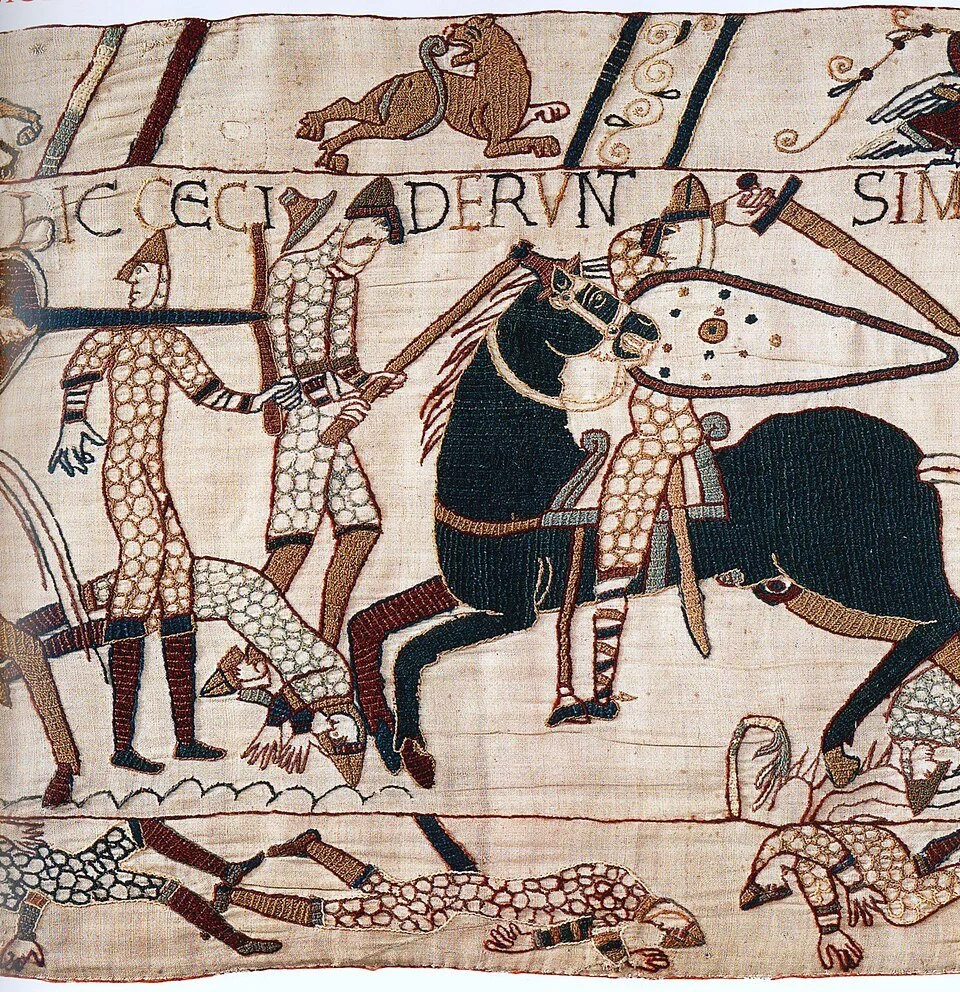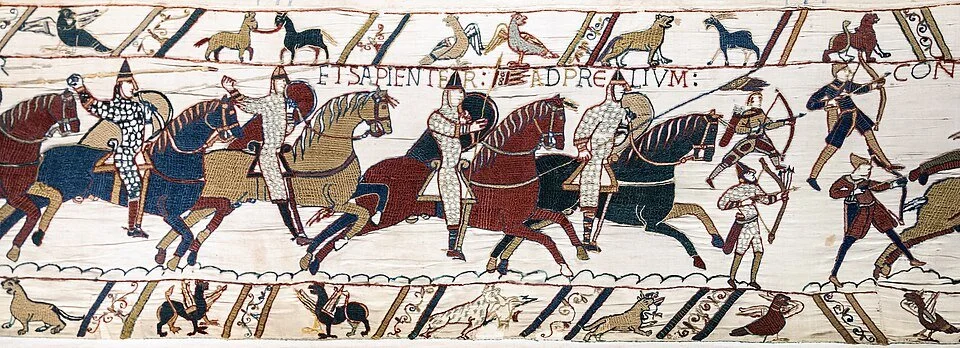
The Battle of Hastings, fought on the 14th of October 1066, decided the immediate fate of the English crown, but it did not deliver England into William of Normandy's hands overnight. Harold Godwinson was dead, his army had been defeated, and the Anglo-Saxon kingdom had lost the king who had led its defense against two successive invasions. Yet England was far from conquered. Its towns remained occupied by people who had not necessarily accepted William as their ruler; its northern and western regions retained powerful traditions of independence, and many of its leading nobles had little reason to welcome a foreign duke who claimed their kingdom by right of conquest. William had won the battle that opened the road to the throne, but the far greater challenge now lay before him: turning military victory into political authority.
Terry Bailey explains.
Read part 1 on the pre-invasion world of 1066 here, part 2 on the road to invasion here, part 3 on the Battle of Stamford Bridge here, and part 4 on the Battle of Hastings here.
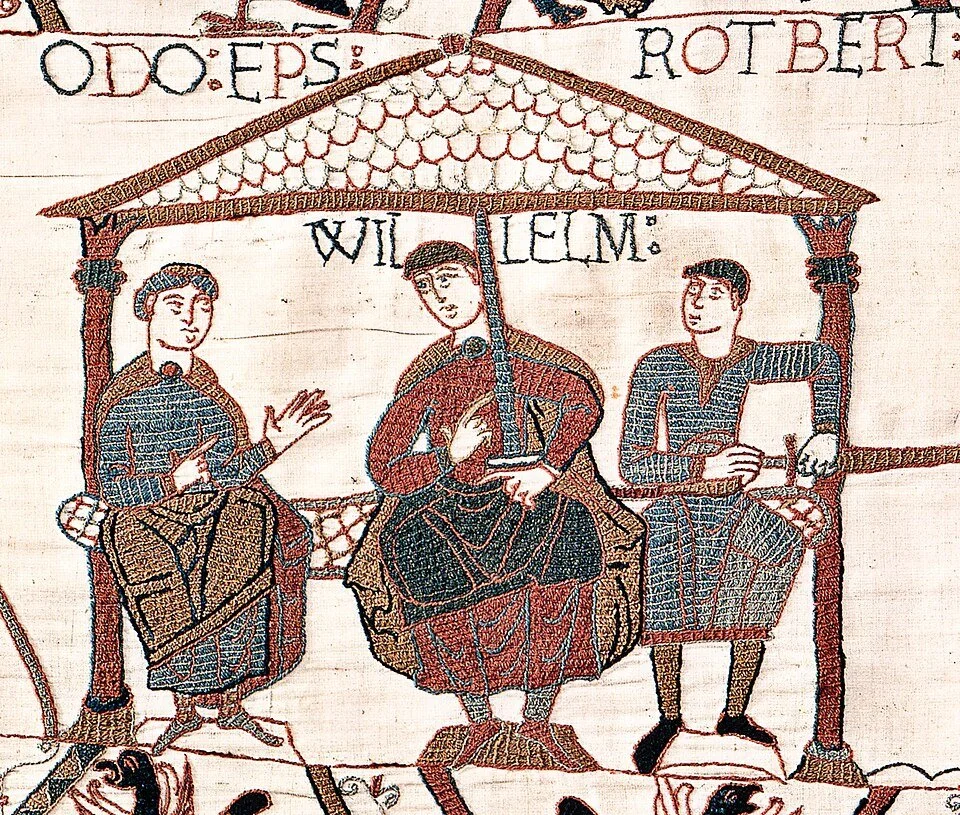
Bishop Odo of Bayeux, William the Conqueror, and Count Robert of Mortain. Source: Public domain, Baeux tapestry Museum, available here.
The events of 1066 had brought England to a moment of extraordinary uncertainty. Edward the Confessor had died without a surviving child, and the competing claims of Harold Godwinson, William of Normandy and Harald Hardrada had exposed the vulnerability of a kingdom whose political stability depended heavily upon the strength and legitimacy of its monarch. Harold's victory over Hardrada's invading Norwegian army at Stamford Bridge had removed one rival, but it had exhausted his forces immediately before William's arrival. Hastings had then removed Harold himself. With the king dead and much of his army destroyed, the English faced a crisis that extended far beyond the battlefield. The question was no longer simply who had the strongest claim to the crown, but whether England could preserve its independence or would be forced to submit to a new ruling dynasty.
In the days following Hastings, William consolidated his position in the south-east. His army had suffered casualties, and he needed time to secure his supplies, organize his forces and establish a reliable base from which to continue the campaign. Rather than immediately rushing towards London, he moved through the surrounding countryside, securing strategic locations and placing pressure upon communities that might otherwise support English resistance. The Normans had demonstrated at Hastings that they could defeat the English in open battle, but William understood that the conquest of a kingdom required more than another spectacular military victory. He needed to control roads, river crossings, settlements and centers of political authority, while convincing England's surviving leaders that resistance had become more dangerous than submission.
London was the crucial objective. As England's largest and wealthiest urban center, it possessed immense commercial importance and considerable political influence. Its position on the River Thames made it a strategic gateway into the heart of the kingdom, while its proximity to the principal routes connecting southern England with the Midlands gave it particular military significance. Whoever controlled London would possess a powerful base from which to influence the rest of the country. Yet the city was not simply waiting to welcome a new king. It contained powerful interests of its own, and the death of Harold had created an opening for English leaders to consider an alternative to immediate Norman domination.
Among the most prominent candidates was Edgar Ætheling, the young grandson of Edmund Ironside and a member of the old West Saxon royal dynasty. Edgar possessed royal ancestry that made him an attractive figure to those who wished to preserve the native monarchy. Following Harold's death, leading English nobles and churchmen recognized him as king, although the precise circumstances and extent of his proclamation remain uncertain. His candidacy represented an attempt to restore continuity with England's established royal house at a moment when the kingdom had lost both its king and the army that had defended him. Edgar's youth, however, presented a serious difficulty. He lacked the military experience, established political authority and independent power necessary to unite the kingdom against William. His claim possessed dynastic legitimacy, but legitimacy alone could not stop an advancing Norman army.
William's response was calculated and relentless. Rather than immediately committing his forces to a direct assault upon London, he continued his advance through the south-east, exploiting the uncertainty among the English leadership. His troops moved through areas from which they could threaten the capital, while his commanders sought to prevent the English from organizing an effective defensive position. The destruction and intimidation associated with the Norman advance increased the pressure upon communities that had to decide whether to resist or negotiate. William's strategy combined military force with political calculation: he wanted the English to understand that continued opposition could bring devastation, while submission offered at least the possibility of preserving local privileges and avoiding further bloodshed.
The English leadership soon found itself divided between the desire to resist and the necessity of preserving what remained of the kingdom. The deaths of Harold and many of his most experienced commanders had weakened the political and military structures upon which resistance depended. Some leading figures recognized that a prolonged struggle against William might result in the destruction of their lands, the loss of their positions and further casualties among an already weakened population. Others remained determined to defend the independence of the English monarchy. Yet without a strong king, a unified army or a settled succession, resistance became increasingly difficult to coordinate. The crisis that had begun with Edward the Confessor's death was now being exploited by a foreign conqueror who understood how quickly political divisions could become military advantages.
As William approached London, prominent English figures began to submit. Among those who eventually accepted his authority were Archbishop Ealdred of York and other important churchmen and nobles, although the process was neither immediate nor universal. The submission of influential leaders helped William present himself not merely as an invader but as the lawful successor to Edward the Confessor. His supporters maintained that Edward had promised him the throne, and William claimed that Harold had broken an earlier oath supporting his succession. These arguments formed an important part of the Norman justification for conquest, although the historical circumstances surrounding Edward's intentions and Harold's oath remain contested. Whatever the merits of William's claim, his growing military advantage made it increasingly difficult for the English leadership to impose an alternative.
William's advance also demonstrated that conquest did not require the complete destruction of every opponent. Political submission could be as valuable as battlefield victory, particularly when it brought towns, estates and religious institutions under his authority without the cost of a prolonged siege. By compelling influential Englishmen to acknowledge him, William weakened the possibility of a united national resistance before it could fully develop. Edgar Ætheling's position consequently deteriorated, and the young claimant lacked the means to turn his royal ancestry into effective military power. England's traditional political leadership was beginning to fracture, and William was prepared to exploit every division.
On Christmas Day 1066, William was crowned king of England at Westminster Abbey. The ceremony was an extraordinary moment in English history: a Norman duke, whose army had defeated the English king only weeks earlier, was formally invested with the crown of the kingdom he had invaded. Archbishop Ealdred of York performed the coronation, lending the ceremony an important element of ecclesiastical legitimacy. The choice of Christmas Day reinforced the solemnity of the occasion, associating William's accession with one of the most significant celebrations in the Christian calendar. The coronation also allowed him to present his rule as the lawful continuation of the English monarchy rather than simply the personal dominion of a victorious foreign commander.
Yet the ceremony contained a revealing contradiction. William's coronation took place within one of England's most important religious buildings, according to the established traditions of kingship, but the army that had brought him to the throne remained a foreign occupying force. The ceremony could establish his claim to the crown, but it could not automatically secure the obedience of every English lord, town or community. Nor could it remove the resentment generated by invasion, casualties, confiscations and the replacement of established leaders. William was king in law and ceremony, but his authority across the kingdom remained incomplete.
This distinction between becoming king and conquering a country is essential to understanding the years that followed. In medieval Europe, royal authority depended upon personal relationships, military strength, control of land and the cooperation of powerful local figures. A king might be crowned in his capital while distant regions continued to obey rival leaders or reject his demands. England possessed a sophisticated administrative tradition and a powerful network of local institutions, but these did not guarantee that a foreign monarch could immediately command universal loyalty. William had secured the crown, yet he still needed to establish a system through which his commands would be obeyed and his opponents prevented from organizing further rebellions.
Resistance continued throughout England, particularly in regions where the Norman presence was weak and local leaders retained the ability to mobilize armed followers. In the west and south-west, opposition reflected both loyalty to the old political order and hostility towards the new regime. William responded through further military campaigns, the establishment of garrisons and the construction of fortified positions. Some communities submitted when confronted by overwhelming force; others continued to resist, sometimes joining wider rebellions when opportunities arose. The conquest was therefore not a single, uninterrupted advance from Hastings to complete domination, but a prolonged process in which military operations, negotiations and political settlements repeatedly reinforced one another.
The north of England proved especially difficult to control. Its distance from the principal Norman power base in the south, its strong regional identities and its connections with Scandinavia created conditions in which opposition could survive. The north had also suffered from the devastation of the Norwegian invasion in 1066, and the political upheaval that followed Hastings created fresh uncertainty. William initially attempted to govern through a combination of military pressure and the appointment of trusted men, but the arrangements proved fragile. Rebellions and attacks on Norman officials revealed how limited his authority remained outside the areas most firmly controlled by his army.
In 1069, northern resistance intensified, and English rebels received support from a Danish fleet whose intervention threatened to turn regional unrest into a wider challenge to Norman rule. Attacks on Norman positions, including the seizure of York, exposed the vulnerability of William's northern administration. The rebellion was not merely a collection of isolated disturbances. It demonstrated that opponents of the new regime could cooperate with external powers and exploit the geographical difficulties of governing a large kingdom. For William, the danger was profound. If the north became a secure base for resistance, his control of southern England might not be sufficient to prevent the emergence of a rival political center.
William responded with a campaign of extraordinary severity, culminating in the operations remembered as the Harrying of the North. During the winter of 1069–1070, Norman forces devastated large areas of northern England, destroying settlements, burning buildings and destroying or seizing food supplies. The purpose was to deny rebels the resources necessary to sustain resistance and to make it impossible for hostile forces to use the region as a secure base. It was a brutal application of medieval warfare, in which the destruction of the land itself became a weapon against those who challenged the king.
The consequences were catastrophic for many communities. Contemporary accounts describe widespread destruction and famine, although the precise scale of the devastation and the number of deaths remain subjects of historical debate. The Domesday survey, compiled in 1086, records numerous northern estates as waste or severely diminished, providing evidence of the profound disruption that followed the conquest and subsequent military campaigns. It would be misleading to attribute every recorded instance of devastation directly to the Harrying, since warfare, earlier unrest and wider economic changes also affected the region. Nevertheless, the campaign inflicted suffering on a scale that made it one of the most notorious episodes of William's reign.
The Harrying of the North reveals the darker reality behind the establishment of Norman England. William was not simply replacing one royal family with another; he was attempting to make resistance materially impossible. By destroying resources, intimidating communities and weakening the regional structures that could sustain rebellion, he sought to transform military superiority into permanent obedience. Such methods could suppress organized opposition, but they also generated enduring hostility. The north became a powerful reminder that conquest was achieved not only through claims of legitimacy and the rituals of kingship, but through coercion and the deliberate use of devastation against those who refused to submit.
Alongside military campaigns, William developed a system of control that would become one of the most recognizable features of Norman England: the castle. The Normans did not invent castles, but they employed fortification with exceptional effectiveness as an instrument of conquest. Early castles, often built as motte-and-bailey structures, could be constructed relatively quickly and provided a defended base from which soldiers could dominate surrounding settlements and countryside. A motte consisted of a raised mound supporting a fortified enclosure or keep, while a bailey formed an enclosed courtyard containing buildings and accommodation. Many early Norman castles relied heavily on earthworks and timber before some were later rebuilt in stone.
The strategic importance of these fortifications extended far beyond their defensive value. A castle housed troops, protected supplies, guarded roads and river crossings, and provided a refuge for Norman officials surrounded by a potentially hostile population. Its presence could also serve as a permanent reminder of the new political order. Towns that resisted could be threatened from nearby strongholds, while the surrounding countryside could be subjected to military patrols and the demands of the garrison. Castles allowed William to establish control without maintaining a large mobile army in every region, creating a network of fortified positions through which his authority could be projected across the kingdom.
The construction of castles also changed the physical appearance of England. In some places, existing settlements were disrupted or cleared to make room for new fortifications, while prominent urban locations became sites of Norman military power. The development of the Tower of London, begun under William's rule, illustrates the connection between fortification and political authority. Situated beside the Thames, the stronghold helped secure the capital and provided a base from which royal power could be enforced. Across the country, castles increasingly shaped the relationship between rulers, soldiers and local populations, contributing to the emergence of a more heavily fortified political landscape.
Military occupation alone, however, could not sustain the new regime indefinitely. William also needed to reward the men who had helped him win the crown and ensure that the lands they received would strengthen his authority. He therefore began a far-reaching redistribution of property, confiscating estates from many English nobles who had died fighting against him, resisted his rule or were considered politically unreliable. Their lands were granted to Norman and other continental followers whose fortunes became dependent upon the king's continued success. In this way, William transformed the conquest into a system of patronage: those who benefited from the new order had powerful reasons to defend it.
The redistribution of land was not always immediate, uniform or complete. Some English landowners initially retained their estates, particularly where they had submitted early or demonstrated their usefulness to the new king. Others lost their property as rebellion, political suspicion and changing royal priorities reshaped the settlement. Over time, however, the English aristocracy was displaced on a remarkable scale. By the time of the Domesday survey in 1086, most major estates were held by the king, the Church or a relatively small group of powerful tenants-in-chief, many of whom were of Norman or other continental origin. The precise pace of this transformation varied by region, but the broad direction was unmistakable: the old Anglo-Saxon landed elite had been largely replaced by a new ruling class whose position rested upon the conquest.
This transformation had consequences extending far beyond the ownership of individual estates. In Anglo-Saxon England, the great landholders had formed part of a political system in which royal authority depended upon relationships with powerful regional families. William could not simply remove every existing institution without risking administrative collapse, so he retained and adapted many established practices. Yet by transferring the wealth and responsibilities of major estates to his own supporters, he changed the balance of power at the highest levels of society. The new aristocracy owed much of its position to the king, while the king gained a network of landholders whose military service and political loyalty were central to the maintenance of Norman rule.
The process was particularly devastating for families that had supported Harold Godwinson or participated in resistance after Hastings. Some were killed in battle, others fled abroad, and many lost their lands through confiscation. The destruction of the Anglo-Saxon aristocracy was therefore both a physical and a political transformation. England did not lose every member of its established elite, and some English landowners continued to hold property, serve in local government or exercise influence within the Church. Nevertheless, the upper ranks of society were remade. A new generation of lords emerged whose language, customs and continental connections differed from those of the people over whom they ruled.
The change was not simply a matter of replacing English names with Norman ones. The new lords had to establish themselves in communities whose inhabitants possessed their own laws, traditions and loyalties. They required local officials, laborers, tenants and agricultural workers to maintain their estates and generate the wealth that sustained their households. Their position also depended upon military readiness, because an apparently subdued region could erupt into rebellion if royal forces were withdrawn or the authority of local commanders weakened. The Norman aristocracy was therefore both an instrument of conquest and a means through which the conquerors gradually became established within English society.
William's transformation of England also involved government. Here, the Normans inherited a kingdom with administrative institutions far more developed than those of many contemporary European states. Anglo-Saxon kings had relied upon shires and hundreds as units of local administration, while sheriffs, royal officials and written records helped the Crown collect revenue and exercise authority. The kingdom possessed an established system of taxation, a functioning royal treasury and a tradition of issuing written commands. William did not create these structures from nothing. Instead, he preserved many of them because they were effective, adapting them to serve a new monarchy.
The continuity of administration is an important corrective to the idea that the Norman Conquest instantly erased Anglo-Saxon England. Many ordinary people continued to live in the same villages, cultivate the same fields and participate in local communities whose routines had existed long before 1066. Existing legal customs and administrative practices survived in altered forms, while the Church retained its central role in religious life and the organization of society. The Norman transformation was most dramatic at the top of the political and social hierarchy, where landownership, military authority and senior ecclesiastical appointments increasingly passed into new hands. Beneath that level, continuity and change existed side by side.
Even so, William's government increasingly reflected the interests and ambitions of the conquerors. Royal authority was reinforced through castles, loyal aristocrats and the redistribution of estates, while ecclesiastical leadership was gradually reshaped through the appointment of Norman and other continental churchmen. In 1070, the appointment of Lanfranc, an Italian-born scholar and abbot who had become prominent in Normandy, as Archbishop of Canterbury marked an important stage in the reorganization of the English Church. Under Lanfranc and William, ecclesiastical administration and royal government became more closely aligned with continental practices, although the transformation was neither immediate nor uniform.
Language also became a visible marker of the new order. Norman French gained prestige among the aristocracy and the royal court, while Latin remained essential to ecclesiastical learning, official records and much formal administration. English continued to be spoken by the overwhelming majority of the population, and the Old English language did not disappear after the conquest. Instead, England developed a society in which different languages served different social and institutional purposes. Over subsequent generations, their interaction would help shape the development of Middle English, but in William's lifetime the linguistic division reflected the sharp distinction between the new ruling elite and the people it governed.
The continuing rebellions of the late 1060s and early 1070s demonstrated that conquest remained an unfinished process. English resistance was not extinguished by the coronation, the construction of castles or the redistribution of land. It resurfaced in local uprisings, regional alliances and attempts to exploit divisions within the Norman leadership. William's opponents could also look beyond England's borders for support, particularly to Scandinavia and the continent. Yet the failure of these challenges to restore the old monarchy gradually strengthened the new regime. The king's ability to respond with military force, reward loyal supporters and adapt existing institutions made it increasingly difficult for resistance to develop into a successful national alternative.
The conquest also altered the relationship between England and continental Europe. Before 1066, the English monarchy had maintained important connections with Normandy and other European powers, but William's accession united the English crown with the vast interests of a ruler whose principal continental territory lay across the English Channel. This created new opportunities and new dangers. England's wealth and resources became entangled with Norman dynastic politics, while the king's obligations and ambitions in France repeatedly influenced his decisions. The conquest was therefore not merely a domestic revolution; it also changed the strategic position of England within western Europe and established political connections that would shape Anglo-French relations for centuries.
By the time William's rule had been consolidated, England had undergone a profound redistribution of power. The king's authority was supported by a network of fortified strongholds, a reconstituted aristocracy, loyal churchmen and an administrative system adapted to the needs of the new regime. Yet the kingdom was not transformed overnight into an entirely foreign creation. The conquerors depended upon the institutions, agricultural wealth and administrative experience of the country they had taken. The Norman rulers had to govern England as it existed, even as they sought to reshape it according to their own interests.
This tension lies at the heart of the Norman Conquest. William needed to destroy the capacity of his opponents to challenge him, but he also needed England to remain productive, governable and wealthy. Excessive destruction could undermine the resources upon which royal power depended, while insufficient force risked allowing rebellion to return. His methods therefore combined ruthless punishment with political accommodation, the replacement of the old aristocracy with the preservation of useful institutions, and the assertion of foreign authority through familiar traditions of English kingship. The result was not a simple Norman takeover, but a difficult and often violent process of adapting an established kingdom to the demands of a new ruling class.
The year 1066 had begun with a succession crisis that exposed the fragility of England's political arrangements. It had produced rival claims, two invasions, two major battles and the death of a king. By the end of the year, William of Normandy wore the English crown, but the events of the following years revealed that the crown was only the beginning. His victory at Hastings had removed Harold Godwinson and opened the path to the throne; it had not secured the obedience of the kingdom. That required further campaigns, the suppression of rebellions, the destruction of opposition, the construction of castles and the remaking of the aristocracy.
William had conquered England militarily, but the final transformation was only beginning. The Anglo-Saxon kingdom had not simply vanished, nor had the Norman state emerged fully formed from the ruins of Hastings. Instead, the old and new systems collided, adapted and gradually became intertwined. The next stage moved beyond the battlefield and the changing ownership of land, the transformation of the Church and government, the evolution of language and culture, and the emergence of a society that was neither wholly Anglo-Saxon nor simply Norman.
Now, read part 6 on the birth of Norman England here.
Enjoyed the piece?
Join thousands of history readers getting occasional updates on new blog posts, books, and video releases — plus a free history book to get you started.