The Avignon Papacy (1309-1376) was the period during which seven successive popes resided at Avignon, in modern-day southern France, rather than at Rome. It followed a bitter conflict between the papacy and King Philip IV of France, and the death of Pope Boniface VIII in 1303 marked a decisive shift in the balance of power within the Church. Talia Bega explains — and looks at the start of a new era in France with the Avignon Papacy.

You can read part 1 on the Church in the 13th century here, and part 2 on the Rise of Philip IV and financial problems here.

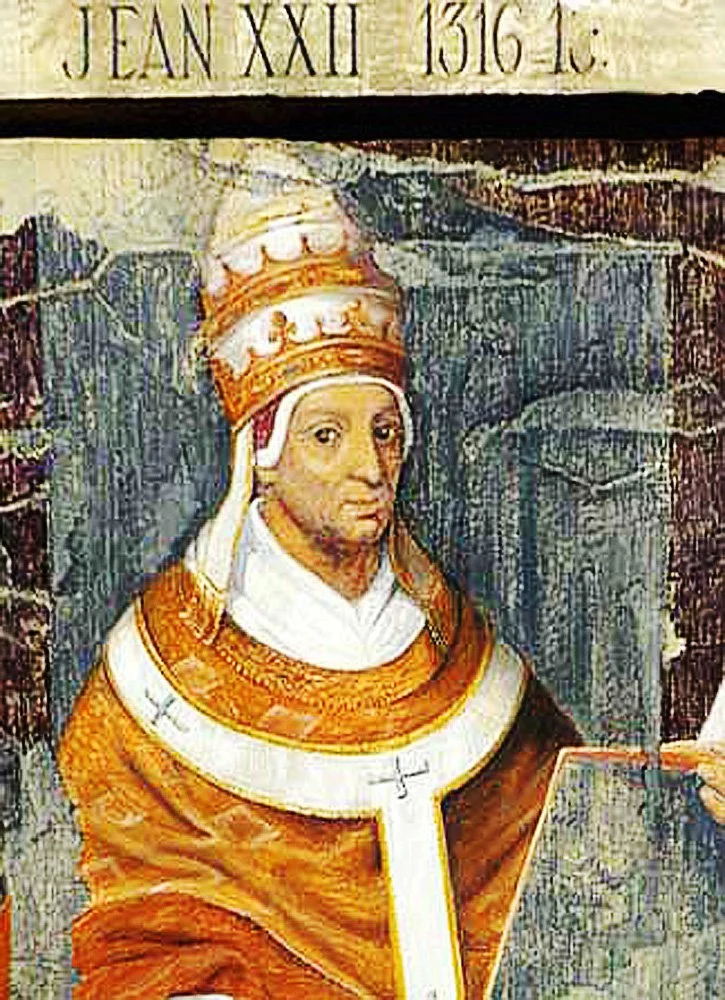
Pope John XXII, artist unknown. Source: c domain, Archives iconographiques du palais du Roure à Avignon, available here.

After Philip requested power

When Philip turned to the Church for money to cover his costly campaigns in the late thirteenth century, he set crown and Church on a collision course. Desperate for funds, he wanted the Church to help pay for his wars in Gascony and Flanders, and as France poured its resources into fighting rather than the welfare of its people, the kingdom slid into crisis. Philip treated these wars as a gamble worth taking, but drawing the Church into them brought him no relief. The confrontation culminated in the seizure of Boniface VIII at Anagni in 1303; released by the townspeople but broken by the ordeal, the pope died about a month later.

Rarely had a secular ruler laid hands on the pope, and never so nakedly over money; yet the seizure of Boniface set in motion what became the Avignon Papacy, during which seven French popes governed the Church from Avignon for some seventy years. The first of them, Bertrand de Got, was elected in 1305 and took the name Po. Clepe ment proved highly amenable to Philip - most visibly in his suppression of the Knights Templar, which he formally abolished at the king's urging (Théry-Astruc, 2016, 36). To many this looked like a capitulation that left the Church dangerously exposed. Clement spent most of his pontificate in France and never went to Rome, and it was under him that the popes came to reside in France rather than at the Holy See.

Clement also had to manage the posthumous proceedings that Philip's lawyers pressed against the memory of Boniface VIII, placating the king by revoking the bulls with which Boniface had asserted papal supremacy over France (Théry-Astruc, 2016, 39). The affair dragged on for roughly two years, the late pope's guilt or innocence argued on both sides, before Clement contrived to have it dropped. The deeper reason the papacy shifted from Rome to France was the turbulence of the Roman Curia itself: with powerful families feuding for control of the city, a more secure base seemed the safer choice, and it suited a papacy bent on centralizing its authority. As the French crown grew stronger through its hold over a compliant pope, Clement sought stability above all and chose never to return to Rome, even when he might have done. Abroad he took up the cause of crusade, receiving overtures from the Mongol Ilkhanate - which proposed a Franco-Mongol alliance against the Mamluks of Egypt - and proclaiming a new crusade at the Council of Vienne in 1312 (Housley, 1980, 166).

The crusade was slow to take shape; after much preaching, and with the backing of several kings, it eventually got under way, one of the last such expeditions ever mounted. In Italy, meanwhile, Rome was convulsed by the feud between the Orsini and Colonna families, which proved impossible to settle. Clement governed the papal lands from afar, entrusting authority in the region to allies while he remained in France, but the situation deteriorated and the cardinals he left in charge were themselves split along factional lines. The vacuum allowed the Holy Roman Emperor, Henry VII, to press his own claims in and around Rome during his Italian expedition, and from a distance Clement watched the region torn by the older rivalry between France and Naples and by Henry's ambitions. He also moved against heresy, calling a crusade that crushed the Dulcinians, the followers of Fra Dolcino. The body of canon law he assembled, the Clementine Constitutions, was completed in his reign but promulgated only by his successor, John XXII, in 1317; it asserted a broad papal authority that later popes would dispute. Clement died in 1314, but his reign had set the papacy on a French course, drawing it away from Rome and toward the power of the West.


France after Philip IV

Philip IV died after a hunting accident in 1314, and the Church's power carried on much as Clement had shaped it. Clement's death brought to the throne John XXII - Jacques Duèze - who came not from Paris but from Cahors, in southern France. Trained above all as a jurist in canon and civil law, he had served for years as an adviser at courts across the region; as chancellor to Charles II of Naples, he is said to have used his influence to have the gladiatorial games at Naples suppressed. In 1310 he became bishop of Avignon and rose swiftly through the ranks of the Church. When Clement died in 1314 it took almost two years to settle on a successor, amid bitter divisions among the cardinals and the deepening quarrel with the Holy Roman Empire.

In 1316 Philip, Count of Poitiers - soon to be Philip V of France - forced the deadlocked cardinals into a conclave of twenty-three at Lyon and pressed them to elect a pope; their choice fell on Jacques Duèze. Like his predecessor, John remained in France and never returned to Rome. His was among the longest of the Avignon pontificates, running for eighteen years. He governed with a formidable will - quick-tempered, jealous of his authority, and ready to assert the Church's claims across the known world, even in letters to non-Christian rulers. He backed Edward II of England against the Scots, though this entangled him in the affairs of Ireland, whose princes petitioned the papacy - in the Remonstrance of 1317 - to be released from English overlordship in favor of a ruler more sympathetic to the Church (Richardson, 1941, 97).

John's greatest struggle was with the Holy Roman Empire. The disputed imperial election of 1314 had set Louis IV of Bavaria against Frederick the Fair of Austria, and John refused to recognize either as emperor, insisting that confirming an imperial election was the pope's prerogative. When Louis prevailed and ignored him, John excommunicated him in 1324; Louis retaliated by invading Italy and installing an antipope, and the feud outlasted John himself. The pattern echoed the old wars between empire and papacy - Frederick II a century earlier had likewise defied Rome and marched into Italy - and John pursued the emperor's Ghibelline allies with the same weapons, condemning the Visconti of Milan as heretics and proclaiming a crusade against them (Menache, 1986, 436). The rest of his reign was taken up with controversies over witchcraft, Franciscan poverty, and the beatific vision. A plan to move the papal seat to Bologna came to nothing when the city rebelled, and the papacy stayed in France. John died in 1334, keeping the Church at Avignon and clear of the warfare consuming Italy.


What then

A single act by the French king in 1303 changed the course of history: for the next seventy years the popes resided in France. Hungry for power, they reached for supreme control over Christendom. Under Clement V the papacy formally left Rome, in what the poet Petrarch would famously condemn as the start of the Church's 'Babylonian Captivity.' Clement remained in Philip's grip and followed his lead at every turn, and under John XXII the papacy again found itself entangled with both France and the Holy Roman Empire. These first two Avignon popes embodied the office at its most political - a mirror of where the papacy's power now lay. What had begun as an attempt to curb the corruption of the Church had transformed it entirely, and the popes who followed would confront the same question anew.


Now read about the War of the Breton Succession here.


Bibliography

Housley, N. J. “The Franco-Papal Crusade Negotiations of 1322-3.” Papers of the British School at Rome, vol. 48, 1980, pp. 166–85. JSTOR, http://www.jstor.org/stable/40310773. Accessed 5 Aug. 2026.

Menache, Sophia. “The Failure of John XXII’s Policy toward France and England: Reasons and Outcomes, 1316-1334.” Church History, vol. 55, no. 4, 1986, pp. 423–37. JSTOR, https://doi.org/10.2307/3166366. Accessed 5 Aug. 2026.
Mommsen, Theodor E. “The Date of Petrarch’s Canzone Italia Mia.” Speculum, vol. 14, no. 1, 1939, pp. 28–37. JSTOR, https://doi.org/10.2307/2853837. Accessed 5 Aug. 2026.

Richardson, H. G. “Clement V and the See of Canterbury.” The English Historical Review, vol. 56, no. 221, 1941, pp. 97–103. JSTOR, http://www.jstor.org/stable/553609. Accessed 5 Aug. 2026.

Théry-Astruc, Julien. “THE FLIGHT OF THE MASTER OF LOMBARDY (13 FEBRUARY 1308) AND CLEMENT V’S STRATEGY IN THE TEMPLAR AFFAIR: A SLAP IN THE POPE’S FACE.” Rivista Di Storia Della Chiesa in Italia, vol. 70, no. 1, 2016, pp. 35–44. JSTOR, http://www.jstor.org/stable/44807473. Accessed 5 Aug. 2026.

Posted
AuthorHistory Is Now Magazine
CategoriesBlog Post

The Avignon Papacy (1309-1376) was the period during which seven successive popes resided at Avignon, in modern-day southern France, rather than at Rome. It followed a bitter conflict between the papacy and King Philip IV of France, and the death of Pope Boniface VIII in 1303 marked a decisive shift in the balance of power within the Church. Talia Bega explains — and looks at the rise of Philip VI and the taxation of the Church.

You can read part 1 on the Church in the 13th century here.

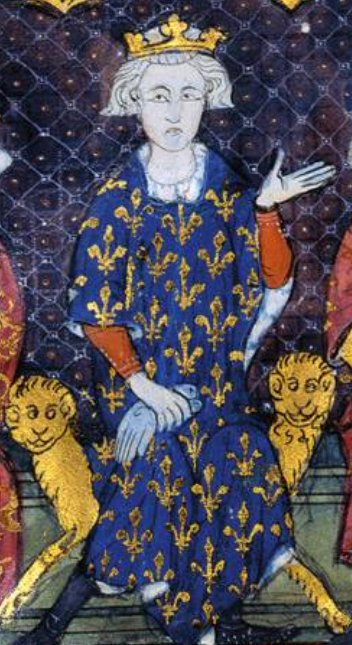
Philip IV. Source: Public domain, Bibliothèque nationale de France, available here.

The Rise of Philip IV

By the thirteenth century France had returned to the height of its power, having recovered from the Plantagenets much of the territory once held by the Angevin Empire. Kings such as Philip II Augustus and Louis VIII enlarged the royal domain and restored France to pre-eminence in western Europe. The French kings of this century were devout Catholic monarchs who leaned heavily on the Church to support their campaigns. One of them, Louis IX - better known as Saint Louis - made France a commanding center of authority through his piety and his ambition on the Seventh Crusade (MacDonald 1931, 692). That crusade ended in disaster, yet Louis's devotion never wavered. He also reformed royal government: he allowed cases to be appealed directly to the crown and abolished trial by combat, the practice of settling guilt or innocence by armed duel. His reforms shaped an enduring ideal of the just king who serves both crown and people (Davis 2010, 215).

Religion was Louis' overriding priority, and his devotion expressed itself daily - most enduringly in the building of the Sainte-Chapelle in Paris, raised in the 1240s to house the relics of Christ's Passion, above all the Crown of Thorns. He treated the defense of the faith as inseparable from justice and maintained a close bond with the Church. That reputation carried him to canonization in 1297, making him the only French king ever recognized as a saint (Marrone 1975, 208). Miracles were reported at his tomb, and the intensity of his devotion did much to hasten his elevation. His grandson, Philip IV, would prove a very different figure, whose quarrel with the Church helped usher in the Avignon Papacy and a new challenge to papal power.

Philip IV (1268-1314), known as Philip the Fair, ruled from 1285 until his death. His reign was dominated by conflict - with England, with his own nobility, and with the Church itself - and by the heavy demands his campaigns placed on the kingdom. Ambitious to the point of dynastic overreach, he sought to extend the reach of his house across Europe, much as his grandfather Louis IX had done in his own way.

The chain of events can be traced to 1293, when a brawl between sailors off the French coast set Philip on a collision course with Edward I of England. Edward held the Duchy of Aquitaine as a vassal of the French crown and owed homage for it. A settlement was negotiated - it included the betrothal of Edward to Margaret, Philip's own sister, and the temporary surrender of Gascony, to be returned once peace was secured. The arrangement collapsed: when Edward was summoned to the French court and failed to appear, Philip declared his French fiefs - Aquitaine, Gascony, and the rest - forfeit in May 1294 (Strayer 1956, 26).

The conflict became known as the Gascon War (1294-1303), and it dragged on between the two kingdoms. It also strained Philip's finances, for he was fighting on several fronts at once - allied with the Scots against England under the 1295 Auld Alliance, while Edward I in turn allied with Flanders, which had risen in revolt against French overlordship. That Flemish rising drew France into the Franco-Flemish War (1297-1305). The Gascon War itself was settled by the Treaty of Paris in 1303, which restored Aquitaine to the English and left the duchy much as it had stood before the fighting began.

This struggle over Gascony is often seen as one of the seeds of the Hundred Years' War. Flanders posed a particular problem, since the Flemish were pressing for independence from the French crown; the fighting there proved costly and inconclusive, and it brought fresh rounds of reform and heavy taxation to both sides. The pressing question - how Francecould pay for all these wars - led straight back to the Church, and what Philip did next would change the course of history.


Money and the Taxation of the Church

Watching France sink into debt, Philip turned to the wealthiest institution within reach - the Church - to fund his wars and shore up his authority. His most consequential move was to tax the French clergy, which brought him into direct conflict with Rome; in 1297, under pressure, Boniface VIII conceded that the king might tax the clergy in cases of genuine emergency (Marrone 1975, 201). Philip's ministers meanwhile mounted a sustained propaganda campaign against the pope (Powicke 1934, 313). The breach widened in 1301, when Philip arrested Bernard Saisset, bishop of Pamiers, on a charge of treason; Boniface responded by summoning the French clergy to Rome to examine the king's conduct.

 In 1302 Boniface issued the bull Unam Sanctam, the most sweeping assertion of papal supremacy over secular rulers yet made. The following year the quarrel turned violent: in September 1303 the king's agents, led by Guillaume de Nogaret, seized the aged pope at Anagni and held him for several days, demanding his resignation. Rarely had a secular ruler laid hands on the head of the Church so brazenly, and the shadow of excommunication hung over Philip throughout (Powicke 1934, 326). Boniface was rescued by the townspeople of Anagni and returned to Rome, but - broken in body and spirit by his ordeal - he died on 11 October 1303 (Powicke 1934, 325).

The assault on Boniface sent shockwaves through the Church; had he been excommunicated first, the consequences for France might have been graver still. His successor, Benedict XI, moved against the men responsible for the outrage at Anagni but died after a reign of only eight months. In 1305 the cardinals chose Bertrand de Got, archbishop of Bordeaux, who took the name Clement V; a Frenchman with strong ties to Philip, he became the first of the Avignon popes. The deeper question was why Philip had pressed so hard against the Church. He had found it at its weakest and meant to bring it to heel - but his overriding motive was money, needed to restore the French crown and fund its wars, and when the money ran out he had little choice but to reckon with the consequences himself.

Philip is remembered above all for the destruction of the Knights Templar, a military religious order founded in the early twelfth century. He cast the order as corrupt and scandal-ridden, and he saw in its suppression a way to escape the debts he owed it and to assert royal power over an institution answerable only to the pope. On 13 October 1307 he had the Templars across France arrested en masse; there followed seven years of trials, torture, and forced confessions. Under pressure from Philip, Clement V dissolved the order at the Council of Vienne in 1312, and in 1314 the last grand master, Jacques de Molay, was burned at the stake in Paris. The Templars had been difficult to control precisely because they answered to Rome alone, but Philip turned his power against them at a moment when the crusading age was fading and his need for money was most acute. Throughout the affair Clement served as Philip's instrument, yielding whenever the king required it and handing him a sweeping victory (Théry-Astruc 2016, 35).

The suppression of the Templars set the tone for Philip's reign and displayed the supreme authority France had come to wield. Under him the French crown drew the Church into its orbit and set the pattern of leadership for the next seventy years. Yet the order Philip imposed rested on unstable foundations: strong kingship could hold it together, but weaker successors would struggle to do so. From the humbling of one pope to the making of another, Philip had shown that a determined king could bend even the Church to his will - and, once bent, it would prove very hard to set right.


Now read part 3 on the start of the Avignon Papacy here.


Bibliography

Davis, Jennifer R. “The Problem of King Louis IX of France: Biography, Sanctity, and Kingship.” The Making of Saint Louis: Kingship, Sanctity, and Crusade in the Later Middle Ages; Saint Louis, by M. Cecilia Gaposchkin, Jacques Le Goff, and Gareth E. Gollrad. The Journal of Interdisciplinary History 41, no. 2 (2010): 209–25. http://www.jstor.org/stable/40785099.

MacDonald, Gregory. “Saint Louis IX of France.” The Irish Monthly 59, no. 701 (1931): 691–96. http://www.jstor.org/stable/20513139.

MARRONE, JOHN, and CHARLES ZUCKERMAN. “CARDINAL SIMON OF BEAULIEU AND RELATIONS BETWEEN PHILIP THE FAIR AND BONIFACE VIII.” Traditio 31 (1975): 195–222. http://www.jstor.org/stable/27830986.

Powicke, F. M. “POPE BONIFACE VIII.” History 18, no. 72 (1934): 307–29. http://www.jstor.org/stable/24401107.

Strayer, Joseph R. “Philip the Fair--A ‘Constitutional’ King.” The American Historical Review 62, no. 1 (1956): 18–32. https://doi.org/10.2307/1848510.

Théry-Astruc, Julien. “THE FLIGHT OF THE MASTER OF LOMBARDY (13 FEBRUARY 1308) AND CLEMENT V’S STRATEGY IN THE TEMPLAR AFFAIR: A SLAP IN THE POPE’S FACE.” Rivista Di Storia Della Chiesa in Italia 70, no. 1 (2016): 35–44. http://www.jstor.org/stable/44807473.

Posted
AuthorHistory Is Now Magazine
CategoriesBlog Post

The Avignon Papacy (1309-1376) was the period during which seven successive popes resided at Avignon, in modern-day southern France, rather than at Rome. It followed a bitter conflict between the papacy and King Philip IV of France, and the death of Pope Boniface VIII in 1303 marked a decisive shift in the balance of power within the Church. Talia Bega explains — and looks at the problems with the Church in the 13th century.

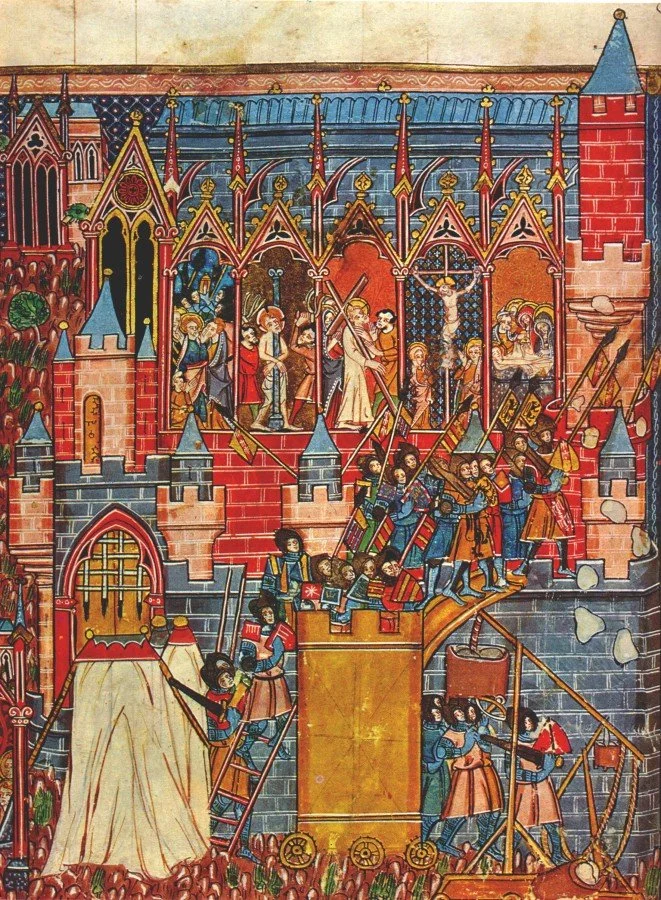
Siege of Jerusalem during the First Crusade. Source: Public domain, Guillaume de Tyr, Historia, BNF ms FR 352 fol. 62, available here.

What was the Church at the Time?

In the Middle Ages the papacy stood at the summit of the Church's hierarchy and wielded an authority that reached deep into government. At a time when Europe's kings were steadily consolidating their power, the Church acted as a check on their ambitions whenever their aims collided with its teaching. Its canon law touched even the conduct of war and the ordinary business of governing. Based in Rome, the pope held the ancient title of Pontifex Maximus, or high priest, and claimed spiritual authority over all Catholics, from questions of law to matters of leadership. After the East-West Schism of 1054 divided the Eastern and Western churches, Catholicism remained the dominant faith of western Europe; but over the following centuries - and especially through the Crusades (1095-1291) - much of the initiative gradually passed to the increasingly centralized kingdoms (Leff 1961, 37). The pope's word carried immense weight, and a ruler who defied it risked excommunication - in effect, banishment from the Church.

Yet monarchs chafed at papal oversight of their every act, and above all at the principle that a war could not lawfully be waged without the Church's sanction (Leff 1961, 37). In France, and especially during the Crusades, the papacy served as a counterweight between throne and altar (Howe 1988, 331). Under pious kings such as Louis IX, personal devotion and asceticism became a way of demonstrating the strength of the faith and of leading his people by example. The thirteenth century, however, brought mounting conflict - the horrors of the later Crusades and the rising power of the Holy Roman Empire - that would challenge the Church anew.

The Crusades grew out of a single pressing question: how could Christendom regain access to the Holy Land - and above all Jerusalem, the site of Christ's crucifixion and resurrection - after these territories passed into Muslim hands?

The First Crusade was a startling success. Preached by Pope Urban II at the Council of Clermont in 1095 as an armed pilgrimage to Jerusalem, it culminated in the capture of the city in 1099 and the founding of the Kingdom of Jerusalem, alongside a cluster of other Crusader states such as the County of Edessa, the Principality of Antioch, and the County of Tripoli. The kingdom had its own Latin patriarch at the head of its church and drew nobles from across Europe to defend it, becoming for a time a stronghold of Latin Christian authority in the East - though rivalries among kingdoms such as France and England limited what it could achieve. Its ascendancy did not last: in 1187 Jerusalem fell to Saladin, and the struggle to recover it would consume the Church for generations, even as the kingdom's own nobility fractured into infighting.

At the start of the thirteenth century Pope Innocent III launched the Fourth Crusade. It became a notorious debacle: instead of striking at Egypt, the Crusaders turned on the Christian Byzantine Empire and sacked its capital, Constantinople, in 1204 (Queller 1974, 461), establishing the Latin Empire that endured until 1261 (Madden 2012, 313). That Christians had made war on fellow Christians appalled contemporaries and drew excommunications, and the campaign left the Church more heavily indebted and secular rulers more powerful over the conquered lands (Madden 2012, 317). Later Crusades fared little better - most disastrously the Seventh, led by Louis IX of France, who was taken captive in Egypt.

The Crusades left a deep mark on the Church, forcing hard questions about how it was to survive and sustain itself. Powerful kingdoms - France, England, and the Holy Roman Empire among them - increasingly cast themselves as its champions, and their rulers cultivated close ties to the Church in order to enlarge their own influence (Queller 1974, 459). Nowhere was that ambition sharper than in the second great pressure on the papacy: the Holy Roman Empire, which seized whatever advantage it could.


The Holy Roman Empire

The Holy Roman Empire did not spring directly from the fall of Rome in 476; it took shape centuries later, conventionally dated to the coronation of Charlemagne in 800 and refounded under Otto I in 962. Centered on Germany but reaching into Burgundy and much of Italy, it cast its rulers as heirs to Rome - indeed as kings of the Romans - and their imperial coronations traditionally took place in Rome, in echo of Charlemagne's. Throughout the Middle Ages these emperors clashed repeatedly with the Church, above all over their claims in Italy. One of the most troublesome was Frederick Barbarossa, whose long series of campaigns in northern Italy - against the cities of the Lombard League and the popes who backed them - brought him into open conflict with Rome. His dynasty's grip on Sicily came only later, through the marriage of his son, the future Henry VI, to the Norman heiress Constance.

Barbarossa's defiance made him one of the first emperors to provoke a serious rupture with the Church, and the contest over imperial authority in Italy carried on into the thirteenth century. Again and again, he sought to extend his power, and again and again he met resistance on every side; only after years of conflict - and a public reconciliation with Pope Alexander III at the 1177 Peace of Venice - was an uneasy peace restored.

Tensions sharpened further with the capture of Richard the Lionheart, seized in December 1192 by Duke Leopold V of Austria as he made his way home from the Third Crusade and handed the following year to Emperor Henry VI, who held the English king for a vast ransom - a striking assertion of imperial power over a fellow monarch, and one the Church condemned. A generation later another formidable emperor, Frederick II, held the crowns of both Sicily and - through his marriage to Isabella II (Yolande) of Jerusalem - the Kingdom of Jerusalem, and was determined to press his authority in the Holy Land. He was excommunicated by Pope Gregory IX in 1227 for repeatedly delaying the crusade he had vowed to lead, and again in 1239 as the breach between emperor and papacy widened (Bird 2022, 87). Frederick's hunger for territory, above all Sicily and southern Italy, which he claimed as the Norman heir, made a collision with the Church all but inevitable, for the papacy was equally unwilling to surrender its authority over the empire (Powell 1963, 493). Significant tension resumed after Innocent IV became pope in 1243, and at the First Council of Lyon in 1245 the pope issued the bull Ad apostolicae dignitatis apicem, which declared Frederick deposed and unworthy to rule and released his subjects from their allegiance (Powell 1963, 490). The sentence changed little on the ground: Frederick fought on, campaigning in Lombardy until his death in 1250.

Such pressure was precisely what the papacy could least afford. Hemmed in on every side, how was it to grow, let alone hold its ground? Sicily remained a source of friction for decades after Frederick's death, and arguably taught later kings that the Church could be defied with impunity. The signs of weakness were unmistakable, not least the papacy's dwindling ability to field armies of its own. These pressures - among many others, from chronic shortages of money to the loss of territory - helped pave the road to Avignon, especially once ambitious monarchs such as Philip IV set out to bend the Church to their will (Leff 1961, 38). The Crusades stand as a vivid example of the damage done across Europe, and of the lessons learned, from the raising of armies to the question of whom to trust. Central as the Church had been, by 1309 it had passed effectively into French hands - a shift that would reshape its diplomacy and, in the eyes of many, shatter its old authority.


The Church on the eve of Avignon

Why dwell on the Crusades and the Holy Roman Empire before turning to Avignon? Together they acted as a catalyst for the decline of a once-dominant Church, exposing the corruption - the bribery and the diplomatic blunders - that ran through the crusading effort and the long struggle with the empire. They also reveal a pattern about power: rulers like Philip IV were now ready to exploit the popes. When Philip sought funds for his campaigns early in the fourteenth century, Boniface VIII refused him - a confrontation that ended in the pope's downfall and, a few years later, in the suppression of the Knights Templar (Théry 2013, 120). Philip, like Frederick before him, saw a Church at its weakest and moved to remake it to his advantage.

The Crusades are the clearest evidence of the strain the Church faced entering the fourteenth century: the Holy Land had been lost for good, and Europe now had to hold together simply to keep the Church intact. The Avignon Papacy that began in 1309 gathered a succession of French popes who governed from Avignon and sought a more centralized authority. Some seventy years on, the papacy would fracture in the Western Schism, when rival claimants - two, and eventually three - split Latin Christendom. The pattern rhymes with what came before; but to understand how matters reached a head in 1309, we must first trace the long road that led there.


Now read about the War of the Breton Succession here.


References

BIRD, JESSALYNN LEA. “PROPHECY, ESCHATOLOGY, GLOBAL NETWORKS, AND THE        

CRUSADES, FROM HATTIN TO FREDERICK II.” Traditio 77 (2022): 31–106. https://www.jstor.org/stable/27191187.

Howe, John. “The Nobility’s Reform of the Medieval Church.” The American Historical Review 93, no. 2 (1988): 317–39. https://doi.org/10.2307/1859921.

Leff, Gordon. “Heresy and the Decline of the Medieval Church.” Past & Present, no. 20 (1961): 36–51. http://www.jstor.org/stable/650135.

Madden, Thomas F. “The Venetian Version of the Fourth Crusade: Memory and the Conquest of Constantinople in Medieval Venice.” Speculum 87, no. 2 (2012): 311–44. http://www.jstor.org/stable/23488041.

Powell, James M. “Frederick II and the Church: A Revisionist View.” The Catholic Historical Review 48, no. 4 (1963): 487–97. http://www.jstor.org/stable/25017141.

Queller, Donald E., Thomas K. Compton, and Donald A. Campbell. “The Fourth Crusade: The Neglected Majority.” Speculum 49, no. 3 (1974): 441–65. https://doi.org/10.2307/2851751.

Théry, Julien . “A Heresy of State: Philip the Fair, the Trial of the ‘Perfidious Templars,’ and the Pontificalization of the French Monarchy.” Journal of Medieval Religious Cultures 39, no. 2 (2013): 117–48. https://doi.org/10.5325/jmedirelicult.39.2.0117.

Posted
AuthorHistory Is Now Magazine
CategoriesBlog Post