The War of the Breton Succession, or Breton War of Succession (1341–1365), was a war over the succession to the dukes of Brittany, in north-western France, that lasted for over twenty years. The war was a major conflict in the long Hundred Years’ War, which drove both France and England into a fight for survival and a contest for supremacy in Western Europe. Talia Bega explains — and asks whether the French could compete with the English.
Part 1 on the origins of the war is here, and part 2 on the rise of the English is here.
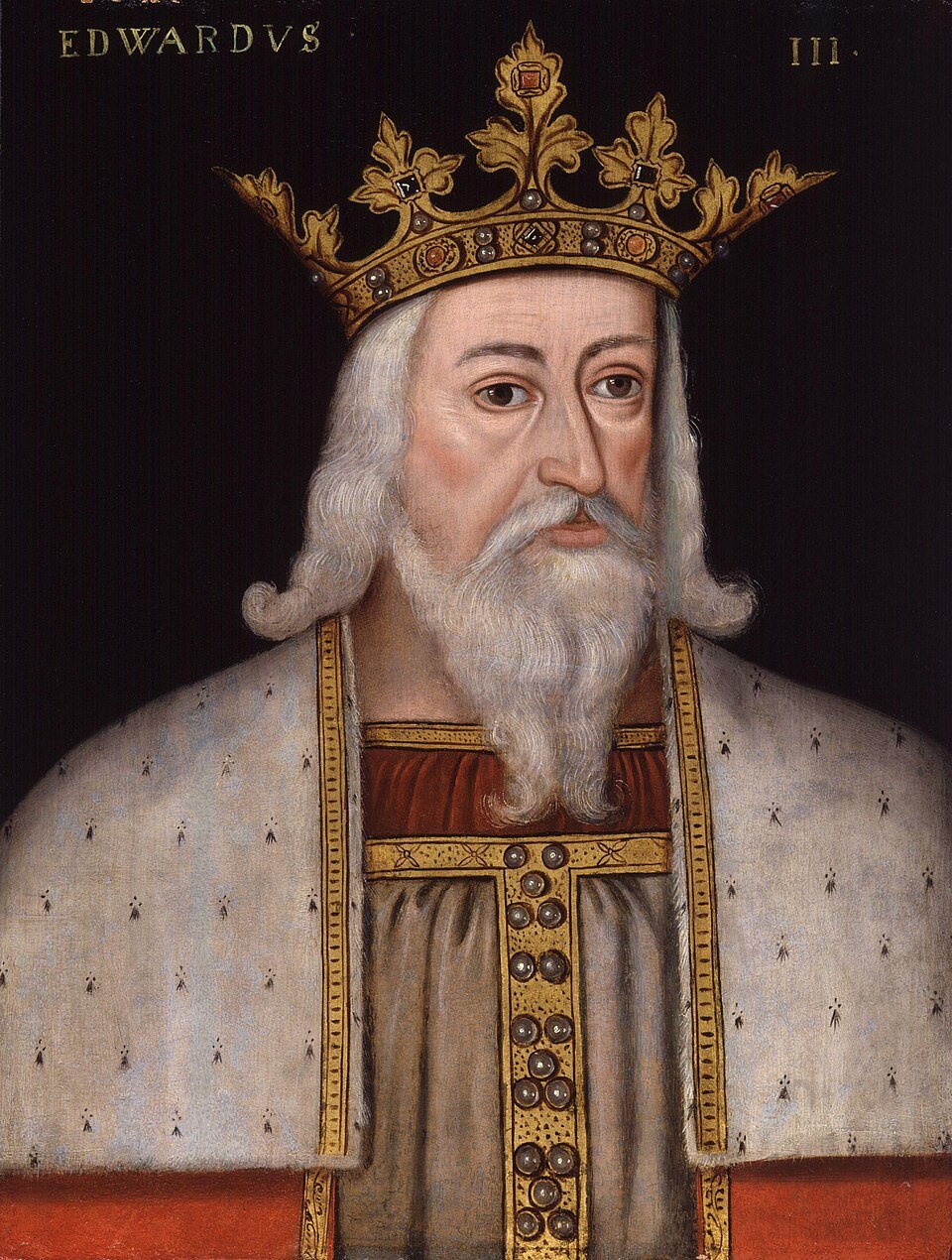
King Edward III, 16th century depiction. Source: Public domain, available here.
Edward III’s Breton Campaign
For the past two years, France and England had been locked in a brutal succession war over who would become the next Duke of Brittany after the death of John III in 1341. The conflict unfolded within the long Hundred Years’ War (1337–1453), a wider trial of which realm was the more powerful. John of Montfort backed the English cause, while Charles of Blois backed the French. Both men were eager to win the duchy, but Edward III of England had plans of his own.
After the Truce of Espléchin in 1340, which paused the fighting for a year, Edward put forward a plan to support John once the old duke died — in return for John’s backing of his own claim to the French throne. The treaty allowed both sides to stop fighting and committed the English not to invade French lands. Charles believed himself the rightful heir to the duchy, not least because of the popular support he enjoyed, while John sought to reconquer territories such as Nantes and Rennes. He was captured by French forces, however, and imprisoned in 1341. Edward resolved to plan an invasion after John’s wife, Joanna of Montfort, begged him to intervene and free her husband. With Edward now involved — a military mastermind backed by a strong realm — Charles was suddenly at risk.
A Large Invasion and the Rise to Victory
The year 1342 at last saw Edward act on his plan to free John from prison and press the Montfort claim to the duchy of Brittany. Helping the duke also allowed Edward to gain territory and strengthen his own bid for the French crown. It is worth noting that many popes of this era were French — a period known as the Avignon Papacy. Many of them were pro-French, which posed a problem for Edward, who needed support for his claim to the French throne. Clement VI in particular was strongly pro-French and had long served at the French court under Philip. Edward, for his part, was determined to turn the duchy to his own advantage.
Clement did his best to resolve the conflict, but Edward refused to cooperate and pressed on with his own plans. He sent a large body of reinforcements after Joanna pleaded for help in the summer of 1342. Charles used the same period to regain lost territory and laid siege to Hennebont in Brittany. By this point John had already been captured, and some of his commanders had passed under his wife’s control. Edward put his reinforcements to work in the struggle for control, winning several victories along the way.
Joanna also proved shrewd, particularly in winning over French supporters such as the famous Amaury de Clisson. Clisson might be seen as a traitor for aiding the Montfort cause and helping to break the siege Charles had laid. The Montfort recovery owed much to Charles himself: his financial terms were ones not everyone would accept, and some of his Italian mercenaries deserted him. His fortunes dipped again a few weeks later, when another of his sieges, this time at Brest, failed. Joanna once more found herself besieged by Charles as he pressed to seize the duchy’s main power base. Since his victory at Sluys in 1340, Edward had built a much stronger navy — one whose value would later show in his greater triumphs of the Hundred Years’ War.
English attack
The English warships were modeled on the cogs of the German territories, in contrast to the French galleys. These large merchant vessels were prized for their carrying capacity, and their roomy holds could just as easily transport soldiers. The crossing to Brest took about three days, carrying a relief force of some 1,350 men. The town of Bayonne, loyal to Edward, proved a great help: it gave him a base from which to launch the ships, and with it the advantage. The English fell on the Genoese galleys without warning and destroyed them one by one. Shaken by the strength of this force, Charles abandoned the field, leaving Brest in English hands for decades to come. His defeats were not yet over — he was beaten again at Morlaix, to the embarrassment of the French. Meanwhile John remained a prisoner, while his wife’s strategy took shape, aided above all by the king of England.
A few weeks later Edward landed and won a victory at Vannes, helped by Robert of Artois, who was wounded there and later died. Robert had watched Charles storm and ravage the town, but with over 10,000 men he helped lift the siege. Vannes endured several sieges in all, and before long both sides had gathered large armies for a far wider war. That war never came: with the help of Pope Clement VI, the Treaty of Malestroit was sealed on 19 January 1343, pausing the conflict for the next three years. The siege was over, and under the treaty the papal legates decided who should govern the territory.
This was a turning point in England’s favor: the treaty suited the English and fulfilled Edward’s wishes. It secured the release of John of Montfort, along with several other prisoners on both sides. The main conference followed a year later, in 1344, though the two delegations never met face to face. It produced a great deal of back-and-forth, since neither side took it seriously and each pursued its own ends. Two years after that, Edward launched his Crécy campaign, ravaging France still further. He was far better prepared than Philip VI, knowing exactly what he wanted and when. His strategy stripped Charles of power and pressed England’s claim in France, even though Charles had until then held the upper hand. The next thirty years would prove perilous for France — and in 1346, everything changed at once.
A reminder that Part 1 on the origins of the war is here.
References
Graham-Goering, E. (2021). Princely power in late medieval France: Jeanne de Penthièvre and the war for Brittany. Cambridge University Press.
Sumption, J. (1991). The Hundred Years’ War. University of Pennsylvania Press.