The European scramble for Africa, the period of imperial expansion in the late 19th and early 20th centuries, was motivated by a variety of reasons. An examination of different sources reveals that the driving force behind the colonization of Africa was mainly economic, fueled by the need for raw materials and new markets. Political rivalries, technological advances, and cultural ideologies were contributory factors, but they were ultimately secondary to the overarching economic imperative. To understand this expansion, one must look at the convergence of the Industrial Revolution’s demands and the geopolitical climate of the era.
Shubh Samant explains.
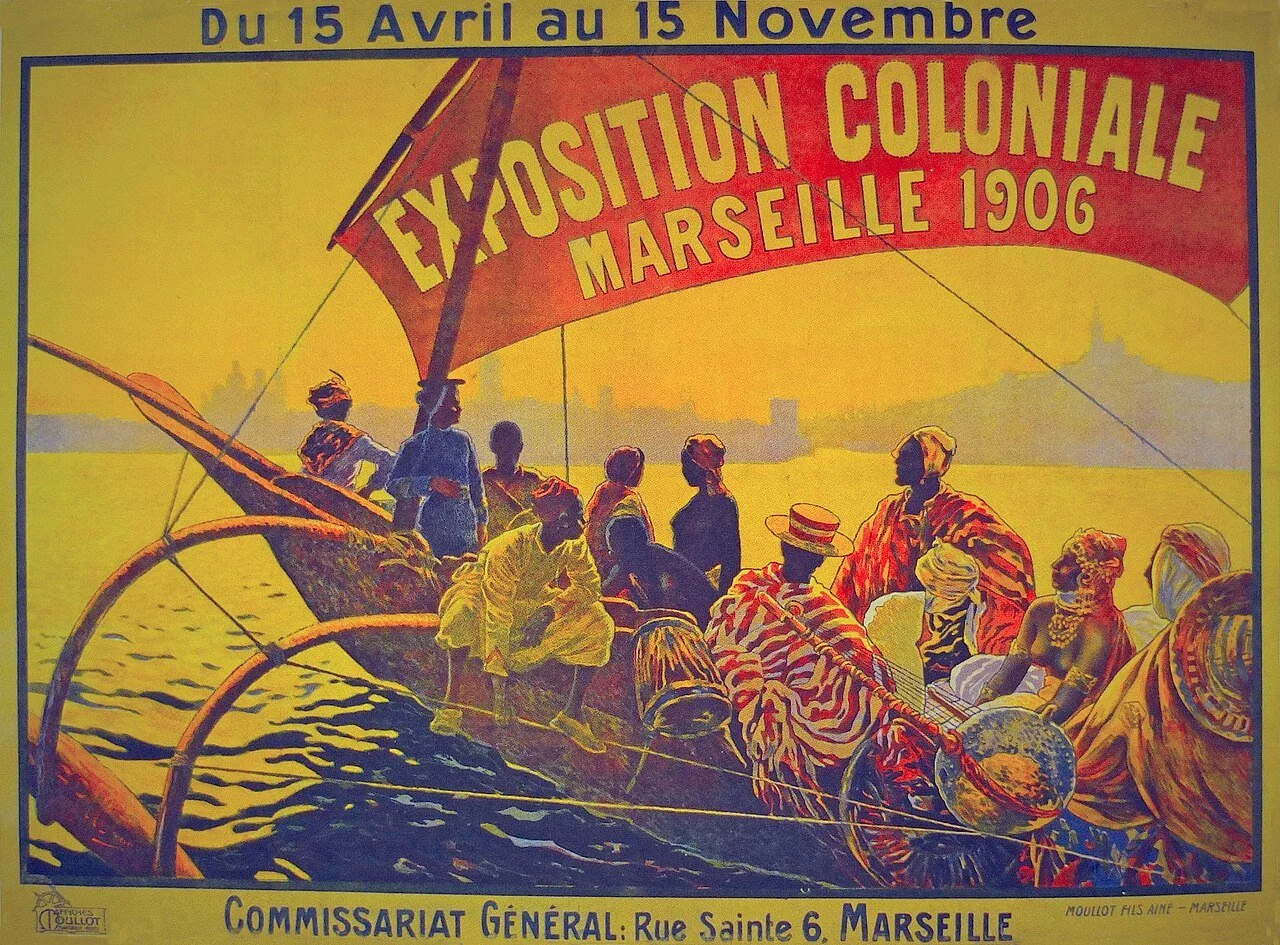
A 1906 Marseille Colonial Exhibition poster. It demonstrates European colonial achievements.
A 1906 Colonial Exhibition poster in Marseille, France.
The Berlin Conference
The term “Scramble for Africa” itself reflects the speed, intensity, and competitive nature of this imperial race. Between roughly 1880 and 1914, European powers carved up nearly the entire continent, often with little regard for existing African societies, cultures, or political boundaries. The Berlin Conference of November 15, 1884 to February 26, 1885, convened by Otto Von Bismarck, symbolized this process, as European nations sat around a table in Berlin and drew borders on maps that would later become the foundations of modern African states. This conference was not about African voices or African agency; it was about European powers negotiating among themselves to avoid conflict while maximizing their territorial and economic gains. The General Act of the Berlin Conference established the principles of "effective occupation," which required powers to demonstrate physical presence and administration to claim sovereignty, further accelerating the rush to the interior.
The Economic Engine
The Industrial Revolution was the force that created an economic push, since it had established an unprecedented need for raw materials. Some examples of natural resources present in Africa included cotton, palm oil, rubber, and minerals. These resources were important to the industries of Europe, and gaining access to them was of the utmost importance. There were economic motivations which pushed the European powers to colonize and tap the wealth of Africa. With the need for new markets in rise, the majority of Africans were perceived as a wonderful opportunity for new markets for European-made manufactured goods. By 1870, industrial output in Europe had reached a point where domestic markets were becoming saturated, leading to a "Long Depression" that made overseas expansion look like a financial necessity.
The economic logic was straightforward: industrial economies in Britain, France, Germany, and Belgium required steady supplies of inputs to sustain production. African rubber fed the tire industry, palm oil was used in soaps and lubricants, cotton supplied textile mills, and gold and diamonds enriched European treasuries. Beyond raw materials, Africa also represented a potential consumer base. Even though most Africans had limited purchasing power, imperialists imagined vast markets where European goods could be sold. This vision of Africa as both a warehouse of resources and a marketplace for manufactured products was central to the imperial project. The discovery of the Witwatersrand gold reef in 1886 transformed South Africa into a focal point of global finance, drawing in billions in European capital and cementing the economic priority of the region.
Political Rivalry and the Rise of Nationalism
While economic reasons were the most significant driver, political rivalry also provoked the scramble for Africa. The extent of European control by 1914 was overwhelming, leaving just two nations (Ethiopia and Liberia) independent. This is indicative of the fierce competition among European nations, each searching for more power and prestige, National pride and the desire to retain power were strong incentives for colonization, as suggested by Freidrich Fabri. Even these political incentives, though, were intertwined with economic ones, as colonies also symbolized a source of wealth and power. Fabri argued in 1879 that for a new nation like Germany, colonial expansion was a vital necessity to maintain its standing among older powers.
Nationalism was a powerful force in late 19th-century Europe. Countries like Germany and Italy had only recently unified, and their leaders sought colonies as a way to demonstrate strength and legitimacy on the global stage. France, still reeling from defeat in the Franco-Prussian War of 1870, looked to Africa to restore its prestige. Britain, already the world’s leading imperial power, sought to maintain its dominance by controlling strategic territories such as Egypt and South Africa. Colonies became symbols of national greatness, and losing ground to rivals was seen as a humiliation. Thus, political rivalry was inseparable from the economic quest, as each empire measured its success not only in wealth but also in the size of its colonial holdings. The "Great Game" was no longer confined to Asia; it had moved to the African continent, where every square mile gained was seen as a blow to a neighbor.
Technological Advancements and Military Dominance
Technological innovations greatly aided European imperialism. Steamships, railroads, etc. allowed Europeans to penetrate into the African interior and overcome the logistical challenges. The invention of the Maxim gun further enhanced European military superiority. These technological innovations were ultimately tools to achieve the economic goals. Without these advancements, the "Dark Continent" would have remained largely inaccessible to large-scale European administration.
The role of technology cannot be overstated. Prior to the late 19th century, much of Africa remained inaccessible to Europeans due to disease, geography, and logistical difficulties. The discovery of quinine as a treatment for malaria reduced mortality rates among Europeans and made deeper incursions possible. Railroads allowed for the rapid transport of goods from the interior to coastal ports, while steamships shortened travel times between Europe and Africa. The Maxim gun, the first fully automatic machine gun, gave European armies overwhelming military superiority over African forces armed with spears, muskets, or outdated rifles. These innovations created the infrastructure and military dominance necessary to sustain imperial control, ensuring that economic exploitation could proceed with minimal resistance. At the Battle of Omdurman in September 2, 1898, British forces used Maxim guns to kill roughly 11,000 Mahdist warriors while losing only 47 of their own men, illustrating the terrifying disparity in power.
Cultural Justifications and Social Darwinism
There were cultural beliefs, such as “The White Man’s Burden” philosophy, that gave a moral reason for European imperialism. These cultural beliefs were used to cover up economic reasons for it. Although there were some Europeans who sincerely believed they were there to civilize the native Africans, they were largely motivated by a desire to acquire wealth and minerals. In general, while the scramble for Africa had a variety of reasons, it was the economic ones which were primary. It was the need for raw materials, markets, and investment opportunities that propelled the rush of the colonization of Africa. Political rivalries, technological changes, and cultural mentality served as underlying factors, but were complementary to the strong economic factors. Social Darwinism provided a pseudo-scientific framework that ranked races, suggesting that the "survival of the fittest" applied to nations and justified the domination of the "weaker" by the "stronger."
The cultural dimension of imperialism was deeply intertwined with notions of racial superiority and paternalism. Rudyard Kipling’s famous poem “The White Man’s Burden” encapsulated the idea that Europeans had a moral duty to “civilize” non-European peoples. Missionaries traveled to Africa to spread Christianity, often believing they were saving souls, but their efforts also paved the way for colonial administrations. Education systems were introduced that emphasized European values, languages, and histories, while African traditions were marginalized or dismissed as primitive. This cultural justification provided a veneer of morality to what was essentially economic exploitation. By framing imperialism as a benevolent mission, European powers could present themselves as altruistic actors, even while extracting immense wealth from African lands. However, the "civilizing mission" often translated into the dismantling of local governance and the imposition of European legal codes that prioritized property rights for settlers over indigenous land use.
African Resistance
As Europeans entered the lands of Africa, so did the Africans resist. African resistance was not a monolith; it ranged from diplomatic negotiation and tactical alliances to full-scale guerrilla warfare and religious uprisings. One of the most significant examples of sustained military resistance was led by Samori Touré, the founder of the Wassoulou Empire. Between 1882 and 1898, Touré utilized a sophisticated "scorched earth" policy and moved his entire empire eastward to evade French forces. His ability to manufacture and repair his own firearms locally allowed him to resist for sixteen years, proving that African states were capable of high-level military organization.
In East Africa, the Maji Maji Rebellion (July 1905 to July 1907) demonstrated the power of spiritual unity. Diverse ethnic groups in German East Africa (modern-day Tanzania) united against forced cotton cultivation. Rebels believed that a sacred water (maji) would turn German bullets into water. While the Germans eventually suppressed the uprising through a manufactured famine that killed hundreds of thousands, the rebellion forced the colonial administration to reform its more brutal labor policies, showing that even "failed" resistance could alter the colonial trajectory.
Perhaps the most striking exception to European dominance was the Ethiopian Empire under Emperor Menelik II. Unlike many of his contemporaries, Menelik II recognized the importance of modernizing his military early. He played European powers against one another to purchase modern rifles and artillery. When Italy attempted to impose a protectorate, the Ethiopian army decisively defeated the Italian forces at the Battle of Adwa on March 1, 1896. This victory ensured Ethiopia remained the only indigenous African state to maintain its independence throughout the Scramble, providing a powerful symbol of hope for future Pan-African movements.
Furthermore, resistance often took place within the colonial system itself. In West Africa, the "Aba Women's War" of November 1929 saw thousands of Igbo women in Nigeria organize mass protests against the British "Warrant Chiefs" and the imposition of new taxes. Through "sitting on" the chiefs, a traditional form of shaming, the women successfully forced the colonial government to drop the tax plans and reform the local administration. These examples illustrate that while the Scramble was a period of intense European aggression, African agency was never extinguished; rather, it adapted to the new realities of imperial rule.
Conclusion
By 1914, Africa was almost entirely under European control, and the continent’s political, economic, and cultural landscapes had been dramatically reshaped. The legacy of this period continues to affect Africa today, as many post-independence states inherited borders, institutions, and economic structures created during colonial rule. The scramble for Africa was not merely a historical episode of conquest; it was a transformative moment that altered global power dynamics, enriched European nations, and imposed lasting challenges on African societies. The transition to independence in the mid-20th century was frequently complicated by these extractive colonial structures, which were not designed for democratic self-governance.
In conclusion, the scramble for Africa was driven primarily by economic imperatives, but it was reinforced by political rivalries, technological innovations, and cultural ideologies. The industrial revolution created the demand for raw materials and markets, nationalism fueled competition among European powers, technology enabled conquest and control, and cultural beliefs provided moral justification. Together, these factors produced one of the most dramatic episodes of imperial expansion in world history. Yet beneath the rhetoric of civilization and progress lay the fundamental reality: Europe’s hunger for wealth and resources was the true engine of colonization. The scramble for Africa was, at its core, an economic enterprise cloaked in the language of politics, technology, and morality. By the time the dust settled, the continent was irrevocably tied to the global capitalist system, a tie that persists in the modern era's neo-colonial economic relationships.
Did you find that piece interesting? If so, join us for free by clicking here.
Now read more about the reasons for European empires here.
References
Fabri, Friedrich. (1879). Bedarf Deutschland der Colonien? (Does Germany Need Colonies?).
Headrick, Daniel R. (1981). The Tools of Empire: Technology and European Imperialism in the Nineteenth Century
Hobson, John A. (1902). Imperialism: A Study.
Hochschild, Adam. (1998). King Leopold's Ghost: A Story of Greed, Terror, and Heroism in Colonial Africa.
Kipling, Rudyard. (1899). The White Man's Burden: The United States and the Philippine Islands.
Pakenham, Thomas. (1991). The Scramble for Africa: White Man's Conquest of the Dark Continent from 1876 to 1912.
Said, Edward W. (1993). Culture and Imperialism.