Leo Clarke's story occupies a unique and almost mythic place in Canada's First World War memory, not only for the astonishing audacity of his Victoria Cross action but for the brevity and intensity of his life at war. In little more than two years, Clarke passed from civilian obscurity to battlefield legend, before being cut down almost immediately after his greatest triumph. His career encapsulates both the heroic ideal and the brutal indifference of industrial warfare, where courage could win a battle in one moment and mean nothing the next.
Terry Bailey explains.
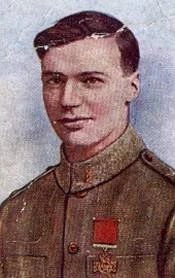
Leo Clarke - colorized. Available here.
Born on the 1st December 1892 in the small community of Waterdown, Ontario, Leo Clarke grew up far removed from the violence that would define his fate. Like many young Canadians of his generation, he was raised in a society still closely tied to Britain, imbued with a sense of imperial duty and adventure. In his early adulthood, Clarke moved west, settling in Edmonton, Alberta, where he worked as a clerk. There is little to suggest that he was extraordinary in a conventional sense; he was not a career soldier, nor a product of military academies. Yet, like thousands of others, the outbreak of the First World War in August 1914 transformed his life almost overnight.
Clarke enlisted in the Canadian Expeditionary Force in 1915, joining the 2nd Battalion of the Canadian Infantry. By the time he reached the Western Front, the romantic notions of war had long since been obliterated by the realities of trench fighting. Mud, shellfire, and relentless casualties defined daily existence. Clarke quickly distinguished himself through aggressiveness and calm under fire, qualities that led to his promotion from the ranks to commissioned officer. By 1916, he held the rank of lieutenant, commanding men in one of the hardest-fought sectors of the front.
The summer and autumn of 1916 marked one of the bloodiest periods in Canadian military history. The Battle of the Somme, launched in July, had already claimed hundreds of thousands of casualties by the time Canadian units became deeply involved near Pozières and Courcelette. The battlefield was a shattered moonscape of shell holes, splintered trees, and pulverized trenches. Gains were measured in yards, often purchased at appalling cost. It was within this environment of attrition and exhaustion that Clarke performed the act for which he would be immortalized.
On the 9th of September 1916, near Pozières, Canadian troops were attempting to consolidate newly won ground when they were held up by a strongly defended German trench. The position posed a serious threat to the Canadian line, and delay meant exposure to counterattack. Rather than wait for orders or reinforcements, Clarke acted on his own initiative. Armed only with a revolver and a supply of grenades, he climbed out of his trench and leapt onto the parapet of the German position, fully exposed to enemy fire.
What followed was an act of battlefield shock that bordered on the unbelievable. From his exposed position, Clarke hurled grenades down into the trench while firing his revolver at point-blank range. His sudden appearance and ferocity produced the illusion that a major assault was underway. German soldiers, stunned by the violence and speed of the attack, broke under the pressure. Clarke moved along the parapet alone, continuing his assault with relentless momentum, killing enemy soldiers and forcing others to surrender as he advanced.
The official Victoria Cross citation later recorded that Clarke killed nineteen German soldiers and captured thirty-three more, all without assistance. Just as crucially, his action neutralized a dangerous enemy position at a decisive moment, allowing Canadian forces to advance and secure the line with far fewer casualties than might otherwise have been expected. It was a moment where individual initiative directly altered the tactical situation, a rare but celebrated phenomenon in the mechanized slaughter of the Somme.
The award of the Victoria Cross recognized not only Clarke's courage but the extraordinary independence of his action. At a time when battlefield success increasingly depended on artillery barrages and coordinated infantry advances, Clarke's lone assault seemed almost an anachronism, recalling earlier ideals of personal gallantry. Yet it was precisely this unpredictability that made his action effective. In a war of routine and repetition, shock and audacity could still break the deadlock, if only briefly.
Clarke's Victoria Cross was gazetted later in 1916, and his deed was widely reported in Canadian newspapers. He became a symbol of Canadian bravery at the front, proof that the young Dominion was producing soldiers equal to any in the British Empire. But the attention and honor came too late to alter his fate. The Somme continued to consume lives indiscriminately, and Clarke remained with his battalion in the line. On the 19th of October 1916, scarcely six weeks after his legendary assault, Clarke was killed in action near Desire Trench during ongoing operations on the Somme. While leading his men under heavy fire, he was struck by a sniper's bullet and died almost instantly. He was just twenty-three years old. There was no dramatic final stand, no heroic flourish to match his Victoria Cross action—only the abrupt, unceremonious end that claimed so many young officers of the Great War.
Clarke's death underscores the cruel paradox at the heart of First World War heroism. Acts of extraordinary bravery could win medals and momentary advantage, but they offered no immunity from the random violence of the battlefield. His life and death illustrate how thin the margin was between legend and loss, and how fleeting individual triumph could be amid the vast machinery of modern war. Today, Leo Clarke is remembered as one of Canada's youngest Victoria Cross recipients and as a figure emblematic of the nation's emergence on the world stage through sacrifice and courage. His grave lies far from home, but his story endures in regimental histories, memorials, and the broader narrative of Canada's First World War experience. In the shattered trenches of the Somme, for a few astonishing minutes, one man standing alone on a parapet changed the course of a fight—and in doing so, secured his place in history, even as history swiftly claimed his life.
Leo Clarke's legacy endures not because his life was long or his career carefully cultivated, but because it distilled, with uncommon clarity, the contradictions of the First World War and of heroism itself. His Victoria Cross action stands as one of the most startling examples of individual initiative in a conflict otherwise dominated by massed firepower and grinding attrition. For a brief moment on the Somme, courage, speed, and audacity triumphed over the machinery of war, reminding contemporaries and later generations that human agency still mattered, even in the most dehumanizing of battles.
Yet Clarke's story resists easy romanticization. The same war that elevated him to national prominence extinguished his life without ceremony only weeks later. His death strips away any lingering illusion that gallantry could shield a soldier from the randomness of industrial warfare. In this sense, Clarke is not merely a heroic outlier but a representative figure, embodying the fate of a generation of young men whose lives were compressed into a handful of violent years and often ended just as abruptly.
For Canada, Leo Clarke's service and sacrifice occupy a significant place in the broader narrative of national maturity forged through war. His actions reinforced the reputation of the Canadian Corps as a formidable fighting force and contributed to a growing sense of distinct national identity within the British Empire. At the same time, his youth and obscurity before the war underscore how profoundly the conflict reshaped ordinary lives, transforming clerks and laborers into symbols of courage at unimaginable cost.
Ultimately, Clarke's story endures because it captures both the extraordinary and the tragically ordinary elements of the Great War. His lone assault on a German trench remains a testament to the power of individual resolve, while his swift death serves as a sober reminder of the war's indifference to such resolve. Remembering Leo Clarke is therefore not only an act of honoring bravery, but also of acknowledging the human price of a conflict that defined a generation. In that balance between heroism and loss, his place in history remains secure, not as a figure of myth alone, but as a young man whose courage briefly altered events and whose fate reflected the unforgiving reality of his time.
The site has been offering a wide variety of high-quality, free history content since 2012. If you’d like to say ‘thank you’ and help us with site running costs, please consider donating here.