Thomas Eugene Kelly was born on the 25th of December, 1919 in Worcester, Massachusetts, and grew up in an America shaped by economic hardship and the lingering trauma of the First World War. Raised during the Great Depression, Kelly belonged to a generation for whom military service was often seen as both duty and opportunity. Following the Japanese attack on Pearl Harbour in December 1941, he enlisted in the United States Marine Corps in April 1942. Like many young Marines, he was forged by demanding training and an unforgiving discipline designed to prepare men for a form of warfare unlike anything the United States had previously faced: amphibious assaults against a determined and well-entrenched enemy across the vast expanse of the Pacific Ocean.
Terry Bailey explains.
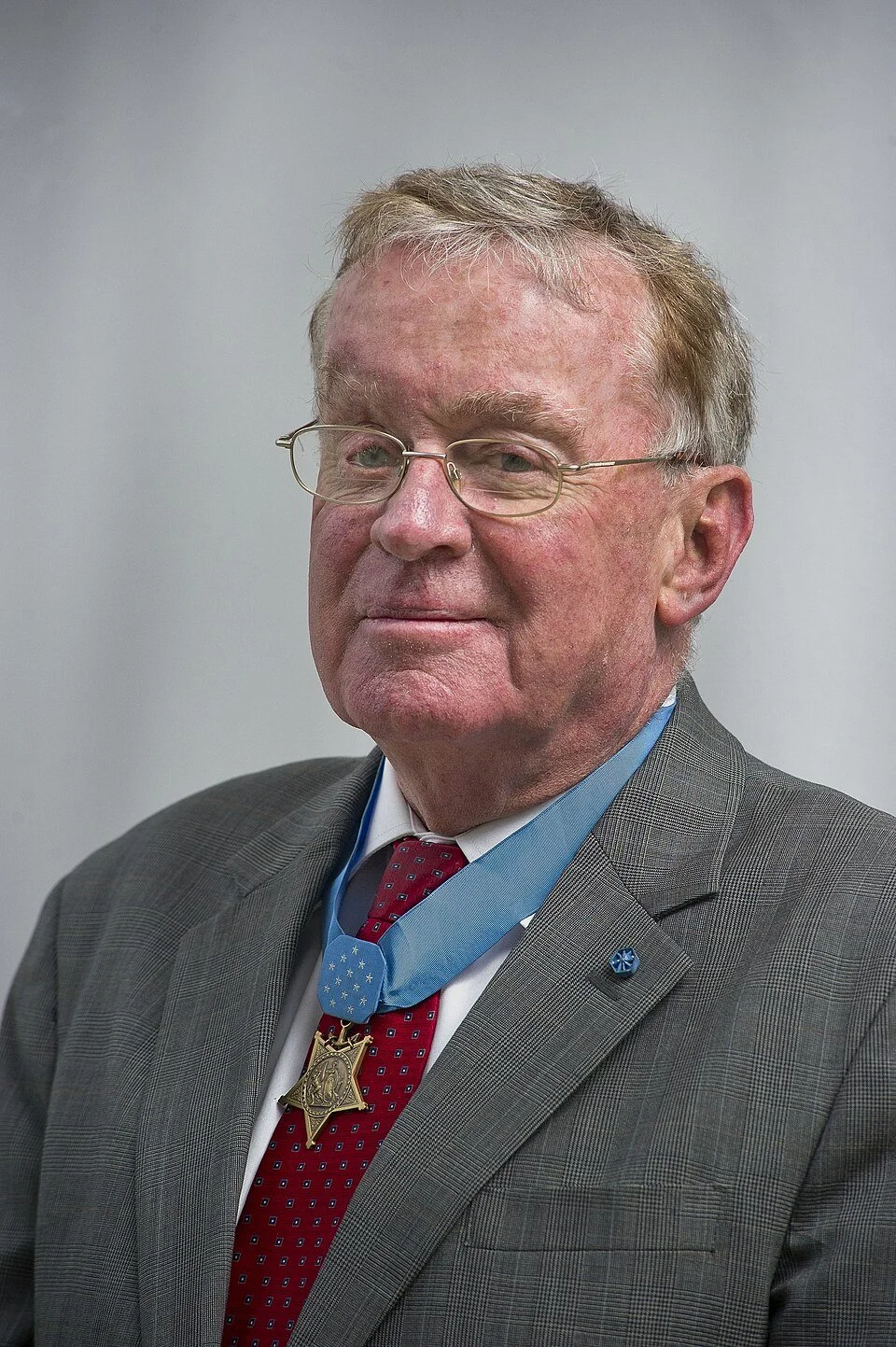
Thomas G. Kelley. Source: Johnny Bivera, MilitaryHealth, available here.
By the time Kelly reached combat, the Pacific War had evolved into a brutal contest of attrition. The early Japanese successes of 1941–1942 had been reversed through a relentless Allied counteroffensive, characterized by "island-hopping" campaigns aimed at bypassing strongholds while seizing strategically vital positions. Battles such as Guadalcanal, Tarawa, Saipan, and Peleliu had demonstrated both the effectiveness and the staggering human cost of this strategy. Japanese forces, increasingly isolated and cut off from resupply, fought with extraordinary tenacity, often to the last man, guided by a military culture that emphasized honor, sacrifice, and resistance to surrender. It was into this unforgiving environment that Kelly and the men of the 5th Marine Division were sent in early 1945.
Iwo Jima represented one of the most formidable objectives of the entire Pacific campaign. A small, barren volcanic island located roughly halfway between the Mariana Islands and Japan, it was prized for its airfields, which could support Japanese interceptors and, if captured, provide emergency landing grounds for American B-29 bombers attacking the Japanese home islands. Anticipating an invasion, Lieutenant General Tadamichi Kuribayashi, the Japanese commander on Iwo Jima, rejected traditional beach defense tactics. Instead, he oversaw the construction of an elaborate underground defensive network of tunnels, bunkers, caves, and reinforced pillboxes, allowing his approximate 21,000 defenders to survive bombardment and emerge to fight with deadly efficiency.
When U.S. Marines landed on Iwo Jima on the 19th of February, 1945 they encountered resistance far more intense than expected. The soft volcanic ash slowed movement, while hidden Japanese positions delivered overlapping fields of fire. Casualties mounted rapidly as Marines struggled to advance yard by yard against an enemy that remained largely invisible. Kelly, serving with the 3rd Battalion, 27th Marines, found himself in the midst of this hellish landscape as the battle ground on through late February, with both sides locked in a savage struggle for control of the island's rugged terrain.
On the 25th of February, 1945 Kelly's company was ordered to seize and hold a strategically vital hill that dominated the surrounding area. The position was heavily defended by Japanese troops manning well-camouflaged strongpoints, supported by machine guns and rifle fire that pinned the Marines down and inflicted serious losses. As the attack stalled and the situation grew increasingly perilous, Kelly acted with decisive courage. Without waiting for orders, he moved forward alone, deliberately exposing himself to intense enemy fire as he closed with the Japanese positions.
Armed with grenades and his rifle, Kelly assaulted one fortified position after another at close range. He destroyed enemy emplacements by hurling grenades into firing ports and engaging defenders directly, often within a few yards. During these actions, he was repeatedly wounded, yet he refused evacuation or medical treatment, continuing to advance despite blood loss and physical pain. His fearless movement across open ground drew enemy fire away from his pinned comrades and provided a rallying point for the rest of the company, which began to advance behind his example.
The Japanese soldiers Kelly faced were veteran defenders operating within Kuribayashi's carefully designed defensive system. They were disciplined, well-trained, and resolute, fighting from mutually supporting positions intended to maximize American casualties. Many were armed with machine guns, rifles, grenades, and mortars, and they exploited the terrain expertly. That Kelly was able to overrun multiple such positions single-handedly speaks to both his extraordinary bravery and the ferocity of the resistance he confronted. By neutralizing key enemy strongpoints, he played a decisive role in allowing his unit to secure the hill and hold it against further attack.
At the end of the action, Kelly had personally accounted for a significant number of enemy soldiers and silenced several critical defensive positions. His conduct under fire was not only tactically decisive but psychologically transformative, inspiring exhausted and battered Marines to press on in one of the most grueling battles of the war. For his conspicuous gallantry and intrepidity above and beyond the call of duty, Thomas Eugene Kelly was awarded the Congressional Medal of Honor. The citation emphasized his repeated solo assaults, his refusal to withdraw despite severe wounds, and the inspirational leadership he displayed under the most extreme combat conditions.
The Battle of Iwo Jima ultimately lasted more than a month and resulted in nearly 7,000 American dead and over 26,000 casualties, making it one of the bloodiest engagements in Marine Corps history. Of the roughly 21,000 Japanese defenders, almost all were killed. The battle became emblematic of the Pacific War's final phase, illustrating both the strategic necessity and the immense human cost of the campaign. Kelly's actions stand out even within this context of widespread heroism, representing the individual courage that underpinned American success in the face of fanatical resistance.
After the war, Kelly was discharged from the Marine Corps and returned to civilian life, bearing the lasting effects of his wounds. Unlike many public war heroes, he lived quietly and did not seek fame or attention for his achievements. He remained proud of his service and of the men with whom he had fought on Iwo Jima, viewing his Medal of Honor as a testament to their collective sacrifice rather than personal glory. Thomas Eugene Kelly died on the 9th of March, 1981 and was laid to rest with military honors.
The story of Kelly's actions endures as part of the broader story of the Pacific campaign, a conflict defined by endurance, sacrifice, and extraordinary acts of courage on both sides. On the shattered volcanic slopes of Iwo Jima, his determination and selflessness helped turn the tide at a critical moment, saving lives and securing ground that had been paid for in blood. His story remains a powerful reminder of the human dimension of war, and of how individual resolve can shape the outcome of history's most brutal battles.
In conclusion, Thomas Eugene Kelly's story brings into sharp focus the essential truth of the Pacific War: that its vast strategies and sweeping offensives ultimately depended on the courage of individuals willing to act under unimaginable pressure. On Iwo Jima, a battle defined by attrition, concealment, and relentless violence, Kelly's actions cut through the paralysis of fear and exhaustion at a moment when failure would have meant further loss of life and momentum. His willingness to advance alone against fortified positions, despite repeated wounds, embodied the Marine Corps ethos of perseverance and initiative, demonstrating how a single Marine's resolve could alter the course of a local engagement and, in doing so, contribute to a larger strategic victory.
Kelly's gallantry cannot be separated from the broader human cost of Iwo Jima. The hill he helped secure was not merely a tactical objective but part of a battlefield where every yard of ground was contested at staggering expense. His heroism stands as a representative example of the countless acts of bravery displayed by Marines who fought in conditions of extreme deprivation, uncertainty, and danger. That Kelly later viewed his Medal of Honor as a symbol of collective sacrifice rather than individual achievement underscores the shared burden borne by those who survived and those who did not.
In the decades since the battle, Iwo Jima has come to symbolize both the necessity and the tragedy of total war in the Pacific. Kelly's quiet post-war life, marked by humility rather than self-promotion, reinforces the enduring divide between wartime heroism and peacetime remembrance. He carried the physical and emotional scars of combat without seeking recognition, allowing his actions on the battlefield to speak for themselves. In doing so, he reflected the experience of an entire generation for whom service was a duty fulfilled, not a platform for acclaim.
Ultimately, Thomas Eugene Kelly's legacy lies not only in the Medal of Honor he received but in what his conduct reveals about courage under fire. His story reminds us that history is shaped as much by individual decisions made in moments of extreme peril as by grand strategies and commanding figures. On Iwo Jima, amid ash, steel, and relentless resistance, Kelly's determination saved lives and inspired others to endure. Remembering his actions ensures that the sacrifices of those who fought in the Pacific are neither abstracted nor forgotten, but understood through the lives of the men who bore the war at its most brutal point.
The site has been offering a wide variety of high-quality, free history content since 2012. If you’d like to say ‘thank you’ and help us with site running costs, please consider donating here.