
Jeb Smith recently read Larry Allen McCluney, Jr.’s book, The Paradox of Freedom: A History of Black Slaveholders in America. Here, he discusses his views of the book.
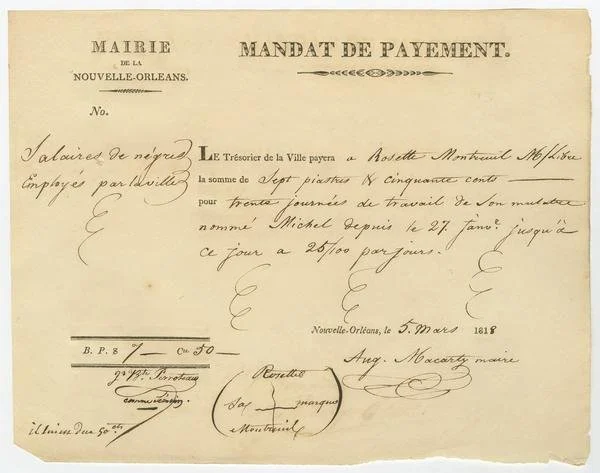
City of New Orleans, 5 March 1818. Order from the Mayor's office to the City Treasury to reimburse Rosette Montreuil, a free woman of color, for the work of her slave, Michel, "mulatto". Signed by mayor Augustin Macarty.

An Instructor of American History at Mississippi Delta Community College and an American Civil War Living Historian since 1995, Larry Allen McCluney received his bachelor’s and master’s degrees in history at Mississippi State University, and his research into original data for this book is extensive (he even utilized a History Is Now article). He cites and quotes many historians, as well as original sources, to bring to life a fact of American history: African Americans were slave owners too.

A mix of various “free peoples of color”—various mixed race and African Americans —owned people of their own race from colonial times up until after the Civil War. In some extreme cases slaves owned slaves. Some free African Americans even engaged in slave trading. This should not surprise us, as Africa has always been the center of slavery, where just as every other race in the world has been enslaved, and continues to enslave their own people. In fact, it was outside pressure from European nations that forced abolitionism on Africa.

African American slaveowners in America at times became some of the wealthiest planters and businessmen in the entire South. McCluney writes they became one with “the upper crust of the economic level in the pre-war South.” They entered into and at times mingled, intermarried, and associated with the white southern aristocratic class. These wealthy included many African American women.

For example, he quotes Steven J. Niven, who wrote of “Marie-Thérèse Coincoin, who lived for eight decades in Natchitoches Parish, La. She would help to found a family dynasty of Free, Colored planters, the Metoyers, who by 1830 owned over 200 slaves—8 percent of all enslaved people in the parish.” In Charleston City, South Carolina, 123 African American women owned slaves and were the “heads” of households, including Maria Weston, who by 1860 owned 14 slaves and owned property amounting to $40,000; the average white earned around $100. Marie Thérèse Metoyer of New Orleans owned around 11,000 acres of land, manufactured medicine, trapped animals, and grew tobacco.


Wealthy slave owners

Many African American slave owners owned hundreds or thousands of acres of land and were wealthier than the vast majority of whites. McCluney writes:

 “In 1860, there were at least six free Blacks who owned 65 or more slaves. The largest number, 152 slaves, was owned by sugar cane planters, the widow C. Richards and her son P.C. Richards. Another slave magnate from Louisiana was Antoine Dubuclet, who owned over 100 slaves. He had an estate worth $264,000 in 1860 dollar value. This was in comparison with the wealth of White men of that time, averaging $3,978."


William Ellison Jr. of South Carolina, a free man of color, was one of the wealthiest plantation owners in the state. He was the largest slave owner in his area, with 171 slaves, and over 900 acres of land producing massive amounts of tobacco. He donated large sums of money and foodstuffs to the Confederate Army, offered the military 53 of his slaves, and his mixed race grandson fought in the Confederate Army.

Many of the slave owners were born in bondage but were later freed and, through either inheritance, gifts, or work ethic, improved their situation, eventually moving into the profitable business of slavery. It was not uncommon for free African Americans to own slaves. Thousands did so. According to the 1860 census, only 1.4% white people owned slaves in 4.8% of southern slave states, but 28% of free African Americans in New Orleans owned slaves. McCluney wrote, “In South Carolina, where forty-three percent of the free African American families owned slaves, the average number of slaves held per owner was about six. Similarly, in Louisiana, forty percent of free African American families owned slaves, twenty-six percent of those in Mississippi held slaves, twenty-five percent of those in Alabama, and this was also true for twenty percent of those in Georgia.”


Status

Their wealth elevated the status of these slaveowners of color, gaining them status among the highest in the white community, intermingling with, socializing, even marrying (even when it was illegal), and becoming some of the most well-respected people in their community. McCluney wrote of Justus Angel, born a slave in South Carolina but who became “a wealthy Black master who lived in Colleton District, South Carolina, in 1830. Angel was a plantation owner who owned 84 slaves, a staggering number even for a Black master. He was a man of great wealth and influence, which allowed him to amass such a large number of enslaved individuals under his control.” Of this wealthy planter class, he wrote, “These individuals often took steps to associate with the White elite, viewing themselves as an extension of this class. In doing so, the Black slaveowners were able to carve out a place for themselves within the ruling class.” Then there is William Johnson in Mississippi, who:

“Became a successful entrepreneur with a barbershop, bath house, bookstore, and land holdings. Though a former slave, in 1834 he would own three slaves and about 3,000 acres of property and would eventually own sixteen slaves before his death. He even hired out his slaves to haul coal and sand. Throughout his life, the white community in Natchez and Adams County held Johnson in high regard. He associated with and was close to many of Adams County’s most prominent white families. Following Johnson’s untimely death at the hands of a “free black, Baylor Winn, the Natchez Courier was moved to comment that Johnson held a “respected position [in the community] on account of his character, intelligence and deportment.”


Further, McCluney argues that it was the common opinion of slaves that African American masters made harsher masters, and they generally preferred white masters to their own color, for example, William Ellison had a reputation for harsh treatment of his slaves. One interviewed slave said, “You might think, master, dat dey would be good to dar own nation; but dey is not. I will tell you the truth, massa; I know I ‘se got to answer; and it’s a fact, they are very bad masters, sar. I’d rather be a servant to any man in de world, dan to a brack man. If I was sold to a brack man, I’d drown myself. I would dat—I’d drown myself! Dough I shouldn’t like to do dat; but I wouldn’t be sold to a coloured master for anything.”


Conclusion

Frederick Law Olmsted traveled south and told of the many wealthy African American planters he saw and interviewed a slave who said the African American masters “bought black folks, he said, and had servants of their own. They were very bad masters, very hard and cruel . . . If he had got to be sold, he would like best to have an American master buy him. The French [black Creole] masters were very severe, and ‘dey whip dar n****** most to deff—dey whipe de flesh off of ‘em.”

Far from abolitionists, these rich masters were reluctant to let their slave labor go as many whites had done. McCluney Quotes B. F. Jonas, of New Orleans who said “I have never heard of a case where a free African American owner of slaves voluntarily manumitted his slaves. On the contrary, they were as a rule considered hard task masters, who got out of their slave property all that they could.” And as has been recorded in Defending Dixie's Land, many of these southern masters supported the preservation of slavery and the continuation and protection of the Confederacy, to maintain bondage of their own brothers.


Jeb Smith is an author and speaker whose books include Defending Dixie's Land: What Every American Should Know About The South And The Civil War written under the pen name Isaac C. Bishop,  Missing Monarchy: Correcting Misconceptions About The Middle Ages, Medieval Kingship, Democracy, And Liberty and he also authored Defending the Middle Ages: Little Known Truths About the Crusades, Inquisitions, Medieval Women, and More. Smith has written over 120 articles found in several publications.

The 1862 Emancipation Proclamation by President Abraham Lincoln took place during the US Civil War. Here, Lloyd W Klein looks at what the Emancipation Proclamation was and the moral and political motivations for it.

First Reading of the Emancipation Proclamation of President Lincoln. By Francis Bicknell Carpenter, 1864.

“Fellow-citizens, we cannot escape history. We of this Congress and this administration, will be remembered in spite of ourselves. No personal significance, or insignificance, can spare one or another of us. The fiery trial through which we pass, will light us down, in honor or dishonor, to the latest generation. We say we are for the Union. The world will not forget that we say this. We know how to save the Union. The world knows we do know how to save it. We -- even we here -- hold the power, and bear the responsibility. In giving freedom to the slave, we assure freedom to the free -- honorable alike in what we give, and what we preserve. We shall nobly save, or meanly lose, the last best hope of earth. Other means may succeed; this could not fail. The way is plain, peaceful, generous, just -- a way which, if followed, the world will forever applaud, and God must forever bless.”

Abraham Lincoln, December 1862 Annual Message to Congress


The earth laughs, the sun laughs

over every wise harvest of man,

over man looking toward peace

by the light of the hard old teaching:

“We must disenthrall ourselves.”

Carl Sandburg, From “The Long Shadow of Lincoln: A Litany”


Carl Sandburg the poet, and lover of words, recognized that Lincoln’s use of the word “disenthrall” in this context was intentional and multi-layered. The word means “to set free” or “to liberate” and Lincoln chose this word on purpose. Lincoln’s genius was in his ability to find new solutions to complicated problems by “thinking outside the box”, which is Lincoln’s literal meaning here.  But he was also “setting free” the slaves. Moreover, crafting the goal of “setting free” the slaves into a war aim meant changing the war’s purpose. It meant giving a new reason to fight the war, adding to our resolve to carry it through. Also, we see that by doing so, the country was going to change – we were setting ourselves free from what the country had been before and would become something new; there was no going backward. “A new birth of freedom”, as he would say a year later. And in doing so, we were liberating ourselves from an immoral practice. As a nation that enslaved humans, we were ourselves enslaved to defend its existence, and now we would be “set free” of that burden, America’s Original Sin.

Lincoln, a highly astute and practical statesman, adeptly maneuvered through the political landscape by employing a pragmatic approach to problem-solving. He relied on empirical evidence to determine effective solutions that would not only maintain his position of authority but also garner sufficient support from the public to bring his government along. Lincoln's profound comprehension of the gravity of the situation, coupled with his remarkable skill in articulating his ideas, reverberates throughout history. The Emancipation Proclamation, hailed as a momentous moral decision, also aligns with this interpretation, further highlighting Lincoln's pragmatic political leadership.

Sandburg’s insight is founded on Lincoln’s 1862 Annual Message to Congress, introducing the Emancipation Proclamation:

“The dogmas of the quiet past are inadequate to the stormy present. The occasion is piled high with difficulty and we must rise with the occasion. As our case is new, we must think anew and act anew. We must disenthrall ourselves, and then we shall save our country.”


There is no doubt that Lincoln didn’t solve all of the problems of his, or our, times, especially connected with race. But neither have the next 30 presidents. Lincoln won the war, but that didn’t mean everyone agreed on what should be done after the war; there were as many views as people on that subject. And then, of course, he was assassinated right as the war ended.


What Were Lincoln’s Views On Slavery?

Lincoln's primary objective was to preserve the unity of the nation, a goal he successfully achieved. This accomplishment was unparalleled, as no other individual could have accomplished this feat. Lincoln's journey towards emancipation was far from simple, as it required more than a mere proclamation. The process necessitated a constitutional amendment and political consensus, both of which were absent at the onset of the war. Furthermore, there was widespread disagreement regarding emancipation, with individuals from both the northern and southern regions expressing dissent. Nevertheless, Lincoln devised a strategy to bring about this significant transformation, a feat that undoubtedly warrants immense recognition. It is important to acknowledge that although the Southerners found ways to circumvent certain laws after the war, and true equality wasn’t a reality until the Civil Rights era, slavery did end. Lincoln deserves credit for this achievement. In the northern states, black individuals were granted voting rights, legal freedom, and equality, a truly remarkable accomplishment.

Throughout his public and private addresses, Lincoln consistently voiced his moral opposition to slavery. He made it clear that he held an inherent aversion to the institution, firmly stating, "I am naturally anti-slavery. If slavery is not wrong, nothing is wrong." "I can not remember when I did not so think, and feel”, he noted.  However, the challenge lay in determining the appropriate course of action to address slavery's existence and bring about its demise. Slavery was deeply entrenched within the nation's constitutional framework and played a significant role in the country's economy. Consequently, finding a solution to this complex problem proved to be politically challenging.

In addition, there was the question of what would become of the four million slaves if liberated: how they would earn a living in a society that had long rejected and marginalized them. His proposition to send African Americans to colonies in Africa rather than keeping them in America, although criticized, stemmed from his recognition of the deeply ingrained prejudice within the American character, prevalent in both the North and the South. Lincoln believed that African Americans would prefer to return to their ancestral homeland due to the pervasive discrimination they faced. However, it was through his friendship with Frederick Douglass and his acknowledgment of the bravery displayed by black troops that Lincoln came to understand that America was indeed their homeland. African Americans desired equality within their own country and had no desire to be relocated elsewhere. This realization challenged Lincoln's previous notions and highlighted the importance of achieving equality within the United States.

Lincoln also had to balance the necessity and emphasis on saving the Union relative to freeing the slaves. His response to Horace Greely’s editorial calling on Lincoln to free the enslaved people is definitive in this regard; he clearly says that his primary goal is to save the Union, and everything that he does, or doesn’t, do is based on his analysis of that test. The last paragraph states: "I have here stated my purpose according to my view of official duty; and I intend no modification of my oft-expressed personal wish that all men everywhere could be free.” Often this response is quoted out of context to suggest that Lincoln didn’t care about slavery. Its intent however is to demonstrate that while Lincoln the man hated slavery, his role as president meant he had to remain focused on what his primary job responsibility – saving the Union -- required.

One month later he released the preliminary emancipation proclamation having determined that freeing the slaves was a necessary goal of the war, which the majority in the Union now supported.

Eric Foner's book, The Fiery Trial, delves into Abraham Lincoln's evolving perspective on race and slavery throughout his lifetime. Foner has said, “I have never called Lincoln a racist. He shared some of the prejudices of his time. Was Lincoln an anti-racist? No not really. Was he an egalitarian in the modern sense? No. Race was not a major concern of Lincoln. He didn’t think about race very much. To ask if he’s a racist is the wrong question. And if you ask the wrong question, you’re going to get the wrong answer.”  While Lincoln always recognized the immorality of slavery and supported the freedom of slaves, his stance on rights shifted in accordance with the changing sentiments of the Republican Party and the North. As a politician, Lincoln strategically positioned himself in the middle ground of prevailing opinions to secure electoral success. It is important to note that he did not lead the way, as Frederick Douglass astutely observed. Despite being influenced by figures like Douglass, Lincoln's stated views on race indicate that he did not truly consider African Americans as his social equals. Foner distinguishes between Lincoln's belief in equal natural rights, his eventual acceptance of legal rights, and his likely lack of support for social acceptance, which he probably never did favor, a sentiment shared by many white individuals in the 19th century.


What was the Emancipation Proclamation?

The issuance of the Emancipation Proclamation by President Abraham Lincoln on January 1, 1863, marked a significant moment in American history. This executive order, which came at a time of great political turmoil, demonstrated a remarkable display of political courage. It was a decision that Lincoln believed to be morally right and necessary for the nation's progress. The Battle of Fredericksburg had dealt a severe blow to Northern morale, plunging the country into a state of despair. In response to the victory at Antietam on September 22, 1862, Lincoln took the opportunity to issue the preliminary Emancipation Proclamation, setting the stage for the eventual liberation of millions of enslaved individuals.

As the commander-in-chief, Lincoln strategically employed the Emancipation Proclamation as a war tactic. By emancipating enslaved people, he aimed to weaken the South's labor force and disrupt their war efforts. However, Lincoln was not oblivious to the potential consequences of his actions. He recognized the deep-rooted racial divisions within the nation and feared the long-lasting impact of his decision. Nevertheless, during his second presidential campaign, Lincoln boldly advocated for the permanent abolition of slavery through a constitutional amendment. The Emancipation Proclamation effectively altered the legal status of over 3.5 million enslaved African Americans in the Confederate states, granting them freedom once they escaped their enslavers' control and sought refuge with Union forces.  The 13th Amendment to the Constitution made this the law of the land.

The Emancipation Proclamation did not free all slaves. It only applied to the ten states that were still in rebellion on January 1, 1863 and did not extend to the approximately 500,000 slaves in the border states of Missouri, Kentucky, Maryland, and Delaware, as well as parts of Virginia and Louisiana that were no longer in rebellion. This has led to debates regarding the effectiveness and impact of the proclamation. Rather than being a definitive act of liberation, it should be understood as a policy announcement that guided the actions of the army and declared freedom as the Union forces advanced.

Lincoln understood that the federal government's authority to abolish slavery during peacetime was limited by the Constitution, which assigned the issue to individual states before 1865. However, during the Civil War, Lincoln utilized his authority as the "Commander in Chief of the Army and Navy" under Article II, section 2 of the United States Constitution to issue the Emancipation Proclamation. In doing so, he claimed the power to emancipate slaves in the rebellious states as a necessary measure to suppress the rebellion. Lincoln also referenced the Confiscation Act of 1861 and the Confiscation Act of 1862 as additional sources of authority in the Preliminary Emancipation Proclamation of 1862 as sources for his authority in the Preliminary Emancipation Proclamation.

While the immediate aim of the Emancipation Proclamation was to weaken the Confederacy's war effort, its broader significance was evident. The document signaled that the United States would no longer support the enslavement of individuals based on their race, a practice deeply ingrained in the nation's history. Furthermore, it opened the door for Black men to participate in national affairs on equal terms. Lincoln actively encouraged Black Americans to join the U.S. Army, which traditionally served as a pathway to citizenship, and urged them to work diligently for fair wages. In this way, the Emancipation Proclamation not only sought to undermine the Confederacy but also aimed to redefine the principles and values of the United States.


Political Versus Moral Motivations

Martin Luther King Jr once said that “the ultimate measure of a man is not where he stands in moments of comfort and convenience, but where he stands at times of challenge and controversy.” As previously noted, December 1862 was one of the darkest moments in our history. After two years of battle and hundreds of thousands of casualties, the Union appeared to be losing the war. People were losing hope and disaster loomed. Lincoln at this moment made an extraordinary paradigm-shattering decision to shift the focus of the war slightly from saving the union to freeing the slaves, arguing they were one and the same.

But although it was presented chiefly as a military measure, the proclamation marked a crucial shift in Lincoln’s views on slavery. By declaring emancipation, the focus of the Civil War shifted from preserving the Union to abolishing slavery, thereby setting a definitive path for the nation's future after the war.

The Republican abolitionists in the North were elated by Lincoln's wholehearted support for their cause, which they had elected him to champion. Although the enslaved individuals in the South did not immediately rise in rebellion upon the proclamation's signing, they gradually began to emancipate themselves as Union forces advanced into Confederate territory. Towards the end of the war, a substantial number of enslaved people left their former masters in large numbers. They actively contributed to the Union Army by engaging in combat, cultivating crops, undertaking various military roles, and working in the mills of the North. While the proclamation did not receive unanimous praise from all northerners, particularly white workers and troops who feared job competition from the influx of formerly enslaved individuals, it did have the distinct advantage of dissuading Britain and France from establishing official diplomatic relations with the Confederacy.


Conclusion

The mythological Lincoln on Mt Rushmore is America's greatest president. We desire our heroes to have been just and motivated to do the right thing. The real Lincoln indeed was, but he was also doing the politically intelligent thing as well. Whichever motive you think was primary and which secondary (although his response to Horace Greeley seems definitive in favor of the political), he found the solution by “disenthralling” ourselves from our past.Morality aside, it was a brilliant political maneuver, perhaps the most magnificent achievement in American history, and it saved our country.

The signing of the Emancipation Proclamation symbolized Lincoln’s unwavering determination to preserve the Union at any cost, while simultaneously finding moral virtue. This act held both political and ethical significance, as it transformed emancipation into a war objective. It is crucial to acknowledge that human beings, including Lincoln, are imperfect, intricate, and often contradictory. Contrary to the idealized image of Lincoln, he was not immune to the complexities of human nature. Ultimately, the limitations of Lincoln’s racial perspectives are an indictment of the larger society. To truly comprehend our identity, it is imperative to examine the unvarnished reality of American history, rather than subscribing to an appealing fairy tale. The intricate and inconsistent nature of human experiences provides a more accurate depiction of our racist past than superficial notions. Just as the romanticized portrayal of Robert E. Lee as the "Marble Man" should be rejected,  so should the myth of Lincoln as the "Great Liberator Father Abraham." A comprehensive understanding necessitates recognizing the arduous journey Lincoln undertook to achieve greatness. This genuine narrative, rather than the oversimplified fable, is truly inspiring and represents the authentic story of our nation.


Find that piece of interest? If so, join us for free by clicking here.