Joshua Lawrence Chamberlain stands as one of the most compelling figures of the American Civil War, not because he was a professional soldier forged in a lifetime of military service, but because he was an intellectual and educator who rose to extraordinary leadership when history demanded it. Born on the 8th of September, 1828 in Brewer, Maine, Chamberlain grew up in a deeply religious and disciplined household. His father, a stern militia officer and shipbuilder, instilled in him a sense of duty and moral responsibility, while his mother encouraged learning and faith. Chamberlain excelled academically, displaying a gift for languages and scholarship that would define his early life. He attended Bowdoin College, where he studied theology and the classics, eventually becoming fluent in multiple ancient and modern languages. By the late 1850s, he was a professor of rhetoric at Bowdoin, seemingly destined for a quiet life of scholarship rather than war.

Terry Bailey explains.
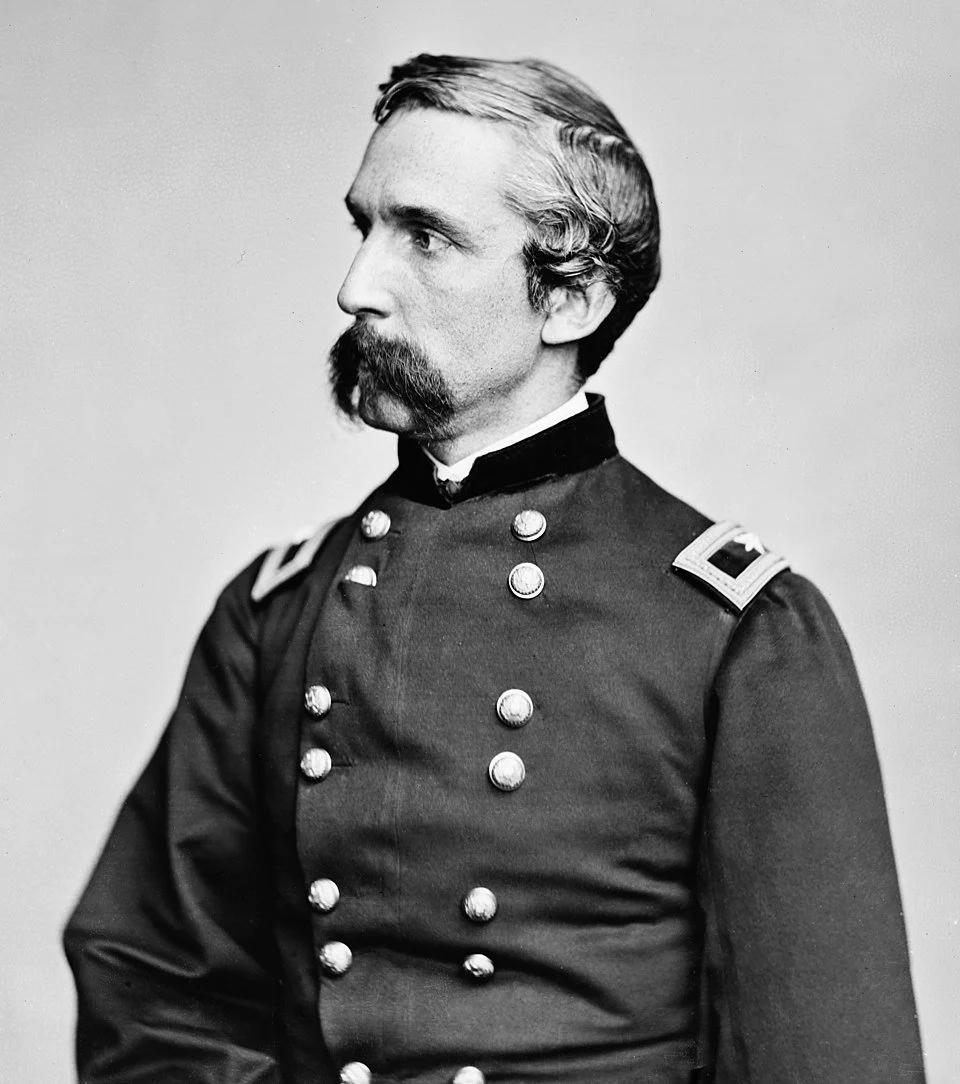
Joshua Chamberlain.

The outbreak of the Civil War in 1861 profoundly unsettled Chamberlain. Though opposed to slavery and deeply committed to the Union, he initially remained at Bowdoin, torn between his academic responsibilities and what he saw as a moral obligation to serve. In 1862, he resolved the conflict decisively. Despite lacking formal military training, he requested a leave of absence to join the army, telling Bowdoin's president that the war represented a struggle for the soul of the nation. He was commissioned as a lieutenant colonel in the 20th Maine Volunteer Infantry, a regiment composed largely of lumbermen and farmers, many of whom were older and physically tougher than their scholarly officer. Chamberlain won their respect not through bluster or harsh discipline, but through fairness, shared hardship, and a willingness to listen, qualities that would later prove critical under fire.

By the summer of 1863, Chamberlain had risen to command the 20th Maine, and his regiment found itself marching into history at Gettysburg. On the 2nd of July, 1863, the second day of the battle, the Union Army hastily extended its left flank to anchor on a rocky hill known as Little Round Top. The position was vital; if Confederate forces seized it, they could roll up the Union line and potentially decide the battle in their favor. The 20th Maine was placed at the extreme left of the Union position, with orders that could not have been clearer or more ominous: "Hold this ground at all hazards." There would be no reinforcements. If the regiment broke, the Union flank would collapse.

Throughout the afternoon, Chamberlain's men endured repeated assaults by the 15th Alabama and other Confederate units under Colonel William C. Oates. The fighting was close, chaotic, and brutal, conducted over boulders and through dense woods in sweltering heat. Each Confederate attack pushed closer to breaking the Union line, and Chamberlain was forced to stretch his regiment dangerously thin, bending his line back like a door hinge to prevent being flanked. Ammunition ran dangerously low. Men collapsed from exhaustion and heat. Chamberlain himself was everywhere along the line, steadying his soldiers, issuing calm orders, and absorbing the terror of combat without losing command of the situation.

As the final Confederate assault loomed, Chamberlain faced a grim reality. His regiment was nearly out of ammunition, and another attack would almost certainly overwhelm them. In that moment, he made one of the most audacious tactical decisions of the war. Rather than waiting passively to be overrun, Chamberlain ordered a bayonet charge. With a sweeping wheel to the left, the 20th Maine surged downhill, shouting and driving their bayonets into stunned Confederate troops who expected no such move from an exhausted and depleted enemy. The sudden offensive shattered the momentum of the Confederate attack. Many Southern soldiers were killed, wounded, or captured, and the rest fled. Little Round Top was held, the Union flank was saved, and the outcome of the Battle of Gettysburg and arguably the war itself tilted decisively in favor of the Union.

Chamberlain's actions at Gettysburg would later earn him the Congressional Medal of Honor, awarded in 1893. The citation recognized his "daring heroism and great tenacity" in holding Little Round Top against overwhelming odds. Yet the significance of his conduct lay not only in bravery, but in leadership and judgment under extreme pressure. Chamberlain demonstrated an intuitive understanding of morale, terrain, and timing, proving that decisive leadership could compensate for material disadvantage. His conduct became a textbook example of initiative at the tactical level, studied by soldiers long after the war. Chamberlain's wartime service did not end at Gettysburg, and the war would exact a terrible physical toll on him. He was promoted to brigadier general and continued to serve with distinction in the Overland Campaign of 1864. At the Battle of Petersburg, he was shot through the hip and groin, a wound so severe that he was expected to die. Grant promoted him on the battlefield as a final honor, but Chamberlain survived after months of agony and recovery. He returned to duty despite chronic pain and lasting disability, embodying the same determination that had defined his stand on Little Round Top.

In one of the war's most symbolic moments, Chamberlain played a prominent role at its conclusion. On the 12th of April, 1865, he was selected to command the Union troops receiving the formal surrender of the Confederate Army of Northern Virginia at Appomattox. In a gesture of reconciliation rather than triumph, Chamberlain ordered his men to salute the defeated Confederates as they laid down their arms. The act reflected his belief that the war had been fought to preserve the Union, not to humiliate the South, and it earned respect from former enemies, including Confederate General John B. Gordon.

After the war, Chamberlain returned to civilian life but never escaped the shadow of his service. He became president of Bowdoin College, guiding the institution through a period of reform and expansion, and later served four terms as governor of Maine. His postwar years were marked by public service, writing, and continued reflection on the meaning of the war. He authored several books and essays, offering thoughtful and often philosophical interpretations of the conflict and its moral dimensions. Though plagued by pain from his wartime wounds for the rest of his life, he remained active and engaged well into old age. Joshua Chamberlain died in 1914, one of the last prominent Civil War generals, and was the final veteran to die from wounds received in that conflict. His legacy endures not merely because of a single dramatic charge, but because his life embodied the idea of citizen-soldiership at its finest. A scholar who became a warrior, a leader who combined compassion with resolve, Chamberlain's stand at Little Round Top remains a powerful reminder of how individual courage and judgment can shape the course of history at its most critical moments.

Joshua Lawrence Chamberlain's life and legacy ultimately transcend the dramatic moments for which he is most famous. His story is not merely one of battlefield heroism, but of moral conviction carried into action, of intellect fused with courage, and of leadership rooted in principle rather than ambition. At Little Round Top, Chamberlain did more than save a tactical position; he exemplified the capacity of an ordinary citizen to rise to extraordinary responsibility when the fate of a nation hung in the balance. His decisions were shaped not by rigid military doctrine, but by empathy for his men, clarity of purpose, and a profound sense of duty to something larger than himself.

What distinguishes Chamberlain from many of his contemporaries is the continuity between his wartime conduct and his postwar life. The values that guided him in combat—discipline tempered by humanity, firmness balanced with reconciliation—were the same values he carried into education, politics, and public service. His salute to the defeated Confederates at Appomattox symbolized his belief that the war's true victory lay not in vengeance, but in the restoration of a fractured nation. This act, quiet yet powerful, reflected a deeper understanding of what lasting peace required and underscored his lifelong commitment to unity and moral responsibility.

Chamberlain's enduring significance lies in the way his life challenges simple definitions of heroism. He was not born a soldier, nor did he seek glory, yet he became one of the war's most respected leaders through resolve, adaptability, and an unwavering ethical compass. His physical suffering after the war, borne without bitterness, further reinforces the depth of his character. Even as his wounds shaped his final decades, he continued to serve, teach, write, and reflect, determined that the sacrifices of the Civil War should be understood and remembered with honesty and purpose.

In the final measure, Joshua Chamberlain represents the highest ideals of citizen leadership. His stand at Little Round Top remains a defining moment in American history, but it gains its full meaning only when viewed within the broader arc of his life, a life devoted to learning, service, reconciliation, and moral courage. Through his actions in war and peace alike, Chamberlain left a legacy that speaks not only to the past, but to the enduring power of individual conscience and leadership in shaping the course of history.


The site has been offering a wide variety of high-quality, free history content since 2012. If you’d like to say ‘thank you’ and help us with site running costs, please consider donating here.


Notes:

The wounds Joshua Lawrence Chamberlain received during the Civil War had a profound and lasting impact on his health, shaping the remainder of his life and ultimately contributing to his death. On the 18th of June 1864, during the Battle of Petersburg, Chamberlain was struck by a Minie ball that passed through his right hip and groin, exiting near the bladder and urethra. The injury was considered mortal at the time; blood loss was severe, infection was likely, and the medical practices of the era offered little hope of recovery. He survived only through extraordinary resilience and prolonged medical care, but the damage inflicted by the wound could never be fully healed.

In the years that followed, Chamberlain endured chronic pain, recurring infections, and serious urological complications as a direct result of the injury. The wound left him with long-term damage to his urinary system, including fistulas and strictures that caused frequent obstruction, inflammation, and bleeding. These conditions required repeated medical interventions throughout his life and often left him weak, feverish, and exhausted. Periods of relative health were frequently interrupted by painful relapses, making daily activity unpredictable and physically taxing. Despite this, Chamberlain persisted in public life, masking the severity of his condition behind an outward appearance of energy and resolve.

As he aged, the cumulative effects of the wound worsened. Recurrent infections increasingly taxed his immune system, while chronic inflammation and impaired urinary function led to progressive organ stress. By the early twentieth century, his body was less able to recover from the complications that had plagued him since the war. In 1914, nearly fifty years after being wounded, Chamberlain succumbed to complications directly linked to his Petersburg injury, making him the last Civil War veteran to die from wounds sustained in that conflict. His death served as a stark reminder that the suffering of war often extends far beyond the battlefield, lingering silently for decades after the guns have fallen silent.

Chamberlain's long struggle with his wounds adds a deeper dimension to his legacy. His postwar achievements in education, governance, and public life were accomplished not in spite of discomfort, but in the midst of persistent physical suffering. That he continued to serve with dignity and determination, even as his health steadily declined, underscores the extraordinary endurance that defined him as both a soldier and a citizen. His life stands as a testament to the hidden, lifelong costs of war and the resilience required to bear them.
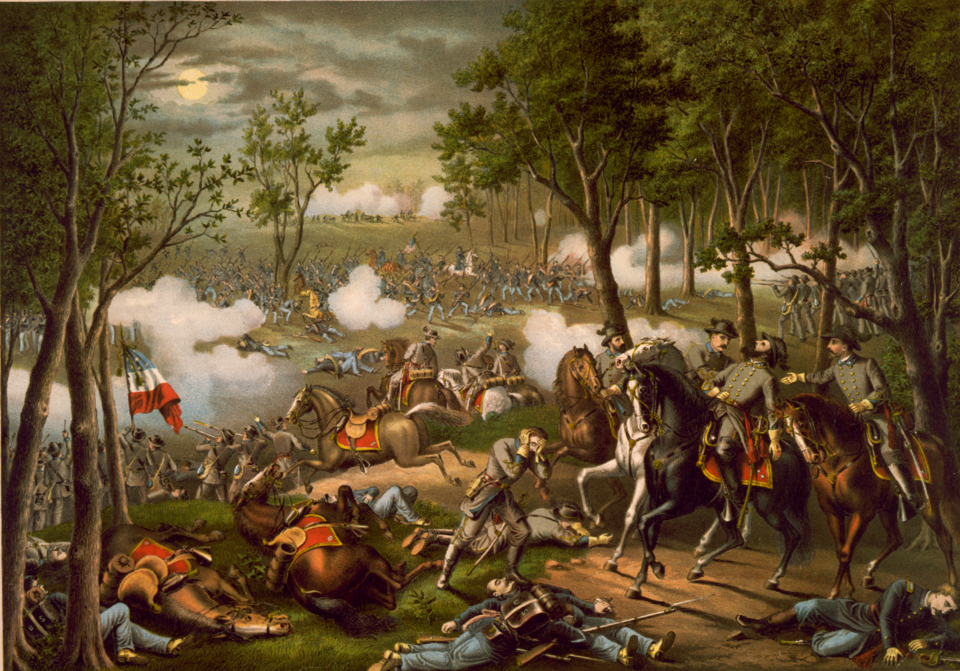
The Battle of Chancellorsville took place April 27-May 6, 1863. It is traditionally described as Lee’s most impressive victory.  General Robert E Lee gambled on dividing his Army of Northern Virginia (ANV) several times in the face of a larger enemy and transported troops back and forth along internal lines to meet each anticipated threat. His victory turned on his audacity and his opponent’s timidity, and is almost always described from that perspective.  In this analysis, we will evaluate the command decisions General Hooker made, the choices he had, and how he contributed to his own defeat. Typically, his self-analysis that he lost confidence in himself is taken at face value, but on deeper reflection that isn’t an accurate analysis.

Lloyd W Klein explains.

Battle of Chancellorsville, by Kurz and Allison, from 1889.

Hooker Takes Command

After the fiasco of the Battle of Fredericksburg and the humiliation of the Mud March, Major General Ambrose Burnside tried to purge the army of weak generals, something only Congress could do. He offered to resign from the army, but Lincoln chose to put him command of IX Corps in the Virginia Peninsula, and in March they were transferred to the Army of Ohio. Although not recognized at the time, it turned out that this was a critical aspect of the battle.

General Joseph Hooker took command of the Army of the Potomac (AoP) on January 26, 1863. He was the obvious choice given his reputation as a tough and aggressive fighter. Almost immediately, two division commanders resigned (William Franklin refused to serve under Hooker; Edwin Sumner had poor health) and Daniel Butterfield became chief of staff. Hooker created the Bureau of Military Information, appointing Colonel George Sharpe to command, who utilized cavalry reconnaissance, spies, scouts and aerial balloons. Consequently, Hooker knew that Lee had covered all of the crossings of the Rappahannock.

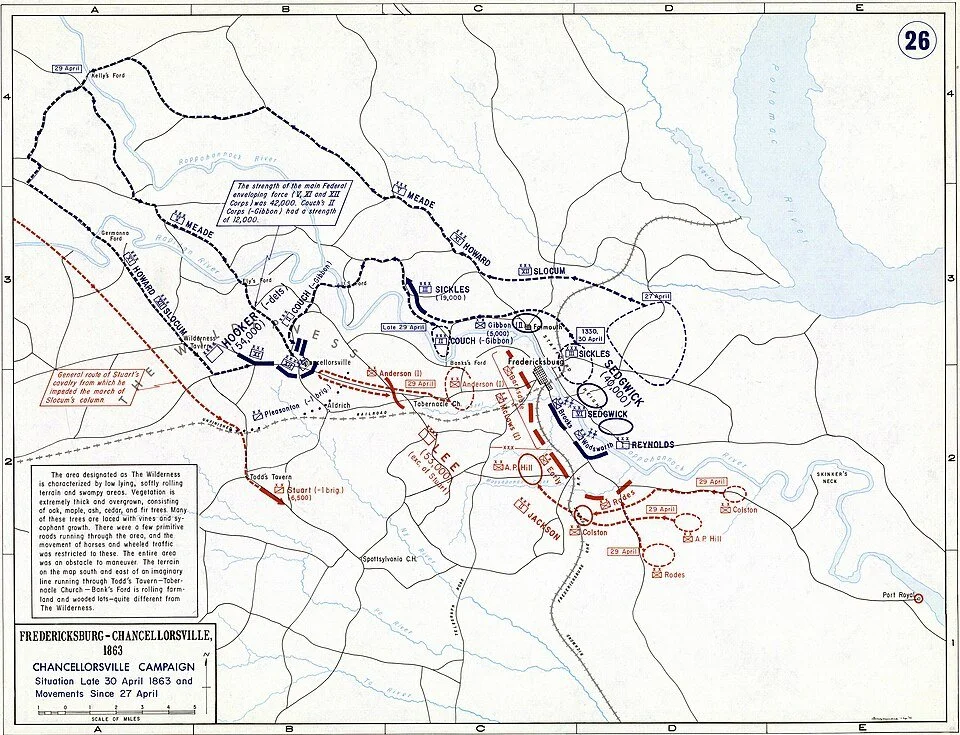
Hooker had an excellent plan for the upcoming campaign. He designed a double envelopment of the ANV, having the cavalry cross far west, while his infantry crossed the Rappahannock and then the Rapidan rivers at Kelly’s Ford,  and then converge at  Ely’s and Germanna fords. Where the two rivers converge provided Hooker cover and opportunity. The second branch of the attack was to have General Sedgwick cross below Fredericksburg, flanking Jackson’s Corps. Thanks to Sharpe, Hooker knew that Lee was covering the fords facing north and east, and that he had to cover Richmond to his south. Therefore, Hooker sensed an opening in the west.

“My plans are perfect, and when I start to carry them out may God have mercy on General Lee, for I will have none.”  General Hooker was a very tough battlefield commander, but was he the right man for army command? This quote shows that was ready to battle directly with Lee and that he had full faith in his plan. But that was his fatal flaw.


Lee’s Divided Army

General Robert E Lee did not expect an attack except by way of Fredericksburg.  For this reason, Longstreet’s corps wasn’t involved in this battle, as they had been detached from Lee to find provisions. Most books say Lee divided his army in 3, but really, he would eventually be divided in 4 parts. Lee detached Longstreet with two divisions (Pickett’s and Hood’s) to southeastern Virginia on a foraging and supply mission and to threaten Union positions around Suffolk, Virginia.

As a result, Lee faced Hooker at Chancellorsville without Longstreet, meaning he fought the battle with only Jackson’s corps, and was well outnumbered. Had Burnside been there, in Longstreet’s absence, Lee would have been markedly outnumbered.

Battle of Chancellorsville, Situation Late 30 April 1863 and Movements since 27 April.


The Battle Begins

On April 27-28, the Union army began crossing the fords and concentrated at Chancellorsville, an obscure crossroads in the Wilderness with just a single brick mansion standing on the north side of an intersection. It was an old inn that was owned by a family named Chancellor located at the junction of 3 roads: Ely’s Ford Road, Orange Turnpike and Orange Plank Road.  Its location was crucial to Hooker’s plan: it was actually in Lee’s west rear.

Hooker arrived there April 30. By May 1, he had 70,000 troops at this location and there was no sign that Lee knew where he was. In fact, although Jeb Stuart had been cut off by Stoneman’s advance but had informed Lee by April 30 of this movement. And Lee knew that Sedgwick would threaten his right flank. He understood exactly the problem. With both wings of the enemy across the Rappahannock, on both his east and west flanks, Lee faced a serious dilemma.

Conventional military wisdom dictated that the outnumbered ANV retreat south and escape Hooker's trap. Lee opted to meet the Federal challenge head-on and not retreat. Lee intuited that Sedgwick was not going to be a real threat but rather a demonstration and that the real threat was in his rear. He also recognized that retreating with the enemy in his rear would create other difficulties.

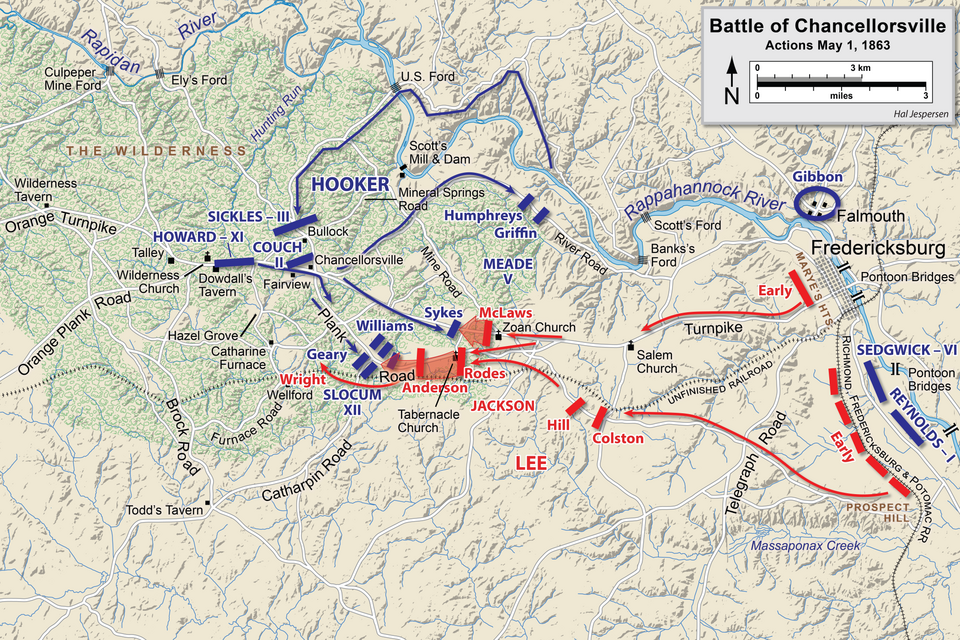
Correctly deducing that Hooker's primary threat lay to the west, Lee assigned 10,000 troops under Major General Jubal A. Early to man the old Fredericksburg entrenchments. The balance of the army would turn toward the tangled Wilderness to confront Hooker's flanking column. Thus, he sent 80% of his army in the opposite direction of the front line. He didn’t think Hooker would allow Sedgwick to command the major attack force. Sedgwick’s division had lost half its men at Antietam, and he himself had been wounded 3 times. He hadn’t been in command at the battle of Fredericksburg and had just taken over for Sumner.

The Federals had encountered virtually no opposition to this point. Moreover, they could now press eastward, break clear of the Wilderness, and uncover Banks Ford downstream, thus significantly shortening the distance between their two wings. Having dropped into Lee’s rear, an aggressive attack might have caught Lee in a bad position forcing him to retreat with the Union army chasing him. But Hooker stopped and waited for Lee to attack him, ceding the initiative to Lee. 

Chancellorsville, May 1. Source: Map by Hal Jespersen, www.cwmaps.com, available here.


Analysis

At this critical moment, Hooker decided to halt at Chancellorsville and await the arrival of additional Union troops. This fateful decision changed the battle. When General Couch protested, Hooker famously said, “"It is all right, Couch, I have got Lee just where I want him; he must fight me on my own ground." Hooker’s lack of imagination as to the various options available to his opponent, a wily old fox, would prove to be his fatal flaw.

Hooker had stopped his forward motion when Lee was caught in between his wings. Had Hooker advanced, he would have kept the initiative and limited Lee’s options.

Hooker instead set up a defensive line to his east and the high ground, Hazel Grove, to the southwest.

Here is one great example of why Lee was a great battlefield commander: his comprehension of how his enemy would analyze the situation. Dividing his army was a gamble; but the real gamble was following his intuition and not hesitating or playing it safe. His instinct about Sedgwick was brilliant.

We hear this battle usually summarized, as Hooker himself did, as a loss of self- confidence. But that isn’t really the case, as his exclamation to Couch shows. He believed either Lee must retreat, with the Union army in his rear, or attack him frontally. Hooker expected Lee to retreat, after all that was the safe thing to do and exactly what Hooker would have done. There is evidence that Hooker was looking to put himself in a position where he would be attacked, and not repeat the Fredericksburg fiasco. He himself suggested that he was concerned that all of his army be up on the battlefield before advancing, and that may also have been part of the decision. It may well also have been  that it was his first time maneuvering an entire army.


The “Surprise Attack”

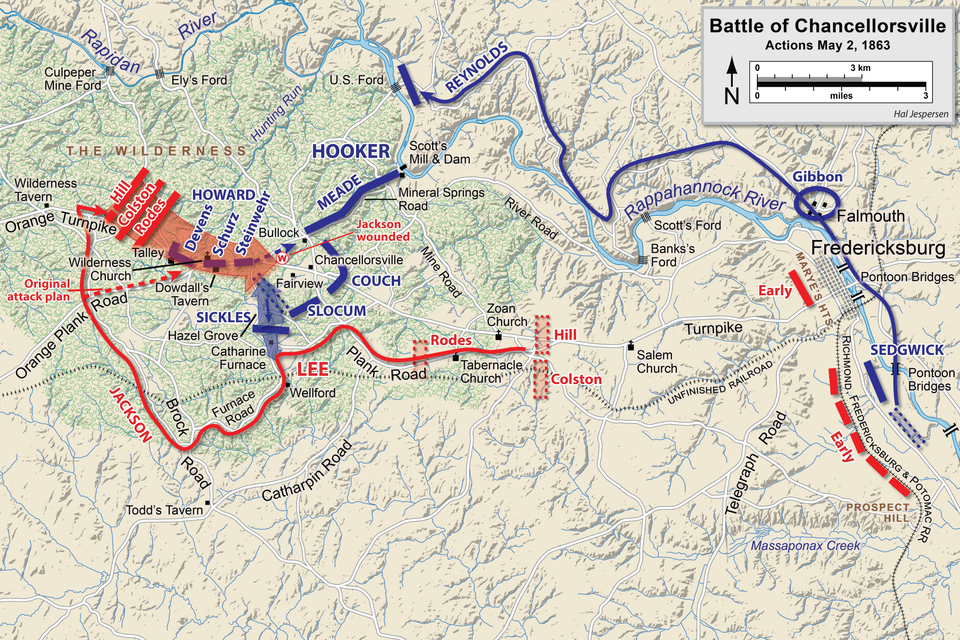
The “surprise flank attack” of Stonewall Jackson using an unmapped road to attack the  rear of the AoP highlights Jackson’s military genius and of course, his ultimately mortal wounding soon thereafter is one of the great American legends. The fact is, that movement was not a surprise nor was it the mortal blow retelling suggests. In fact, his wounding occurred because Jackson understood that he hadn’t defeated a major portion of the Union army, was dangerously separated, and so was looking for an opportunity to take further advantage. On May 2, Jackson devised a daring plan that divided the numerically inferior southern army and then marched Jackson’s men far around the Union army to strike unsuspecting Union troops on their extreme right flank.

The Union army was positioned north of the Turnpike and also at Hazel Grove. Lee understood very well that his army was divided and that he is outnumbered everywhere. He knew that Hooker expected him to either retreat – and be forced to defend his rear – or attack his line. Instead, Lee looked for an alternative.

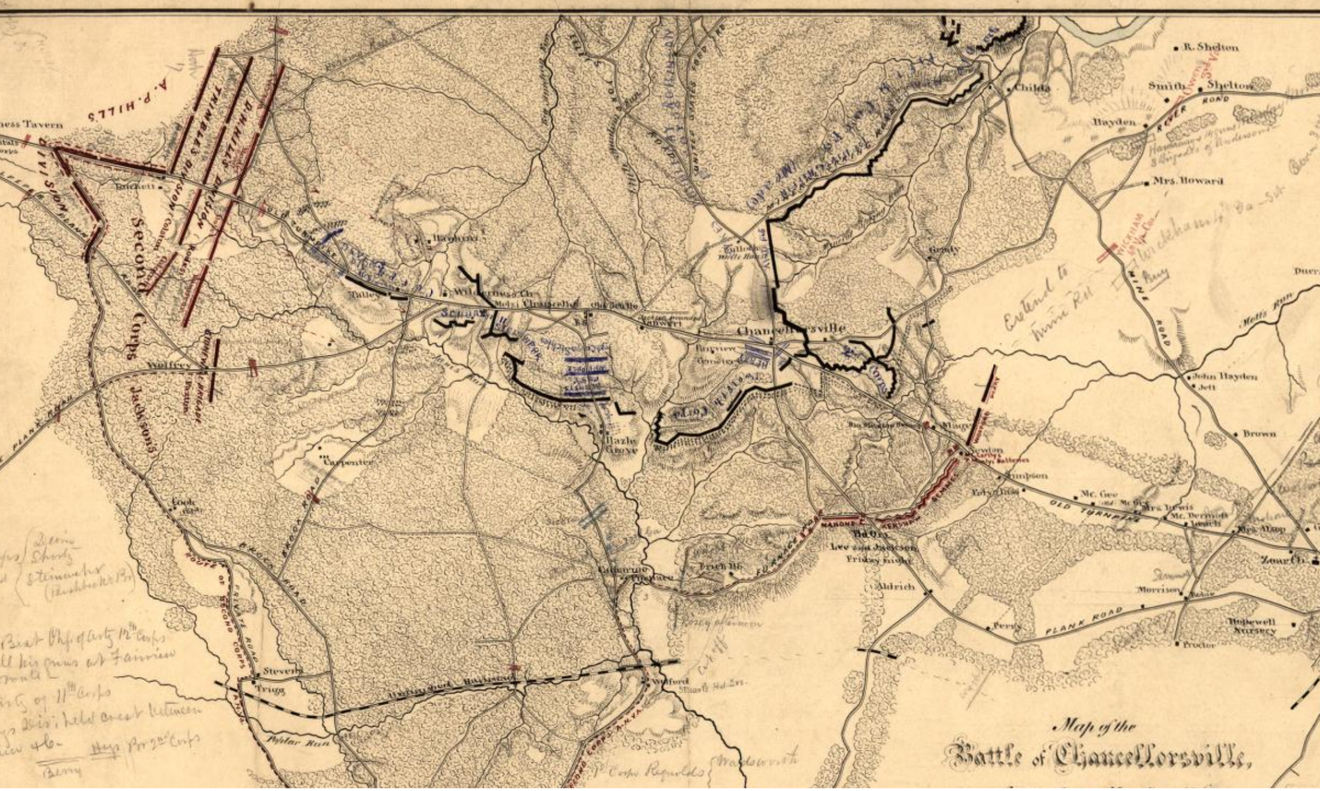
Hotchkiss’ hand drawn map of the battlefield at Chancellorsville, including the Jackson Flank Attack. Library of Congress.

It must be emphasized that Jackson didn’t actually find the road, his cartographer did. A brilliant confederate cartographer named Jedidiah Hotchkiss found the road. Stonewall Jackson had asked him to draw maps of this battlefield, and he made the discovery of a hidden road not on any maps of the time. The road that Hotchkiss found begins at an iron foundry called Catharine Furnace not far from Hazel Grove and leads south – the opposite direction – and then after a wide swing, goes north. The road then crosses the turnpike and fortuitously leads directly to the Union right flank. Investigations of a route to be used to reach the flank were made by Hotchkiss and Reverend Beverly Tucker Lacy, Jackson’s “chaplain general”. Lacy introduced Hotchkiss to the proprietor of Catharine Furnace, Charles C. Wellford, who showed Hotchkiss, Jackson's cartographer, a recently constructed road through the forest that would shield marchers from the observation of Union pickets.

Stonewall Jackson knew that taking this very roundabout route would lead him to the Union right flank, but how did he know that it wasn’t covered and unentrenched? Recall that the union cavalry was off making a wide right flank maneuver, so it wasn’t around to screen the reserve corps from confederate cavalry. About midnight, Jeb Stuart told Jackson that his reconnaissance had showed that the right flank wasn’t entrenched.  Jackson dispatched Hotchkiss to explore the roads to the west. Although Hooker's left flank was firmly anchored by Meade's V Corps on the Rappahannock, and his center was strongly fortified, his right flank was "in the air." Howard's XI Corps was camped on the Orange Turnpike, extending past Wilderness Church, and was vulnerable to a flanking attack.

At dawn, Lee and Jackson studied Hotchkiss’s hastily drawn map and decided to undertake one of the biggest gambles in American military history. Jackson's corps, about 30,000 troops, would follow a series of country roads and woods paths to reach the Union right. Lee, with the remaining 14,000 infantry, would occupy a position more than three miles long and divert Hooker's attention during Jackson's dangerous trek. Lee therefore divided his small army once again: he is now in 3 parts, all of them facing larger forces.


Analysis

Hooker was expecting to be attacked frontally, but Jackson had developed a different plan. Once again we see General Lee making the right decision. Unlike Hooker, Lee knew his opponent. He judged Hooker to be a tough fighter but not the most imaginative strategist. And Lee was a clever tactician; he looked for an opportunity and here one presents itself.

We know that this is an accurate summary of events because Hotchkiss wrote a book, The Battlefields of Virginia, Chancellorsville. The famous description is from his book:

“With a map before him, General Jackson suggested an entire circuit of the right of the opposing army, and that the attack be made on its rear. Lee inquired with what force he would do this. Jackson replied, “With my whole corps, present.” Lee then asked what would be left to him with which to resist an advance of the enemy towards Fredericksburg. “The divisions of Anderson and McLaws,” said Jackson. For a moment Lee reflected on the audacity of this plan in the face of Hooker’s superior numbers. With less than forty-two thousand muskets, he was in the presence of sixty thousand. To divide his army into two parts, and place the whole Federal force between them, was extremely hazardous.”

Chancellorsville, May 2. Source: Map by Hal Jespersen, www.cwmaps.com, available here.

May 2: The Flank Attack

By the morning of May 2, Hooker realized that Lee was not fooled by Sedgwick at Fredericksburg. Recognizing that he needed to modify his plan, he made two decisions.

First, he tried to bring General Reynolds and the I Corps to Chancellorsville. Hooker had a good plan for positioning Reynolds. However, he thought Reynolds was across the Rappahannock but in fact, he was still with Sedgwick. This required Reynolds to make a prolonged day march.

Second, he did the math finally and realized that if most of Lee’s army is now in his front, that the Fredericksburg line must be weak. Hooker surmised that Early was vastly undermanned. He therefore ordered Sedgwick to make a full attack at Fredericksburg. Proving that Lee was right about Sedgwick all along, the attack never materialized on May 2. His attack was delayed until May 3, making all of the difference.

Reynolds was supposed to be  positioned further to the right beyond Howard to anchor that flank on the Rappahannock. The myth that Hooker didn’t know his right flank was in the air is wrong. He merely saw it as his rear.

It was also a myth that the attack was a surprise, except perhaps to General Hooker. Numerous Union forces had in fact detected Jackson’s movement, and Colonel Sharpe himself had warned Hooker that Jackson’s corps wasn’t in his front. But Hooker believed that Jackson was in retreat, not advancing on his flank.

Scouts on Hazel Grove informed Hooker that they saw and heard Jackson’s men to their west. Sharpe had deployed aerial balloons and spotted the movement. When Hooker received these reports about the Confederate movement, he thought that Lee might be starting a retreat, but he also realized that a flanking march might be in progress. He took two actions. First, he sent a message at 9:30 a.m. to the commander of the XI Corps, Maj. Gen. Oliver O. Howard on his right flank: "We have good reason to suppose the enemy is moving to our right. Please advance your pickets for purposes of observation as far as may be safe in order to obtain timely information of their approach." He did not order entrenchment and Howard never considered it.

As the morning progressed, however, Hooker grew to believe that Lee was actually withdrawing; this was the course of events Hooker most preferred. He became less concerned about his right. Instead, he ordered Third Corps to harass the tail end of Lee's "retreating" army. General Sickles advanced from Hazel Grove towards Catharine Furnace and attacked Jackson’s men in the rear guard. This movement guaranteed that Sickles could not come to Howard’s reinforcement when attacked. Jackson’s main force continued onto Brock Road where it meets the Orange Plank Road – directly into the Union right flank. Sickles informed Hooker, to no avail, that Jackson wasn’t retreating but was on the move.

Northern soldiers were caught almost completely unawares and quickly succumbed to panic and rout, resulting in one of the most striking tactical defeats of the war.


Analysis

Obviously, this was an awful judgment; it changed Hooker’s life and his reputation forever after. Most narratives say that Hooker lost his confidence; but that cannot explain his not listening to all of the reports being given. In fact, these actions demonstrate irrational overconfidence. Hooker didn’t have the imagination to plan what he would do if he were in Lees’ situation. Therefore, he could not anticipate what Lee would do. Knowing your enemy is crucial. He himself would do the safe thing, retreat, and he never considered other alternatives. This was his undoing. Lee was never, ever about the safe thing.

Lee and Jackson had made yet another gamble. They deduced that 4 conditions would apply that might make this risky plan a success: a) Jackson had to make a 12-mile march via roundabout roads to reach the Union right, and he had to do it undetected. b) Hooker had to stay tamely on the defensive. c) Early would have to keep Sedgwick bottled up at Fredericksburg, despite the four-to-one Union advantage there. d) When Jackson launched his attack, he had to hope that the Union forces were unprepared.

Why didn’t the Union cavalry show Hooker where Jackson’s corps was moving? Stoneman’s cavalry was carrying out its long distance raid against the Confederate supply lines, so they weren’t there. Hooker had sent the cavalry off to cut Lee's line of supply by tearing up the railroad in Lee's rear. Unfortunately, the mission failed.

It was thought that the Wilderness woods was impenetrable and so there was temporary protection especially as the front was in the east.

Why wasn’t Howard entrenched? He perceived his position to be in the rear of the army, and thus not likely to become involved in the days fighting.

Stonewall Jackson's victory on May 2 did not result in a significant military advantage for the Army of Northern Virginia. Howard's XI Corps had been defeated, but the Army of the Potomac remained a potent force and in fact were in excellent position for May 3. This is one of the least understood facets of this battle. Jackson deserves great credit for this attack, but he recognized in the moment that nothing really had been accomplished.

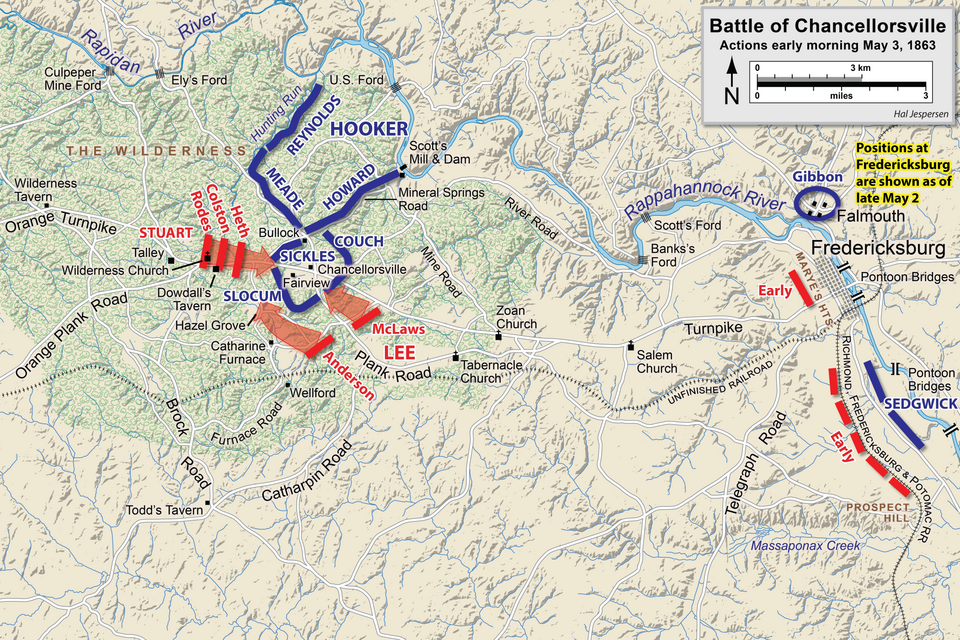
Chancellorsville, May 3 morning. Source: Map by Hal Jespersen, www.cwmaps.com, available here.

May 3: Hazel Grove

Even after the May 2 surprise attack, Lee was still in a difficult position. Jackson realized that the Union army in his front remained formidable. That evening, he considered a night attack to continue the great rout his surprise attack had created, but not completed: that is why he was out there that night.  Jackson and Hill were wounded by their own men performing a reconnaissance and JEB Stuart was given temporary command of Jackson’s Corps.

By the morning of May 3, Howard's XI Corps had been defeated, but the Army of the Potomac remained a potent force and Reynolds's I Corps had arrived overnight, which replaced Howard's losses. About 76,000 Union men faced 43,000 Confederate at the Chancellorsville front. The two halves of Lee's army at Chancellorsville were separated by Sickles’ III Corps, which occupied a strong position on high ground at Hazel Grove.

And, the ANV was divided all over the battlefield. Sickles’ troops at Hazel Grove were right in between. Hooker could have attacked either part of Lee’s army, moving in any direction, and destroyed it. Stuart was completely aware of this predicament. He was not in a position for a defensive battle. So instead, he prepared an attack at dawn on Hazel Grove rather than await one.

And then Hooker, who continually made the wrong decisions in this battle, then made his most disastrous decision. He ordered Sickles to abandon Hazel Grove at the very instant when that high ground became critical to the position.

The Union position at Hazel Grove was separated from the main army position with tentative connection and support. Hooker pulled Sickles back for its survival. Hooker was thinking defensively not offensively. Hooker ordered Sickles off that high ground and instead to another area much lower called Fairview. Hooker felt he was losing and he couldn’t see the advantage of his position so he retreated to what he erroneously thought was a safe fallback position. As previously noted, Hooker was unimaginative; if you are losing, you fall back.

Stuart had been ready to fight for that ground and now it had been given to him. He took control of the high ground and blasted Sickles at Fairview, where he was a sitting duck for Stuart’s artillery.

Recognizing that his forces were divided and lower numbers, and that Hooker expected him to retreat, instead Lee launched multiple attacks against the Union position at Chancellorsville, resulting in heavy losses on both sides.  The army that ended up pulling back was Hooker's main army. Lee had taken the initiative from Hooker, who sensed he was losing – because it wasn’t going according to his plans, not because of what was happening on the field.


Analysis

At Chancellorsville, the Union army had 106,000 engaged suffering 12,000 casualties and the Confederate army of 60,000 had almost 13,000 casualties. Lee lost over 1/5 of his army in a win – obviously this casualty rate could not be sustained, and definitely not for only a minimal strategic advantage. Lee and the ANV had lost more men, but Hooker didn’t realize it.

But wait! What about Hooker being conked in the head? We often hear this as an excuse for Hooker’s poor decisions, but it is an implausible one. Hooker suffered an injury on May 3 when at 9:15 a.m. a Confederate cannonball hit a wooden pillar he was leaning against at his headquarters. This occurred during the main battle from the bombardment from Hazel Grove. He later wrote that half of the pillar "violently [struck me] ... in an erect position from my head to my feet." He suffered a concussion, which caused him to be unconscious for over an hour. He did not give up command, but General Couch reported that he was in a daze most of that day. No significant orders were made in that time period. Yet another myth is that Hooker lost the battle because of this injury, but it wasn’t true: he made poor decisions both before and afterwards.

Chancellorsville, May 3 during the day. Source: Map by Hal Jespersen, www.cwmaps.com, available here.

Salem Church

Hooker had ordered Sedgwick to attack the morning of May 2. Sedgwick didn’t receive this order until late in the day, and even then Sedgwick was slow to take action.  But eventually he crossed the Rappahannock River on May 3. Interestingly, had he attacked on May 2, he would have found Jubal Early entirely unprepared.

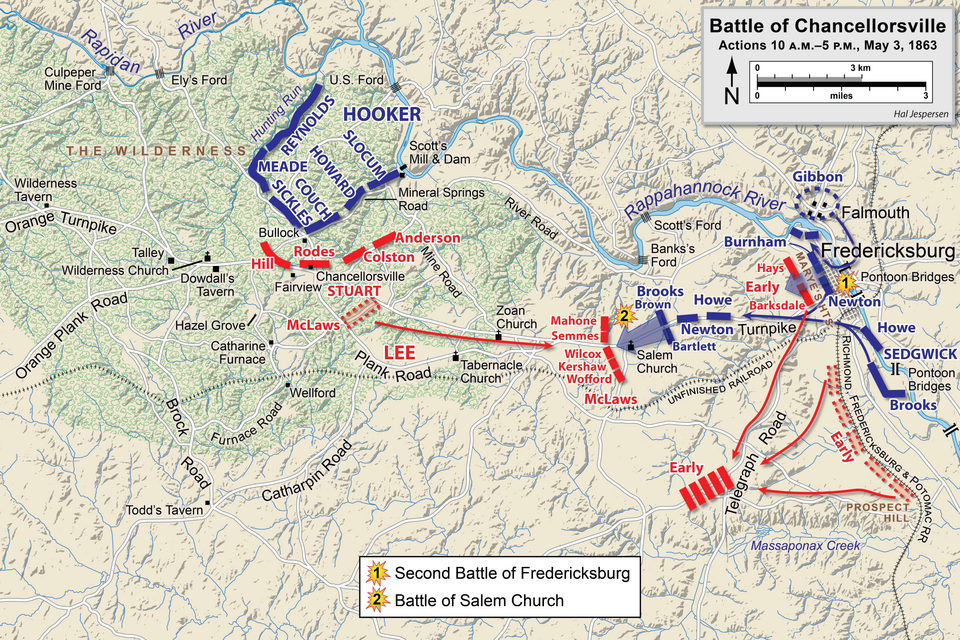
On May 3 Sedgwick and Early fought the Second Battle of Fredericksburg. The idea was to move west to join forces with Hooker and trap Lee between the halves of the Union army. Sedgwick joined with Gibbons and attacked Marye’s Heights, yet again. Barksdale’s brigade again held back the Union. A truce was called to allow the Union army to clear the field of its dead and wounded.

Then finally, fortune smiled on the Union army. On May 1, Lee had given Early provisional orders to retreat in case he was defeated at Chancellorsville. Early misunderstood orders and retreated anyway. Fredericksburg was open that afternoon, but Sedgwick never knew it. That night, Lee corrected the error and Early was in place the morning of May 3.

During the attack, a halt was called for the removal of the dead and wounded. It was noticed during the truce that Barksdale’s left flank was unprotected. Sedgwick re-directed the attack, drove Barksdale off the heights, and then again past the road and Lee’s Hill. Early withdrew south and Wilcox west, holding the road from further Union advance. Early had clearly lost his position. He also sustained 700 casualties of 12000 troops, vs 1100 union casualties of 27,000 troops.

After occupying Marye's Heights on May 3, following the Second Battle of Fredericksburg, Sedgwick's VI Corps marched out on the Orange Plank Road with the objective of reaching Hooker's force at Chancellorsville. He was delayed by Wilcox's brigade of Maj. Gen. Jubal A. Early's force during the afternoon of May 3 before halting at Salem Church. Gibbon was left to defend the town. The next morning, thinking there was only Wilcox in his front, he renewed the attack. Once again, the Union command did not anticipate that Lee would respond to events.

After receiving word of Sedgwick's breakthrough at Fredericksburg, Lee detached the division of Lafayette McLaws from the Chancellorsville lines and marched them to Salem Church. McLaws's division arrived at Wilcox's position shortly after noon, reinforced by William Mahone's brigade of Richard H. Anderson's division. he was stopped by elements of Lee's Second Corps (under Maj. Gen. J.E.B. Stuart, following the wounding of Jackson) at the Battle of Salem Church, forcing his eventual retreat back over the Rappahannock.

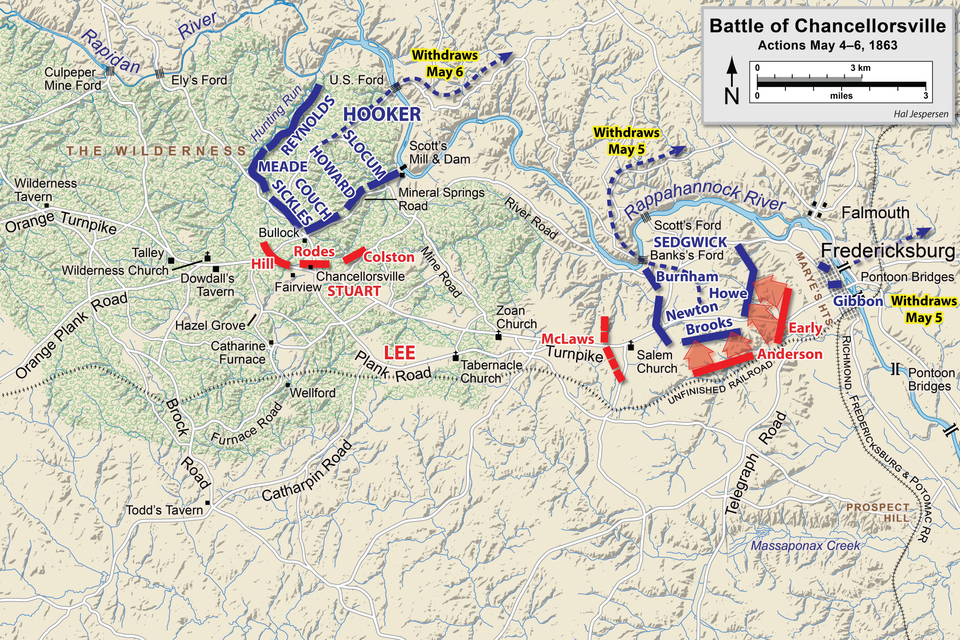
By 11 a.m. on May 4 General Sedgwick was facing three directions; west towards Lee's main body and Salem Church, south towards Anderson's division, and East towards Early's division. When General Sedgwick heard rumors that reinforcements from Richmond had arrived he felt his situation was becoming more difficult. He already had a six mile long line held by 20,000 troops with only a bridgehead to retreat upon in failure, with more Confederates possibly arriving.  He had sustained 5,000 casualties in the fighting and he was concerned if he could hold on against the horde he felt was arriving soon. He reported his difficult situation to General Hooker and requested the main army assist him. General Hooker, however, replied not to attack unless the main army did the same.

Meanwhile, General Lee arrived at McLaws' headquarters at 11 a.m. and McLaws informed him that he did not feel strong enough to launch an attack and asked for reinforcements. There were no reinforcements coming and he had 10,000 men. Anderson was ordered to bring the other three brigades of his division and position them between McLaws and Early; he then launched additional attacks, which were also defeated.


Analysis

Both sides in this battle thought they were outnumbered. But the Union in fact had a 23,000 to 10,000 advantage. Why did Sedgwick misunderstand his situation? Sedgwick was covering a wider area so he had the illusion of fewer troops. The act is, once again, all he had to do was gather everyone together and fight one or the other divided confederate divisions. Both sides had about 5000 casualties, again a much higher rate in the Confederate army. Sedgwick was in a great position to attack.

Imagine if Hooker had just attacked Lee on May 4 after Lee sent McLaws to Salem Church? By licking his wounds instead of acting aggressively, Hooker lost the battle he could have won.

Chancellorsville, May 4-6. Source: Map by Hal Jespersen, www.cwmaps.com, available here.

The Retreat

After dark, Sedgwick sent Hooker a message recommending that the VI Corps retreat across the river. After Hooker sent his approval at 1 a.m., Sedgwick withdrew across two pontoon bridges at Banks' Ford, completing the retreat about 4 a.m. Hearing that Sedgwick had been repulsed, Hooker abandoned the entire campaign, recrossing the main body of the Union army on the night of May 5 into May 6 to the north bank of the Rappahannock River.

Hooker retreated when Sedgwick did. Some think that this was the biggest blunder of the battle.  Hooker no longer posed the original threat to attack Lee on both his flanks. He never considered that he still outnumbered Lee in each section of the battlefield. Lee's impending assault on May 6 might have failed and completely reversed the outcome of the battle.


Final Analysis

Hooker never lost any day’s battle except for Jackson’s surprise attack. Although Hooker suffered more than 17,000 casualties, those losses accounted for only 13% of his total strength. Lee's 13,000 casualties amounted to 22% of his army.

Hooker never considered what Lee might do, and thought Lee could not discern his plan; he underestimated his enemy and never thought about the response Lee might make. Lee on the other hand calculated very carefully the situation of the new Union commander, understood what choices he would not make, leaving him with a window into what he would do. Hooker made plans and had only limited flexibility when that plan met obstacles and he had little ability to analyze how the enemy would respond to situations.

Did he lose self-confidence as he himself said later? Sure; but the reason was that by the time he retreated to find safety, Lee had already figured out how to counter that move. Hooker was playing one step at a time strictly by the book while Lee was thinking several steps ahead and knew he had to take calculated risks.

But most importantly Lee then bet all of his chips on his judgment. He didn’t hold back in case he was wrong. Why was he so confident?  He knew his opponent, and basically, he had no other realistic chance to win. This is how winners win in making decisions.

Did the Confederate Army win the battle?  It is traditionally interpreted that way, with Hooker leaving the field in defeat. Lee did a masterful job despite Hooker stealing a march on him. But the casualties don’t bear that out. It is often called a Pyrrhic victory. But really, the only difference between Hooker at Chancellorsville and Grant at Wilderness a year later was that Grant moved forward. If Hooker moved forward, then it would have been considered a draw. But Hooker retreated because he did what was the expected, usual thing.

Meanwhile, Lee had 22% fewer soldiers to invade Pennsylvania in 1 month. The Pennsylvania campaign could well have turned out differently with that many additional men at the right moments.

The truth is that General Hooker defeated himself.  Lee didn’t so much win the battle as Hooker lost it. Hooker never considered what Lee might do, and thought Lee could not discern his plan; he underestimated his enemy and never thought about the responses Lee might make. Lee on the other hand calculated very carefully the situation of the new Union commander, understood what choices he would not make, leaving him with a window into what he would do. Hooker made plans and had only limited flexibility when that plan met obstacles and he had little ability to analyze how the enemy would respond to situations. When things went wrong, or unplanned things happened, he was unable to adapt.


The site has been offering a wide variety of high-quality, free history content since 2012. If you’d like to say ‘thank you’ and help us with site running costs, please consider donating here.


References

https://www.battlefields.org/learn/articles/reverend-beverly-tucker-lacy

Stephen W Sears, Chancellorsville. Mariner Books, 1996.

James K Bryan II, The Chancellorsville Campaign. The History Press, Civil War Sesquicentennial Series. 2009.

James M McPherson, Battle Cry of Freedom. Oxford University Press, 1988.

One of the most vital statistics to discover regarding contributions to the U.S. Civil War effort by states is the total number of troops each state provided. From that, Jeb Smith looks at the importance of Virginia to the Civil War.

General William Tecumseh Sherman.

Finding statistics for each Confederate state regarding troop numbers is an uncertain and inconclusive process, with wildly varying estimates encountered; a situation not helped by Confederate forces’ destruction of records prior to the fall of Richmond. However, according to historian James M. McPherson in his book For Cause and Comrades, the following statistics represent the percentage contribution of each state[1] to the total forces of the Confederacy:

N. Carolina 15%

S. Carolina 6%

Virginia 14%

Texas 6%

Tennessee 12%

Kentucky 5%

Georgia 11%

Arkansas 3%

Alabama 9%

Missouri 3%

Mississippi 7%

Florida 2%

Louisiana 6%

Maryland 2%


However, according to Randolph H. McKim in his book The Numerical Strength of the Confederate Army, contemporary figures (of which he is highly skeptical, considering them wildly inflated) placed Virginia as the leader providing 175,000 troops, followed by North Carolina with 129,000, Tennessee at 115,000, Georgia 120,000, Alabama 90,000, South Carolina 75,000, Mississippi 70,000, and Florida 15,000. And according to the website Civil War Talk, the following is the number of troops supplied to the Confederacy by each state, with Virginia leading the way:

Virginia 160,875

S. Carolina 76,783

Tennessee 141,728

Louisiana 69,840

Georgia 135,774

Arkansas 58,000

Alabama 106,803

Missouri 39,750

N. Carolina 103,145

Kentucky 28,038

Mississippi 95,301

Florida 17,535

Texas 86,702    

Maryland 3,324


And the National Park Service’s (inflated but never corrected) numbers put Virginia as the leader at 282,432, followed by Tennessee at 277,183, Georgia at 244,142, and North Carolina at 202,009.

If any state were to challenge Virginia in total troop contribution to the Confederate armies, it appears that state is North Carolina. Clearly, no agreement is in place, as one has North Carolina slightly above Virginia while the other three show Virginia in the lead, and one puts North Carolina as low as fifth on the Confederate list of troops. And it does appear that Virginia contributed the most troops to the defense of the South. Not surprisingly, as according to the 1860 census, it had the South’s largest population, with 1,596,318 total, and a free population of 1,105,453. Tennessee (split loyalty) followed with a total population of 1,109,801, and Georgia with 1,057,286, including a significant slave percentage in each case. Then comes North Carolina, with a total population of 992,622, of which only 661,563 were free, as it had a higher percentage of slaves compared to Old Virginia (though lower than in Georgia).

This indicates that Virginia had a significantly larger population than North Carolina and a slightly higher percentage of free whites able to contribute in more ways than the typical slave. So we would expect, especially with war at the door, that Virginia, proud in its heritage and prestige, would muster the most men of all the Southern states. Further, North Carolina was strongly pro-Union before Lincoln's call for volunteers, more so than Virginia, and thus the loyalty to the South would likely not be as fervent. During General Sherman's famous (and infamous) March to the Sea, which involved burning and looting South Carolina and Georgia, his men's passage into North Carolina prompted a reminder by their commander of the state's loyalty to the Union, leading to a significant decrease in pillaging and overall bad behavior.

It is well known that Virginia led the seceding states in industrial production. With factories like the Richmond Armory and the renowned Tredegar Iron Works, which alone produced half the artillery pieces for the Confederacy (along with substantial navy ironclad material), Richmond was the center of industrial production in the Confederacy. Iron, coal, salt, and various agricultural materials were found within the state. A large amount of rail was laid in Virginia, utilized during the war not just to ship supplies but men to battle in and out of the state. And, of course, Virginia housed the Confederate government. North Carolina though was never considered among the most productive Southern states, with Georgia, Alabama, and Tennessee also mentioned behind Virginia.

However, the most compelling argument for Virginia’s status as the most influential state in the Confederacy is the exceptional Confederate generals it produced. A Google search of “top ten” Civil War generals will reveal that Virginia supplied many of the best commanders. It can at least be argued that they provided the top three generals of the war in Lee, Jackson, and George Thomas, who I believe to be the Union’s best commander, and all three regularly make the top five on historians’ lists. Others that often or occasionally make the top ten who hailed from Virginia are Jeb Stuart, Jubal Early, John Mosby, A.P. Hill, Joseph E. Johnston, and Richard Ewell. Added to that was the large population, trained militia, various military schools, and industrial production that Virginia contributed to the war. It makes me think Virginia had the most to contribute to the war of any of the states in the Confederacy, and perhaps the Union. In contrast, North Carolina was remarkably underproductive in its gifted generals.


Greatest in the Confederacy, or Union?

I believe few would disagree with my assessment that Virginia made more contributions to the Confederate war effort than any other Southern state. However, many might contest the claim that Virginia's contributions surpassed those of any Northern state.

In 1860, four states had larger populations than Virginia, with New York being the largest. New York not only contributed by far the most soldiers to the Union but was also an industrial powerhouse, and thus the leading contender from the North (Pennsylvania and Ohio might object).

A 24/7 Wall Street article, which used most likely inflated numbers (for all of the states – the National Park Service had even greater numbers for New York) claimed New York produced the most men of any state, with 448,850 soldiers, followed by Pennsylvania and Ohio, respectively providing 337,936 and 313,180. At the same time, Virginia was fourth (first among the Confederates) with 282,432. Obviously, the South mobilized a greater percentage of the population than the North, as seen in the comparison between Virginia's and New York's total output. Even so, New York has a significant advantage in manpower, 448,000 to 282,000. So how could I argue that Virginia was the leading state?

First, we must look at the statistics another way. According to the American Battlefield Trust, 31,000 Virginians were casualties in battle, and only 39,000 New Yorkers. The same numbers can be found in other locations. But why such a vast discrepancy in the percentage of casualties? And what does it tell us?

A substantial portion of troops from New York were recent immigrants, many of them essentially mercenaries who lacked the commitment to the cause of the native-born Americans. They thus were less willing to make the greatest sacrifice. Many were drafted, yet they opposed the war. New York City Mayor Fernando Wood advocated secession after Lincoln's election due to tariffs.  The city had large-scale riots opposing the draft and Lincoln in 1863, which then morphed into some of the worst race riots in American history. Lincoln won the 1864 election in the state by a small margin of 6,749, which included known intimidation and voter fraud in NYC aimed at swaying and intimidating Peace Democrats. In other words, the typical New Yorker lacked the dedication and commitment that the typical Virginian had. Thus, the two are not equal and cannot be judged by numbers alone.

Further, slaves in the South helped maximize the white population’s contribution. They worked the fields, fed the armies, built fortifications, repaired bridges, constructed railroads, and performed labor work, enabling a larger percentage of whites to participate in combat. General Beauregard noted that the slaves' construction of defensive works provided the soldiers with rest and time to train more effectively. And to a much greater extent than the South the North would lose production when men went to war, leaving farms and jobs vacant across the various states. There were also thousands of slaves and free blacks who would fight for the South or would be medics, cooks, musicians, etc, in the Confederate army.

But more than this, Southerners were, generally, better soldiers. State militias had a greater impact in the South, as did pre-war training, and the vast majority of military colleges (outside of West Point, where many attendees were Southerners) were located in the South. The South had quality generalship from the bottom up, and more talent to spread around. And the size of the Union Army depleted the quality of the commanders they did have. The South also produced many great generals with no military training, such as Nathan Bedford Forrest, Wade Hampton III and others.


Industry

Many historians, instead of only decrying the lack of industry in the South, will tell of the benefits of agrarian life regarding the military, especially the familiarity with weapons among the rural Southern population, where gun ownership was nearly universal. They had fewer police and thus often relied on armed citizens. A priority for them was dueling. They were more commonly hunters and farmers, needing to provide food and protect livestock, as well as engage in target practice or serve in a local militia. Even today, if you take 100 citizens in a rural area and put them with 100 urban, you can guess where the money would go if you bet who was more familiar with guns and could shoot better.

Another massive advantage that historians regularly admit is the Southern advantage of cavalry. The Southern agrarian lifestyle and lack of rail, urban life, and mass transit meant Southerners relied on horses for travel and were more accustomed to equestrianism than the Northern soldier. Southerner David Hundley wrote before the war that Southerners, if not racing horses, were hunting, shooting, fishing or swimming. He stated, “Whether for fox hunting like the old English or horse racing, horses were the beloved animal of the South.” Northerner Joseph Ingraham visited the South and wrote, “At the North, few ride except in gigs. But here all are horsemen; horsemen, and it is unusual to see a gentleman in a gig or carriage…cavalier bearing is thereby imperceptibly acquired, more congenial with the wild, free spirit of the Middle Ages than the refinement of modern times.” James Everitt, a plantation owner in North Carolina, said of the Southern gentleman, “From his very cradledom, he was made familiar with his horse.” So the typical Southern soldier was a far more experienced rider and also brought his horse with him, and thus could literally jump right into the war, while Northern cavalry had the horses provided for them by the army and needed to train.

Both North and South viewed Southern cavalry as far superior. Union General William Tecumseh Sherman described the Confederate cavalry in 1863 as “splendid riders, shots, and utterly reckless... the best Cavalry in the world.”. General Sherman noted how General Forrest’s cavalry could “Travel one hundred miles in less time than it takes our troops to travel ten.” A Union officer said of the cavalry in Virginia led by Ashby, “I can’t catch them, sir; they leap fences and walls like deer, neither our men nor horses are so trained.” Southern generals, especially early in the war, consistently demonstrated their superior riding skills and horsemanship by riding around entire Union armies, and in the case of J.O. Shelby, entire states, thereby boosting Southern morale. A song was written early in the war because of the dominance of the Southern cavalry under General Stuart in Virginia, who ran around the entire Union army on multiple occasions. Some of the lyrics go like this:

“If you want to have a good time, jine [Join] the cavalry!

Join the cavalry! Jine the cavalry!

If you want to catch the Devil, if you want to have fun,

If you want to smell Hell, jine the cavalry!”


Cavalry

Such was the dominance of the Virginia cavalry that warfare became a game, a confident, fun, certainty of victory.

The South effectively utilized cavalry from the onset to its full potential, and had many more trained cavalry officers. They had great cavalry commanders like Nathan Bedford Forrest, J.O. Shelby, Joseph Wheeler, John Mosby, Jeb Stuart, John Wharton, Wade Hampton III, Fitzhugh Lee, William Quantrill, the Native American leader Stand Watie, William Anderson, Turner Ashby, and more. The North lacked great cavalry generals, with Phil Sheridan being the only notable exception.

Now, there is no question that New York was an industrial giant, outperforming Virginia; however, when we look at Virginia, it could arm its soldiers with rifles and, as stated, produced half the Confederacy's artillery pieces from one factory alone. The North’s industrial output was only marginally over three times that of the South, and if Virginia produced at least half of the entire South’s manufactures, New York likely did not far outpace Virginia. Also, the majority of Confederate artillery was captured! They didn't have to produce as much due to on-field acquisition. Both sides really produced all they needed or could use. Due to a lack of proper lines of fire or suitable terrain and time to maneuver into position, neither army deployed all its artillery. Many battles were fought in the woods of Virginia to negate the advantage of manpower and artillery. Further, the use of artillery was not as vital as commonly believed; it only contributed to 5% of casualties during the war. And it was the South that first massed artillery. It was not until Gettysburg that the North began to do so.

Virginia provided its people with great defensive terrain, including many mountains, hills, rivers, and dense woods, to combat Northern advantages. The comparisons of Virginia generals and those from New York reveal an irreconcilable difference between the two. Virginia, ‘Our great Virginia’ as the state song says, was the most potent state during the war.


Jeb Smith is an author and speaker whose books include Defending Dixie's Land: What Every American Should Know About The South And The Civil War written under the pen name Isaac C. Bishop,  Missing Monarchy: Correcting Misconceptions About The Middle Ages, Medieval Kingship, Democracy, And Liberty and he also authored Defending the Middle Ages: Little Known Truths About the Crusades, Inquisitions, Medieval Women, and More. Smith has written over 120 articles found in several publications.

Links:

Defending Dixie's Land — Shotwell Publishing

Missing Monarchy: Correcting Misconceptions About The Middle Ages, Medieval Kingship, Democracy, And Liberty: Smith, Jeb J, Hedberg Jr., Lloyd R.: 9798327712362: Amazon.com: Books


[1] None of Kentucky, Maryland and Missouri were members of the Confederacy. They nevertheless appear in the statistics, since large numbers of citizens of each of these states served in the Southern forces. Note also that due to rounding the table does not add up to exactly 100%.