
Jeb Smith recently read Larry Allen McCluney, Jr.’s book, The Paradox of Freedom: A History of Black Slaveholders in America. Here, he discusses his views of the book.
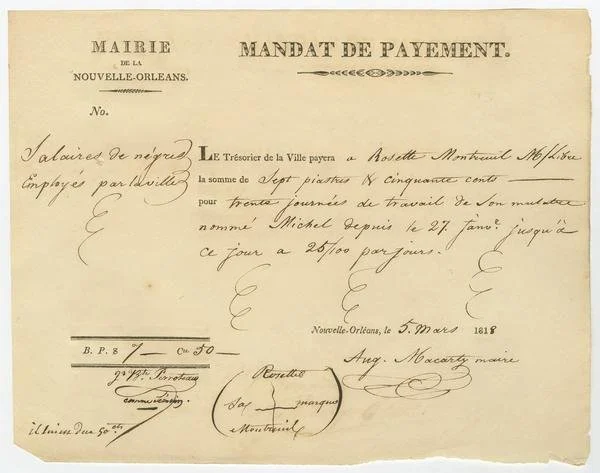
City of New Orleans, 5 March 1818. Order from the Mayor's office to the City Treasury to reimburse Rosette Montreuil, a free woman of color, for the work of her slave, Michel, "mulatto". Signed by mayor Augustin Macarty.

An Instructor of American History at Mississippi Delta Community College and an American Civil War Living Historian since 1995, Larry Allen McCluney received his bachelor’s and master’s degrees in history at Mississippi State University, and his research into original data for this book is extensive (he even utilized a History Is Now article). He cites and quotes many historians, as well as original sources, to bring to life a fact of American history: African Americans were slave owners too.

A mix of various “free peoples of color”—various mixed race and African Americans —owned people of their own race from colonial times up until after the Civil War. In some extreme cases slaves owned slaves. Some free African Americans even engaged in slave trading. This should not surprise us, as Africa has always been the center of slavery, where just as every other race in the world has been enslaved, and continues to enslave their own people. In fact, it was outside pressure from European nations that forced abolitionism on Africa.

African American slaveowners in America at times became some of the wealthiest planters and businessmen in the entire South. McCluney writes they became one with “the upper crust of the economic level in the pre-war South.” They entered into and at times mingled, intermarried, and associated with the white southern aristocratic class. These wealthy included many African American women.

For example, he quotes Steven J. Niven, who wrote of “Marie-Thérèse Coincoin, who lived for eight decades in Natchitoches Parish, La. She would help to found a family dynasty of Free, Colored planters, the Metoyers, who by 1830 owned over 200 slaves—8 percent of all enslaved people in the parish.” In Charleston City, South Carolina, 123 African American women owned slaves and were the “heads” of households, including Maria Weston, who by 1860 owned 14 slaves and owned property amounting to $40,000; the average white earned around $100. Marie Thérèse Metoyer of New Orleans owned around 11,000 acres of land, manufactured medicine, trapped animals, and grew tobacco.


Wealthy slave owners

Many African American slave owners owned hundreds or thousands of acres of land and were wealthier than the vast majority of whites. McCluney writes:

 “In 1860, there were at least six free Blacks who owned 65 or more slaves. The largest number, 152 slaves, was owned by sugar cane planters, the widow C. Richards and her son P.C. Richards. Another slave magnate from Louisiana was Antoine Dubuclet, who owned over 100 slaves. He had an estate worth $264,000 in 1860 dollar value. This was in comparison with the wealth of White men of that time, averaging $3,978."


William Ellison Jr. of South Carolina, a free man of color, was one of the wealthiest plantation owners in the state. He was the largest slave owner in his area, with 171 slaves, and over 900 acres of land producing massive amounts of tobacco. He donated large sums of money and foodstuffs to the Confederate Army, offered the military 53 of his slaves, and his mixed race grandson fought in the Confederate Army.

Many of the slave owners were born in bondage but were later freed and, through either inheritance, gifts, or work ethic, improved their situation, eventually moving into the profitable business of slavery. It was not uncommon for free African Americans to own slaves. Thousands did so. According to the 1860 census, only 1.4% white people owned slaves in 4.8% of southern slave states, but 28% of free African Americans in New Orleans owned slaves. McCluney wrote, “In South Carolina, where forty-three percent of the free African American families owned slaves, the average number of slaves held per owner was about six. Similarly, in Louisiana, forty percent of free African American families owned slaves, twenty-six percent of those in Mississippi held slaves, twenty-five percent of those in Alabama, and this was also true for twenty percent of those in Georgia.”


Status

Their wealth elevated the status of these slaveowners of color, gaining them status among the highest in the white community, intermingling with, socializing, even marrying (even when it was illegal), and becoming some of the most well-respected people in their community. McCluney wrote of Justus Angel, born a slave in South Carolina but who became “a wealthy Black master who lived in Colleton District, South Carolina, in 1830. Angel was a plantation owner who owned 84 slaves, a staggering number even for a Black master. He was a man of great wealth and influence, which allowed him to amass such a large number of enslaved individuals under his control.” Of this wealthy planter class, he wrote, “These individuals often took steps to associate with the White elite, viewing themselves as an extension of this class. In doing so, the Black slaveowners were able to carve out a place for themselves within the ruling class.” Then there is William Johnson in Mississippi, who:

“Became a successful entrepreneur with a barbershop, bath house, bookstore, and land holdings. Though a former slave, in 1834 he would own three slaves and about 3,000 acres of property and would eventually own sixteen slaves before his death. He even hired out his slaves to haul coal and sand. Throughout his life, the white community in Natchez and Adams County held Johnson in high regard. He associated with and was close to many of Adams County’s most prominent white families. Following Johnson’s untimely death at the hands of a “free black, Baylor Winn, the Natchez Courier was moved to comment that Johnson held a “respected position [in the community] on account of his character, intelligence and deportment.”


Further, McCluney argues that it was the common opinion of slaves that African American masters made harsher masters, and they generally preferred white masters to their own color, for example, William Ellison had a reputation for harsh treatment of his slaves. One interviewed slave said, “You might think, master, dat dey would be good to dar own nation; but dey is not. I will tell you the truth, massa; I know I ‘se got to answer; and it’s a fact, they are very bad masters, sar. I’d rather be a servant to any man in de world, dan to a brack man. If I was sold to a brack man, I’d drown myself. I would dat—I’d drown myself! Dough I shouldn’t like to do dat; but I wouldn’t be sold to a coloured master for anything.”


Conclusion

Frederick Law Olmsted traveled south and told of the many wealthy African American planters he saw and interviewed a slave who said the African American masters “bought black folks, he said, and had servants of their own. They were very bad masters, very hard and cruel . . . If he had got to be sold, he would like best to have an American master buy him. The French [black Creole] masters were very severe, and ‘dey whip dar n****** most to deff—dey whipe de flesh off of ‘em.”

Far from abolitionists, these rich masters were reluctant to let their slave labor go as many whites had done. McCluney Quotes B. F. Jonas, of New Orleans who said “I have never heard of a case where a free African American owner of slaves voluntarily manumitted his slaves. On the contrary, they were as a rule considered hard task masters, who got out of their slave property all that they could.” And as has been recorded in Defending Dixie's Land, many of these southern masters supported the preservation of slavery and the continuation and protection of the Confederacy, to maintain bondage of their own brothers.


Jeb Smith is an author and speaker whose books include Defending Dixie's Land: What Every American Should Know About The South And The Civil War written under the pen name Isaac C. Bishop,  Missing Monarchy: Correcting Misconceptions About The Middle Ages, Medieval Kingship, Democracy, And Liberty and he also authored Defending the Middle Ages: Little Known Truths About the Crusades, Inquisitions, Medieval Women, and More. Smith has written over 120 articles found in several publications.

For a few centuries, the United States of America has been known as ‘the land of the free and home of the brave.’ Here, Aarushi Anand argues that in the context of slavery, the adage still holds true for the past three centuries, only the narrative gets reversed.

Mid-19th century painting Slaves Waiting for Sale - Richmond, Virginia. By Eyre Crowe.

America was the land of free people, of its native people. With the advent of British imperialism in the eighteenth-century slavery became the norm. Different degrees of freedom coexisted, from the slave stripped completely of liberty to the independent slave-owner who enjoyed a full range of rights. The settlers’ success, however, rested on depriving Native Americans of their land and, in some colonies, importing large numbers of African slaves as laborers. Freedom and lack of freedom expanded together from seventeenth-century to nineteenth-century America. 

In writings from the eighteenth century, the image of the “grateful slave,” becomes commonplace. Such a stereotype provided readers and viewers with what appeared to be a seemingly positive alternative to the injustices of human trafficking and exploitation:  a willing and even desperate captive who served a beloved White master out of gratitude for their good deeds. In the latter half of the century the vision of the “grateful slave” contributed to colonial practices of White supremacy.


Historiographical trends in analyzing relationship between master and slave

By the 1960s, U.B. Phillips had become a paradigm for the racist and regressive aspects of slave historiography. He substantiates his arguments by stressing on availability of amenities: adequate food, clothing, housing, medical care, along with instruction in contemporary technologies to “civilise" the slaves. Only occasionally were slave laws enforced, and owners hardly ever sold their slaves, "except in emergencies." Despite its significance in structuring Southern society, Phillips addresses the unprofitability of enslaved labour which slowed down the industrialization process, restricted crop diversification, and wasted soil fertility. His claim that "a negro was what a white man made him" reflects his beliefs that Blacks were culturally blank and retained few native African qualities after enslavement. 

Innumerable historians have responded unfavourably to Phillips' writings. Historian Kenneth M. Stampp dismantled Phillips' portrayal of benign paternalism and presented a starkly cruel reality to the academics and students of the South. Slaves in Charleston could not “swear, smoke, walk with a cane. or make joyful demonstrations.” For some crimes, Florida's laws permitted branding, mutilation, and even execution. Working hours from sunup to sunset, course food, exacting work, limited medical care were other forms of exploitation.  According to Stampp, absence of paternal authority and no legal sanction for slave marriages weakened the Afro-American kinship system: “the slave woman was first a full-time worker for her owner and only incidentally a wife, a mother and homemaker.” Additionally, the sale of family members separately led to “widespread sexual promiscuity” among both men and women, typified by a Kentucky female slave labour “who had each of her seven children by a different father.” 

Stanley Elkins argues that the origin of North American slavery had capitalistic tendencies which gave paramount rights to slave owners, and barred slaves from appealing to institutions, like the church or the state, which in Spanish America might protect them from some forms of exploitation. The "shock" and trauma of the slave trade, along with the adaptation to the “closed system" of the Southern plantations, resulted in the infantilization of the Afro-Americans and their absolute subservience to authority.

Initiating a new chapter in the debate over slavery, historian Eugene D. Genovese draws upon the writings of U.B. Phillips. Genovese saw the plantations as pre capitalist firms and the slave South as a distinctive civilization that was anti-bourgeois. He contends that plantations were inefficient in the South and that plantation owners were unable to make investments in labour-saving efficiency to preserve the worth of their slaves. His Marxist vision is ironic in the sense that he talks about the slave economy on the one hand, but he minimizes the degree of exploitation in the relationship between slaveholder and slave on the other. He envisioned a mutual acceptance of paternalism by both master and slave. Paternalism contained resistance, perpetuated class rule, and gave slaves moderate bargaining power.

His analysis of slave religion reveals it to be a religion of resignation which was not conducive to revolutionary political or ideological tradition. Slaves had no prophetic heritage, therefore plantation owner’s control over slave religion and Afro-American culture continued to be dictated by the whims of the planters. Genovese discredits the humanity of Africans and emphasizes the Biblical endorsement of human enslavement in order to rebut the abolitionists’ contention that slavery must be abolished on the grounds of Christianity, reason, and property ownership.

Some historians focus on the high rates of slave mortality in the rice plantations, where owners’ absenteeism was frequent, while others stress on the slave trade. In terms of housing slaves had one or two-room cottages that were situated on agricultural fields, had no ventilation and were unbearably hot. They were more susceptible to illnesses than their owners were because of poor nutrition, unhygienic living conditions, and excessive work. Skin irritations, toothaches, rickets, beriberi, and scurvy were all exacerbated by vitamin deficits. Juxta positioned with racist historiography no kind slave owner would disperse familial groups, sever the bond of father and child, or exploit slaves in the above-mentioned manner.


Debunking the narrative of father-son relationship through slave resistance

Emphasis on African antecedents provides a viable interpretive framework for understanding the subtle ways in which they provided resistance. Slaves typically hold out to music from their native countries. This implies preservation of their own culture through the memorialization of their homeland in songs, poems, and fables was a kind of resistance to white civilization. Sabotage, sluggish labour rates, and escape from plantations were the more visible forms of resistance. To limit the quantity of their services slaves encouraged their masters to underestimate their intelligence by damaging tools and feigning illnesses. Depending on the severity of the white master's brutality or the type of order disobeyed, the penalties varied from starvation and limited ration to physical violence and death. The number of laws enacted to keep the institution working gives clinching evidence of the amount of resistance slaves offered. 

An additional form of resistance was the occasional murder of overseers or masters. Additionally, slaves who had access to the master's residence would make attempts to assassinate them. One of those suspected of killing the master was the barber (as he got extremely close to him when providing grooming services and had access to long blades for shaving). Another strategy is to inflict severe discomfort or a bleeding nose on the master. People with access to a White man's household, such as female slave servants, could kill the occupants by slow poisoning, which involves putting a small amount of arsenic in meals to simulate kidney failure and demonstrate natural death.


Female experience of slavery

New work on gender and slavery throws light on the experiences and extent of resistance offered by women. Sexuality imposed an implicit price constraint on the worth of enslaved labour. The cost of female slave labour was cheaper than male slave labour, particularly when planters applied to black women the same tax-exempt status that applied to white female servants. Slave pregnancy was one of the best ways for a slave owner to increase slave numbers without being forced to buy new ones. To curb sexual attacks on White women Black females were originally brought from Africa to act as companions (sexual gratification) for the male slaves. 

Slavery, according to some historians, was an opening for a white man's sexual playground. Female slaves received the nickname "Fancy maids," and they were auctioned off into the "fancy trade." This "fancy trade" was expressly established to sell mixed-race women for sexual liaison and trafficking. Female slaves frequently attempted to flee, but since they were more concerned with the welfare of their children, their mobility was restricted and likelihood of capture raised. In addition to their physical labour, women's reproductive work was aggressively exploited. As a result slave women suffered from difficulties arising due to birthing complications, and sexually transmitted infections. To provide resistance, women in the fertile stage practiced birth control and abortion to avoid remaining in a perpetual state of pregnancy.  Thus, in the lives of slave women, financial affairs and the biological process entwined in intricate and tragic ways.

Historian Ira Berlin rightly contends that comprehending the economic, social, and political evolution of North America, particularly the United States, requires confronting slavery's key role in the nation's foundation. While the ruthless oppression of slaves constituted the foundation of colonial American society, traditional historians viewed the dehumanizing institution through rose-tinted spectacles. The revisionists' study of data pertaining to several fugitive laws, reports on death, violence and an agonizing living experience of slaves destroy the conception of a father-child bond between slave and slave owner. When Eric Foner remarked "parents do not typically sell their children," the institution’s non-paternalistic, exploitative bent gets highlighted. No wonder slavery is referred to as the nation's original sin.


What do you think of the article? Let us know below.


References

·       Genovese, E.D. (2011). Roll, Jordan, Roll: The World the Slaves Made. 9th edition. New York: Knopf Doubleday Publishing Group.

·       Morris, Richard B. "The Peculiar Institution: Slavery in the Ante-Bellum South. By Kenneth M. Stampp. New York: Alfred A. Knopf, Inc., 1956. Pp. xxi, 435. $5.75." The Journal of Economic History 18.1 (1958): 89-90.

·       Genovese, Eugene. (1989). The Political Economy of Slavery: Studies in the Economy and Society of the Slave South. Connecticut: Wesleyan University Press.

·       Stampp, K. The Peculiar Institution: Slavery in the Ante-Bellum South. New York: Vintage, 1989.

·       Deborah Gray White; ‘The Nature of Female Slavery’; “Aren’t I am Woman? Female Slaves in the Plantation South”; W.W. Norton and Company.

Posted
AuthorGeorge Levrier-Jones