Lady Jane Grey is a highly disputed monarch.  Her reign lasted only nine days —long enough to change history, but too short to change her fate. At the age of sixteen, Jane was elevated to the throne as part of an unsuccessful bid to prevent her Catholic cousin Mary Tudor’s accession. Jane was a highly intelligent woman who never truly ruled, never sought power or the crown. She never stood a chance of succeeding. Her reign was brief, her power illusory, and her death a chilling reminder of where ambition takes you.

Sophie Riley explains.

The Streatham Portrait of Lady Jane Grey.

The Road to the Throne

1553, was a tumultuous year of shifting loyalties, political intrigue and religious tension. Fearing a return to Catholic devotion after Edward VI ’s death, England stood on a knife edge as his advisors rushed to rewrite the future.  In secret they penned the name Jane Grey — young, intelligent, and a devout Protestant — as their Queen. Innocent and perhaps naïve, she was sixteen and powerless to the patriarchal desires that surrounded her. But political and religious ambition rarely listens to innocence.  What choice does a girl have when the men around her have already sealed her fate?

Jane’s story is that of a teenager who was thrust into power by the will of others and handed a crown that quickly became her noose. Her nine-day reign consisted of betrayal, sorrow and survival. Her legacy endures a chilling reminder of where unchecked power and political games can lead, capturing the imagination of historians and storytellers alike.


A Crown Without a Coronation

Four days after Edwards death a reluctant Jane was brought to the Tower of London by her parents and the Duke of Northumberland. It was there where she was proclaimed to be the next heir to the English throne. Upon hearing this Jane collapsed to the floor weeping ‘the crown is not my right and pleases me not.’ This reaction caused her parents to remind a distressed Jane that it is her duty to accept, and that it had been Edward’s dying wish for her to inherit the throne.  The people of London however, were far from convinced as many remained quietly loyal to Mary I, seeing her as the rightful heir.

Even in that first moment, Jane sensed that the crown would be her undoing. On the 10th July 1553, she was formally proclaimed the Queen — though she was never coronated. But Janes rule was fragile from the start and would soon be eclipsed by her cousin Mary I.

The Tower of London a place synonymous with torture and confinement became a gilded cage for a sixteen-year-old Jane. Within its stone-cold walls Jane attempted the duties expected by a monarch. She met with her privy council regularly, signed proclamations and attended petitions, all under the watchful and judging eye of the Duke of Northumberland. Jane would have spent the majority of her time reading and reviewing documents.

Even her private moments were measured by duty, her husband was pushed into being crowned King by her political advisors though Jane protested.  She however continued to find her solace in prayer to the Protestant faith. This reflection would later sustain her during imprisonment and in death.  Her meals were formal and sparse alongside endless meetings that were rigidly scheduled.  Every move she made in those short days was monitored and judged by the very men who assigned her to the throne.

Meanwhile Mary’s supporters were mobilising her return to the throne rapidly. Noblemen and commoners would flock to her side, recognising her as the legitimate heir to the throne. As the days passed, Mary would see her circle grow alongside a weakening Jane. By the 19th July, the tide had turned in Mary’s favour, Jane’s privy council had abandoned her, and any attempts to enforce Janes claim from the military forces had ultimately failed.  Janes brief reign left an unclaimed crown of illusion that she never had the chance to wield. Mary’s triumph left Jane with no allies and no crown. The girl who briefly reigned would no be in a prisoner in the tower she once called home.


Downfall and imprisonment

Janes fleeting grasp on the throne ended as quickly as it began. The girl who ruled a country for less than two weeks would be imprisoned in the very tower she attempted to rule from. Jane was imprisoned In the Tower of London, until her execution in February 1554. During her imprisonment she was allowed some home comforts, she was attended to by servants and was allowed to walk freely in the Queens Gardens at convenient times. In addition to this she was also allowed to see her husband within the towers palace despite being separated. 

During her months in confinement Jane maintained a composed and confident persona despite her fate being sealed. Her brief reign had made her a target and for that she knew that a trial was inevitable despite this she looked on it with great determination. Each day in confinement she maintained and confided in her faith which in turn strengthened her resolve, preparing her for the trials to come. Yet Tudor mercy would be proved futile. Jane’s composure impressed many, but it was futile, her imprisonment delayed the inevitable: a trial for treason.


Trial and Execution

On the 13th of November 1553, Jane, her husband and other co-conspirators were marched from the Tower of London to Guildhall. When they arrived, they were charged with high treason and sentenced to death. During her trial Jane remained calm and confident through the comfort of her faith, she remained determined that her death would mean something. This resilience was displayed further during her imprisonment both before and after the trial. The more she was pushed into hardships and lack of liberty the more devout she became.

Though she was condemned in November, her execution was delayed. Mary I was hesitant to kill her cousin whose naivety and youthfulness had stirred sympathy from her own enemies. But political unrest caused by the Wyatt rebellion of early 1554 sealed Janes fate. By February a date was set and her death warrant was signed.  

As she walked to the scaffold dressed in all black, she remained calm. On the scaffold she remained a dutiful protestant reciting Psalm 51 from her prayer book. She then removed her gown, headdress and gloves which she passed to her ladies in waiting. In her final moments she asked the executioner to dispatch her quickly as she tied the blindfold around her eyes. Her head laid on the block she recited her last words ‘Lord, into thy hands I commend my spirit’. The axe fell; she was just seventeen years old.


Legacy and Historical Impact

Though her reign was brief, Lady Jane Grey’s story reiterates the fragility of women in power and the human cost of their political ambition. She was a pawn in a highly political, religious and patriarchal world where at every turn she was confronted and constrained by those around her. Yet despite her lack of control Jane remained confident and unwavering. She is remembered as a Protestant martyr, her history celebrated in art, literature and sermons.  Whilst historians continuously debate whether she was a victim or a reluctant participant in the Tudor succession for the throne. Her life ending serves as a cautionary tale and testimony proving that those denied power can leave an indelible mark on the world.  

A queen for nine days, a prisoner for months — yet Janes courage and resilience turned a pawn of politics into a legend with story that captivates historians today.   


The site has been offering a wide variety of high-quality, free history content since 2012. If you’d like to say ‘thank you’ and help us with site running costs, please consider donating here.

Posted
AuthorGeorge Levrier-Jones
CategoriesBlog Post

Good Queen Anne or Anne of Bohemia (1366-1394) was Queen of England from 1382-1394 as the wife of King Richard II of England (1367-1400; king from 1377-1399). Here, we tell you about Anne’s life, the many good deeds she did, the positive influence she had on Richard, and how both she and Richard II died.

Anne of Bohemia as seen on the Liber Regalis.

Anne of Bohemia as seen on the Liber Regalis.

The background to Anne’s arrival

Anne was born May 11, 1366 in Prague, Bohemia (now the Czech Republic) as the eldest daughter to Charles IV, Holy Roman Emperor and King of Bohemia, and Elizabeth of Pomerania. Charles IV was the most powerful monarch in Europe at the time and ruled over half of Europe’s population and territory. The majority of her childhood was spent at the Hradschin Palace, today known as Prague Castle, in the recently renovated and flourishing city of Prague. Anne was given an extraordinary education and could speak several languages. Her love of reading was greatly noted as she possessed the Scriptures in three languages, her favorites being the four Gospels, which she constantly studied.

In 1377, King Edward III of England died in the fiftieth year of his reign. Since his eldest son, Edward, Prince of Wales (the Black Prince) had died the previous year, the elderly king was succeeded by his grandson King Richard II who was ten years old at the time. Conflicts were already brewing in the early years of his reign which included England beginning to lose the Hundred Years’ War with France, border clashes with Scotland, and economic strains brought on by the Black Death thirty years prior. Following the Peasants’ Revolt in 1381, pressures were made to find the now 15-year old Richard a suitable bride.

Three years earlier, a split was formed within the Roman Catholic Church when two men claimed the papal throne, the elected Urban VI and his rival Clement VII. Anne of Bohemia seemed the most strategic choice for the sitting pope, Urban VI, as Bohemia and the Holy Roman Empire could be potential allies against France which backed Clement VII as the true pope. King Wesceslaus of Bohemia, Anne’s brother, enthusiastically embraced the marriage proposal between his sister and the King of England. The marriage was not popular among the English nobility and members of parliament as Anne brought no dowry and few diplomatic benefits while King Richard gave Wenceslaus 20,000 florins (4,000,000 pounds in today’s value). Sir Simon Burley, King Richard’s tutor, traveled with the Earl of Suffolk to negotiate the marriage with King Wenceslas in place of her late father and by 1381, the negotiations were settled.


Anne to England

Anne voyaged to England, bringing a mass of ladies-in-waiting and gentlemen. She was stumped at Brussels on the way as the French had schemed to kidnap Anne and her uncle, the Duke of Brabant, who managed to confer with the French king. Charles VI, King of France, recalled his armed vessels, citing his love for his cousin, Anne, and not for the English king. She then sailed to Calais, then Dover, where she was received by the English king’s uncle, John of Gaunt. Upon her arrival, Anne was harshly critiqued by contemporary chroniclers, possibly as a result of the financial arrangements of the marriage. The Westminster Chronicler remarked that she was “a tiny scrap of humanity.” A Benedictine monk, Thomas Walsingham, pointed out a disastrous omen upon her arrival when her ships were smashed to pieces by a violent storm as soon as she disembarked. Anne spent the Christmas season at Leeds Castle before journeying to Westminster where she was greeted with magnificent displays and her future husband at last.

However, as Anne and Richard proceeded through the streets, the crowds ripped the royal arms apart which had been crossed with the imperial arms and mounted on a fountain in her honor. The Bohemian princess was not welcome among the people of England on her arrival.

Nevertheless, Anne and Richard II were married in Westminster Abbey on January 20, 1382, the fifth royal wedding in Westminster Abbey and the last for the next 537 years. She was sixteen years old, Richard a year younger. The exact date of their wedding is still debated. Anne was crowned Queen of England two days later. Despite their tender age, the relationship between these “two wispy teenagers” developed into more than just a political alliance. The king seemed delighted with his bride and paid her every attention. After a week of festivities and tournaments at Westminster in celebration of their marriage, the young couple travelled by river to Windsor Castle accompanied by King Richard’s mother, Joan, Princess of Wales.

King Richard II of England.

King Richard II of England.

Growing popularity

Initially resented, Anne earned the love and popularity of England over the years. She was gentle and kind in nature, wielding considerable influence over her husband by interceding on behalf of others who displeased him. Examples include acquiring pardons for the Peasant’s Revolt culprits on the occasion of her coronation and begging on her knees for three hours before her husband and his political opponents for the life of Sir Simon Burley, the king’s own tutor, to be spared. He didn’t grant her wish this time but Burley was spared the gruesome traitor’s death.

In 1392, Richard requested a loan from the City of London which the city refused as they were already suffering from food shortages and plague. Angered, the king had the mayor and sheriffs arrested, revoked some of the city’s privileges, and named his own wardens. To add to the stacking penalties, he fined London one hundred thousand pounds. The Londoners submitted. Once again, Anne intervened and begged on her knees for Richard to forgive them at Windsor and Nottingham. The royal couple entered the city to Westminster Hall where Anne begged on her knees for the city’s behalf in a public ceremony. Richard raised her from her knees and seated her next to him before assuring the city officials of their renewed favor, pardoning them in September.

An often overlooked action of Anne’s reign was her protection for the religious reformer John Wycliffe against prosecution and potential death. With her encouragement, Bohemian students traveled to Oxford to study under Wycliffe. As a result, many writings and teachings of Wycliffe were carried back to Prague, Bohemia and throughout central Europe.

The Queen contributed to her new home country in the fashion sense too. She introduced the Polish long-pointed shoes called Cracows. Anne is also credited with introducing a head-dress for ladies known as the horned cap which were two feet high, two feet wide, arranged on a frame of wire and pasteboard, and covered with gold-speckled muslin or gauze. Before her groundbreaking introduction of pins which were produced in Germany for some time, gowns were fastened by tiny skewers consisting of ivory or wood. The queen also accompanied her husband on horseback all over the country. In this age, women rode seated sideways on a cushion behind the male rider’s saddle until Anne was said to have brought in sidesaddles, seats made of wood strapped to the horse’s back with a pommel for gripping, and a wooden plank that was wide enough to accommodate both feet and hung along the left side of the animal.


True love

Richard and Anne grew to love each other deeply. Richard was devoted to his wife and rarely left her side. In a letter to his mother-in-law, Elizabeth of Pomerania, he refers to her as “mater nostra carissima” which loosely translates to ‘mother of my beloved.’ They travelled together everywhere including to a 1383 pilgrimage to the shrine of Walsingham which may have been an attempt at seeking divine intervention for their childlessness. Despite no children being produced during their twelve year marriage, Anne did not become a discarded wife and the lack of illegitimate children shows he did not take any mistresses. At least one biographer theorized that their marriage was childless because it was chaste, due to Richard’s admiration for Edward the Confessor, though Richard strongly expressed a sense of lineage. Ultimately, both were still young so the king must have believed there was still hope for a future heir.

King Richard was infamous for his fierce temper and lack of forethought. The queen rarely wielded political influence but encouraged him to curb his temper and think before reacting rashly, even helping him through his severe depression. After the 1386 death of his mother, his wife became his sole and trustworthy confidant though he continued to favor some nobles.


Death

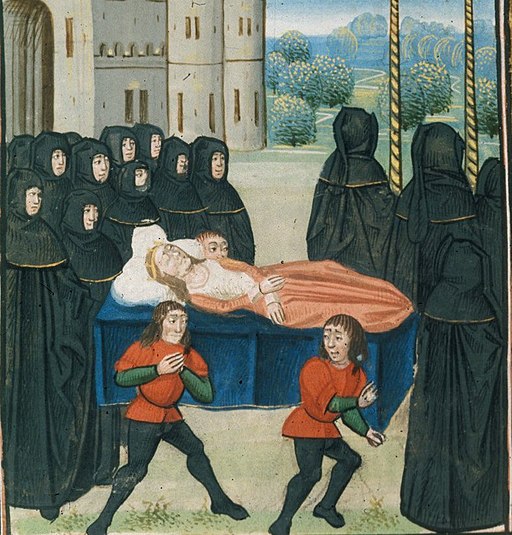
In 1394, the plague struck and Queen Anne fell seriously ill. She died on June 7, 1394 at Sheen Palace. She was just 28 years old. The king was preparing an expedition to quell a rebellion in Ireland when she fell ill. He rushed to her side and was with her when she died. He was described as “wild with grief” and inconsolable, ordering Sheen Palace to be demolished. Richard summoned all the barons and nobles of England to her expensive and lavish funeral that would take two months to prepare. Extra wax torches were ordered from Flanders. The nobles and their wives were expected to arrive the day before and escort the body from Sheen to Westminster Abbey. On August 3, her body was carried from Sheen to Old St. Paul’s Cathedral to Westminster Abbey. Archbishop Arundel conducted her funeral service and praised her commitment to pious reading.

An embarrassing incident occurred during the funeral when Richard Fitzalan, Earl of Arundel, was not present for the procession and then, arriving late at the abbey, tactlessly asked the King’s permission to leave early on urgent business. Enraged, King Richard drew his sword and struck the Earl’s head so violently that he fell dizzily to the ground before ordering him to the Tower. He was released a week later.

Anne’s funeral.

Anne’s funeral.

Richard after Anne

Richard’s biographer, Nigel Saul, states that even the year after Anne’s death, the widowed king refused to go into any room she had been in. In 1395, Richard commissioned lifelike tombs for himself and Anne with their right hands joined and both holding scepters in their left hands. For matters of state, Richard married Isabella of Valois, daughter of Charles VI of France, two years after Anne’s death. She was only six years old at the time and it would be several years before their marriage was to be consummated, thus giving the King more time to overcome his grief for Anne. Despite her age, Richard was fond of her, showering her with gifts and visiting her often. Accounts report that she mourned deeply for him after his death.

The last two years of Richard’s reign were chronicled as a period of tyranny with levied forced loans, arbitrary arrests, and murdering of the king’s rivals. Historians debate whether Richard was suffering from mental illness during this time. Richard’s friends quickly deserted him. If Anne lived, would her pious and gentle influence over her husband have made a difference? The answer is simply no; Richard had very definitive ideals of kingship and his own reign that made him increasingly unpopular.

In 1399, Richard’s first cousin and childhood playmate, Henry Bolingbroke gained enough power and support to declare himself Henry IV of England and deposed Richard, citing his incompetence and tyranny as being unworthy to rule. Richard is thought to have starved to death in captivity at the Tower of London around February 14, 1400. Henry did not honor Richard’s wishes to be buried by his beloved late wife.

Henry IV’s son, Henry V, in an effort to atone for Richard’s dishonorable death and to silence persistent rumors of Richard’s survival, as well as possibly recognizing the tender love between Richard and Anne, moved Richard’s body to Westminster Abbey beside her where they remain today.

While their tomb has been subsequently damaged over time, its effigy initially showed the couple clasping hands, inseparable in death as they were in life.


What do you think of Good Queen Anne? Let us know below.


Sources

Abernethy, Susan. “Anne of Bohemia, Queen of England.” The Freelance History Writer, 7 June 2017, thefreelancehistorywriter.com/2014/10/03/anne-of-bohemia-queen-of-england/.

“Anne of Bohemia - Good Queen Anne.” History of Royal Women, 4 Feb. 2018, www.historyofroyalwomen.com/anne-of-bohemia/anne-bohemia-good-queen-anne/.

“Anne of Bohemia.” Henry VI, www.englishmonarchs.co.uk/plantagenet_61.html.

Brown, Rebecca Starr. “The Wedding of Richard II & Anne of Bohemia.” RebeccaStarrBrown.com, 27 Sept. 2017, rebeccastarrbrown.com/2017/01/14/january-14-the-wedding-of-richard-ii-anne-of-bohemia/.

Davison, Anita. “A Royal Love Story-Richard II and Anne of Bohemia.” Political Meaning in 18th Century Nursery Rhymes (Part Two), 5 Aug. 2012, englishhistoryauthors.blogspot.com/2012/08/a-royal-love-story-richard-ii-and-anne.html.

Eckford, Teresa. “Richard II and Anne of Bohemia.” To Be Noble in Italy: Outward Displays of Grandeur as a Means of Class Identification, www.triviumpublishing.com/articles/richard_ii_anne_bohemia.html.

Posted
AuthorGeorge Levrier-Jones
CategoriesBlog Post