Few soldiers in modern military history have embodied quiet courage and relentless determination as completely as Charles Upham. A modest farmer from rural New Zealand, Upham remains one of the very few combatants ever to be awarded the Victoria Cross twice, earning the distinction of a Bar to his original decoration during the Second World War. His dual awards were not the result of a single dramatic flourish, but of sustained, repeated acts of conspicuous gallantry under devastating fire, carried out with a composure that astonished his comrades and embarrassed the man himself, who consistently downplayed his heroism.
Terry Bailey explains.
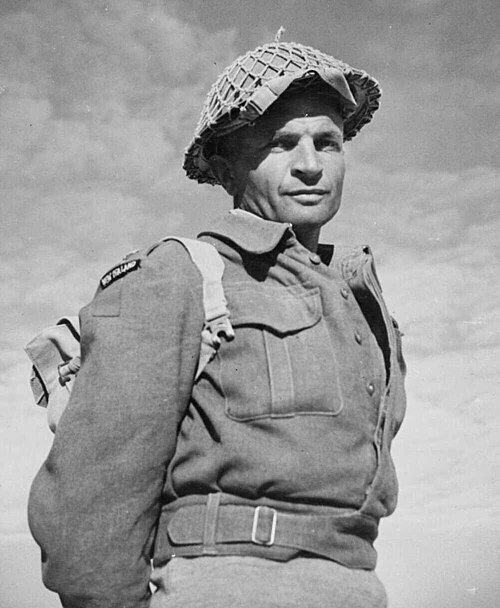
Charles Upham in 1941.
Charles Hazlitt Upham was born in 1908 in Christchurch, New Zealand, and grew up in a rural environment that instilled in him endurance, physical toughness, and self-reliance. He was educated at Christ's College in Christchurch and later studied agriculture at Lincoln College, eventually becoming a sheep farmer. Those who knew him before the war described him as intelligent, reserved, and possessed of a dry wit, but there was little outward sign that he would become one of the most decorated soldiers of the war. When New Zealand committed forces to the Allied cause in 1939, Upham volunteered for service, joining the 20th Battalion of the 2nd New Zealand Division, a formation that would see extensive action in the Mediterranean theatre.
Upham's first Victoria Cross was earned during the desperate fighting on the island of Crete in May 1941. The German invasion of Crete, launched under Operation Mercury, marked the first large-scale airborne assault in history. German Fallschirmjäger descended by parachute and glider, seeking to overwhelm British, Australian, New Zealand, and Greek defenders before reinforcements could arrive. The campaign quickly became chaotic and brutal, with isolated Allied units fighting determined delaying actions against better-coordinated German attacks supported by air superiority.
During the fighting around Maleme and Galatas, Upham displayed extraordinary courage over several consecutive days. Acting as a platoon commander, he repeatedly exposed himself to enemy fire in order to lead attacks, rescue wounded men, and reorganize defensive positions. On one occasion he advanced alone to silence a German machine-gun post, killing the crew with grenades and rifle fire. On another, though wounded in the shoulder by mortar fragments and later shot through the foot, he refused evacuation and continued to move among his men, encouraging them and directing fire. He personally carried wounded soldiers to safety under intense fire and launched counterattacks at critical moments when German forces threatened to break through. His conduct was described as "outstanding bravery and leadership," and in 1941 he was awarded the Victoria Cross for his actions during the Crete campaign. Although the Allies ultimately withdrew from the island, the stubborn resistance of units like Upham's delayed German consolidation and imposed significant casualties.
Upham's second Victoria Cross was earned the following year during the First Battle of El Alamein in Egypt in July 1942, one of the pivotal confrontations of the North African campaign. The desert war between Axis forces under Field Marshal Erwin Rommel and the British Eighth Army had see-sawed across Libya and Egypt, with both sides seeking control of the Suez Canal and the Middle Eastern oil routes. By mid-1942, Axis forces had pushed deep into Egypt, and the line near El Alamein became the last defensible position before Alexandria and Cairo.
Now a company commander, Upham again demonstrated conspicuous gallantry during fierce fighting against entrenched German and Italian forces. Over several days he led aggressive patrols and attacks against enemy strongpoints, often advancing across open desert under artillery and machine-gun fire. Despite being wounded multiple times, including by shell fragments and small-arms fire, he continued to lead from the front. In one action he crawled forward alone to destroy a truckload of German soldiers with grenades, and in another, he moved under direct fire to bring up ammunition and reposition anti-tank guns at a critical moment. Even after being severely wounded in the elbow, he refused medical treatment until he was physically incapable of continuing. Eventually, while attempting to break through encircling German forces, he was captured. For these actions, marked by sustained courage and disregard for his own safety, he was awarded a Bar to his Victoria Cross, making him one of only three men in history to receive the decoration twice.
His ordeal did not end with capture. As a prisoner of war, Upham proved as defiant as he had been in combat. He made repeated escape attempts from German camps, demonstrating ingenuity and sheer determination. His persistent efforts eventually led German authorities to classify him as particularly troublesome, and he was transferred to the notorious Colditz Castle, reserved for high-risk Allied prisoners. Even there, he continued to resist passivity, maintaining morale among fellow prisoners until the camp's liberation in 1945.
After the war, Upham returned to New Zealand and resumed farming in relative obscurity. He avoided publicity, declined opportunities for self-promotion, and rarely spoke of his wartime experiences. Those who met him in later life often remarked on his humility and discomfort with praise. He served on local boards and remained active in his community, embodying the same quiet sense of duty that had characterized his military service. When asked about his decorations, he consistently deflected attention toward the men who had served beside him, insisting that he had simply done his job.
Charles Upham died in 1994, but his legacy endures as a testament to steadfast courage under fire. His two Victoria Crosses were not the result of a single dramatic episode, but of repeated acts of leadership, endurance, and self-sacrifice in two of the most intense campaigns of the Second World War. In an era defined by mechanized slaughter and vast armies, Upham's story stands as a reminder that individual resolve and moral courage could still shape events on the battlefield. His life, from rural New Zealand farmer to double recipient of the Commonwealth's highest award for valor, remains one of the most compelling narratives of the war.
In assessing the life of Charles Upham, it becomes clear that his distinction lies not merely in the rarity of his two awards of the Victoria Cross, but in the character that underpinned them. The decoration itself is reserved for the most conspicuous bravery in the presence of the enemy; to receive it twice is almost without parallel. Yet Upham's greatness did not reside in medals, citations, or ceremony. It resided in an unwavering sense of responsibility to the men around him and in a refusal to accept limits imposed by fear, pain, or circumstance. Time and again, whether amid the chaos of airborne assault on Crete or the furnace-like conditions of the North African desert, he placed himself in harm's way not for glory, but because leadership demanded it.
What makes his story enduring is the consistency of that conduct. His gallantry was not an isolated flash of heroism under extraordinary pressure; it was sustained, deliberate, and repeated across campaigns separated by geography, time, and tactical conditions. Even in captivity, deprived of command and confined behind barbed wire, the same indomitable will manifested itself in escape attempts and quiet resistance. The qualities that defined him in battle—resilience, initiative, and moral courage—proved inseparable from the man himself.
Equally significant is the life he chose after 1945. In returning to farming and community life in New Zealand, he demonstrated that true courage requires no audience. He neither traded on his reputation nor sought to shape his own legend. Instead, he reaffirmed by example that service is an obligation fulfilled, not a platform for acclaim. In doing so, he reinforced the essential truth that heroism is often most authentic when it is least advertised.
Charles Upham's legacy therefore transcends military history. It speaks to the enduring value of integrity under pressure and humility in triumph. In a conflict that consumed millions and was fought on a scale previously unimaginable, his life reminds us that the course of events can still hinge upon the resolve of an individual. His story remains not only a chapter in the annals of the Second World War, but a benchmark by which courage itself may be measured.
The site has been offering a wide variety of high-quality, free history content since 2012. If you’d like to say ‘thank you’ and help us with site running costs, please consider donating here.
Notes:
A well-known anecdote surrounds Charles Upham and his second award of the Victoria Cross. When the recommendation for a Bar to his existing VC reached George VI, the King is said to have asked, with some astonishment, whether Upham truly deserved a second such decoration. An officer familiar with the actions and fighting reportedly replied that, if anything, the recommendation understated the case — and that if strict justice were applied, Upham's repeated acts of gallantry might well have merited several more.